
 Vorschau anzeigen
 Versenden
 Teilen
 Details anzeigen

 Herunterladen
 Ähnliche Objekte
 Röntgenaufnahme
 Diashow
Landscape


 Weiterlesen
Giclée / Kunstdruck
Giclée- oder Leinwanddruck in Museumsqualität mit schneller Produktion und flexiblen Veredelungsoptionen. ( Handgemalte Reproduktion bestellen Bild kaufen)




P118B $10

P118H $10

P118W $10

P438Z $10

P508JH $12

P508YH $12

P805H $10

P805Z $10

P919BZ $10

P919G $10

P919XJ $10

P959ZH $10

P968JZ $12

W106C $8

W218G $10

W218JH $8

W218Y $10

W307PJ $10

W316G $10

W316PJ $8

W316Y $10

W398PJ $8

W4111J $10

W500HY $15

W500JH $15

W692G $12

W849H $8

W940BG $15

W953PJ $8




Wählen Sie aus unseren vordefinierten Formaten, die den ursprünglichen Proportionen des Kunstwerks entsprechen.

Sie können Ihre eigenen Maße eingeben, um ein bestimmtes Format oder einen speziellen Platz einzupassen. Wenn das von Ihnen gewählte Format nicht den Proportionen des Originalbildes entspricht, werden wir das Kunstwerk entweder beschneiden oder das Bild mit einem gespiegelten oder einfarbigen Rand erweitern. Ein digitaler Entwurf wird Ihnen zur Genehmigung zugesandt, bevor die Produktion beginnt.
Bitte beachten Sie, dass die Vorschau auf dem Bildschirm nicht den tatsächlichen Zuschnitt oder die Erweiterung widerspiegelt. Nur der Entwurf zeigt die endgültige Komposition präzise an.
Obwohl Sondermaße verfügbar sind, empfehlen wir die Auswahl eines Maßes aus der vordefinierten Liste, um die ursprünglichen Proportionen zu bewahren.
Weltweiter Versand () innerhalb von 2 Wochen statt der üblichen 4/5 Wochen. (18 August)

Kostenloser weltweiter Expressversand

Hochwertige Leinenleinwand

Umfassender Versicherungsschutz beim Versand

Zollgebühren-Rückerstattungsgarantie

Garantie für exakte Farbtreue

60 Tage Rückgaberecht (nur bei Mängeln)

100% Geld-zurück-Garantie

Mengenrabatt verfügbar
 Die Glasoption ist nur für Größen unter 110 cm verfügbar.

Landscape
Giclée / Kunstdruck
Format der Reproduktion
-


Gesamtpreis
$ 80
Sammlerstück-Beschreibung
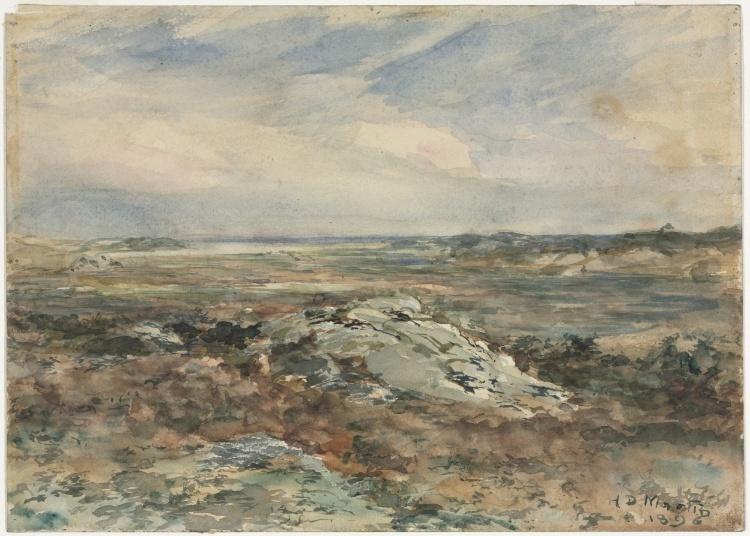
A Moment Frozen: The Poetic Landscape of Homer Dodge Martin
Homer Dodge Martin's "Landscape," painted circa 1865, isn’t merely a depiction of a vista; it’s an immersion into a specific mood—a quiet contemplation of the vastness and solitude of nature. Born in Albany, New York, in 1836, Martin navigated the shifting currents between the established realism of the Hudson River School and the burgeoning possibilities of Impressionism, forging a unique style characterized by a profound sensitivity to light, atmosphere, and the emotional resonance of the natural world. This particular work exemplifies his mastery of capturing fleeting impressions, prioritizing feeling over precise representation – a hallmark of his artistic journey.
The scene unfolds across rolling hills that recede into a hazy horizon, dominated by an overcast sky pregnant with suggestion rather than explicit detail. There’s no dramatic sun or sharp delineation of form; instead, Martin employs a masterful use of wet-on-wet watercolor techniques, allowing colors to bleed and mingle seamlessly. The brushstrokes are loose and expressive, creating a sense of movement and fluidity that mirrors the gentle undulations of the landscape itself. The foreground is particularly textured, utilizing dry brushwork to suggest the roughness of rocks and vegetation – tangible elements grounding the viewer in this imagined space.
Echoes of the Barbizon School: Light, Color, and a Sense of Place
Martin’s approach bears a clear kinship with the Barbizon school of French landscape painters, who sought to capture the essence of nature through direct observation and a focus on atmospheric effects. Like his contemporaries, he eschewed meticulous detail in favor of conveying the *feeling* of a place – its light, its air, its inherent stillness. The muted palette—dominated by browns, greens, grays, and subtle blues—contributes significantly to this effect. The colors aren’t vibrant or saturated; they are subdued and atmospheric, creating a sense of depth and distance through the application of *atmospheric perspective*. Distant elements appear paler and less distinct, reinforcing the illusion of vastness.
Furthermore, Martin's work reflects a growing interest in capturing the ephemeral qualities of light. The overcast sky casts a diffuse glow across the landscape, softening edges and lending an air of melancholy to the scene. The lack of strong highlights or shadows creates a sense of quiet contemplation, inviting the viewer to lose themselves in the atmosphere. It’s a deliberate choice that elevates the painting beyond a simple topographical representation, transforming it into a meditation on light, color, and the sublime beauty of nature.
Symbolism and Emotional Resonance: Solitude and the Vastness of Nature
“Landscape” isn't simply a pretty picture; it’s imbued with a subtle sense of symbolism. The solitary hills and distant horizon evoke feelings of solitude, introspection, and perhaps even a touch of melancholy. The vastness of the landscape can be interpreted as a metaphor for the power and indifference of nature – a reminder of humanity’s smallness in the face of the immense forces that shape our world. The painting's quietude speaks to a deeper longing for connection with something larger than oneself, a sentiment deeply resonant within the Romantic tradition.
Considered alongside Martin’s biography—a man who sought to bridge the gap between traditional and modern artistic approaches—this work becomes more than just a landscape; it's a testament to his artistic vision. It invites us to pause, breathe, and contemplate the beauty and mystery of the natural world, offering a moment of quiet reflection in an increasingly complex world.
Über den Künstler
Frühes Leben und Einflüsse der Hudson River School
- Geboren: Albany, New York (28. Oktober 1836)
- Gestorben: St. Paul, Minnesota (12. Februar 1897)
- Familiärer Hintergrund: Sohn von Homer Martin und Sarah Dodge.
- Frühe Ausbildung: Kurze Zeit Schüler von William Hart.
- Verbindung zur Hudson River School: Anfänglich mit dem Stil der Hudson River School verbunden, was ein Interesse an realistischen Landschaftsdarstellungen zeigte.
- Albany-Beziehungen: Verbunden mit anderen Albany-Malern wie George Boughton und Edward Gay. Diese Beziehungen förderten seine frühe künstlerische Entwicklung.
Entwicklung des Stils und europäische Einflüsse
- Sommer in den Adirondacks, Catskills und White Mountains: Während der 1860er Jahre verbrachte Martin Sommer damit, Landschaften nach Skizzen zu malen, die er in diesen Regionen angefertigt hatte, später arbeitete er daran in seinem New Yorker Atelier.
- Anerkennung durch die National Academy of Design: Gewählt als Associate im Jahr 1868 und als ordentliches Mitglied (Academician) im Jahr 1874, was seine wachsende Reputation in der Kunstwelt signalisierte.
- Europareise (1876): Eine entscheidende Reise nach Europa führte ihn an die Schule von Barbizon und die Impressionisten heran.
- Stilwandel: Nach seiner europäischen Erfahrung entwickelte sich Martins Stil hin zu dunkleren, stimmungsvolleren Tönen mit einer lockereren Pinseltechnik. Dies markierte eine Abkehr von seinen früheren Einflüssen der Hudson River School.
Zeit in Frankreich und wichtige Werke
- Aufenthalt in der Normandie (1882-1886): Martin lebte mehrere Jahre in Frankreich, hauptsächlich in der Normandie, einschließlich Aufenthalten in der Kunstkolonie Étaples.
- Bemerkenswerte französische Gemälde:
- Der Hafen von Étaples: Eine topografische Ansicht, die Schiffsbau und maritime Aktivitäten darstellt.
- Hütte im Wald: Eine atmosphärische Darstellung einer Dünenlandschaft bei Sonnenuntergang.
- Harfe der Winde (1895): Gilt als eines seiner bekanntesten Werke, das sich jetzt im Metropolitan Museum of Art befindet.
Späte Jahre und Vermächtnis
- Umzug nach St. Paul, Minnesota: Aufgrund von Armut und fortschreitender Blindheit zog Martin 1893 nach St. Paul um.
- Adirondack Scenery (1895): Gemalt aus dem Gedächtnis, während er fast blind war, ist dieses Werk eines seiner bekanntesten.
- Posthume Anerkennung: Trotz begrenztem Erfolg zu Lebzeiten wuchs Martins Ruf nach seinem Tod. Adirondack Scenery wurde kurz nach seinem Ableben für 5500 Dollar verkauft.
- Museumsdarstellung: Seine Gemälde befinden sich jetzt in zahlreichen bedeutenden amerikanischen Museen, darunter:
- Metropolitan Museum of Art
- Smithsonian American Art Museum
- Addison Gallery of American Art
- Albany Institute of History and Art
- Cleveland Museum of Art
- Portland Art Museum
- Museum of Fine Arts, Boston
- Künstlerische Bedeutung: Homer Dodge Martin gilt als eine Übergangsfigur zwischen der Hudson River School und dem amerikanischen Impressionismus. Seine späteren Werke demonstrieren einen innovativen Ansatz in der Landschaftsmalerei, der durch atmosphärische Effekte und lockere Pinselstriche gekennzeichnet ist.

Homer Dodge Martin
1836 - 1897 , Vereinigte Staaten von Amerika
Kurzinfos
- Bemerkenswerte Werke:
- Bash Bish Falls
- Upper Ausable Lake
- Harp of the Winds
- Einflussreiche Künstler:
- William Hart
- George Boughton
- Edward Gay
- Geburtsdatum: 28. Oktober 1836
- Geburtsort: Albany, USA
- Künstlerische Richtung:
- Hudson River School
- Impressionismus
- Nationalität: Amerikanisch
- Sterbedatum: 12. Februar 1897
- Vollständiger Name: Homer Dodge Martin
Ähnliche Artikel
Winslow Homer: Die 25 Meisterwerke des amerikanischen Realismus | OriginalUniqueArt
Entdecken Sie die 25 Meisterwerke von Winslow Homer! Tauchen Sie ein in amerikanische Kunst, maritime Landschaften & beeindruckende Ölmalerei. Hochwertige Reproduktionen für Ihr Zuhause – jetzt auf OriginalUniqueArt.com!

Die 10 legendärsten Aquarellwerke der Kunstgeschichte – Meisterwerke für Ihr Zuhause
Entdecken Sie die 10 legendärsten Aquarellwerke der Kunstgeschichte! Von Turner bis Monet – erleben Sie die Geschichten, Techniken & Farben dieser Meisterwerke. Finden Sie hochwertige Kunstdrucke auf OriginalUniqueArt.com und gestalten Sie Ihr Zuhause mit zeitloser Eleganz.

Amerikanischer Realismus: Die 10 Meisterwerke, die eine Ära prägten | OriginalUniqueArt
Entdecken Sie die 10 Meisterwerke des Amerikanischen Realismus! Von Edward Hopper bis Winslow Homer – erleben Sie die Geschichten, Techniken & zeitlose Schönheit. Hochwertige Kunstdrucke auf OriginalUniqueArt.com.

Ephemeral Visions: Exploring the Artistic Legacy & Contemporary Practice of Watercolor Painting
Explore the captivating world of watercolor painting! Discover its rich history, essential techniques, influential artists & collecting tips. A comprehensive guide for art enthusiasts from OriginalUniqueArt.
Die schönsten Landschaftsbilder: 10 Meisterwerke für Ihr Zuhause | OriginalUniqueArt.com
Entdecken Sie die 10 schönsten Landschaftsbilder der Kunstgeschichte! Von Monet bis Van Gogh – erfahren Sie die Geschichten hinter Meisterwerken & finden Sie Inspiration für Ihr Zuhause. Hochwertige Kunstdrucke auf OriginalUniqueArt.com.


