

 In echtem Maßstab anzeigen
 Versenden als Grußkarte
 Teilen
 Details anzeigen
 Leitfaden öffnen

 Herunterladen
 Ähnliche Objekte
 Röntgenaufnahme
 Diashow
 Besucherstatistiken
Apollo Killing the Python
 Engraving
- Baroque Mannerism
 1589
1589 21.0 x 29.0 cm
 Los Angeles County Museum of Art
 Mehr anzeigen
Giclée / Kunstdruck
Giclée- oder Leinwanddruck in Museumsqualität mit schneller Produktion und flexiblen Veredelungsoptionen. ( Handgemalte Reproduktion kaufen Zum digitalen Bild wechseln)




P118B €10

P118H €10

P118W €10

P438Z €10

P508JH €12

P508YH €12

P805H €10

P805Z €10

P919BZ €10

P919G €10

P919XJ €10

P959ZH €10

P968JZ €12

W106C €8

W218G €10

W218JH €8

W218Y €10

W307PJ €10

W316G €10

W316PJ €8

W316Y €10

W398PJ €8

W4111J €10

W500HY €15

W500JH €15

W692G €12

W849H €8

W940BG €15

W953PJ €8




Wählen Sie aus unseren vordefinierten Formaten, die den ursprünglichen Proportionen des Kunstwerks entsprechen.

Geben Sie die Breite und die Höhe an, die Sie benötigen, damit der Druck perfekt in Ihren Rahmen oder an Ihre Wand passt. Ein Druck kann nur beschnitten werden und niemals größer als das Originalbild gemacht werden; daher verliert ein Format mit einer anderen Proportion einen Teil des Bildes. Wir senden Ihnen ein digitales Mockup zur Freigabe, bevor wir den Druck ausführen. Das auf dieser Seite gezeigte Bild zeigt nicht den tatsächlichen Beschnitt – dies ist nur im Mockup ersichtlich.
Weltweiter Versand () innerhalb von 2 Wochen statt der üblichen 4/5 Wochen. (19 Oktober)

Kostenloser weltweiter Expressversand

Hochwertige Leinenleinwand

Vollständiger Versicherungsschutz beim Versand

Zollgebühren-Rückerstattungsgarantie

Garantie für exakte Farbtreue

100-tägiges Rückgaberecht (nur bei Mängeln)

100% Geld-zurück-Garantie

Angebot für Mengenrabatt
 Die Glasoption ist nur für Größen unter 110 cm verfügbar.

Apollo Killing the Python
Giclée / Kunstdruck
Format der Reproduktion
-


Gesamtpreis
€ 70
Hendrik Goltzius’s Apollo Killing the Python: A Masterpiece of Mannerist Drama
Apollo Killing the Python is more than just an image; it's a distillation of Renaissance mythology into a powerfully expressive engraving by Hendrik Goltzius, completed in 1589. This artwork stands as a testament to Goltzius’s innovative approach to printmaking and his ability to convey complex narratives with breathtaking visual clarity—a skill that cemented his place among the foremost artists of the Baroque era. The piece captures a pivotal moment from Ovid's Metamorphoses, depicting Apollo, god of music and poetry, engaged in a brutal confrontation with Python, representing primordial chaos and evil.- Composition & Style: Goltzius’s masterful use of perspective creates a dynamic scene that draws the viewer into the drama unfolding before them. The engraving adheres to the principles of Mannerism—a stylistic movement characterized by elongated figures, stylized poses, and dramatic contrasts of light and shadow—reflecting a desire to transcend realism and explore psychological states rather than simply depicting observable reality.
- Technique: Goltzius employed a technique known as ‘swelling line,’ which he developed himself, resulting in lines that appear thicker than they actually are. This method dramatically enhances the visual impact of the engraving, emphasizing contours and creating an illusion of depth—a hallmark of Baroque art. The meticulous detail achieved through hatching and shading contributes to the overall sense of realism despite the stylized figures.
- Symbolism: The confrontation between Apollo and Python carries profound symbolic weight. Apollo embodies reason, order, and divine authority, battling against the forces of darkness and irrationality. The serpent symbolizes primordial chaos, representing the struggle between good and evil that underlies all human experience. Goltzius’s depiction underscores the enduring themes of heroism, triumph over adversity, and the victory of intellect over instinct.
- Historical Context: Created during a period of artistic experimentation and intellectual ferment—the early Baroque—Apollo Killing the Python reflects the broader cultural anxieties surrounding religious reform and the burgeoning humanist spirit. Goltzius’s engraving aligns with the prevailing aesthetic sensibilities of the time, demonstrating an artist's engagement with contemporary philosophical ideas.
- Emotional Impact: The engraving evokes a palpable sense of tension and drama—a hallmark of Mannerist art. Goltzius skillfully captures the physicality of the struggle between gods and serpent, conveying both violence and nobility. The image resonates with viewers today due to its exploration of universal themes concerning conflict, resilience, and the pursuit of enlightenment.
Fragen & Antworten
Wo kann ich eine digitale Abbildung von "Apollo Killing the Python" von Hendrik Goltzius kaufen?
"Apollo Killing the Python" ist als ein hochauflösender digitaler Bild-Download erhältlich, direkt über die Seite Digitales Bild.
Für welchen Raum wird "Apollo Killing the Python" von Hendrik Goltzius empfohlen?
Eine Reproduktion von „Apollo Killing the Python“ passt hervorragend in ein Living Room.
Sind die Farben von "Apollo Killing the Python" von Hendrik Goltzius gesättigt oder gedämpft?
Die Farbpalette von "Apollo Killing the Python" weist eine Sättigung von Muted auf.
Biografie des Künstlers
early life and training
hendrick goltzius (* januar oder februar 1558 in bracht, heute ortsteil von Brüggen im kreis viersen – bei venlo; † 29. dezember 1616 oder 1. januar 1617 in haarlem) war ein niederländischer maler, zeichner und kupferstecher. sein werk stand unter dem einfluss der durch die nachahmung italienischer meister hervorgerufenen manieristischen strömung, welche damals die holländische kunst beherrschte. gemäß a. hyatt mayor, goltzius "war der letzte professionelle engraver, der mit der autorität eines guten malers zeichnete und der letzte, der viele bilder für andere zu kopieren versuchte". seine familie zog nach duisburg, als er 3 jahre alt war, und nachdem er kunst auf glas unter seinem vater studierte, lernte er kupferstechern von dirck volkertszoon coornhert und dem austausch an der haarlemer akademie, der auch bartholomeus spranger, cornelis van haarlem und karel van mander angehörten. ab 1577 zog goltzius mit coornhert nach haarlem in die dutch republik und blieb dort für den rest seines lebens. er wurde außerdem von philip galle angestellt, um eine serie von drucken über die geschichte von lucretia zu gravieren. sein rechter hand war durch ein feuer als baby missgestaltet, was sich besonders gut zum halten des burin eignete. dieses einzigartige körperliche charakteristik ermöglichte ihm, einen beherrschenden schwung der linie zu meistern und machte seine gravüren somit hoch individuell. goltzius begann malerei mit vierzig jahren; einige seiner gemälde können im vienna gefunden werden. er führte auch ein paar chiaroscuro holzschnitte durch.artistic career
in 1577, goltzius moved with coornhert to haarlem in the dutch republic, where he remained based for the rest of his life. he was also employed by philip galle to engrave a set of prints of the history of lucretia. goltzius had a malformed right hand from a fire when he was a baby, which turned out to be especially well-suited to holding the burin. this unique physical characteristic allowed him to master a commanding swing of line, making his engravings highly distinctive. goltzius brought to an unprecedented level the use of the "swelling line", where the burin is manipulated to make lines thicker or thinner to create a tonal effect from a distance. he began painting at the age of forty-two; some of his paintings can be found in vienna. he also executed a few chiaroscuro woodcuts.technique and style
goltzius was a pioneer of the "dot and lozenge" technique, where dots are placed in the middle of lozenge-shaped spaces created by crosshatching to further refine tonal shading. his command of the burin is said to rival dürer, and he made engravings of bartholomeus spranger's paintings, thus increasing the fame of the latter – and his own. goltzius was a pioneer of the "dot and lozenge" technique, where dots are placed in the middle of lozenge-shaped spaces created by crosshatching to further refine tonal shading. his command of the burin is said to rival dürer, and he made engravings of bartholomeus spranger's paintings, thus increasing the fame of the latter – and his own.public collections and legacy
most major print rooms will have a group of goltzius's many engravings, including the museum boijmans van beuningen, rijksmuseum amsterdam, and the metropolitan museum of art. his legacy can be seen in the works of other artists, such as jacques bellange, who was also a master of northern mannerist printmaking. goltzius's engravings and paintings continue to inspire art lovers and scholars alike, and his work can be found on OriginalUniqueArt.com and in the wikipedia article dedicated to his life and work.
Hendrik Goltzius
1558 - 1617 , Deutschland
Eckdaten zum Künstler
- Artistic Movement Or Style: Nordmanierismus & Barockdruckkunst
- Artists Or Movements Influenced By This Artist: ['Jacques Bellange']
- Artists Who Influenced This Artist:
- Dirck Volckertszoon Coornhert
- Bartholomeus Spranger
- Date Of Birth: Januar oder Februar 1558
- Date Of Death: bei Venlo; † Dezember 1616 oder Januar 1617
- Full Name: Hendrick Goltzius
- Nationality: Niederländisch
- Notable Artworks:
- Der Prophet Jeremia
- Die Hochzeit des Amor und Psyche
- Herkules und zwei Beobachter
- Place Of Birth: Braunschweig, Italien
Verwandte Artikel

Chiaroscuro and Character: A Definitive Guide to Light and Shadow in the Dutch Baroque Era
Explore the dramatic mastery of the Dutch Baroque era. Discover how masters like Rembrandt used chiaroscuro to transform everyday life into timeless art. An expert guide for collectors and enthusiasts seeking to understand the profound interplay of light and shadow.
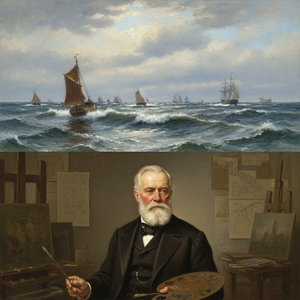
Hendrik Willem Mesdag: Pioneering Impressionism & the Dutch Maritime Tradition
Explore the life & work of Hendrik Willem Mesdag, a pioneer of Dutch Impressionism and leading figure of the Hague School. Discover his captivating seascapes and the immersive Panorama Mesdag – a true masterpiece.

Golden Light & Dutch Skies: The Timeless Magic of Dutch Golden Age Landscapes
Discover the breathtaking beauty of Dutch Golden Age landscapes. Explore the mastery of light, chiaroscuro, and 17th-century realism through an expert art history lens, celebrating the enduring legacy of the Dutch Masters for discerning collectors and art lovers.
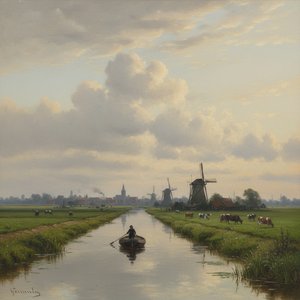
Johan Hendrik Weissenbruch: Capturing Dutch Light & Atmosphere – A Master of Realism
Discover Johan Hendrik Weissenbruch (1824-1903), a leading Dutch Hague School painter renowned for his atmospheric watercolours & oil landscapes. Explore his beautiful depictions of the Dutch countryside and skies – a master of light & detail.

Hendrick Goltzius: Meister der Linie und des Manierismus – Ein niederländischer Virtuose
Entdecken Sie Hendrick Goltzius, den niederländischen Meister des Manierismus und virtuosen Kupferstechers! Erfahren Sie mehr über sein Leben, seine Technik und seinen Einfluss auf die Kunstgeschichte. Jetzt lesen!


