 In echtem Maßstab anzeigen
 Versenden als Grußkarte
 Teilen
 Details anzeigen
 Leitfaden öffnen

 Herunterladen
 Ähnliche Objekte
 Röntgenaufnahme
 Diashow
 Besucherstatistiken
Die Steinhauer
 Acryl auf Leinwand
- Wandkunst
- Realistischer Realismus
 1849
1849 165.0 x 257.0 cm
 Gemäldegalerie Alte Meister
 Mehr anzeigen
Giclée / Kunstdruck
Giclée- oder Leinwanddruck in Museumsqualität mit schneller Produktion und flexiblen Veredelungsoptionen. ( Handgemalte Reproduktion kaufen Zum digitalen Bild wechseln)




P118B €10

P118H €10

P118W €10

P438Z €10

P508JH €12

P508YH €12

P805H €10

P805Z €10

P919BZ €10

P919G €10

P919XJ €10

P959ZH €10

P968JZ €12

W106C €8

W218G €10

W218JH €8

W218Y €10

W307PJ €10

W316G €10

W316PJ €8

W316Y €10

W398PJ €8

W4111J €10

W500HY €15

W500JH €15

W692G €12

W849H €8

W940BG €15

W953PJ €8




Wählen Sie aus unseren vordefinierten Formaten, die den ursprünglichen Proportionen des Kunstwerks entsprechen.

Geben Sie die Breite und die Höhe an, die Sie benötigen, damit der Druck perfekt in Ihren Rahmen oder an Ihre Wand passt. Ein Druck kann nur beschnitten werden und niemals größer als das Originalbild gemacht werden; daher verliert ein Format mit einer anderen Proportion einen Teil des Bildes. Wir senden Ihnen ein digitales Mockup zur Freigabe, bevor wir den Druck ausführen. Das auf dieser Seite gezeigte Bild zeigt nicht den tatsächlichen Beschnitt – dies ist nur im Mockup ersichtlich.
Weltweiter Versand () innerhalb von 2 Wochen statt der üblichen 4/5 Wochen. (24 Oktober)

Kostenloser weltweiter Expressversand

Hochwertige Leinenleinwand

Vollständiger Versicherungsschutz beim Versand

Zollgebühren-Rückerstattungsgarantie

Garantie für exakte Farbtreue

100-tägiges Rückgaberecht (nur bei Mängeln)

100% Geld-zurück-Garantie

Angebot für Mengenrabatt
 Die Glasoption ist nur für Größen unter 110 cm verfügbar.

Die Steinhauer
Giclée / Kunstdruck
Format der Reproduktion
-


Gesamtpreis
€ 70
Das Schicksal der Arbeiter: Eine Betrachtung über Courbets „Die Steinhauer“
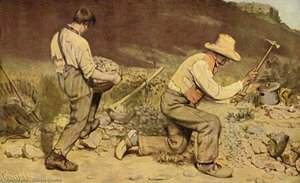
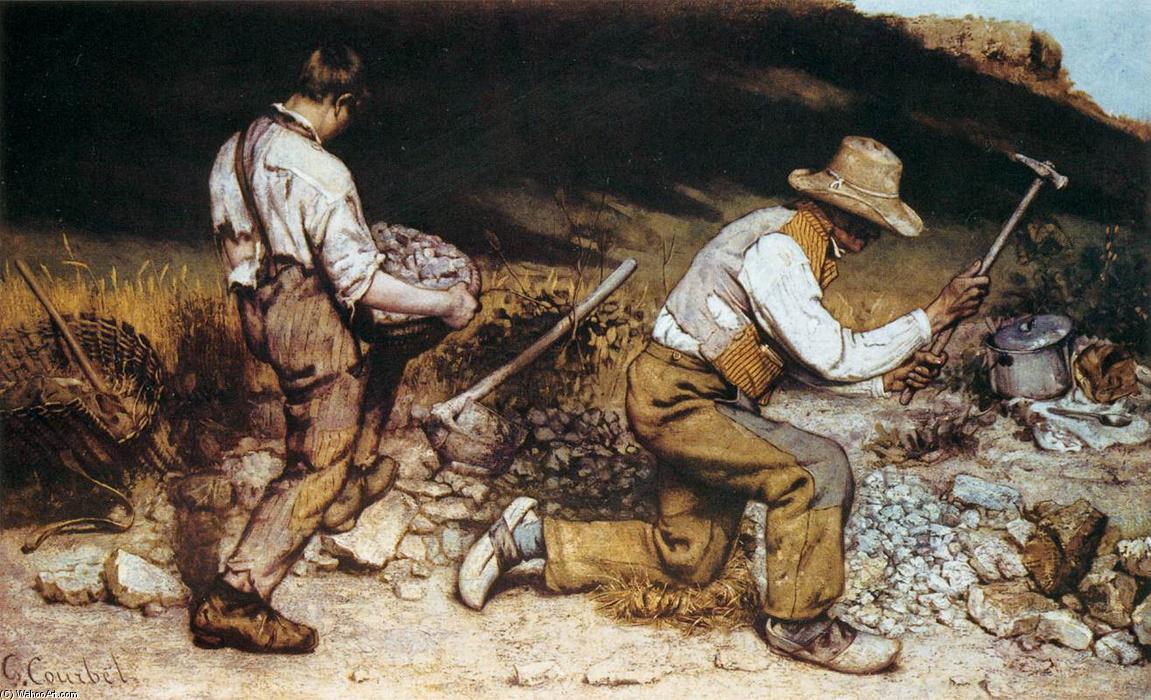
Gustave Courbet’s “Die Steinhauer” (1849) is not merely a depiction of manual labor; it's a profound statement about the realities of rural life and the burgeoning social consciousness of 19th-century France. This monumental canvas, measuring an impressive 165 x 257 cm, immediately confronts the viewer with two figures engaged in backbreaking work – men stripped bare of romantic idealization, their bodies etched with the marks of toil. The scene unfolds within a sunlit field, yet there’s no warmth or beauty to be found; instead, we are presented with an unvarnished portrayal of physical exertion and the relentless demands of agricultural existence.
- The Raw Realism: Courbet's commitment to *Realismus* – a movement he largely spearheaded – is powerfully evident here. He rejected the idealized forms and mythological subjects favored by the established Salon system, choosing instead to depict ordinary people in their everyday lives. The figures are not heroic or noble; they are simply men doing a difficult job.
- A Departure from Tradition: Prior to Courbet, landscape painting often served as a backdrop for historical or allegorical narratives. “Die Steinhauer” flips this convention on its head, placing the focus squarely on the laborers and their arduous task. This shift signaled a radical departure from artistic conventions and paved the way for future generations of realist painters.
Farben und Technik: Ein Blick auf Courbets Malweise
Courbet’s technique is characterized by its deliberate roughness and lack of meticulous detail. He employed a bold, impasto application of paint – thick layers of pigment applied directly to the canvas – creating a tactile surface that invites close inspection. The colors are muted and earthy: browns, ochres, and grays dominate the palette, reflecting the dusty environment and the laborers’ worn clothing. Notice how he uses light not to create beauty but to highlight the physical strain on the men's bodies. There is no dramatic lighting or atmospheric perspective; instead, a flat, almost photographic quality pervades the scene, emphasizing the starkness of their situation.
- The Impasto Technique: The thick application of paint isn’t just decorative; it contributes to the painting's sense of immediacy and physicality. It suggests the texture of the earth, the roughness of the stone, and the sweat on the men’s brows.
- Color as Documentation: Courbet’s restrained color palette serves a documentary purpose, aiming to accurately represent the visual reality of the scene rather than imposing an aesthetic ideal.
Symbolik und Kontext: Mehr als nur Arbeit
Beyond its straightforward depiction of manual labor, “Die Steinhauer” carries significant symbolic weight. The two figures, anonymous and unheroic, represent the vast majority of French society – those who toiled in the fields to sustain the nation. Their relentless work speaks to the social inequalities of the time and the often-overlooked contributions of the working class. The scattered rocks surrounding them aren’t merely props; they symbolize the obstacles and hardships faced by these laborers, mirroring their own struggles against the demands of their labor.
Historical Context: The painting was created during a period of significant social and political upheaval in France – the aftermath of the 1848 Revolution. Courbet’s work reflects this climate of unrest and his desire to challenge the established order. He deliberately chose subjects that were often ignored by the art establishment, asserting the importance of portraying the lives of ordinary people.Emotionale Wirkung und Interpretation: Ein Spiegel der Gesellschaft
“Die Steinhauer” is a profoundly moving work that transcends its seemingly simple subject matter. It evokes a sense of empathy for the laborers depicted and prompts us to consider the human cost of progress and industrialization. The painting’s stark realism forces viewers to confront uncomfortable truths about social inequality and the often-brutal realities of everyday life. It's not a celebration of labor, but rather an honest and unflinching portrayal of its burdens. As a reproduction, this artwork offers a powerful opportunity to engage with a pivotal moment in art history and reflect on the enduring relevance of Courbet’s social commentary.
Fragen & Antworten
Ist "Die Steinhauer" typisch für das, was Gustave Courbet üblicherweise geschaffen hat?
"Die Steinhauer" stellt arbeitsleben, landwirtschaft, frankreich, arbeiter, steinbrüche, realismus, körperlichkeit, 1849 dar, während die dokumentierten Themen von Gustave Courbet delacroix, géricault, soziale kritik, arbeitsklasse, realismus, gesellschaft, revolutionäre haltung, wahrheit zeigen sind. Ein Vergleich der beiden zeigt, wie das Werk mit den üblichen Sujets des Künstlers in Verbindung steht.
Was ist das Entstehungsdatum von "Die Steinhauer" von Gustave Courbet?
"Die Steinhauer" von Gustave Courbet entstand im Jahr 1849.
Wie ist die Farbkomposition von "Die Steinhauer" von Gustave Courbet aufgebaut?
In "Die Steinhauer" wird ein Aussagekraft Kontrast mit einer Starke farbliche Einheitlichkeit Harmonie gepaart.
Biografie des Künstlers
Gustave Courbet: Ein Pionier des Realismus
Frühes Leben und Ausbildung
- Gustave Courbet wurde am 31. Juli 1819 in Ornans, Frankreich, geboren und stammte aus einer relativ wohlhabenden bürgerlichen Familie.
- Seine frühen künstlerischen Neigungen wurden von seiner Mutter gefördert, die seine Zeichenfähigkeiten ermutigte.
- Er erhielt eine formale Ausbildung an der École des Beaux-Arts in Paris, beginnend im Jahr 1839, obwohl er oft mit akademischen Konventionen in Konflikt geriet.
- Einflüsse in dieser Zeit waren Eugène Delacroix und Théodore Géricault, aber Courbet lehnte ihren romantischen Idealismus letztendlich ab.
Künstlerische Entwicklung und Schlüsselthemen
- Courbets künstlerische Entwicklung war durch eine bewusste Ablehnung der akademischen Malstile gekennzeichnet. Er suchte, die Welt so darzustellen, wie er sie sah, ohne Idealizierung oder Verzierungen.
- Seine frühen Werke erkundeten Landschaften und Porträts und verschoben sich allmählich zu Szenen aus dem Alltag und arbeitslosen Bevölkerungsgruppen.
- Schlüsselthemen in seinem Werk sind sozialer Realismus, Landleben und die Würde der Arbeit.
- Er wählte oft große Formate, die traditionell für historische oder religiöse Gemälde reserviert waren, um gewöhnliche Menschen und Ereignisse darzustellen.
Wichtige Werke und Leistungen
- “Die Steinbrecher” (1849): Dieses frühe Meisterwerk, das leider während des Zweiten Weltkriegs zerstört wurde, veranschaulichte Courbets Engagement, die harten Realitäten des Arbeitsvolks darzustellen.
- “Eine Beerdigung in Ornans” (1850): Ein monumentales Gemälde, das konventionelle Vorstellungen von Geschichtsgemälden herausforderte, indem es eine provinzielle Beerdigung mit unerbittlicher Realität darstellte.
- “Das Atelier des Malers” (1855): Eine allegorische Arbeit, die Courbets künstlerphilosophie widerspiegelte und seinen Umgang mit zeitgenössischen sozialen Problemen zeigte.
- “Ansicht im Fontainebleau-Wald” (1855): Demonstriert seine Fähigkeiten in der Landschaftsmalerei und fängt die natürliche Schönheit des Waldes ein, während er einen realistischen Ansatz beibehält.
- Seine Teilnahme am Salon des Refusés im Jahr 1863, bei dem Werke gezeigt wurden, die vom offiziellen Salon abgelehnt worden waren, festigte seinen Ruf als rebellischer Künstler weiter.
Einflüsse und Vermächtnis
- Während er akademische Traditionen ablehnte, war Courbet von früheren Meistern wie Caravaggio beeinflusst, für ihren dramatischen Realismus und ihre Verwendung von Licht und Schatten.
- Er hatte einen tiefgreifenden Einfluss auf nachfolgende Kunstbewegungen, insbesondere Impressionismus und Post-Impressionismus, indem er Künstler von den Zwängen der traditionellen Darstellung befreite.
- Sein Schwerpunkt auf soziale Kommentare ebnete den Weg für spätere sozial engagierte Künstler.
- Courbets Vermächtnis reicht über seine Gemälde hinaus; er war ein engagierter Verfechter künstlerischer Freiheit und politischer Veränderungen.
Historische Bedeutung
- Gustave Courbet spielte eine entscheidende Rolle bei der Entwicklung des Realismus als dominierende Kraft im 19. Jahrhundert.
- Sein Werk stellte etablierte Normen in Frage und löste Debatten über den Zweck und die Funktion von Kunst in der Gesellschaft aus.
- Er nahm aktiv an den politischen Umwälzungen seiner Zeit teil, darunter die Pariser Kommune von 1871, die zu einer Exilzeit in der Schweiz führte.
- Courbet starb am 29. April 1877 und hinterließ ein Werk, das bis heute inspiriert und provoziert.

Gustave Courbet
1819 - 1877 , Frankreich
Eckdaten zum Künstler
- Beeinflusste Kunstrichtungen:
- Impressionismus
- Post-Impressionismus
- Beeinflusste Künstler:
- Eugène Delacroix
- Théodore Géricault
- Bemerkenswerte Werke:
- Die Steinbrecher
- Eine Beerdigung in Ornans
- Das Atelier des Malers
- Ansicht im Fontainebleau-Wald
- Die Entstehung der Welt
- Geburtsdatum: 31. Juli 1819
- Geburtsort: Orléans, Frankreich
- Künstlerische Richtung: Realismus
- Nationalität: Französisch
- Sterbedatum: 29. April 1877
- Vollständiger Name: Gustave Courbet
- Von Künstlern Beeinflusst: ['Caravaggio']
Verwandte Artikel

10 Meisterwerke des Romantischen Realismus: Wenn Emotion auf Wahrheit trifft
Entdecken Sie 10 Meisterwerke des Romantischen Realismus. Erleben Sie die emotionale Tiefe von Künstlern wie Constable und Friedrich – perfekt als Inspiration für Ihre Kunstsammlung oder Wandgestaltung. Finden Sie museale Reproduktionen auf OriginalUniqueArt.com.
Gustave Courbet: Revolutionärer Realismus und die soziale Leinwand des 19. Jahrhunderts
Entdecken Sie Gustave Courbets revolutionären Realismus! Erfahren Sie mehr über seine provokanten Werke, seinen Einfluss auf die Kunstgeschichte und die soziale Bedeutung seiner Malerei. Jetzt lesen!

Historical Realism: A Pursuit of Truthful Representation in 19th-Century Art
Explore the captivating world of 19th-century Realism! Discover key artists like Courbet, groundbreaking techniques & the social context behind this influential art movement. Expert insights at OriginalUniqueArt.

Realismus in der Kunst: Die 10 Meisterwerke, die eine Ära prägten |
Entdecken Sie die 10 Meisterwerke des Realismus! Courbet, Millet & Daumier prägten eine Ära. Erfahren Sie die Geschichten hinter ikonischen Gemälden und finden Sie hochwertige Art Reproduktionen für Ihr Zuhause auf

The Poetic Truth of Observation: Exploring 19th-Century Realism in Painting
Explore the captivating world of 19th-century Realism! Discover key artists like Courbet & Millet, masterpieces, and the powerful social commentary behind this influential art movement. Expert insights at OriginalUniqueArt.