Versenden
 Teilen
 Details anzeigen

 Herunterladen
 Ähnliche Objekte
 Diashow
Arithmetic


 Weiterlesen
Giclée / Kunstdruck
Giclée- oder Leinwanddruck in Museumsqualität mit schneller Produktion und flexiblen Veredelungsoptionen. ( Handgemalte Reproduktion bestellen Bild kaufen)




































Wählen Sie aus unseren vordefinierten Formaten, die den ursprünglichen Proportionen des Kunstwerks entsprechen.

Sie können Ihre eigenen Maße eingeben, um ein bestimmtes Format oder einen speziellen Platz einzupassen. Wenn das von Ihnen gewählte Format nicht den Proportionen des Originalbildes entspricht, werden wir das Kunstwerk entweder beschneiden oder das Bild mit einem gespiegelten oder einfarbigen Rand erweitern. Ein digitaler Entwurf wird Ihnen zur Genehmigung zugesandt, bevor die Produktion beginnt.
Bitte beachten Sie, dass die Vorschau auf dem Bildschirm nicht den tatsächlichen Zuschnitt oder die Erweiterung widerspiegelt. Nur der Entwurf zeigt die endgültige Komposition präzise an.
Obwohl Sondermaße verfügbar sind, empfehlen wir die Auswahl eines Maßes aus der vordefinierten Liste, um die ursprünglichen Proportionen zu bewahren.
Weltweiter Versand () innerhalb von 2 Wochen statt der üblichen 4/5 Wochen. (31 August)

Kostenloser weltweiter Expressversand

Hochwertige Leinenleinwand

Umfassender Versicherungsschutz beim Versand

Zollgebühren-Rückerstattungsgarantie

Garantie für exakte Farbtreue

60 Tage Rückgaberecht (nur bei Mängeln)

100% Geld-zurück-Garantie

Mengenrabatt verfügbar
 Die Glasoption ist nur für Größen unter 110 cm verfügbar.

Arithmetic
Giclée / Kunstdruck
Format der Reproduktion
-


Gesamtpreis
$ 80
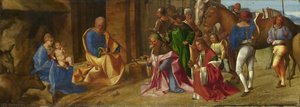
A Geometric Symphony: Decoding Giorgione’s Arithmetic
In the heart of the Venetian Renaissance, where the shimmering reflections of the Adriatic met the intellectual fervor of humanist scholarship, emerged a work of profound and enigmatic beauty. Arithmetic, attributed to the elusive master Giorgione, is not merely a study of shapes, but a window into the soul of a period obsessed with the divine order of the universe. At first glance, the viewer is met with a deceptively simple arrangement of circles and geometric forms, yet beneath this surface lies a complex tapestry of meaning. The painting functions as a visual meditation on the mathematical proportions that Renaissance thinkers believed governed both the heavens and the earth. It is a piece that invites the eye to wander through its intricate patterns, finding rhythm in the placement of each arc and line, much like a silent piece of music composed in pigment.
The technique employed in this work speaks to the very essence of Venetian colorito. Eschewing the rigid, linear constraints often found in Florentine disegno, Giorgione utilized a fresco-style approach that allows for a breathtaking luminosity. By applying thin, translucent washes of color onto the surface, the artist achieved a depth that feels almost atmospheric, as if the light itself is trapped within the layers of pigment. The palette is a sophisticated collection of earth tones—warm ochres, muted terracottas, and soft umbers—which lend the composition a timeless, organic quality. This mastery of tonal harmony ensures that even the most abstract elements feel grounded in a natural reality, creating a sense of permanence and weight that is rare in such delicate execution.
The Intersection of Science and Spirit
To understand Arithmetic, one must look toward the cultural crossroads of 1510 Venice. This was an era where the boundaries between art, science, and philosophy were fluid. The title itself serves as a clue to the painting's symbolic depth; it reflects the Renaissance fascination with classical ideals and the belief that mathematical precision was a reflection of divine perfection. Each circle and geometric intersection acts as a symbol of cosmic balance. For the modern collector or interior designer, this piece offers more than just aesthetic pleasure; it provides a focal point of intellectual intrigue. It is a work that rewards prolonged contemplation, revealing new layers of complexity each time it is viewed.
Integrating such a masterpiece into a contemporary space requires an appreciation for its emotional resonance. There is a profound stillness within the composition, a quietude that can transform a room into a sanctuary of thought. Whether placed in a minimalist gallery setting or as a sophisticated accent in a richly textured study, the painting’s ability to blend architectural structure with soft, painterly textures makes it an invaluable asset for any curated collection. It stands as a testament to Giorgione's unique ability to capture not just the visible world, but the invisible laws that shape our perception of beauty and order.
Über den Künstler
Ein kurzer, aber brillanter Werdegang im Hochrenaissance
Giorgio (1477/78 oder 1473/74 – 1510), ein illustrer Maler der Hochrenaissance aus der venezianischen Schule, hat trotz seiner kurzen Karriere und begrenzter bestätigter Werke einen unauslöschlichen Eindruck in der Kunstwelt hinterlassen. Seine Gemälde werden für ihre lyrischen und rätselhaften Qualitäten gelobt, wobei nur eine Handvoll zweifelsfrei ihm zugeschrieben werden können.Beitrag zum venezianischen Malstil
Giorgios Beitrag, zusammen mit dem legendären Tizian, legte die Grundlagen für den venezianischen Malstil, der sich durch seinen Schwerpunkt auf Farbe und Atmosphäre im Gegensatz zum linienorientierten Ansatz florentinischer Kunst auszeichnete. Dieser innovative Ansatz ebnete den Weg für zukünftige Generationen von Künstlern.Bekannte Werke und ihre Bedeutung
- Porträt eines venezianischen Herrn (76 x 64 cm, Hochrenaissance, Öl auf Leinwand): Ein Meisterwerk, das Giorgios Können bei der Erfassung der Essenz seiner Sujets demonstriert.
- Pastoraler Konzert (Fête Champêtre) (110 x 138 cm, Musée du Louvre, Paris, Frankreich, Hochrenaissance, Öl auf Leinwand): Demonstriert Giorgios Fähigkeit, Emotionen durch seine Arbeit hervorzurufen.
- Judith (1504) (Öl auf Leinwand, von einer Platte übertragen, 144 x 68 cm, Hermitage, St. Petersburg): Ein frühes Gemälde des Künstlers, das ursprünglich Raffael zugeschrieben wurde, und zeigt Giorgios Wachstum und Experimentierfreude.
Vermächtnis und Einfluss
Giorgio bleibt eine rätselhafte Figur in der Kunstgeschichte, wobei sein Leben und seine Werke im Dunkeln liegen, was die Faszination und Tiefe seines künstlerischen Erbes verstärkt. Sein Einfluss ist in den Werken nachfolgender Künstlerinnen und Künstler zu sehen, die auf den Grundstein aufbauten, den er in der venezianischen Schule legte. Erfahren Sie mehr über Giorgios Werke auf OriginalUniqueArt: * Giorgio (Giorgio Barbarelli da Castelfranco) * Porträt eines venezianischen Herrn * Pastoraler Konzert (Fête Champêtre) Entdecken Sie die venezianische Malbewegung auf OriginalUniqueArt: * Die venezianische Malbewegung
Giorgione
1477 - 1510 , Italien
Kurzinfos
- Beeinflusste Künstler: ['Titian']
- Bemerkenswerte Werke:
- Der Sturm
- Landliches Konzert
- Schlafende Venus
- Judith
- Porträt eines Venezianers
- Geburtsdatum: 1477/78 oder 1473/74
- Geburtsort: Castel Franco Veneto, Italien
- Künstlerische Bewegung: Hochrenaissance, Venetianischer Stil
- Künstlerische Einflüsse:
- Giovanni Bellini
- Mantegna
- Nationalität: Italienisch
- Sterbedatum: 1510
- Vollständiger Name: Giorgione (Giorgio Barbarelli)
Ähnliche Artikel

Das Familienerbe an die Wand bringen: Wandgemälde als Generationenschatz
Verwandeln Sie Ihre Familiengeschichte in ein beeindruckendes Wandgemälde! Expertenrat & hochwertige Handwerkskunst für einzigartige Kunstwerke, die Generationen verbinden. Entdecken Sie jetzt!
The Enduring Legacy of Fresco Painting: Techniques, History & Contemporary Relevance
Explore the rich history & enduring artistry of fresco painting – from Giotto to Michelangelo! Discover techniques, conservation efforts, & modern applications. Learn how OriginalUniqueArt brings this timeless art form to your home.

The Enduring Legacy of Fresco: Technique, History & Artistic Expression Across Cultures
Explore the rich history & enduring legacy of fresco painting! Discover ancient techniques, Giotto's masterpieces, and modern applications. Expert insights for art lovers & professionals.

Giorgione: Rätsel und Innovation der frühen venezianischen Renaissance-Malerei
Entdecken Sie das faszinierende Werk Giorgiones und seinen Einfluss auf die venezianische Renaissance-Malerei. Analysen, Hintergrundinformationen & Meisterwerke – jetzt lesen!

Die bleibende Pracht der Freskomalerei: Technik, Geschichte und künstlerischer Ausdruck
Entdecken Sie die faszinierende Welt der Freskomalerei! Von den Ursprüngen bis zur Renaissance – wir beleuchten Technik, Geschichte und künstlerischen Ausdruck dieser einzigartigen Kunstform. Expertenwissen für Sammler & Liebhaber.