Vorschau anzeigen
 Versenden
 Teilen
 Details anzeigen
 Leitfaden

 Herunterladen
 Ähnliche Objekte
 Röntgenaufnahme
 Diashow
 Q&A
Q&A Statistiken
Tree with Cut Limb


 Weiterlesen
Die auf dieser Seite dargestellten Kunstwerke sind urheberrechtlich geschützt, was bedeutet, dass wir keine identische Reproduktion rechtmäßig erstellen oder verkaufen dürfen. Dieser Schutz wird durch internationale Abkommen wie die Berner Übereinkunft und durch nationale Gesetze, einschließlich derer, die von den US-Urheberrecht – Titel 17.
Diese Methode entspricht vollumfänglich den Urheberrechtsbestimmungen, da sie keine Kopie oder Vervielfältigung des geschützten Kunstwerks darstellt. Stattdessen handelt es sich um eine kreative Neuinterpretation – ein neues Gemälde, das vom Original inspiriert, aber nicht identisch mit ihm ist.
Giclée / Kunstdruck
Giclée- oder Leinwanddruck in Museumsqualität mit schneller Produktion und flexiblen Veredelungsoptionen. ( Handgemalte Reproduktion bestellen Zum digitalen Bild wechseln)




P118B €10

P118H €10

P118W €10

P438Z €10

P508JH €12

P508YH €12

P805H €10

P805Z €10

P919BZ €10

P919G €10

P919XJ €10

P959ZH €10

P968JZ €12

W106C €8

W218G €10

W218JH €8

W218Y €10

W307PJ €10

W316G €10

W316PJ €8

W316Y €10

W398PJ €8

W4111J €10

W500HY €15

W500JH €15

W692G €12

W849H €8

W940BG €15

W953PJ €8




Wählen Sie aus unseren vordefinierten Formaten, die den ursprünglichen Proportionen des Kunstwerks entsprechen.

Geben Sie die benötigte Breite und Höhe an, damit der Druck perfekt in Ihren Rahmen oder an Ihre Wand passt. Ein Druck kann nur beschnitten, aber niemals größer als das Originalbild angefertigt werden; daher verliert ein Format mit anderen Proportionen einen Teil des Bildes. Wir senden Ihnen ein digitales Mockup zur Freigabe, bevor wir den Druck ausführen. Das auf dieser Seite gezeigte Bild zeigt nicht den tatsächlichen Beschnitt – dies ist nur im Mockup ersichtlich.
Weltweiter Versand () innerhalb von 2 Wochen statt der üblichen 4/5 Wochen. (1 November)

Kostenloser weltweiter Expressversand

Hochwertige Leinenleinwand

Umfassender Versicherungsschutz beim Versand

Zollgebühren-Rückerstattungsgarantie

Garantie für exakte Farbtreue

100 Tage Rückgaberecht (nur bei Mängeln)

100% Geld-zurück-Garantie

Mengenrabatt verfügbar
 Die Glasoption ist nur für Größen unter 110 cm verfügbar.

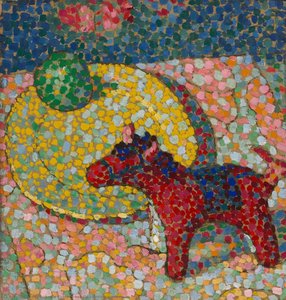
Tree with Cut Limb
Giclée / Kunstdruck
Format der Reproduktion
-


Endpreis
€ 71
Georgia O’Keeffe's “Tree with Cut Limb”: A Study in Minimalism and Melancholy
The artwork presents a striking depiction of a solitary tree against a serene azure sky, executed in a masterful style that embodies the core tenets of American Modernism. Georgia O’Keeffe’s “Tree with Cut Limb,” created in 1920, transcends mere representation; it delves into profound symbolism and evokes an atmosphere of contemplative sadness—a characteristic hallmark of her oeuvre. This piece exemplifies O'Keeffe’s pioneering approach to abstraction, prioritizing emotional resonance over literal accuracy.Composition and Style: Embracing Geometric Simplicity
O’Keeffe’s compositional choices are deliberately reductive. The tree dominates the canvas, rendered in bold, angular lines that delineate its trunk and branches with unwavering precision. These geometric forms—primarily rectangles and simplified curves—establish a vertical axis, emphasizing resilience and permanence against the expansive backdrop of the sky. Color is employed sparingly, primarily shades of green ranging from deep emerald to pale lime, contrasted by a stark black background and a muted blue expanse. This restrained palette contributes significantly to the artwork’s melancholic mood, mirroring the quiet dignity of decay—a recurring motif in O'Keeffe’s landscapes. The overall style leans toward naive art or children’s book illustration, prioritizing clarity and emotional impact over meticulous detail.Technique: Brushwork as Expression
The painting’s technique relies heavily on expressive brushstrokes—broad sweeps of pigment applied with confident assurance to define shapes and textures. Layers of oil paint are skillfully blended to create a smooth surface that subtly captures the nuances of light and shadow, enhancing the sense of depth without resorting to traditional perspective techniques. The artist's meticulous attention to detail is evident in the careful delineation of the tree’s bark—a textured surface achieved through precise brushwork—and the subtle gradations of color within the foliage. This technique underscores O’Keeffe’s commitment to conveying emotion directly, bypassing intellectual mediation and tapping into primal instincts.Historical Context: The Dawn of Abstract Expressionism
“Tree with Cut Limb” stands as a pivotal work in the burgeoning movement of Abstract Expressionism—a reaction against European Surrealism and Impressionism that championed spontaneity and emotional intensity. Influenced by Arthur Wesley Dow’s teachings on harmonious color and line, O'Keeffe rejected representational conventions in favor of exploring inner landscapes and conveying subjective experience. The painting reflects the broader cultural anxieties of the early 20th century—a period marked by disillusionment following World War I and a growing fascination with psychological exploration—themes that resonate powerfully within the artwork’s symbolic language.Symbolism: Decay, Resilience, and Remembrance
The severed limb serves as a potent symbol of loss and vulnerability—yet simultaneously embodies resilience and enduring beauty. It represents not merely physical damage but also the inevitable passage of time and the acceptance of mortality—concepts central to O'Keeffe’s philosophical worldview. The tree itself symbolizes strength, rootedness, and continuity—affirming life’s capacity for renewal even amidst hardship. Furthermore, the muted blue sky evokes a sense of serenity and remembrance—suggesting that beauty persists beyond earthly concerns. Ultimately, “Tree with Cut Limb” invites contemplation on themes of impermanence, transformation, and the profound interconnectedness between nature and human emotion.Emotional Impact: A Quiet Reflection on Beauty and Loss
The artwork’s enduring appeal lies in its ability to evoke a visceral emotional response—a feeling of quiet melancholy mingled with admiration for natural grandeur. Its simplicity compels viewers to confront fundamental questions about existence, prompting introspection and fostering a deeper appreciation for the sublime qualities of art. Like many of O'Keeffe’s paintings, “Tree with Cut Limb” transcends mere visual stimulation; it communicates an unspoken narrative—a testament to the artist’s profound understanding of human psychology and her unwavering devotion to capturing the essence of experience.Fragen & Antworten
Wie hell ist "Tree with Cut Limb" insgesamt?
Die wahrgenommene Helligkeit von "Tree with Cut Limb" von Georgia O’Keeffe beträgt tiefste Schattenwerte. Sie lässt sich optimal an das Licht des vorgesehenen Raumes anpassen.
Welche Technik wurde für "Tree with Cut Limb" verwendet und wann entstand das Werk?
"Tree with Cut Limb" entstand im Jahr 1920 mit der Technik Acryl auf Leinwand. Material und Datum beschreiben, wie und wann das Original geschaffen wurde.
Welche emotionale Stimmung prägt den Stil der Modernism-Epoche in „Tree with Cut Limb“?
Die Melancholisch Ausstrahlung von „Tree with Cut Limb“ wird durch seinen Modernism-Stil ergänzt.
Künstlerbiografie
Frühe Jahre und Ausbildung (1887–1916)
Georgia Totto O’Keeffe, eine zentrale Figur des amerikanischen Modernismus, wurde am 15. November 1887 in Sun Prairie, Wisconsin, geboren. Ihre Eltern waren Francis Calyxtus O’Keeffe und Ida (Totto) O’Keeffe, Milchbauern irischer und ungarischer Abstammung. Schon im Alter von zehn Jahren entschied Georgia, Künstlerin zu werden. Sie erhielt Kunstunterricht von der lokalen Aquarellistin Sara Mann und besuchte später das Art Institute of Chicago von 1905 bis 1906, wo sie unter John Vanderpoel studierte. Ihr einzigartiger Stil begann sich während ihrer Studien in Virginia zu entwickeln.Künstlerische Karriere (1917–1986)
Alfred Stieglitz, ein Kunsthändler und Fotograf, veranstaltete 1917 eine Ausstellung von O’Keeffes Werken. Dies markierte den Beginn ihrer professionellen Karriere. Sie zog 1918 auf Stieltiz's Wunsch nach New York und begann ernsthaft als Künstlerin zu arbeiten. Ihre berufliche Beziehung entwickelte sich zu einer persönlichen, die zur Heirat am 11. Dezember 1924 führte. O’Keeffes abstrakte Kunst, darunter Nahaufnahmen von Blumen wie *Rote Canna*, wurde oft als Darstellung weiblicher Geschlechtsorgane interpretiert, obwohl sie dies stets bestritt. Ihre Arbeit wurde auch von ihrer Zeit im Südwesten beeinflusst, was Gemälde wie *Schädel eines Rindes: Rot, Weiß und Blau (1931)* und *Sommertage (1936)* inspirierte.Einflüsse und Stilentwicklung
O’Keeffe war stark von Arthur Wesley Dow beeinflusst, dessen Lehren über abstraktes Design ihre künstlerische Praxis prägten. Sie experimentierte mit verschiedenen Stilen, darunter Präzisionismus, der sich in ihren Gemälden von New Yorker Wolkenkratzern zeigt. Ihre Landschaftsbilder aus New Mexico, insbesondere die Wüstenlandschaften rund um Abiquiú, wurden zu einem zentralen Thema ihres Werkes und zeigten ihre tiefe Verbindung zur Natur. Die Farbpalette O’Keeffes entwickelte sich im Laufe ihrer Karriere weiter, von den gedämpften Tönen ihrer frühen Werke bis hin zu den leuchtenden Farben, die in ihren späteren Gemälden dominieren.Vermächtnis und Bedeutung
Nach Stieltiz's Tod 1946 lebte O’Keeffe für die nächsten 40 Jahre in New Mexico. Ihr Gemälde *Jimson Weed/White Flower No. 1* aus dem Jahr 1932 wurde 2014 für 44,405.000 Dollar verkauft und stellte einen Rekordpreis für ein Werk einer weiblichen Künstlerin auf. Das Georgia O’Keeffe Museum wurde 2006 in Santa Fe gegründet, um ihrem Werk zu widmen. Ihre Werke sind auch in zahlreichen anderen Museen vertreten. Sie gilt als eine der wichtigsten Künstlerinnen des 20. Jahrhunderts und hat die Entwicklung der amerikanischen Kunst maßgeblich beeinflusst.Wichtige Werke
- Rote Canna
- Schädel eines Rindes: Rot, Weiß und Blau (1931)
- Sommertage (1936)
- Jimson Weed/White Flower No. 1
- Blaue und grüne Musik
Museen mit O’Keeffe-Werken
- Georgia O’Keeffe Museum
- Verschiedene weitere Museen, Informationen hier: https://www.okeeffemuseum.org/

Georgia O’Keeffe
1887 - 1986 , Vereinigte Staaten von Amerika
Kurzinfos
- Beeinflusste Künstler: ['Keine Angaben']
- Bemerkenswerte Werke:
- Roter Canna
- Kuhschädel Rot, Weiß und Blau
- Sommertage
- Spitzwurz/Weißes Blumen Nr. 1
- Einflüsse: ['Alfred Stieglitz']
- Geburtsdatum: 15. November 1887
- Geburtsort: Sun Prairie, Vereinigte Staaten
- Künstlerische Richtung: Amerikanischer Modernismus
- Nationalität: Amerikanisch
- Sterbedatum: 6. März 1986
- Vollständiger Name: Georgia O’Keeffe
Ähnliche Artikel

Die Top 10 Gemälde in Schattierungen von 'Slate Blue': Kunst für Ihr Zuhause
Entdecken Sie die Top 10 Gemälde in faszinierenden 'Slate Blue' Tönen! Von Monet bis Manet – erleben Sie Kunstgeschichte und lassen Sie sich von Meisterwerken inspirieren. Hochwertige Kunstdrucke auf

Abstrakter Expressionismus: Die 10 Meisterwerke, die eine Kunstbewegung prägten |
Entdecken Sie die 10 Meisterwerke des Abstrakten Expressionismus! Von Jackson Pollock bis Mark Rothko – erfahren Sie die Geschichten hinter ikonischen Gemälde und finden Sie hochwertige Reproduktionen für Ihr Zuhause. Jetzt bei entdecken!

Geometrische Abstraktion: Die 10 Meisterwerke, die Kunstgeschichte prägten | OriginalUniqueArt.com
Entdecken Sie die 10 Meisterwerke der geometrischen Abstraktion! Von Kandinsky bis Mondrian – erleben Sie die Geschichte, Farben & Formen dieser revolutionären Kunstrichtung. Hochwertige Kunstreproduktionen auf OriginalUniqueArt.com

Meister der Abstraktion: Die 25 ikonischsten Werke von Wassily Kandinsky
Entdecken Sie die 25 Meisterwerke Kandinskys und die Magie der Abstraktion. Erleben Sie die volle Sammlung auf OriginalUniqueArt.com.

Georgia O’Keeffe: Symbolismus und Landschaft – Eine Neudefinition der Moderne in der amerikanischen Kunst
Entdecken Sie Georgia O’Keeffes revolutionäre Kunst! Analysieren Sie ihren Symbolismus, ihre Landschaftsmalerei und ihren Einfluss auf die amerikanische Moderne. Expertenwissen & tiefe Einblicke.