In echtem Maßstab anzeigen
 Versenden als Grußkarte
 Teilen
 Details anzeigen
 Leitfaden öffnen

 Herunterladen
 Ähnliche Objekte
 Röntgenaufnahme
 Diashow
 Besucherstatistiken
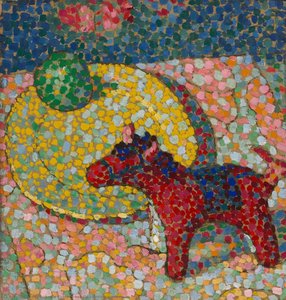
Red Cannas
 Öl auf Leinwand
- Wandkunst
- Modernism
 1927
1927 76.0 x 91.0 cm
 Amon Carter Museum of American Art
 Mehr anzeigen
Die auf dieser Seite dargestellten Kunstwerke sind urheberrechtlich geschützt, was bedeutet, dass wir keine identische Reproduktion rechtmäßig erstellen oder verkaufen dürfen. Dieser Schutz wird durch internationale Abkommen wie die Berner Übereinkunft und durch nationale Gesetze, einschließlich derer, die von den ... festgelegt wurden US-Urheberrecht – Titel 17.
Diese Methode entspricht vollumfänglich den Urheberrechtsbestimmungen, da sie keine Kopie oder Vervielfältigung des geschützten Kunstwerks darstellt. Stattdessen handelt es sich um eine kreative Neuinterpretation – ein neues Gemälde, das vom Original inspiriert, aber nicht identisch mit ihm ist.
Giclée / Kunstdruck
Giclée- oder Leinwanddruck in Museumsqualität mit schneller Produktion und flexiblen Veredelungsoptionen. ( Handgemalte Reproduktion kaufen Zum digitalen Bild wechseln)




P118B €10

P118H €10

P118W €10

P438Z €10

P508JH €12

P508YH €12

P805H €10

P805Z €10

P919BZ €10

P919G €10

P919XJ €10

P959ZH €10

P968JZ €12

W106C €8

W218G €10

W218JH €8

W218Y €10

W307PJ €10

W316G €10

W316PJ €8

W316Y €10

W398PJ €8

W4111J €10

W500HY €15

W500JH €15

W692G €12

W849H €8

W940BG €15

W953PJ €8




Wählen Sie aus unseren vordefinierten Formaten, die den ursprünglichen Proportionen des Kunstwerks entsprechen.

Geben Sie die Breite und die Höhe an, die Sie benötigen, damit der Druck perfekt in Ihren Rahmen oder an Ihre Wand passt. Ein Druck kann nur beschnitten werden und niemals größer als das Originalbild gemacht werden; daher verliert ein Format mit einer anderen Proportion einen Teil des Bildes. Wir senden Ihnen ein digitales Mockup zur Freigabe, bevor wir den Druck ausführen. Das auf dieser Seite gezeigte Bild zeigt nicht den tatsächlichen Beschnitt – dies ist nur im Mockup ersichtlich.
Weltweiter Versand () innerhalb von 2 Wochen statt der üblichen 4/5 Wochen. (22 Oktober)

Kostenloser weltweiter Expressversand

Hochwertige Leinenleinwand

Vollständiger Versicherungsschutz beim Versand

Zollgebühren-Rückerstattungsgarantie

Garantie für exakte Farbtreue

100-tägiges Rückgaberecht (nur bei Mängeln)

100% Geld-zurück-Garantie

Angebot für Mengenrabatt
 Die Glasoption ist nur für Größen unter 110 cm verfügbar.

Red Cannas
Giclée / Kunstdruck
Format der Reproduktion
-


Gesamtpreis
€ 70
Georgia O’Keeffe’s Red Cannas: A Bloom of Boldness
Georgia O'Keeffe’s 1927 painting, “Red Cannas,” isn’t merely a depiction of a flower; it’s an immersion into a world of vibrant color, sensual curves, and intensely personal vision. This iconic work, currently residing at the Amon Carter Museum of American Art in Fort Worth, Texas, represents a pivotal moment in O'Keeffe’s artistic evolution – a shift toward abstraction that simultaneously celebrated the beauty of the natural world and explored the depths of her own emotional landscape. The painting captures a single red canna lily, dramatically enlarged and presented with an almost unsettling intimacy, demanding the viewer’s complete attention.
O'Keeffe’s approach to this subject was revolutionary for its time. Rather than striving for photographic realism, she employed bold brushstrokes and saturated hues – deep reds, vibrant yellows, and subtle pinks – to convey not just the appearance of the flower but also a sense of its underlying energy and form. The canvas itself becomes a stage for this botanical drama, with the lily dominating the composition while surrounding foliage is reduced to suggestive masses of color and texture. This technique was heavily influenced by Arthur Wesley Dow’s teachings on color theory and personal expression, which encouraged artists to prioritize feeling over strict representation.
The Language of Form and Feeling
The painting's power lies in its deliberate ambiguity. While undeniably a canna lily, the image transcends simple botanical illustration. O'Keeffe’s masterful use of overlapping petals, distorted perspectives, and carefully considered color relationships creates an effect that is both alluring and slightly unsettling. The downward-curving petal, almost like a closed mouth or a gently folded hand, has fueled decades of speculation about its symbolic meaning. Some critics interpreted it as a reference to female genitalia, a reading O'Keeffe vehemently denied, insisting she was simply capturing the essence of the flower’s form and her own deeply felt connection to it.
Regardless of the specific interpretation, “Red Cannas” speaks powerfully to themes of sensuality, beauty, and the artist’s intimate relationship with nature. O'Keeffe’s decision to isolate this single bloom – a common motif in her work – elevates it to an almost mythical status. The scale of the painting further emphasizes this sense of grandeur, drawing the viewer into a world where the ordinary becomes extraordinary.
Context and Legacy
Created during a period of intense artistic experimentation, “Red Cannas” reflects O'Keeffe’s growing independence as an artist. Following her move to New York in 1918 and her association with Alfred Stieglitz, she began to develop a unique style that challenged conventional notions of landscape painting. This work marked a departure from the more representational styles she had previously explored, signaling a shift toward abstraction and a greater emphasis on personal expression.
The painting’s influence extends far beyond the art world. Its bold colors and evocative imagery have been widely reproduced in posters, fabrics, and other decorative items, cementing its status as one of O'Keeffe’s most recognizable works. “Red Cannas” remains a testament to her extraordinary vision and her ability to transform the familiar into something profoundly beautiful and deeply resonant. It is a painting that continues to captivate viewers with its sensual intensity and enduring mystery.
Technical Details & Reproduction Considerations
Executed in oil on canvas, “Red Cannas” measures 36 1/8 x 30 1/8 inches. O’Keeffe's distinctive brushwork is immediately apparent – thick, layered strokes of color that build up to create a rich and textured surface. The careful layering of pigments creates an almost sculptural effect, giving the painting a tangible presence. When considering reproductions, it’s important to note the original’s vibrant palette; achieving accurate color reproduction can be challenging, but high-quality prints utilizing archival inks are crucial for capturing the painting's full impact.
Fragen & Antworten
In welcher Größe wird empfohlen, "Red Cannas" zu drucken?
Für "Red Cannas" wird ein Druckformat von Großformatig empfohlen. Weitere Größen sind im gleichen Seitenverhältnis verfügbar.
Gibt es einen Leitfaden für "Red Cannas" von Georgia O’Keeffe?
Eine Leitfaden-Seite ist für "Red Cannas" von Georgia O’Keeffe verfügbar: ein druckbares Infoblatt zum Kunstwerk, konzipiert für Schüler und den Einsatz im Unterricht.
Um welche Art von Kunstwerk handelt es sich bei "Red Cannas"?
"Red Cannas" ist ein Werk der Art Wandkunst.
Biografie des Künstlers
Frühe Jahre und Ausbildung (1887–1916)
Georgia Totto O’Keeffe, eine zentrale Figur des amerikanischen Modernismus, wurde am 15. November 1887 in Sun Prairie, Wisconsin, geboren. Ihre Eltern waren Francis Calyxtus O’Keeffe und Ida (Totto) O’Keeffe, Milchbauern irischer und ungarischer Abstammung. Schon im Alter von zehn Jahren entschied Georgia, Künstlerin zu werden. Sie erhielt Kunstunterricht von der lokalen Aquarellistin Sara Mann und besuchte später das Art Institute of Chicago von 1905 bis 1906, wo sie unter John Vanderpoel studierte. Ihr einzigartiger Stil begann sich während ihrer Studien in Virginia zu entwickeln.Künstlerische Karriere (1917–1986)
Alfred Stieglitz, ein Kunsthändler und Fotograf, veranstaltete 1917 eine Ausstellung von O’Keeffes Werken. Dies markierte den Beginn ihrer professionellen Karriere. Sie zog 1918 auf Stieltiz's Wunsch nach New York und begann ernsthaft als Künstlerin zu arbeiten. Ihre berufliche Beziehung entwickelte sich zu einer persönlichen, die zur Heirat am 11. Dezember 1924 führte. O’Keeffes abstrakte Kunst, darunter Nahaufnahmen von Blumen wie *Rote Canna*, wurde oft als Darstellung weiblicher Geschlechtsorgane interpretiert, obwohl sie dies stets bestritt. Ihre Arbeit wurde auch von ihrer Zeit im Südwesten beeinflusst, was Gemälde wie *Schädel eines Rindes: Rot, Weiß und Blau (1931)* und *Sommertage (1936)* inspirierte.Einflüsse und Stilentwicklung
O’Keeffe war stark von Arthur Wesley Dow beeinflusst, dessen Lehren über abstraktes Design ihre künstlerische Praxis prägten. Sie experimentierte mit verschiedenen Stilen, darunter Präzisionismus, der sich in ihren Gemälden von New Yorker Wolkenkratzern zeigt. Ihre Landschaftsbilder aus New Mexico, insbesondere die Wüstenlandschaften rund um Abiquiú, wurden zu einem zentralen Thema ihres Werkes und zeigten ihre tiefe Verbindung zur Natur. Die Farbpalette O’Keeffes entwickelte sich im Laufe ihrer Karriere weiter, von den gedämpften Tönen ihrer frühen Werke bis hin zu den leuchtenden Farben, die in ihren späteren Gemälden dominieren.Vermächtnis und Bedeutung
Nach Stieltiz's Tod 1946 lebte O’Keeffe für die nächsten 40 Jahre in New Mexico. Ihr Gemälde *Jimson Weed/White Flower No. 1* aus dem Jahr 1932 wurde 2014 für 44,405.000 Dollar verkauft und stellte einen Rekordpreis für ein Werk einer weiblichen Künstlerin auf. Das Georgia O’Keeffe Museum wurde 2006 in Santa Fe gegründet, um ihrem Werk zu widmen. Ihre Werke sind auch in zahlreichen anderen Museen vertreten. Sie gilt als eine der wichtigsten Künstlerinnen des 20. Jahrhunderts und hat die Entwicklung der amerikanischen Kunst maßgeblich beeinflusst.Wichtige Werke
- Rote Canna
- Schädel eines Rindes: Rot, Weiß und Blau (1931)
- Sommertage (1936)
- Jimson Weed/White Flower No. 1
- Blaue und grüne Musik
Museen mit O’Keeffe-Werken
- Georgia O’Keeffe Museum
- Verschiedene weitere Museen, Informationen hier: https://www.okeeffemuseum.org/

Georgia O’Keeffe
1887 - 1986 , Vereinigte Staaten von Amerika
Eckdaten zum Künstler
- Beeinflusste Künstler: ['Keine Angaben']
- Bemerkenswerte Werke:
- Roter Canna
- Kuhschädel Rot, Weiß und Blau
- Sommertage
- Spitzwurz/Weißes Blumen Nr. 1
- Einflüsse: ['Alfred Stieglitz']
- Geburtsdatum: 15. November 1887
- Geburtsort: Sun Prairie, Vereinigte Staaten
- Künstlerische Richtung: Amerikanischer Modernismus
- Nationalität: Amerikanisch
- Sterbedatum: 6. März 1986
- Vollständiger Name: Georgia O’Keeffe
Verwandte Artikel
Mark Rothkos Meisterwerke: Die Top 25 für Kunstliebhaber | OriginalUniqueArt
Entdecken Sie die 25 Meisterwerke von Mark Rothko! Tauchen Sie ein in die Welt der abstrakten Kunst, des Expressionismus und der Farbfeldmalerei. Hochwertige Kunstdrucke & Reproduktionen auf OriginalUniqueArt.com – für Ihre Wohnräume.

Geometrische Abstraktion: Die 10 Meisterwerke, die Kunstgeschichte prägten | OriginalUniqueArt.com
Entdecken Sie die 10 Meisterwerke der geometrischen Abstraktion! Von Kandinsky bis Mondrian – erleben Sie die Geschichte, Farben & Formen dieser revolutionären Kunstrichtung. Hochwertige Kunstreproduktionen auf OriginalUniqueArt.com

Georgia O’Keeffe: Symbolismus und Landschaft – Eine Neudefinition der Moderne in der amerikanischen Kunst
Entdecken Sie Georgia O’Keeffes revolutionäre Kunst! Analysieren Sie ihren Symbolismus, ihre Landschaftsmalerei und ihren Einfluss auf die amerikanische Moderne. Expertenwissen & tiefe Einblicke.

Abstrakter Expressionismus: Die 10 Meisterwerke, die eine Kunstbewegung prägten |
Entdecken Sie die 10 Meisterwerke des Abstrakten Expressionismus! Von Jackson Pollock bis Mark Rothko – erfahren Sie die Geschichten hinter ikonischen Gemälde und finden Sie hochwertige Reproduktionen für Ihr Zuhause. Jetzt bei entdecken!

Kandinsky: Die 25 Meisterwerke des Abstrakten – Kunst für Ihr Zuhause | OriginalUniqueArt
Entdecken Sie die 25 bedeutendsten Gemälde von Wassily Kandinsky! Tauchen Sie ein in die Welt der abstrakten Kunst, des Expressionismus und der Farbkomposition. Hochwertige Kunstdrucke & Inspiration für Ihr Zuhause auf OriginalUniqueArt.com.