In echtem Maßstab anzeigen
 Versenden als Grußkarte
 Teilen
 Details anzeigen
 Leitfaden öffnen

 Herunterladen
 Ähnliche Objekte
 Röntgenaufnahme
 Diashow
 Besucherstatistiken
Corn, No. 2


 Mehr anzeigen
Die auf dieser Seite dargestellten Kunstwerke sind urheberrechtlich geschützt, was bedeutet, dass wir keine identische Reproduktion rechtmäßig erstellen oder verkaufen dürfen. Dieser Schutz wird durch internationale Abkommen wie die Berner Übereinkunft und durch nationale Gesetze, einschließlich derer, die von den ... festgelegt wurden US-Urheberrecht – Titel 17.
Diese Methode entspricht vollumfänglich den Urheberrechtsbestimmungen, da sie keine Kopie oder Vervielfältigung des geschützten Kunstwerks darstellt. Stattdessen handelt es sich um eine kreative Neuinterpretation – ein neues Gemälde, das vom Original inspiriert, aber nicht identisch mit ihm ist.
Giclée / Kunstdruck
Giclée- oder Leinwanddruck in Museumsqualität mit schneller Produktion und flexiblen Veredelungsoptionen. ( Handgemalte Reproduktion kaufen Zum digitalen Bild wechseln)




P118B €10

P118H €10

P118W €10

P438Z €10

P508JH €12

P508YH €12

P805H €10

P805Z €10

P919BZ €10

P919G €10

P919XJ €10

P959ZH €10

P968JZ €12

W106C €8

W218G €10

W218JH €8

W218Y €10

W307PJ €10

W316G €10

W316PJ €8

W316Y €10

W398PJ €8

W4111J €10

W500HY €15

W500JH €15

W692G €12

W849H €8

W940BG €15

W953PJ €8




Wählen Sie aus unseren vordefinierten Formaten, die den ursprünglichen Proportionen des Kunstwerks entsprechen.

Geben Sie die Breite und die Höhe an, die Sie benötigen, damit der Druck perfekt in Ihren Rahmen oder an Ihre Wand passt. Ein Druck kann nur beschnitten werden und niemals größer als das Originalbild gemacht werden; daher verliert ein Format mit einer anderen Proportion einen Teil des Bildes. Wir senden Ihnen ein digitales Mockup zur Freigabe, bevor wir den Druck ausführen. Das auf dieser Seite gezeigte Bild zeigt nicht den tatsächlichen Beschnitt – dies ist nur im Mockup ersichtlich.
Weltweiter Versand () innerhalb von 2 Wochen statt der üblichen 4/5 Wochen. (24 Oktober)

Kostenloser weltweiter Expressversand

Hochwertige Leinenleinwand

Vollständiger Versicherungsschutz beim Versand

Zollgebühren-Rückerstattungsgarantie

Garantie für exakte Farbtreue

100-tägiges Rückgaberecht (nur bei Mängeln)

100% Geld-zurück-Garantie

Angebot für Mengenrabatt
 Die Glasoption ist nur für Größen unter 110 cm verfügbar.

Corn, No. 2
Giclée / Kunstdruck
Format der Reproduktion
-


Gesamtpreis
€ 70
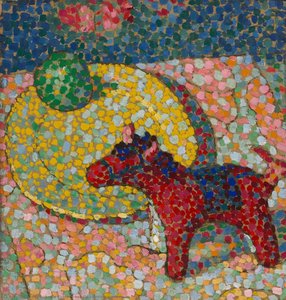
A Silent Bloom: Exploring Georgia O’Keeffe's Corn, No. 2
Georgia O’Keeffe’s “Corn, No. 2,” painted in 1924, isn’t merely a depiction of plant life; it’s an embodiment of modernist sensibilities and a profound meditation on perception itself. Captured at the Georgia O'Keeffe Museum in Santa Fe, New Mexico, this oil on canvas piece exemplifies O’Keeffe’s signature style—a bold simplification of form combined with vibrant color palettes that prioritize emotional resonance over meticulous representation. The painting presents a single stalk of corn, rendered in shades of emerald green and punctuated by splashes of golden yellow, seemingly frozen mid-growth. It's remarkable how O’Keeffe manages to convey an immense sense of scale and dynamism within this deceptively minimalist composition.The Influence of Arthur Wesley Dow: Harmonious Balance and Personal Expression
O’Keeffe’s artistic journey was fundamentally shaped by the teachings of Arthur Wesley Dow, a pioneer in American Impressionism who championed a revolutionary approach to painting. Unlike traditional academic art that aimed for photographic accuracy, Dow advocated for artists to prioritize “harmony” – achieving balance between color and line—and above all, to express their inner vision authentically. This philosophy directly countered the prevailing artistic conventions of the time and instilled in O’Keeffe a conviction that art should communicate feeling rather than simply mirroring reality. The resulting style is instantly recognizable: flattened planes of color punctuated by bold lines that guide the viewer's eye across the canvas, creating an immersive experience.A Symbol of Resilience and Transformation
Beyond its formal qualities, “Corn, No. 2” carries significant symbolic weight. Corn has long been a staple crop in American agriculture and represents fertility, sustenance, and cyclical renewal—themes that resonate deeply within O’Keeffe's oeuvre. The artist herself frequently explored motifs of desert landscapes and abstracted floral forms, reflecting her fascination with the natural world and her desire to capture its essence. Here, the upward thrust of the corn stalk symbolizes growth and aspiration, while the yellow accents evoke warmth and optimism. Furthermore, the unfinished appearance of the painting—a deliberate choice by O’Keeffe—suggests an ongoing process of observation and interpretation, mirroring the artist's own engagement with the subject matter.Technique and Color Palette: Mastering Impressionistic Principles
O’Keeffe skillfully employed techniques rooted in Impressionism to achieve her desired effect. She utilized thick impasto – applying paint thickly onto the canvas – creating textural surfaces that capture the light and atmosphere of the scene. This technique isn't merely decorative; it actively contributes to the painting's emotional impact, conveying a sense of immediacy and physicality. The color palette is equally deliberate. O’Keeffe favored complementary colors—green and yellow—to heighten visual vibrancy and create a harmonious balance within the composition. Careful consideration was given to how light interacts with pigment, resulting in luminous hues that capture the subtle nuances of the plant's form.Emotional Resonance: Capturing the Essence of Place
Ultimately, “Corn, No. 2” succeeds in conveying a powerful emotional response. It’s more than just a botanical illustration; it’s an invitation to contemplate the beauty and grandeur of the American Southwest—a region that held profound significance for O’Keeffe. The painting captures not only the visual appearance of the corn stalk but also its underlying energy, suggesting a connection between the artist and her environment. Viewing this piece evokes feelings of tranquility, contemplation, and appreciation for the simple wonders of nature – qualities that continue to inspire audiences today.Fragen & Antworten
Wann wurde "Corn, No. 2" geschaffen und welcher Stilrichtung lässt es sich zuordnen?
"Corn, No. 2" entstand im Jahr 1924 als Werk der Abstract Expressionism-Bewegung. Datum und Stilrichtung verankern das Kunstwerk in der Kunstgeschichte.
Wo kann ich eine Vorschau von „Corn, No. 2“ sehen?
Um eine Reproduktion von "Corn, No. 2" von Georgia O’Keeffe in der Vorschau zu sehen, öffnen Sie die Vorschau-Seite des Kunstwerks.
Wie kann ich einen Druck von "Corn, No. 2" von Georgia O’Keeffe erwerben?
Ein Druck von "Corn, No. 2" von Georgia O’Keeffe kann direkt auf der entsprechenden Kunstdruck-Seite bestellt werden: ein Fine Art Print auf Baumwollkanvas oder Archiv-Leinwandpapier.
Biografie des Künstlers
Frühe Jahre und Ausbildung (1887–1916)
Georgia Totto O’Keeffe, eine zentrale Figur des amerikanischen Modernismus, wurde am 15. November 1887 in Sun Prairie, Wisconsin, geboren. Ihre Eltern waren Francis Calyxtus O’Keeffe und Ida (Totto) O’Keeffe, Milchbauern irischer und ungarischer Abstammung. Schon im Alter von zehn Jahren entschied Georgia, Künstlerin zu werden. Sie erhielt Kunstunterricht von der lokalen Aquarellistin Sara Mann und besuchte später das Art Institute of Chicago von 1905 bis 1906, wo sie unter John Vanderpoel studierte. Ihr einzigartiger Stil begann sich während ihrer Studien in Virginia zu entwickeln.Künstlerische Karriere (1917–1986)
Alfred Stieglitz, ein Kunsthändler und Fotograf, veranstaltete 1917 eine Ausstellung von O’Keeffes Werken. Dies markierte den Beginn ihrer professionellen Karriere. Sie zog 1918 auf Stieltiz's Wunsch nach New York und begann ernsthaft als Künstlerin zu arbeiten. Ihre berufliche Beziehung entwickelte sich zu einer persönlichen, die zur Heirat am 11. Dezember 1924 führte. O’Keeffes abstrakte Kunst, darunter Nahaufnahmen von Blumen wie *Rote Canna*, wurde oft als Darstellung weiblicher Geschlechtsorgane interpretiert, obwohl sie dies stets bestritt. Ihre Arbeit wurde auch von ihrer Zeit im Südwesten beeinflusst, was Gemälde wie *Schädel eines Rindes: Rot, Weiß und Blau (1931)* und *Sommertage (1936)* inspirierte.Einflüsse und Stilentwicklung
O’Keeffe war stark von Arthur Wesley Dow beeinflusst, dessen Lehren über abstraktes Design ihre künstlerische Praxis prägten. Sie experimentierte mit verschiedenen Stilen, darunter Präzisionismus, der sich in ihren Gemälden von New Yorker Wolkenkratzern zeigt. Ihre Landschaftsbilder aus New Mexico, insbesondere die Wüstenlandschaften rund um Abiquiú, wurden zu einem zentralen Thema ihres Werkes und zeigten ihre tiefe Verbindung zur Natur. Die Farbpalette O’Keeffes entwickelte sich im Laufe ihrer Karriere weiter, von den gedämpften Tönen ihrer frühen Werke bis hin zu den leuchtenden Farben, die in ihren späteren Gemälden dominieren.Vermächtnis und Bedeutung
Nach Stieltiz's Tod 1946 lebte O’Keeffe für die nächsten 40 Jahre in New Mexico. Ihr Gemälde *Jimson Weed/White Flower No. 1* aus dem Jahr 1932 wurde 2014 für 44,405.000 Dollar verkauft und stellte einen Rekordpreis für ein Werk einer weiblichen Künstlerin auf. Das Georgia O’Keeffe Museum wurde 2006 in Santa Fe gegründet, um ihrem Werk zu widmen. Ihre Werke sind auch in zahlreichen anderen Museen vertreten. Sie gilt als eine der wichtigsten Künstlerinnen des 20. Jahrhunderts und hat die Entwicklung der amerikanischen Kunst maßgeblich beeinflusst.Wichtige Werke
- Rote Canna
- Schädel eines Rindes: Rot, Weiß und Blau (1931)
- Sommertage (1936)
- Jimson Weed/White Flower No. 1
- Blaue und grüne Musik
Museen mit O’Keeffe-Werken
- Georgia O’Keeffe Museum
- Verschiedene weitere Museen, Informationen hier: https://www.okeeffemuseum.org/

Georgia O’Keeffe
1887 - 1986 , Vereinigte Staaten von Amerika
Eckdaten zum Künstler
- Beeinflusste Künstler: ['Keine Angaben']
- Bemerkenswerte Werke:
- Roter Canna
- Kuhschädel Rot, Weiß und Blau
- Sommertage
- Spitzwurz/Weißes Blumen Nr. 1
- Einflüsse: ['Alfred Stieglitz']
- Geburtsdatum: 15. November 1887
- Geburtsort: Sun Prairie, Vereinigte Staaten
- Künstlerische Richtung: Amerikanischer Modernismus
- Nationalität: Amerikanisch
- Sterbedatum: 6. März 1986
- Vollständiger Name: Georgia O’Keeffe
Verwandte Artikel

Das bleibende Erbe der Ölmalerei: Technik, Geschichte und zeitgenössische Praxis
Entdecken Sie die faszinierende Geschichte der Ölmalerei – von den frühen Techniken bis zur modernen Kunst. Expertenwissen, detaillierte Analysen und Inspiration für Sammler & Kunstliebhaber.

Öl auf Leinwand: Eine historische und technische Erkundung eines zeitlosen künstlerischen Mediums
Entdecken Sie die faszinierende Welt der Ölmalerei! Von historischen Techniken bis zur modernen Anwendung – wir bieten Expertenwissen, Restaurierungstipps und hochwertige Reproduktionen. Jetzt informieren!

The Soul of Impressionism: Why Oil on Canvas Captures Eternal Light and Timeless Emotion
Discover the enchanting alchemy of Impressionism. Explore how the mastery of oil on canvas, through glazing and impasto, captures eternal light and emotion. Perfect for lovers of Monet and Van Gogh seeking the profound depth of hand-painted fine art.

Georgia O’Keeffe: Symbolismus und Landschaft – Eine Neudefinition der Moderne in der amerikanischen Kunst
Entdecken Sie Georgia O’Keeffes revolutionäre Kunst! Analysieren Sie ihren Symbolismus, ihre Landschaftsmalerei und ihren Einfluss auf die amerikanische Moderne. Expertenwissen & tiefe Einblicke.

The Enduring Legacy of Oil on Canvas: Technique, History & Aesthetic Impact
Explore the rich history & techniques of oil painting – from Renaissance masters to Impressionism. Discover pigments, layering methods, and why this timeless medium endures. Expert insights for artists & art enthusiasts.