In echtem Maßstab anzeigen
 Versenden als Grußkarte
 Teilen
 Details anzeigen
 Leitfaden öffnen

 Herunterladen
 Ähnliche Objekte
 Röntgenaufnahme
 Diashow
 Besucherstatistiken
Suburb
 Öl auf Leinwand
- Wandkunst
- Pointillist Style
 1882
1882- Frühmittelalter
 32.0 x 40.0 cm
 Musée d'art moderne de Troyes
 Mehr anzeigen
Handgefertigte Ölreproduktion
Handgemaltes Ölgemälde auf Leinwand in Ihrer Wunschgröße und mit Rahmen, auf Bestellung von unseren Künstlern angefertigt. ( Zum Druck wechseln Zum digitalen Bild wechseln)




P118B €10

P118H €10

P118W €10

P438Z €10

P508JH €12

P508YH €12

P805H €10

P805Z €10

P919BZ €10

P919G €10

P919XJ €10

P959ZH €10

P968JZ €12

W106C €8

W218G €10

W218JH €8

W218Y €10

W307PJ €10

W316G €10

W316PJ €8

W316Y €10

W398PJ €8

W4111J €10

W500HY €15

W500JH €15

W692G €12

W849H €8

W940BG €15

W953PJ €8




Wählen Sie aus unseren vordefinierten Formaten, die den ursprünglichen Proportionen des Kunstwerks entsprechen.

Geben Sie die Breite und die Höhe an, die Sie für Ihren Rahmen oder Ihre Wand benötigen. Da dieses Werk handgemalt ist, kann der Künstler bei einer anderen Form etwas mehr um das Bild herum malen oder etwas abschneiden – Sie entscheiden. Wir senden Ihnen ein digitales Mockup zur Freigabe, bevor mit dem Malen begonnen wird. Das auf dieser Seite gezeigte Bild stellt nicht das tatsächliche Ergebnis dar – dies tut nur das Mockup.
Nach der Bestellung wird das OriginalUniqueArt.com-Team dem Kunden Anweisungen per E-Mail zusenden und eine Mockup-Vorschau bereitstellen.
Weltweiter Versand () in nur 3 bis 4 Wochen statt der üblichen 5 Wochen. (23 Oktober). Keine Kompromisse bei der Qualität.

Kostenloser weltweiter Expressversand

Hochwertige Leinenleinwand

Vollständiger Versicherungsschutz beim Versand

Zollgebühren-Rückerstattungsgarantie

Garantie für exakte Farbtreue

100-tägiges Rückgaberecht (nur bei Mängeln)

100% Geld-zurück-Garantie

Angebot für Mengenrabatt
 Die Glasoption ist nur für Größen unter 110 cm verfügbar.

Suburb
Reproduktionsmedium
Format der Reproduktion
-


Gesamtpreis
€ 263
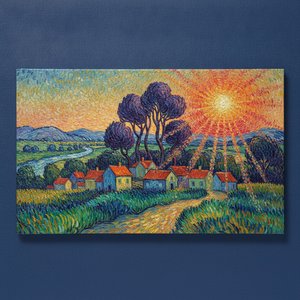
Georges Seurat – *Suburb*: A Glimpse into Industrialized France
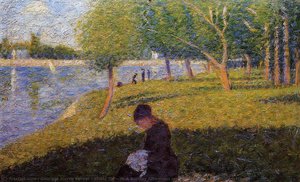
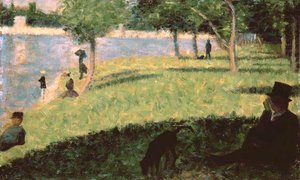
Georges Pierre Seurat’s *Suburb*, painted in 1882, is more than just a depiction of a provincial village; it's a meticulously constructed meditation on modernity and the burgeoning relationship between humanity and industry. This small canvas, measuring only 32 x 40 cm, offers an intimate yet profoundly unsettling view into a France undergoing rapid transformation – a nation grappling with the rise of factories and the changing rhythms of rural life. Seurat, a true pioneer of “luminous precision,” sought to capture not merely what he *saw*, but how the eye *perceived* light and color, a principle that defines his revolutionary Pointillist technique.
The Language of Dots: Seurat’s Pointillism
At first glance, *Suburb* might appear deceptively simple. However, beneath the surface lies an astonishingly complex system of tiny, independent dots – meticulously applied in a vibrant palette of colors. This is Pointillism, a technique developed by Seurat himself, based on his studies of optics and color theory. Rather than blending colors directly on the canvas, he built up layers of pure hues, allowing the viewer’s eye to optically mix them when viewed from a distance. The effect is remarkably luminous and creates an almost shimmering quality, particularly noticeable in the depiction of sunlight filtering through the buildings and illuminating the figures within. The seemingly random arrangement of dots actually represents a carefully calculated composition, designed to evoke specific emotional responses and create a sense of depth and atmosphere.
A Village on the Brink: Symbolism and Context
The scene itself is imbued with symbolic weight. The prominent factory in the background immediately establishes the painting’s central theme – industrialization and its impact on traditional rural life. The two horses, one positioned to the left and the other closer to the center, could represent the old ways of farming versus the new demands of industry. The figures scattered throughout the village are not idealized portraits; they appear weary, engaged in mundane tasks, reflecting a sense of displacement and perhaps even unease. Seurat’s choice of subject matter reflects a broader societal anxiety prevalent at the time – a questioning of progress and its potential consequences. It's important to note that Seurat was deeply interested in scientific observation and sought to understand the world through rational analysis, which is reflected in his precise rendering of even the most ordinary details.
Emotional Resonance: Light, Color, and Perception
*Suburb* isn’t simply a record of a place; it's an exploration of perception itself. Seurat wasn’t interested in creating a realistic representation, but rather in capturing the *impression* of light and color as experienced by the eye. The painting evokes a sense of quiet melancholy, a subtle tension between beauty and decay, tradition and modernity. The carefully chosen colors – predominantly blues, greens, and ochres – contribute to this atmosphere, suggesting both the warmth of the sun and the coolness of industrial smoke. When viewed closely, the individual dots become almost hypnotic, drawing the viewer into Seurat’s meticulously constructed world. The reproduction offered by OriginalUniqueArt.com allows you to experience this captivating technique firsthand, bringing a piece of art history into your own space.
- Dimensions: 32 x 40 cm
- Date: 1882
- Location: Musée d'Art Moderne de Troyes, France
- Artist: Georges Seurat
Consider a high-quality reproduction of *Suburb* to add a touch of intellectual elegance and subtle emotional depth to your interior design. It’s a powerful reminder of the transformative period in art history that Seurat helped shape – a testament to the enduring power of observation, technique, and the human desire to understand the world around us.
Fragen & Antworten
Wer ist der Urheber von "Suburb" und aus welchem Jahr stammt das Werk?
"Suburb" wurde von Georges Pierre Seurat im Jahr 1882 geschaffen.
Wie sehen die Reproduktionsrechte für „Suburb“ im Musée d'art moderne de Troyes aus?
Das Original "Suburb" befindet sich im Musée d'art moderne de Troyes, und das Werk ist gemeinfrei – das Urheberrecht ist abgelaufen.
Ist "Suburb" ein berühmtes Kunstwerk der Pointillist Style-Epoche?
Innerhalb der Pointillist Style-Strömung weist „Suburb“ ein Anerkannt Bekanntheitsniveau auf.
Biografie des Künstlers
Georges Seurat: Ein Pionier des Neoimpressionismus
Frühes Leben und Ausbildung
- Geboren: 2. Dezember 1859 in Paris, Frankreich.
- Seurats Familie zog kurz nach seiner Geburt auf den Boulevard de Magenta um.
- Sein Vater, Antoine Chrysostome Seurat, war ein ehemaliger Jurist, der durch Immobilienhandel reich wurde.
- Er begann seine künstlerische Ausbildung an der École Municipale de Sculpture et Dessin, in der Nähe seines Zuhauses, unter dem Bildhauer Justin Lequien.
- Im Jahr 1878 meldete er sich an der renommierten École des Beaux-Arts an und studierte bei Henri Lehmann.
Künstlerische Entwicklung und Einflüsse
- Seurats künstlerliche Persönlichkeit war eine einzigartige Mischung aus Sensibilität und logischer Abstraktion. Er verband zarte Empfindsamkeit mit mathematischer Präzision.
- Einflüsse: Obwohl spezifische Einflüsse diskutiert werden, studierte er die Farbbtheorien von Wissenschaftlern wie Michel Eugène Chevreul und Ogden Rood.
- Er experimentierte zunächst mit traditionellen Zeichentechniken, bevor er seinen charakteristischen Stil entwickelte.
- Seine frühen Werke zeigen ein Interesse an akademischer Malerei, ging aber allmählich zu einem innovativeren Ansatz über.
Chromoluminarismus und Pointillismus
- Seurat entwickelte die Techniken des Chromoluminarismus (die Wissenschaft der Farbe) und des Pointillismus, indem er kleine, deutliche Punkte reiner Farbe auf eine Leinwand auftrug.
- Er verwendete Conté-Kreide für detaillierte Zeichnungen auf rauer Papiersubstanz als Teil seines Prozesses.
- Ziel des Pointillismus: Die Idee war, dass das Auge des Betrachters diese Farben optisch miteinander mischen und so einen lebendigen und leuchtenden Effekt erzeugt.
Wichtige Leistungen und bemerkenswerte Werke
- Ein Sonntagnachmittag auf der Île de la Grande Jatte (1884-1886): Sein berühmtestes Werk, das den Beginn des Neoimpressionismus markiert. Es veranschaulicht seine Pointillist-Technik und seinen methodischen Ansatz.
- Alfalfa, Saint-Denis (1886-1887): Demonstriert seine Anwendung der Farbbtheorie auf eine ländliche Landschaft.
- Landschaft bei Saint-Ouen (1882-1883): Ein frühes Beispiel, das seinen sich entwickelnden Stil und sein Interesse an Licht und Atmosphäre zeigt.
- Der Eiffelturm (1889): Eine Darstellung des ikonischen Pariser Wahrzeichens, dargestellt mit Pointillist-Techniken.
- Bäderer in Asnières (1884): Ein weiteres bedeutendes Werk, das Freizeit und modernen Lebensstil mit seinem unverwechselbaren Stil erforscht.
Historische Bedeutung und Vermächtnis
- Seureats Werk beeinflusste die Entwicklung der modernen Kunst nachhaltig, insbesondere durch seinen Schwerpunkt auf subjektivem Ausdruck und die Erforschung neuer Techniken.
- Legte den Grundstein: Er legte den Grundstein für Bewegungen wie Fauvismus, Kubismus und Expressionismus.
- Sein wissenschaftlicher Ansatz in der Malerei stellte traditionelle künstlerische Konventionen in Frage.
- Trotz seines kurzen Lebens (er starb im Alter von 31 Jahren) hinterließ Seurat einen unauslöschlichen Eindruck in der Kunstgeschichte und inspirierte Generationen von Künstlern mit seiner innovativen Vision.

Georges Pierre Seurat
1859 - 1891 , Frankreich
Eckdaten zum Künstler
- Beeinflusste Künstler:
- Fauvismus
- Kubismus
- Bemerkenswerte Werke:
- Ein Sonntagnachmittag...
- Bäufer in Asnières
- Der Eiffelturm
- Einflüsse:
- Michel Eugène Chevreul
- Ogden Rood
- Geburtsdatum: 2. Dezember 1859
- Geburtsort: Paris, Frankreich
- Künstlerische Bewegung: Neo-Impressionismus
- Nationalität: Französisch
- Sterbedatum: 1891
- Vollständiger Name: Georges Pierre Seurat
Verwandte Artikel

Georges Seurat: Die 25 Meisterwerke des Pointillismus für Ihr Zuhause | OriginalUniqueArt
Entdecken Sie die 25 ikonischsten Meisterwerke von Georges Seurat! Tauchen Sie ein in die Welt des Pointillismus, der Farbtheorie und des Impressionismus. Hochwertige Kunst reproduzieren für Ihr Zuhause – jetzt auf OriginalUniqueArt.com!

Impressionismus Meisterwerke: Die Top 10 Kunstwerke für Ihr Zuhause | OriginalUniqueArt
Entdecken Sie die Top 10 Meisterwerke des Impressionismus! Von Monet bis Renoir – erfahren Sie die Geschichten hinter berühmten Gemälden, Techniken & Farben. Hochwertige Kunstdrucke auf OriginalUniqueArt.com.
Georges Seurat und der Pointillismus: Eine Revolution der Wahrnehmung
Entdecken Sie die faszinierende Welt des Pointillismus! Erfahren Sie alles über Georges Seurat, seine revolutionäre Maltechnik und die wissenschaftlichen Grundlagen dieser bedeutenden Kunstrichtung. Expertenwissen auf OriginalUniqueArt.
Chromatic Islands: Exploring the Theory & Legacy of Pointillism in 19th-Century Art
Explore the revolutionary world of Pointillism! Discover Georges Seurat's color theory, techniques & lasting impact on art history. Learn about Signac, Luce & Neo-Impressionism’s scientific approach to painting.
Beyond Impressionism: A Deep Dive into the Vibrant Evolution of Post-Impressionist Art
Explore the vibrant evolution of Post-Impressionism. From Seurat's revolutionary Pointillism to the emotional depth of masters, discover how this movement redefined modern art history through color, structure, and unparalleled creative expression.