Academic Art · 1915
Kit Carson (Frederick William Macmonnies, 1915)
Frederick William Macmonnies (1863–1937) schuf Kit Carson. Es stammt aus dem Jahr 1915. Es gehört zur Academic Art-Strömung. Es ist aus Bronze gefertigt. Es befindet sich im Sagamore Hill National Historic Site in Oyster Bay, Vereinigte Staaten von Amerika.

 Handgemaltes Ölgemälde
 Versenden
 Teilen
 Datenblatt


 Herunterladen
 Ähnliche Objekte
 Diashow
 Fragen & Antworten

 Statistiken
Kit Carson im Überblick
- Titel
- Kit Carson
- Künstler
- Frederick William Macmonnies (1863–1937)
- Geburtsjahr des Künstlers
- Brooklyn Heights, Vereinigte Staaten
- Datum
- 1915
- Medium
- Bronze
- Ausstellungsort
- Sagamore Hill National Historic Site, Oyster Bay, Vereinigte Staaten von Amerika
- Bewegung
- Academic Art
- Epoche
- 19th Century
- Motiv
- man, horse, rifle, rock, foliage, bronze
Was stellt Kit Carson dar?
The Depiction of Kit Carson by Macmonnies
In this bronze work, Frederick William Macmonnies captures Kit Carson on horseback. The sculpture portrays the frontiersman as a significant figure from American history, presented in a moment of action. It was unveiled in 1911 as a large public sculpture celebrating the pioneers of the American Old West. Macmonnies, a sculptor known for his ability to imbue bronze with a sense of vitality, focuses here on the physical presence of the rider and his mount.
The subject, Kit Carson, is depicted with a sense of determination. He sits poised upon the horse, his form integrated into the rugged landscape of the base. This piece reflects the artist's interest in capturing the essence of movement and the spirit of the American frontier. By focusing on the tension within the figure, Macmonnies provides a study of a man defined by the landscape he navigated.
Composition and Visual Elements of the Sculpture
The composition is inherently dynamic, capturing a fleeting moment of action. The rider is poised with a focused intensity, appearing as if he is in the very act of aiming a rifle. This sense of movement is anchored by an elaborate base, where sculpted rocks and foliage provide a rugged foundation for the scene. The perspective is slightly low, looking up at the statue to lend the figure an imposing presence.
Visual rhythm is achieved through a careful balance of lines. Strong, defined lines delineate the musculature of both the horse and the rider, emphasizing the physical tension of the moment. These angular elements contrast with the curved lines that define the contours of the horse's body and the flowing mane. Depth is achieved through the use of overlapping forms, such as the rider positioned in front of the horse’s head, which creates a sense of three-dimensional space within the bronze.
Technique and Materials of the Bronze Work
The sculpture is cast in bronze, a choice that allows for the intricate rendering of the rider and his mount. The execution suggests the use of the lost-wax casting method, or cire perdue, which has enabled the artist to capture fine details within the musculature and the folds of the clothing. This technique provides a level of precision necessary for such a dynamic, active pose.
The surface of the bronze is not perfectly smooth; instead, it possesses a granular quality. This texture lends a sense of realism to the piece, mimicking the ruggedness of the frontier setting. The color palette remains quiet, dominated by muted tones of brown and grey. These hues shift subtly where light meets the metal, creating highlights and shadows that emphasize the three-dimensional form of the horse and rider.
The work rests upon an elaborate base composed of sculpted rocks and foliage. While the sculpture itself is bronze, the base is likely fashioned from stone or plaster to provide a stable, grounded foundation for the equestrian figure. The interplay between the heavy, textured base and the detailed bronze figure creates a sense of weight and presence.
Related Works by Frederick William Macmonnies
To understand the breadth of Macmonnies's sculptural language, one might look toward his earlier explorations of form and movement. His ability to capture a sense of rhythmic vitality is evident in works such as Bacchante and Infant Faun and his depiction of Diana. These pieces demonstrate a particular sensitivity to the human figure in motion, a quality that defined much of his celebrated output during the Beaux-Arts era. He possessed a rare capacity to imbue bronze and marble with a sense of breath, moving beyond static representation to capture fleeting gestures.
His reach extended from intimate mythological studies to significant civic commissions. He designed the Pan fountain sculpture for Rohallion in New Jersey, a work that reflects his ability to integrate sculpture into functional, decorative environments. This skill for public engagement is further seen in the colossal group Civic Virtue, a fountain created for New York City Hall. Such large-scale projects required a mastery of both monumental scale and intricate detail, balancing the requirements of urban architecture with a refined aesthetic sensibility.
The artist also achieved significant recognition through his portraiture and historical depictions. His 8' tall Nathan Hale statue remains a notable example of his ability to imbue historical figures with profound dignity. Through these diverse subjects—from the mythological to the patriotic—Macmonnies established a presence that bridged classical traditions with a modern, energetic approach to the medium of bronze.
In welchem Museum befindet sich Kit Carson?
Sagamore Hill National Historic Site
Oyster Bay, Vereinigte Staaten von Amerika
Das Sagamore Hill National Historic Site: Ein Fenster in die Seele eines amerikanischen Präsidenten Sagamore Hill, eingebettet in die malerische Küstenlandschaft von Oyster Bay auf Long Island, ist weit mehr als nur ein Herrenhaus; es ist ein lebendiges Denkmal für Theodore Roosevelt und seine unermüdliche Hingabe an Amerika. Dieses außergewöhnliche Anwesen, das einst als Sommerresidenz des Weißen Hauses diente, entfaltet eine faszinierende Geschichte von Politik, Naturschutz und persönlicher Integrität – eine Geschichte, die sich in jedem Detail seines architektonischen Schicksals und seiner sorgfältig kuratierten Sammlung widerspiegelt. Die Anlage ist ein einzigartiges Beispiel für den Shingle-Stil, eine elegante und unprätentiöse Architekturform, die dem Haus eine zeitlose Anmut verleiht und gleichzeitig seine Verbindung zur Natur betont.


Hochauflösende Bilder von Kit Carson

Gemeinfrei: Der Künstler verstarb im Jahr 1937.
Andere Formate, Ausschnitte und Zitierhinweise →Frederick William Macmonnies, Kit Carson (1915), Sagamore Hill National Historic Site. Gemeinfreiheit
Fragen zu Kit Carson, beantwortet
In welchem Museum befindet sich das Original von „Kit Carson“?
Das Originalwerk „Kit Carson“ können Sie im Sagamore Hill National Historic Site, Oyster Bay, Vereinigte Staaten von Amerika bewundern.
In welchem Jahr wurde "Kit Carson" von Frederick William Macmonnies geschaffen?
"Kit Carson" von Frederick William Macmonnies entstand im Jahr 1915.
Welche Technik wurde für "Kit Carson" von Frederick William Macmonnies verwendet?
Das Medium von "Kit Carson" von Frederick William Macmonnies ist Bronze. Die Reproduktionen zielen darauf ab, die Optik dieser Technik wiederzugeben.
Welche Motive sind in "Kit Carson" von Frederick William Macmonnies zu sehen?
"Kit Carson" von Frederick William Macmonnies zeigt: man, horse, rifle, rock, foliage, bronze, hat.
Ist "Kit Carson" von Frederick William Macmonnies gemeinfrei?
"Kit Carson" von Frederick William Macmonnies ist gemeinfrei – das Urheberrecht ist abgelaufen. Dieser Status bestimmt, wie das Bild des Werkes vervielfältigt werden darf.
Welchem Künstler wird "Kit Carson" zugeschrieben?
Der Künstler hinter „Kit Carson“ ist Frederick William Macmonnies. Das Werk ist unter dem Namen von Frederick William Macmonnies katalogisiert.
Zu welcher Stilrichtung gehört "Kit Carson"?
"Kit Carson" von Frederick William Macmonnies lässt sich der Strömung des Academic Art zuordnen. Diese Stilrichtung bildet den künstlerischen Kontext des Werkes.
Welcher Phase in der künstlerischen Entwicklung von Frederick William Macmonnies lässt sich "Kit Carson" zuordnen?
"Kit Carson" repräsentiert die Mature Period von Frederick William Macmonnies.
In welchem Alter schuf Frederick William Macmonnies „Kit Carson"?
Als "Kit Carson" im Jahr 1915 entstand, war Frederick William Macmonnies – geboren 1863 – 52 Jahre alt.
Über den Künstler, Frederick William Macmonnies

1863–1937, Vereinigte Staaten
Frederick William Macmonnies
Der Bildhauer von Licht und Bronze: Das Leben von Frederick William Macmonnies An der lebendigen Schnittstelle zwischen amerikanischem Ehrgeiz und europäischer Raffinesse schwingt der Name Frederick William Macmonnies als Symbol der Beaux-Arts-Ära mit. Geboren 1863 in Brooklyn Heights, war Macmonnies ein Wunderkind der Steinmetzkunst und besaß bereits in erstaunlich jungem Alter die angeborene Fähigkeit, kaltem Material Leben einzuhauchen. Sein Weg war nicht nur eine Geschichte des persönlichen Wachstums, sondern eine transatlantische Odyssee, die ihn schließlich zu dem gefeiertesten Expatriate-Bildhauer seiner Generation machen sollte. Er besaß eine seltene, duale Meisterschaft über die fließenden Pinselstriche der Malerei sowie die strukturelle Beständigkeit der Bildhauerei, was es ihm ermöglichte, die Form mit einer einzigartigen Sensibilität für Licht und Bewegung zu behandeln, die nur wenige seiner Zeitgenossen replizieren konnten.
Über Frederick William Macmonnies Bemerkenswerte Werke von Frederick William Macmonnies
Ebenfalls von Frederick William Macmonnies
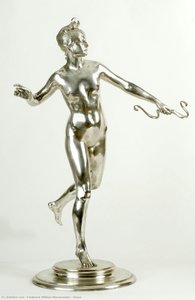 Diana1890
 Young Chevalier1898
 May Suydam Palmer1903
 Stephen S. Palmer, Trustee 1908-1913, Donor of Palmer Hall (1853-1913)1915

Essays zu Kit Carson
 Amerikanische Kunstwerke der 1900er JahreErleben Sie US-Meisterwerke von Winslow Homer bis Remington. Entdecken Sie ikonische Kunst auf OriginalUniqueArt.com.
 Capturing Motion: The Timeless Beauty of Sir Alfred James Munnings' Equestrian MasterpiecesDiscover the breathtaking equestrian mastery of Sir Alfred James Munnings. Explore an art-history journey through his impressionistic captu…
 Amerikanische Kunst der 1910er JahreErleben Sie US-Meisterwerke der 1910er von Hassam bis Bellows. Entdecken Sie ikonische Kunst auf OriginalUniqueArt.com.