In echtem Maßstab anzeigen
 Versenden als Grußkarte
 Teilen
 Details anzeigen
 Leitfaden öffnen

 Herunterladen
 Ähnliche Objekte
 Röntgenaufnahme
 Diashow
 Besucherstatistiken
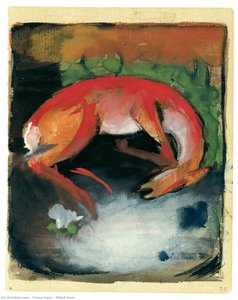
Gefallenes Reh
 Acryl auf Leinwand
- Wandkunst
- Expressionism
 Moderne
 13.0 x 16.0 cm
 Franz Marc Museum
 Mehr anzeigen
Handgefertigte Ölreproduktion
Handgemaltes Ölgemälde auf Leinwand in Ihrer Wunschgröße und mit Rahmen, auf Bestellung von unseren Künstlern angefertigt. ( Zum Druck wechseln Zum digitalen Bild wechseln)




P118B €10

P118H €10

P118W €10

P438Z €10

P508JH €12

P508YH €12

P805H €10

P805Z €10

P919BZ €10

P919G €10

P919XJ €10

P959ZH €10

P968JZ €12

W106C €8

W218G €10

W218JH €8

W218Y €10

W307PJ €10

W316G €10

W316PJ €8

W316Y €10

W398PJ €8

W4111J €10

W500HY €15

W500JH €15

W692G €12

W849H €8

W940BG €15

W953PJ €8




Wählen Sie aus unseren vordefinierten Formaten, die den ursprünglichen Proportionen des Kunstwerks entsprechen.

Geben Sie die Breite und die Höhe an, die Sie für Ihren Rahmen oder Ihre Wand benötigen. Da dieses Werk handgemalt ist, kann der Künstler bei einer anderen Form etwas mehr um das Bild herum malen oder etwas abschneiden – Sie entscheiden. Wir senden Ihnen ein digitales Mockup zur Freigabe, bevor mit dem Malen begonnen wird. Das auf dieser Seite gezeigte Bild stellt nicht das tatsächliche Ergebnis dar – dies tut nur das Mockup.
Nach der Bestellung wird das OriginalUniqueArt.com-Team dem Kunden Anweisungen per E-Mail zusenden und eine Mockup-Vorschau bereitstellen.
Weltweiter Versand () in nur 3 bis 4 Wochen statt der üblichen 5 Wochen. (21 Oktober). Keine Kompromisse bei der Qualität.

Kostenloser weltweiter Expressversand

Hochwertige Leinenleinwand

Vollständiger Versicherungsschutz beim Versand

Zollgebühren-Rückerstattungsgarantie

Garantie für exakte Farbtreue

100-tägiges Rückgaberecht (nur bei Mängeln)

100% Geld-zurück-Garantie

Angebot für Mengenrabatt
 Die Glasoption ist nur für Größen unter 110 cm verfügbar.

Gefallenes Reh
Reproduktionsmedium
Format der Reproduktion
-


Gesamtpreis
€ 262
Das verstörende Bild "Killed Dear" von Franz Marc
Franz Marc’s “Killed Dear” – originally titled “Todesfuchs” (Dead Fox) – is not merely a depiction of an animal; it's a profound meditation on mortality, spirituality, and the precariousness of existence. Painted in 1913, during a turbulent period in German history leading up to World War I, this watercolor on paper offers a glimpse into Marc’s intensely personal and deeply felt worldview. The painting immediately confronts the viewer with a starkly rendered fox lying prone on the ground, its head bowed in what appears to be distress or even death. Yet, it's not a scene of simple tragedy; rather, it’s imbued with an unsettling beauty and a haunting sense of quiet contemplation.
Marc, a pivotal figure within the Der Blaue Reiter circle – a group dedicated to exploring spirituality through art – was deeply influenced by Symbolism and his own profound connection to nature. He sought to transcend mere representation, aiming instead to capture the *inner* essence of his subjects. In “Killed Dear,” he achieves this brilliantly. The fox isn’t simply a fox; it embodies a universal symbol of vulnerability, instinct, and ultimately, the fleeting nature of life. Marc's masterful use of color is central to the painting’s impact. He employs a deliberately contrasting palette: deep reds and browns dominate the fox’s form, evoking blood, earth, and primal energy – symbols of vitality and earthly existence. These are sharply offset by cooler blues and whites in the surrounding landscape, suggesting a sense of melancholy, loss, and perhaps even an approaching spiritual realm.
Die Ausdrucksstil und die Technik
Marc’s style is immediately recognizable as Expressionist, though he predates many of the more rigidly defined tenets of the movement. His brushstrokes are loose and gestural, conveying a sense of urgency and emotional intensity. The forms are simplified and stylized, prioritizing feeling over precise detail. Notice how the fox's body is rendered with broad, sweeping lines, emphasizing its vulnerability and stillness. The background, while seemingly simple – consisting of trees and a hazy landscape – is far from passive. Marc uses color to create depth and atmosphere, suggesting both the harshness of the natural world and an underlying spiritual dimension. The watercolor medium itself lends a remarkable luminosity and transparency to the work, enhancing the painting’s ethereal quality.
Technically, Marc employed a technique he called “color-form,” where color was not merely decorative but actively shaped the form of the subject. He layered colors strategically, allowing them to bleed into one another, creating subtle shifts in tone and texture. This approach is particularly evident in the rendering of the fox’s fur – each strand appears to shimmer with an inner light. The painting's composition—the fox centrally positioned against a muted background—draws the viewer's eye directly to the subject, intensifying its emotional impact.
Symbolik und Interpretation
“Killed Dear” is rich in symbolic meaning, inviting multiple interpretations. The fox itself has long been associated with cunning, instinct, and the wildness of nature – qualities that are both admired and feared. However, Marc’s depiction suggests a more complex relationship between humanity and the animal kingdom. Some scholars interpret the painting as an allegory for the loss of innocence and the inevitability of death. The fox's vulnerability could represent the fragility of life itself, while the surrounding landscape might symbolize the indifference of nature to human suffering.
Others see in the work a reflection of Marc’s own spiritual quest – his desire to connect with something larger than himself. The use of blue, often associated with spirituality and transcendence, hints at an afterlife or a realm beyond earthly existence. The fox's pose—head bowed, body still—could be interpreted as a gesture of acceptance in the face of mortality. Ultimately, “Killed Dear” is not a straightforward narrative; it’s a deeply evocative image that invites viewers to contemplate their own place within the larger tapestry of life and death.
OriginalUniqueArt Reproductions: Ein Meisterwerk für Ihre Sammlung
OriginalUniqueArt offers meticulously crafted hand-painted reproductions of Franz Marc's “Killed Dear,” allowing you to bring this iconic artwork into your home or office. We utilize only the finest archival materials and employ skilled artists who faithfully recreate Marc’s distinctive style, color palette, and emotional intensity. Whether you choose a large-scale canvas print or a detailed framed reproduction, our reproductions capture the essence of this profound masterpiece. Explore our range of sizes and framing options to find the perfect addition to your art collection – a tangible reminder of Marc's enduring legacy and his poignant exploration of life’s mysteries.
Fragen & Antworten
Welche Farbe sticht in "Gefallenes Reh" am meisten hervor?
Die Farbe, die in „Gefallenes Reh“ am stärksten hervorsticht, ist Ton (#915f3f). Die dominante Farbe ist hilfreich, um ein Kunstwerk auf eine Inneneinrichtung abzustimmen.
Ist "Gefallenes Reh" von Franz Marc ein helles oder ein dunkles Kunstwerk?
"Gefallenes Reh" weist eine Gesamthelligkeit von hell auf, und die Luminanz beträgt Sanfte Leuchtkraft.
Wie populär ist "Gefallenes Reh" innerhalb von Expressionism?
Innerhalb der Expressionism-Strömung weist „Gefallenes Reh“ ein Ikonisch Bekanntheitsniveau auf.
Biografie des Künstlers
Franz Marc: Ein Pionier des Deutschen Expressionismus
Frühes Leben und Ausbildung
- Franz Moritz Wilhelm Marc wurde am 8. Februar 1880 in München, Deutschland, geboren.
- Sein Vater, Wilhelm Marc, war Landschaftsmaler und beeinflusste seinen Sohn zunächst durch seine künstlerischen Neigungen.
- Marc erwog kurz Theologie, bevor er sich der Kunst widmete und nach dem Besuch der Universität München an der Akademie der Bildenden Künste in München studierte.
- Zu den frühen Studien gehörten das Kopieren von Meistern und die Erforschung verschiedener künstlerischer Techniken.
Künstlerische Entwicklung und Einflüsse
- Anfangs wurden Marcs Werke von Impressionismus und akademischen Malstilen beeinflusst.
- Ein entscheidender Moment war seine Besuche in Paris, wo er die Werke von Vincent van Gogh entdeckte und seine Verwendung von Farbe und emotionaler Ausdruck maßgeblich prägte.
- Er experimentierte mit verschiedenen künstlerischen Gruppen wie der Neuen Künstlervereinigung München, bevor er Der Blaue Reiter gemeinsam gründete.
- Auch Robert Delaunays Werk beeinflusste Marcs Erkundung abstrakter Formen und lebendiger Farben.
Der Blaue Reiter und Schlüsselwerke
- Im Jahr 1911 gründete Marc gemeinsam mit Wassily Kandinsky Der Blaue Reiter (Der Blaue Reiter), eine Zeitschrift und Künstlergruppe, die für den deutschen Expressionismus von zentraler Bedeutung wurde.
- Diese Gruppe suchte nach spiritueller Bedeutung in der Kunst und lehnte traditionelle künstlerische Konventionen ab.
- Bekannte Werke aus dieser Zeit sind:
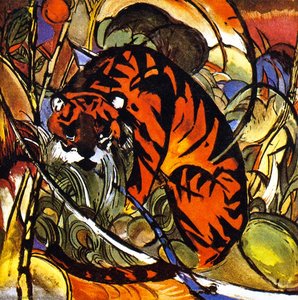
- Der Tiger (1912) – zeigend seinen sich entwickelnden Stil und seine symbolische Verwendung von Tieren.
- Rehdamee (1912) - demonstrierend eine wachsende Konzentration auf Tierdarstellungen.
- Der Turm der blauen Pferde, Die Füchse und das Schicksal der Tiere (1913) – repräsentierend die Culmination seiner künstlerischen Vision.
Themen und Künstlerischer Stil
- Marcs Kunst ist durch ihre lebendigen Farben, vereinfachte Formen und symbolische Darstellung von Tieren gekennzeichnet.
- Er glaubte, dass Tiere eine Reinheit und eine spirituelle Verbindung zur Natur besaßen, die der Mensch verloren hatte.
- Seine Verwendung von Farbe diente nicht nur der Beschreibung, sondern auch dem Ausdruck, Emotionen und innere Zustände zu vermitteln.
- Er versuchte, die Essenz seiner Motive darzustellen, anstatt realistische Darstellungen.
Erster Weltkrieg und tragisches Ende
- Mit dem Ausbruch des Ersten Weltkriegs im Jahr 1914 wurde Marc in die deutsche Armee eingezogen.
- Trotz seines Versuchs, aufgrund seiner künstlerischen Tätigkeit von der Dienstpflicht freigestellt zu werden, diente er als Kavallerieoffizier.
- Er starb am 4. März 1916 im Verlauf der Schlacht an der Verdun tragisch.
- Sein Tod beendete eine vielversprechende Karriere, festigte aber gleichzeitig seinen Platz in der Kunstgeschichte.
Vermächtnis und historische Bedeutung
- Marcs Werk bleibt hoch einflussreich für seine expressive Verwendung von Farbe, symbolische Bilder und spirituelle Tiefe.
- Er gilt als eine Schlüsselgestalt bei der Entwicklung des Deutschen Expressionismus und als Vorläufer der abstrakten Kunst.
- Seine Gemälde werden in großen Museen auf der ganzen Welt ausgestellt, darunter das Lenbachhaus in München, das eine umfangreiche Sammlung seiner Werke beherbergt.
- Marcs künstlerische Vision inspiriert weiterhin Künstler und fesselt das Publikum bis heute.

Franz Marc
1880 - 1916 , Deutschland
Eckdaten zum Künstler
- Beeinflusste Kunstrichtungen: ['Abstrakte Kunst']
- Beeinflusste Künstler: ['Vincent van Gogh']
- Bekannte Werke:
- Der Tiger (1912)
- Rehdamee (1912)
- Turm der blauen Pferde (1913)
- Die Füchse und das Schicksal
- Geburtsdatum: 08. Februar 1880
- Geburtsort: München, Deutschland
- Künstlerische Richtung: Deutscher Expressionismus
- Nationalität: Deutsch
- Todatum: 4. März 1916
- Vollständiger Name: Franz Marc
Verwandte Artikel

Die 10 legendärsten Aquarellwerke der Kunstgeschichte – Meisterwerke für Ihr Zuhause
Entdecken Sie die 10 legendärsten Aquarellwerke der Kunstgeschichte! Von Turner bis Monet – erleben Sie die Geschichten, Techniken & Farben dieser Meisterwerke. Finden Sie hochwertige Kunstdrucke auf OriginalUniqueArt.com und gestalten Sie Ihr Zuhause mit zeitloser Eleganz.

Franz Marc: Expressionismus, Spiritualität und die Tier-Symbolik eines modernen Meisters
Entdecken Sie das faszinierende Werk von Franz Marc! Erfahren Sie mehr über seine spirituelle Kunst, die Tierdarstellungen und seinen Einfluss auf den Expressionismus. Expertenanalyse & Hintergrundinformationen.

Die Top 10 Gemälde in Schattierungen von 'Slate Blue': Kunst für Ihr Zuhause
Entdecken Sie die Top 10 Gemälde in faszinierenden 'Slate Blue' Tönen! Von Monet bis Manet – erleben Sie Kunstgeschichte und lassen Sie sich von Meisterwerken inspirieren. Hochwertige Kunstdrucke auf

Ephemeral Visions: Exploring the Artistic Legacy & Contemporary Practice of Watercolor Painting
Explore the captivating world of watercolor painting! Discover its rich history, essential techniques, influential artists & collecting tips. A comprehensive guide for art enthusiasts from OriginalUniqueArt.

Deutsche Expressionismus Meisterwerke: Die 10 wichtigsten Kunstwerke für Ihr Zuhause
Entdecken Sie die 10 bedeutendsten Werke des Deutschen Expressionismus! Kirchner, Nolde & Co. – ihre Geschichten, Techniken und zeitlose Schönheit. Hochwertige Kunstdrucke auf OriginalUniqueArt.com kaufen und Ihr Zuhause mit emotionaler Kunst bereichern. Jetzt entdecken!