

 In echtem Maßstab anzeigen
 Versenden als Grußkarte
 Teilen
 Details anzeigen
 Leitfaden öffnen

 Herunterladen
 Ähnliche Objekte
 Röntgenaufnahme
 Diashow
 Besucherstatistiken
Warm Chromatics
 Acrylic On Canvas
- WallArt
- Orphism
 1912
1912- Modern
 105.0 x 105.0 cm
 Mehr anzeigen
Die auf dieser Seite dargestellten Kunstwerke sind urheberrechtlich geschützt, was bedeutet, dass wir keine identische Reproduktion rechtmäßig erstellen oder verkaufen dürfen. Dieser Schutz wird durch internationale Abkommen wie die Berner Übereinkunft und durch nationale Gesetze, einschließlich derer, die von den ... festgelegt wurden US-Urheberrecht – Titel 17.
Diese Methode entspricht vollumfänglich den Urheberrechtsbestimmungen, da sie keine Kopie oder Vervielfältigung des geschützten Kunstwerks darstellt. Stattdessen handelt es sich um eine kreative Neuinterpretation – ein neues Gemälde, das vom Original inspiriert, aber nicht identisch mit ihm ist.
Giclée / Kunstdruck
Giclée- oder Leinwanddruck in Museumsqualität mit schneller Produktion und flexiblen Veredelungsoptionen. ( Handgemalte Reproduktion kaufen Zum digitalen Bild wechseln)




P118B €10

P118H €10

P118W €10

P438Z €10

P508JH €12

P508YH €12

P805H €10

P805Z €10

P919BZ €10

P919G €10

P919XJ €10

P959ZH €10

P968JZ €12

W106C €8

W218G €10

W218JH €8

W218Y €10

W307PJ €10

W316G €10

W316PJ €8

W316Y €10

W398PJ €8

W4111J €10

W500HY €15

W500JH €15

W692G €12

W849H €8

W940BG €15

W953PJ €8




Wählen Sie aus unseren vordefinierten Formaten, die den ursprünglichen Proportionen des Kunstwerks entsprechen.

Geben Sie die Breite und die Höhe an, die Sie benötigen, damit der Druck perfekt in Ihren Rahmen oder an Ihre Wand passt. Ein Druck kann nur beschnitten werden und niemals größer als das Originalbild gemacht werden; daher verliert ein Format mit einer anderen Proportion einen Teil des Bildes. Wir senden Ihnen ein digitales Mockup zur Freigabe, bevor wir den Druck ausführen. Das auf dieser Seite gezeigte Bild zeigt nicht den tatsächlichen Beschnitt – dies ist nur im Mockup ersichtlich.
Weltweiter Versand () innerhalb von 2 Wochen statt der üblichen 4/5 Wochen. (23 Oktober)

Kostenloser weltweiter Expressversand

Hochwertige Leinenleinwand

Vollständiger Versicherungsschutz beim Versand

Zollgebühren-Rückerstattungsgarantie

Garantie für exakte Farbtreue

100-tägiges Rückgaberecht (nur bei Mängeln)

100% Geld-zurück-Garantie

Angebot für Mengenrabatt
 Die Glasoption ist nur für Größen unter 110 cm verfügbar.

Warm Chromatics
Giclée / Kunstdruck
Format der Reproduktion
-


Gesamtpreis
€ 70
František Kupka’s ‘Warm Chromatics’: A Pioneering Exploration of Orphism
“Warm Chromatics,” painted in 1912 by František Kupka, stands as a pivotal work in the nascent movement of Orphism. This vibrant canvas, measuring 105 x 105 cm, immediately captivates with its audacious use of color and form – a radical departure from the representational traditions that dominated European art at the turn of the century. Kupka, a key figure in the development of abstract art, was driven by a profound desire to capture not just what he *saw*, but rather the very essence of color itself, anticipating movements like Cubism and Fauvism decades before their formal emergence.
- Orphism’s Genesis: The painting exemplifies Orphism, a style developed by Kupka and his contemporaries that prioritized the visual impact of pure color and geometric forms. Rejecting traditional perspective and illusionistic techniques, these artists sought to create purely aesthetic compositions based on the emotional resonance of color combinations.
- Technique & Materials: Executed in oil on canvas, “Warm Chromatics” showcases Kupka’s meticulous layering of pigment. The artist employed a technique of ‘alla prima,’ applying paint directly onto the canvas with broad brushstrokes and rapid gestures, building up complex color relationships through successive glazes. This approach maximized luminosity and saturation, characteristic of Orphism's emphasis on vibrant hues.
A Symphony of Color: Deconstructing Form
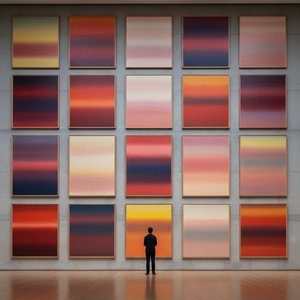
The composition itself is a carefully orchestrated dance of chromatic elements. The central focus is a flower rendered in bold reds and purples, immediately drawing the eye with its intensity. Surrounding it are three additional flowers – one pink, one orange, and one green – each contributing to the overall harmonic tension. Kupka deliberately deconstructed traditional floral representation, reducing forms to their essential color components. The overlapping planes and ambiguous spatial relationships contribute to a sense of dynamism and movement, reflecting the artist’s interest in capturing fleeting visual sensations.
- Color Theory: Kupka was deeply influenced by contemporary theories of color, particularly those of Michel Eugène Chevreul, who explored the principles of simultaneous contrast. The juxtaposition of complementary colors – red and green, orange and blue – creates a visually stimulating effect, enhancing the vibrancy and depth of the painting.
- Abstraction as Emotion: The deliberate abstraction serves not merely as an aesthetic exercise but as a vehicle for expressing emotional states. The intense color palette evokes feelings of passion, energy, and perhaps even spiritual yearning—reflecting Kupka’s own philosophical explorations.
Historical Context & Symbolism
Created in 1912, “Warm Chromatics” emerged during a period of immense artistic and intellectual ferment. The rise of modernism challenged established norms, and artists like Kupka were at the forefront of this revolution. While the painting lacks overt symbolic meaning – a hallmark of Orphism – it can be interpreted as an exploration of the fundamental building blocks of visual experience: color. The flower itself, a recurring motif in Kupka’s work, may represent the ephemeral beauty of nature or the blossoming of artistic creativity.
Artist Biography Snippet: František Kupka (1871-1957) was a pioneer of abstraction, his early works demonstrating a gradual shift from historical themes to increasingly non-representational forms. His time in Paris proved crucial, exposing him to the radical ideas circulating within the artistic community.A Timeless Masterpiece: Reproduction & Collection
"Warm Chromatics" by František Kupka is more than just a painting; it’s a testament to the power of color and form. A hand-painted reproduction offers an unparalleled opportunity to experience the full impact of this seminal work in your own space. OriginalUniqueArt's meticulous reproductions capture every nuance of Kupka’s technique, ensuring that you possess a faithful representation of this important piece of art history.
Fragen & Antworten
Was sind die Technik und das Entstehungsdatum von "Warm Chromatics" von František Kupka?
Das Medium von "Warm Chromatics" von František Kupka ist Acrylic On Canvas, und das Werk wird auf 1912 datiert.
Was ist die dominierende Farbe von "Warm Chromatics" von František Kupka?
Die dominante Farbe von "Warm Chromatics" von František Kupka ist Phthalo Green (#2d291d).
Woraus besteht "Warm Chromatics"?
"Warm Chromatics" wurde in Acrylic On Canvas ausgeführt.
Biografie des Künstlers
Frühe Jahre und Ausbildung
František Kupka, ein renommierter tschechischer Maler und Grafiker, wurde am 23. September 1871 in Opočno, Ostböhmen, Österreich-Ungarn, geboren. Von 1889 bis 1892 studierte er an der Akademie der Schönen Künste in Prag, wobei er sich auf historische und patriotische Themen konzentrierte. Später schrieb er sich an der Akademie der Bildenden Künste in Wien ein und widmete sich symbolischen und allegorischen Motiven.Künstlerische Entwicklung und Einflüsse
Kupkas künstlerischer Stil entwickelte sich von Realismus zur reinen abstrakten Kunst, beeinflusst durch seine Auseinandersetzung mit Theosophie und östlicher Philosophie. Im Jahr 1894 ließ er sich in Paris nieder, besuchte kurzzeitig die Académie Julian und studierte bei Jean-Pierre Laurens an der École des Beaux-Arts.Wichtige Werke und Beiträge
- Der Farbige (65 x 54 cm, Solomon R. Guggenheim Museum, New York, Vereinigte Staaten), eine abstrakte Darstellung eines weiblichen Aktes, die Kupkas kühne Form der figürlichen Darstellung zeigt.
- Um einen Punkt (Musée d'Art Moderne de Paris), ein Werk, das von Kupkas üblicher Verwischung von Grenzen abweicht und definierte Ränder aufweist und die Theorien über Licht und Farbe erforscht.
Expositionen und Vermächtnis
Kupka war 1931 Gründungsmitglied von Abstraction-Création. Seine Werke wurden 1936 in der Ausstellung „Kubismus und abstrakte Kunst“ im Museum of Modern Art in New York City gezeigt. Eine Retrospektive seiner Arbeit fand 1946 in der Galerie Mánes in Prag statt.- Betrachten Sie František Kupkas Werke auf OriginalUniqueArt
- Erkunden Sie Ms. Kupka zwischen Vertikalen (abstrakter Expressionismus)
- Entdecken Sie mehr über František Kupkas Leben und Werk auf Wikipedia: Wikipedia
Museen mit Werken von František Kupka
- Solomon R. Guggenheim Museum (New York, Vereinigte Staaten)
- Das Musée d'Art Moderne de Paris (Paris, Frankreich)
- Galerie Mánes (Prag, Tschechische Republik)

František Kupka
1871 - 1957 , Tschechische Republik
Eckdaten zum Künstler
- Beeinflusste Künstler: ['Abstraction-Création']
- Bemerkenswerte Werke:
- Der Farbige
- Um einen Punkt
- Vertikale Ebenen
- Einflüsse:
- Theosophie
- Östliche Philosophie
- Geburtsdatum: 23. September 1871
- Geburtsort: Opava, Tschechien
- Künstlerische Bewegung: Orphismus, Abstraktion
- Nationalität: Tschechisch
- Todatum: 24. Juni 1957
- Vollständiger Name: František Kupka
Verwandte Artikel
Mark Rothkos Meisterwerke: Die Top 25 für Kunstliebhaber | OriginalUniqueArt
Entdecken Sie die 25 Meisterwerke von Mark Rothko! Tauchen Sie ein in die Welt der abstrakten Kunst, des Expressionismus und der Farbfeldmalerei. Hochwertige Kunstdrucke & Reproduktionen auf OriginalUniqueArt.com – für Ihre Wohnräume.

Geometrische Abstraktion: Die 10 Meisterwerke, die Kunstgeschichte prägten | OriginalUniqueArt.com
Entdecken Sie die 10 Meisterwerke der geometrischen Abstraktion! Von Kandinsky bis Mondrian – erleben Sie die Geschichte, Farben & Formen dieser revolutionären Kunstrichtung. Hochwertige Kunstreproduktionen auf OriginalUniqueArt.com

Beyond Form & Color: Geometric Abstraction's Evolution in 20th/21st Century Art
Explore the evolution of geometric abstraction from Cubism to contemporary art. Discover key artists like Malevich & Mondrian, investment insights, and expert collecting advice at OriginalUniqueArt.

Kandinsky: Die 25 Meisterwerke des Abstrakten – Kunst für Ihr Zuhause | OriginalUniqueArt
Entdecken Sie die 25 bedeutendsten Gemälde von Wassily Kandinsky! Tauchen Sie ein in die Welt der abstrakten Kunst, des Expressionismus und der Farbkomposition. Hochwertige Kunstdrucke & Inspiration für Ihr Zuhause auf OriginalUniqueArt.com.

Abstrakter Expressionismus: Die 10 Meisterwerke, die eine Kunstbewegung prägten |
Entdecken Sie die 10 Meisterwerke des Abstrakten Expressionismus! Von Jackson Pollock bis Mark Rothko – erfahren Sie die Geschichten hinter ikonischen Gemälde und finden Sie hochwertige Reproduktionen für Ihr Zuhause. Jetzt bei entdecken!


