

 Vorschau anzeigen
 Versenden
 Teilen
 Details anzeigen

 Herunterladen
 Ähnliche Objekte
 Röntgenaufnahme
 Diashow
 Statistiken
Bull-Hunting
 Oil On Canvas
- WallArt
- Rococo
 1736
1736- Early Modern
 114.0 x 150.0 cm
 Gallerie dell’Accademia
 Weiterlesen
Handgefertigte Ölreproduktion
Handgemaltes Ölgemälde auf Leinwand in Ihrer Wunschgröße und mit Rahmen, auf Bestellung von unseren Künstlern angefertigt. ( Zu Druck wechseln Zum digitalen Bild wechseln)




P118B $10

P118H $10

P118W $10

P438Z $10

P508JH $12

P508YH $12

P805H $10

P805Z $10

P919BZ $10

P919G $10

P919XJ $10

P959ZH $10

P968JZ $12

W106C $8

W218G $10

W218JH $8

W218Y $10

W307PJ $10

W316G $10

W316PJ $8

W316Y $10

W398PJ $8

W4111J $10

W500HY $15

W500JH $15

W692G $12

W849H $8

W940BG $15

W953PJ $8




Wählen Sie aus unseren vordefinierten Formaten, die den ursprünglichen Proportionen des Kunstwerks entsprechen.

Sie können Ihre eigenen Maße eingeben, um einen bestimmten Rahmen oder Platz auszufüllen. Wenn die gewählte Größe nicht den Proportionen des Originalbildes entspricht, werden wir das Kunstwerk entweder beschneiden oder das Gemälde durch zusätzliche, handgemalte Elemente erweitern. Ein digitales Mockup wird Ihnen zur Genehmigung zugesandt, bevor die Produktion beginnt.
Bitte beachten Sie, dass die Bildschirmvorschau nicht die tatsächliche Beschneidung oder Erweiterung widerspiegelt. Nur das Mockup zeigt die endgültige Komposition exakt an.
Obwohl Sondermaße verfügbar sind, empfehlen wir, eine Größe aus der vordefinierten Liste zu wählen, um die ursprünglichen Proportionen beizubehalten.
Nach der Bestellung wird das OriginalUniqueArt.com-Team dem Kunden Anweisungen per E-Mail zusenden und eine Mockup-Vorschau bereitstellen.
Weltweiter Versand () in nur 3 bis 4 Wochen statt der üblichen 5 Wochen. (13 September). Keine Kompromisse bei der Qualität.

Kostenloser weltweiter Expressversand

Hochwertige Leinenleinwand

Umfassender Versicherungsschutz beim Versand

Zollgebühren-Rückerstattungsgarantie

Garantie für exakte Farbtreue

100-Tage-Rückgaberecht (nur bei Mängeln)

100% Geld-zurück-Garantie

Mengenrabatt verfügbar
 Die Glasoption ist nur für Größen unter 110 cm verfügbar.

Bull-Hunting
Art der Reproduktion
Format der Reproduktion
-


Gesamtpreis
$ 300
A Pastoral Symphony in Pastel
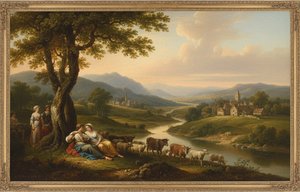
In the heart of the mid-18th century, the Venetian landscape underwent a profound transformation, moving away from the dramatic tensions of the Baroque toward the luminous, airy grace of the Rococo. At the forefront of this movement stood Francesco Zuccarelli, a master whose brush possessed the unique ability to capture the ephemeral soul of nature. His masterpiece, “Bull-Hunting,” serves as a breathtaking window into an idealized world, where the ruggedness of a hunt is softened by the poetic elegance of an Arcadian dream. The painting does not merely depict a scene; it invites the viewer to step into a realm of perpetual spring, where the air feels light and the atmosphere is saturated with a gentle, rhythmic vitality.
The visual experience begins with Zuccarelli’s exquisite command of color. Eschewing heavy shadows and somber tones, the artist employs a palette of delicate pastels that seems to glow from within. Pale, cerulean blues mirror the clarity of a Venetian sky, while muted mossy greens and soft, sun-drenched ochres create a lush, velvety landscape. These colors work in harmony to establish a sense of profound tranquility, making the piece an ideal centerpiece for any space seeking to evoke serenity and sophistication. The light in the composition is diffused and ethereal, casting no harsh shadows, which allows the eye to wander effortlessly across the rolling hills and through the dappified groves.
The Dance of Humanity and Nature
Beyond its aesthetic beauty, “Bull-Hunting” is a complex narrative of movement and mythological resonance. The composition is alive with a choreographed energy; figures dressed in the elegant attire of the 1730s are scattered across the terrain, engaged in a spirited pursuit. The bulls themselves, varying in size and posture, introduce a dynamic tension that prevents the scene from becoming static. Yet, even in this moment of action, there is an underlying sense of order and nobility. Zuccarelli subtly weaves in elements of classical allegory, suggesting that this hunt is not merely a feat of strength, but a celebration of the harmonious relationship between humanity and the natural world.
The technique employed here is nothing short of masterful. Zuccarelli’s brushwork is remarkably fluid and loose, a hallmark of the Rococo style that avoids rigid outlines in favor of soft, blended textures. This painterly approach allows the foliage to appear as if it might rustle in a passing breeze and gives the figures a sense of weightless motion. For the discerning collector or interior designer, this fluidity offers a sense of organic movement that breathes life into a room. To possess a reproduction of such a work is to bring a piece of historical grandeur and rhythmic grace into a contemporary setting, offering an enduring sense of luxury and peace.
An Enduring Legacy for the Modern Collector
To contemplate “Bull-Hunting” is to engage with the very essence of the 18th-century European ideal. It captures a moment in time when art sought to elevate the mundane into the magnificent, turning a simple pastoral event into a timeless tableau of beauty. The painting’s ability to balance vigorous action with a soothing color temperature makes it a versatile treasure, capable of anchoring a formal gallery wall or providing a soft, sophisticated accent in a sunlit study.
For those looking to invest in high-quality art reproductions, this work represents a pinnacle of the Venetian tradition. It is more than a decoration; it is an emotional experience—a reminder of the beauty found in balance, light, and the eternal dance of life. Whether adorning a grand estate or a curated modern apartment, Zuccarelli’s vision continues to inspire awe, offering a window into a world where nature and humanity exist in perfect, sun-drenched accord.
Über den Künstler
Francesco Zuccarelli: Ein Leben zwischen Barock und Rokoko
- Geboren: 15. August 1702 in Pitigliano, Italien
- Gestorben: 30. Dezember 1788 in Florenz, Italien
- Hauptwirkungsort: Venedig, England
- Bekannt für: Landschaftsmalerei, Rokoko- und Barockstil
Frühe Jahre und Ausbildung (1702-1732)
- Zuccarelli wurde in Pitigliano, Süd-Toskana, geboren. Sein Vater besaß Weinberge und einen Laden für Küchenutensilien.
- Mit etwa elf oder zwölf Jahren begann er seine Lehre in Rom bei den Porträtmalern Giovanni Maria Morandi und Pietro Nelli. Dort lernte er die Grundlagen des Designs und absorbierte die Lektionen des römischen Klassizismus.
- Zwischen 1725 und 1727 schuf er seine erste Auftragsarbeit in Pitigliano: ein Paar Altarbilder für eine Kapelle.
- Unter der Schirmherrschaft von Francesco Maria Niccolò Gabburri widmete er sich von 1728 bis 1731 hauptsächlich dem Radieren und fertigte mindestens 43 Drucke an, darunter Serien, die die verfallenen Fresken von Giovanni da San Giovanni und Andrea del Sarto dokumentierten.
- Während seiner Zeit in Florenz begann er, Landschaftsskizzen anzufertigen, was seinen späteren Stil beeinflusste.
- Paolo Anesi, ein römischer Landschaftsmaler und Radierer, gilt als sein wichtigster Mentor in der Landschaftsmalerei.
Die Venezianische Periode und Erfolg (1732-1768)
- 1732 zog Zuccarelli nach Venedig, wo er eine Marktlücke im Bereich der Landschaftsmalerei fand, die durch den Tod von Marco Ricci entstanden war.
- Er kombinierte religiöse und mythologische Themen mit Landschaften und entwickelte einen eigenen Stil, inspiriert von Claude Lorrain und der römischen Schule.
- Seine frühen Gemälde zeigten Einflüsse von Alessandro Magnasco und später von Marco Ricci. Er brachte eine sanftere Palette und höhere Lichtwerte in die venezianische Farbgebung ein.
- Er erlangte schnell Erfolg und Patronage von Persönlichkeiten wie Marshal Schulenburg, Joseph Smith (sein langjähriger Förderer) und Francesco Algarotti.
- 1735 heiratete er Giustina Agata Simonetti und hatte vier Kinder, von denen zwei im Kindesalter starben.
- Zusammen mit Antonio Visentini schuf er eine Serie mit neupalladianischer Architektur (Burlington House, 1746).
- Ein bemerkenswertes Projekt war ein Satz von 52 Spielkarten mit biblischen Themen (Altes Testament), die 1748 in Venedig veröffentlicht wurden.
- Eine Reihe von sieben Leinwänden, die Rebecca mit Jakob und Esau darstellen, befindet sich heute im Windsor Castle.
England und Anerkennung (1768-1788)
- 1768 wurde Zuccarelli zu einem Gründungsmitglied der Royal Academy of Arts in London ernannt.
- Er verbrachte zwei längere Zeiträume in England, wo seine Werke großen Anklang fanden.
- Seine Landschaftsbilder wurden von George III geschätzt.
- Nach seiner Rückkehr nach Italien wurde er zum Präsidenten der venezianischen Akademie gewählt.
- Obwohl er zu Lebzeiten berühmt war, sank sein Ruf im frühen 19. Jahrhundert mit dem Aufkommen des Naturalismus in der Landschaftsmalerei.
- Turner kritisierte ihn zwar mild, erkannte aber die Schönheit seiner Figuren an.
- Michael Levey argumentierte, dass Zuccarellis Erfolg auf der dekorativen Natur seiner Werke beruhte.
Bedeutung und Vermächtnis
- Zuccarelli gilt als einer der bedeutendsten Landschaftsmaler des venezianischen 18. Jahrhunderts.
- Seine Werke beeinflussten die englische Landschaftsmalerei maßgeblich.
- Seit den 1990er Jahren gibt es ein erneutes Interesse an seinem Werk durch italienische Gelehrte, was zu Ausstellungen und Publikationen geführt hat.
- Er schuf nicht nur Gemälde, sondern auch Radierungen, Zeichnungen, Entwürfe für Wandteppiche und sogar Spielkarten.

Francesco Zuccarelli
1702 - 1788 , Italien
Kurzinfos
- Beeinflusste Künstler:
- Paolo Anesi
- Alessandro Magnasco
- Marco Ricci
- Bemerkenswerte Werke:
- Bacchanal
- Landschaft mit Figuren
- Kapricio mit San Giorgio
- Pastorale Kapriccio
- Geburtsdatum: 15. August 1702
- Geburtsort: Pitigliano, Italien
- Künstlerische Bewegung: Rococo, Barock
- Nationalität: Italienisch
- Sterbedatum: 30. Dezember 1788
- Vollständiger Name: Francesco Zuccarelli
Ähnliche Artikel

Romantische Landschaften: Die 10 Meisterwerke, die eine Epoche prägten | OriginalUniqueArt
Entdecken Sie die 10 Meisterwerke der Romantischen Landschaftsmalerei! Von Caspar David Friedrich bis Turner – erleben Sie die Kunst, Emotion & Natur. Hochwertige Reproduktionen auf OriginalUniqueArt.com

John Constable: Die 25 Meisterwerke des englischen Landschaftsgenies – OriginalUniqueArt
Entdecken Sie die 25 Meisterwerke von John Constable! Erleben Sie englische Landschaftsmalerei vom Hay Wain bis zur Stour Valley. Hochwertige Reproduktionen & Kunst für Ihr Zuhause auf OriginalUniqueArt.com.

Idyllic Visions: Exploring the Pastoral Scene in Art History – From Arcadia to Modern Interpretations
Explore the captivating history of pastoral art from classical Arcadia to modern masterpieces. Discover key artists like Millet & Cole at OriginalUniqueArt. Find serene landscape paintings for your home.

Katsushika Hokusai: Die 25 Meisterwerke des Ukiyo-e – Kunst für Ihr Zuhause | OriginalUniqueArt
Entdecken Sie die 25 Meisterwerke von Katsushika Hokusai! Tauchen Sie ein in die Welt des Ukiyo-e, berühmte Holzschnitte wie 'Die große Welle' & Fuji-Ansichten. Hochwertige Kunstdrucke für Ihr Zuhause – jetzt auf OriginalUniqueArt.com!
Idyllic Visions: Exploring the Pastoral Tradition in Western Art – Themes, Techniques & Enduring Appeal
Explore the rich history of pastoral art from classical Arcadia to contemporary interpretations. Discover key artists, themes & collecting tips at OriginalUniqueArt.