- Startseite

- Ölgemälde-Reproduktion
- Fernand Léger
- untitled (4330)
 Preview
 Versenden
 Teilen
 Details anzeigen

 Herunterladen
 Ähnliche Objekte
 Röntgenaufnahme
 Diashow anzeigen
untitled (4330)


 Weiterlesen
Handgefertigte Öl-Reproduktion
Handgemaltes Ölgemälde auf Leinwand in Ihrer Wunschgröße und mit Rahmen, auf Bestellung von unseren Künstlern angefertigt. ( Switch to Print Switch to Image)




P118B $10

P118H $10

P118W $10

P438Z $10

P508JH $12

P508YH $12

P805H $10

P805Z $10

P919BZ $10

P919G $10

P919XJ $10

P959ZH $10

P968JZ $12

W106C $8

W218G $10

W218JH $8

W218Y $10

W307PJ $10

W316G $10

W316PJ $8

W316Y $10

W398PJ $8

W4111J $10

W500HY $15

W500JH $15

W692G $12

W849H $8

W940BG $15

W953PJ $8




Wählen Sie aus unseren vordefinierten Größen, die den ursprünglichen Proportionen des Kunstwerks entsprechen.

Sie können Ihre eigenen Maße eingeben, um einen bestimmten Rahmen oder Platz auszufüllen. Wenn die gewählte Größe nicht den Proportionen des Originalbildes entspricht, werden wir das Kunstwerk entweder beschneiden oder das Gemälde durch zusätzliche, handgemalte Elemente erweitern. Ein digitales Mockup wird Ihnen zur Genehmigung zugesandt, bevor die Produktion beginnt.
Bitte beachten Sie, dass die Bildschirmvorschau nicht die tatsächliche Beschneidung oder Erweiterung widerspiegelt. Nur das Mockup zeigt die endgültige Komposition exakt an.
Obwohl Sondermaße verfügbar sind, empfehlen wir, eine Größe aus der vordefinierten Liste zu wählen, um die ursprünglichen Proportionen beizubehalten.
Nach der Bestellung wird das OriginalUniqueArt.com-Team dem Kunden Anweisungen per E-Mail zusenden und eine Mockup-Vorschau bereitstellen.
Weltweiter Versand () in nur 3 bis 4 Wochen statt der üblichen 5 Wochen. (30 Juli). Keine Kompromisse bei der Qualität.

Kostenloser weltweiter Expressversand

Hochwertige Leinenleinwand

Umfassender Versicherungsschutz beim Versand

Zollsteuer-Rückerstattungsgarantie

Garantie für echte Farbtreue

60-Tage-Rückgaberecht (nur bei Mängeln)

100% Geld-zurück-Garantie

Mengenrabatt verfügbar
 Die Glasoption ist nur in Größen unter 110 cm verfügbar.

untitled (4330)
Art der Reproduktion
Größe der Reproduktion
-


Endpreis aller Optionen
$ 300
Beschreibung des Kunstwerks
A Study in Modern Man: Unveiling “Untitled (4330)” by Fernand Léger
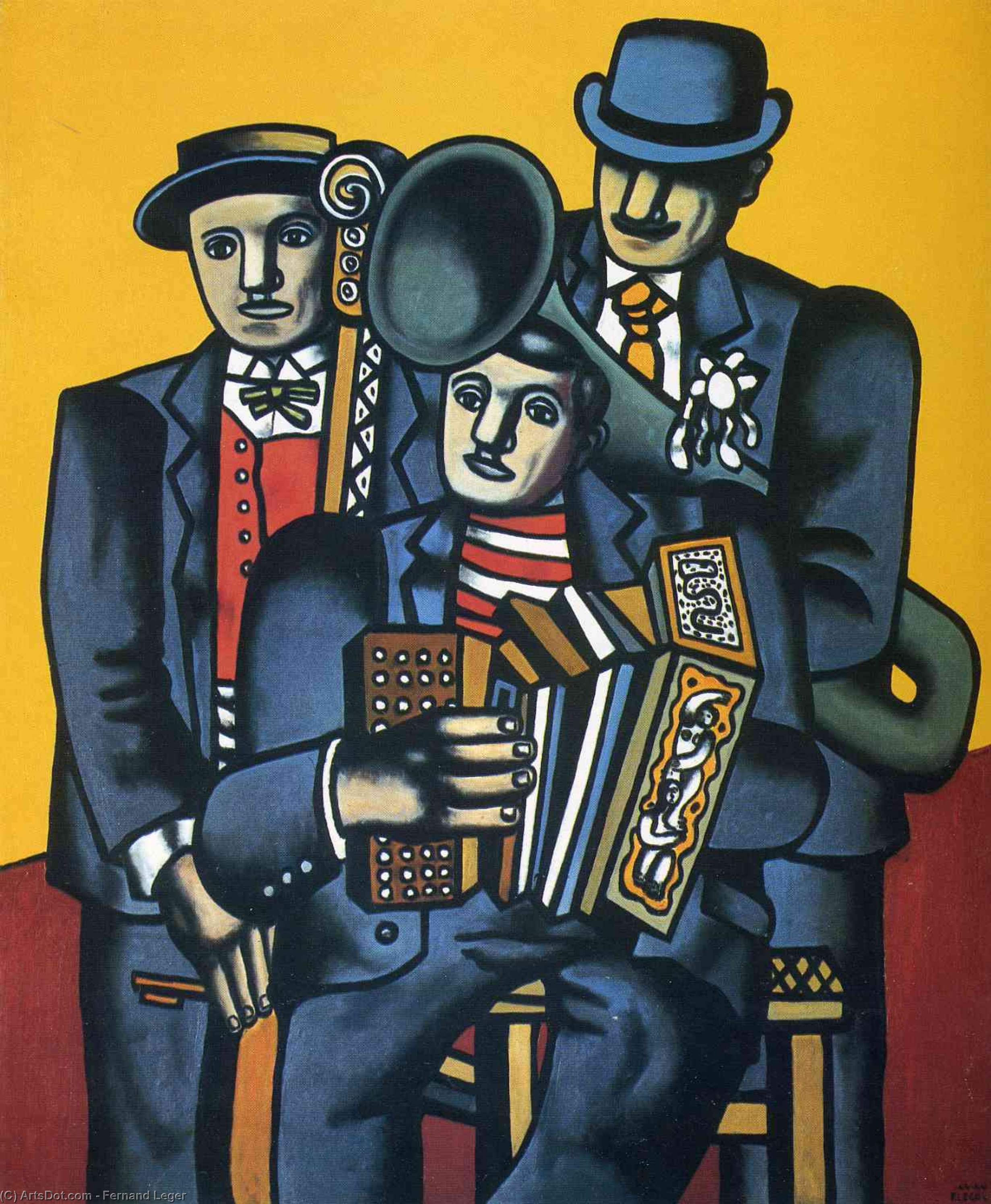
This compelling Cubist composition, designated "Untitled (4330)," offers a captivating glimpse into the artistic vision of Fernand Léger, a pivotal figure who bridged the gap between abstraction and representation. Executed with Léger’s signature approach – often termed “Tubism” in its earlier iterations – the artwork presents three men engaged in an ambiguous tableau, their forms fractured and reassembled according to principles of geometric reduction and dynamic perspective. The scene is imbued with a palpable sense of modernity, reflecting Léger's fascination with the burgeoning industrial age and its impact on human form and experience. The figures, rendered in bold, primary colors punctuated by earthy tones, embody a deliberate rejection of traditional academic realism, instead embracing a fragmented yet powerfully expressive approach to depicting the world around him. The artist’s meticulous attention to detail – evident in the textures of the suits, the scattered books, and the carefully positioned objects – elevates this work beyond mere abstraction, grounding it in a recognizable reality filtered through a distinctly modern lens.Cubist Techniques and the Representation of Form
Léger’s artistic process was deeply rooted in his exploration of geometric forms, particularly cylinders and cones, which he saw as fundamental building blocks of the machine age. “Untitled (4330)” exemplifies this approach through its deliberate dissection of the human figure into interlocking planes. The men are not depicted as unified wholes but rather as collections of fragmented shapes, each contributing to a dynamic composition that conveys movement and energy. This technique, characteristic of Cubism’s early phase, seeks to capture multiple viewpoints simultaneously, challenging the viewer's perception of space and form. Note the careful layering of color and texture – the smooth surfaces juxtaposed with rougher areas – further enhancing the sense of depth and dimensionality within this seemingly flattened representation. The artist’s use of bold outlines and sharp angles reinforces the mechanical aesthetic that defines much of Léger’s oeuvre, reflecting his fascination with industrial design and urban landscapes.Symbolism and Context: A Portrait of Modern Life
The inclusion of specific objects – a hat, a trombone, books – adds layers of symbolic meaning to the composition. The men's attire, formal suits, suggests a sense of professionalism or perhaps even social status within an increasingly industrialized society. The scattered books hint at intellectual pursuits and the dissemination of knowledge, themes central to Léger’s broader engagement with modernity. The trombone, a recurring motif in Léger’s work, can be interpreted as representing both musical expression and the rhythmic pulse of industrial machinery. Created during a period of rapid technological advancement and social change, “Untitled (4330)” serves as a visual commentary on the evolving role of humanity within a world dominated by machines. Léger's intention was to create art that resonated with the experiences of ordinary people in this new era, making it accessible and relatable through his simplified forms and bold colors.Emotional Impact and Artistic Legacy
Despite its fragmented aesthetic, “Untitled (4330)” possesses a surprising emotional resonance. The figures’ postures – seemingly engaged in conversation or contemplation – evoke a sense of human connection amidst the mechanical landscape. Léger's work is not simply about depicting objects; it’s about capturing the *spirit* of modernity—its dynamism, its potential for both progress and alienation. As a key figure in the development of Cubism, Léger’s influence extended beyond the purely formal realm, impacting subsequent generations of artists who sought to explore new ways of representing reality. This artwork stands as a testament to his innovative approach and enduring legacy within the history of modern art. A hand-painted reproduction offers an exceptional opportunity to bring this powerful image into your space, allowing you to contemplate its complexities and appreciate Léger’s unique artistic vision.Biografie des Künstlers
frühes Leben und Ausbildung
Fernand Légér, ein französischer Maler, Bildhauer und Filmemacher, wurde am 4. Februar 1881 in Argentan, Orne, Niedergermanien geboren. Sein Vater züchtete Rinder, und Légér erhielt zunächst eine Ausbildung als Architekt von 1897 bis 1899. Er zog dann im Jahr 1900 nach Paris und unterstützte sich dort als Architektenzeichner.Künstlerische Entwicklung
Légers frühe Werke wurden vom Impressionismus beeinflusst, wie in Le Jardin de ma Mère (Mein Muttergarten) (1905) zu sehen ist. Nach dem Besuch der Schule für dekorative Künste und der Académie Julian begann er ab seinem 25. Lebensjahr ernsthaft als Maler zu arbeiten. Sein Stil entwickelte sich zu einer persönlichen Form des Kubismus, der von Kritikern als "Tubism" bezeichnet wurde, da er sich auf zylindrische Formen konzentrierte.Kubismus und die Puteaux-Gruppe
Im Jahr 1910 stellte Légér im Salon d’Automne zusammen mit Jean Metzinger und Henri Le Fauconnier aus. Er schloss sich der Puteaux-Gruppe an, auch bekannt als die Section d’Or (die Goldene Proportion), zusammen mit anderen Künstlern wie Francis Picabia und Marcel Duchamp.Krieg und seine Auswirkungen auf Légers Werk
Légers Erfahrungen im Ersten Weltkrieg hatten einen erheblichen Einfluss auf sein Werk. Während seiner Zeit an der Front produzierte er Skizzen von Artilleriegeschützen, Flugzeugen und Soldaten. Sein Gemälde Soldat mit Pfeife (1916) spiegelt diese Zeit wider.Spätere Werke und Vermächtnis
Légers Nachkriegszeitliche Arbeiten, die von glatten, maschinellen Formen geprägt waren, verknüpften ihn mit der Tradition der französischen figurativen Malerei. Seine "animierten Landschaften" von 1921 zeigten Figuren und Tiere in harmonischen, stromlinienförmigen Formen.- Fernand Légers Werke auf OriginalUniqueArt
- Mehr über Fernand Légér auf Wikipedia
- Entdecken Sie das Musée National Fernand Légér (Frankreich) mit OriginalUniqueArt
- Die Sitzende Frau (100 x 81 cm, Tubism)
- Maschinenelement (Kubismus)

Fernand Léger
1881 - 1955 , Frankreich
Kurzinfos
- Beeinflusste Kunstrichtungen: ['Pop Art']
- Beeinflusste Künstler: ['Paul Cézanne']
- Bemerkenswerte Werke:
- Die Sitzende Frau
- Maschinenelement
- Der Große Umzug
- Die Stadt
- Geburtsdatum: 04. Februar 1881
- Geburtsort: Argentan, Frankreich
- Künstlerische Richtung: Kubismus, Tubismus
- Nationalität: Französisch
- Sterbedatum: 1955
- Vollständiger Name: Fernand Léger
- Von Kunstbewegungen Beeinflusst: ['Cézannismus']
- Von Künstlern Beeinflusst: ['Impressionismus']
Ähnliche Artikel
Payne's Gray: Die 10 berühmtesten Gemälde in Grautönen | Kunst & Dekoration
Entdecken Sie die 10 berühmtesten Gemälde, die von Payne's Gray dominiert werden! Von Rembrandt bis Turner – erleben Sie düstere Schönheit & melancholische Meisterwerke. Hochwertige Kunstdrucke auf OriginalUniqueArt.com.
Die 10 Meisterwerke des Kubismus: Kunst für Ihr Zuhause | OriginalUniqueArt
Entdecken Sie die 10 bedeutendsten Meisterwerke des Kubismus von Picasso, Braque & Gris! Erfahren Sie mehr über Kunstgeschichte, Techniken und Farben. Hochwertige Kunstdrucke auf OriginalUniqueArt.com – für stilvolle Wandgestaltung.
Die 10 Meisterwerke des Kubismus: Kunstgeschichte für Ihr Zuhause |
Entdecken Sie die 10 prägendsten Meisterwerke des Kubismus! Von Picasso bis Braque – erfahren Sie die Geschichten hinter ikonischen Gemälde und lassen Sie sich von moderner Kunst inspirieren. Kunstreproduktionen in Museumsqualiät auf .
Kubismus: Die 10 Meisterwerke, die eine Revolution definierten | OriginalUniqueArt
Entdecken Sie die 10 Meisterwerke des Kubismus! Von Picasso bis Braque – erleben Sie die Revolution abstrakter Kunst. Kunstdrucke & Wandbilder für Ihr Zuhause auf OriginalUniqueArt.com.
Die 10 Meisterwerke des Kubismus: Revolutionäre Porträts für Ihr Zuhause | OriginalUniqueArt
Entdecken Sie die 10 revolutionärsten kubistischen Porträts von Picasso, Braque & Co.! Erfahren Sie die Geschichten hinter Meisterwerken der Moderne und lassen Sie sich für Ihre Wohnraumgestaltung inspirieren. Museum-Qualität bei OriginalUniqueArt.