

 In echtem Maßstab anzeigen
 Versenden als Grußkarte
 Teilen
 Details anzeigen
 Leitfaden öffnen

 Herunterladen
 Ähnliche Objekte
 Röntgenaufnahme
 Diashow
 Besucherstatistiken
Still Life


 Mehr anzeigen
Giclée / Kunstdruck
Giclée- oder Leinwanddruck in Museumsqualität mit schneller Produktion und flexiblen Veredelungsoptionen. ( Handgemalte Reproduktion kaufen Zum digitalen Bild wechseln)




P118B €10

P118H €10

P118W €10

P438Z €10

P508JH €12

P508YH €12

P805H €10

P805Z €10

P919BZ €10

P919G €10

P919XJ €10

P959ZH €10

P968JZ €12

W106C €8

W218G €10

W218JH €8

W218Y €10

W307PJ €10

W316G €10

W316PJ €8

W316Y €10

W398PJ €8

W4111J €10

W500HY €15

W500JH €15

W692G €12

W849H €8

W940BG €15

W953PJ €8




Wählen Sie aus unseren vordefinierten Formaten, die den ursprünglichen Proportionen des Kunstwerks entsprechen.

Geben Sie die Breite und die Höhe an, die Sie benötigen, damit der Druck perfekt in Ihren Rahmen oder an Ihre Wand passt. Ein Druck kann nur beschnitten werden und niemals größer als das Originalbild gemacht werden; daher verliert ein Format mit einer anderen Proportion einen Teil des Bildes. Wir senden Ihnen ein digitales Mockup zur Freigabe, bevor wir den Druck ausführen. Das auf dieser Seite gezeigte Bild zeigt nicht den tatsächlichen Beschnitt – dies ist nur im Mockup ersichtlich.
Weltweiter Versand () innerhalb von 2 Wochen statt der üblichen 4/5 Wochen. (22 Oktober)

Kostenloser weltweiter Expressversand

Hochwertige Leinenleinwand

Vollständiger Versicherungsschutz beim Versand

Zollgebühren-Rückerstattungsgarantie

Garantie für exakte Farbtreue

100-tägiges Rückgaberecht (nur bei Mängeln)

100% Geld-zurück-Garantie

Angebot für Mengenrabatt
 Die Glasoption ist nur für Größen unter 110 cm verfügbar.

Still Life
Giclée / Kunstdruck
Format der Reproduktion
-


Gesamtpreis
€ 70
A Moment Frozen in Time: Ferdinand Guillaimin’s “Still Life”
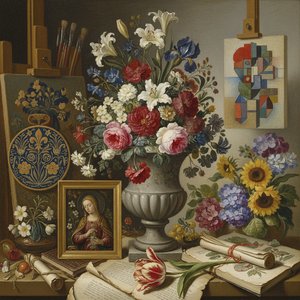
Ferdinand Guillaimin's "Still Life," painted in 1872, isn’t merely a depiction of objects arranged on a table; it’s a carefully constructed tableau brimming with quiet observation and subtle symbolism. This work, rendered in the heart of the Impressionist movement, captures a fleeting moment of domestic tranquility – a scene both familiar and imbued with an understated elegance. The painting immediately draws the eye to the central arrangement: a vase overflowing with vibrant red and yellow flowers, their petals seemingly caught mid-bloom, radiating warmth against the cooler tones that dominate the rest of the composition. Beside them rests a worn book, its pages hinting at untold stories and intellectual pursuits, while a simple bowl holds what appears to be fruit – perhaps apples or pears – adding another layer of earthly abundance.
Guillaimin’s technique is distinctly Impressionistic, prioritizing capturing the *impression* of light and color rather than precise detail. Loose brushstrokes dance across the canvas, creating an atmospheric haze that softens the edges of each object. He masterfully employs broken color – applying small dabs of paint side-by-side to build up hues and create a shimmering effect, particularly noticeable in the reflections on the table’s surface. The dark background serves not as mere backdrop but as a crucial element, intensifying the luminosity of the floral arrangement and lending the scene a sense of intimacy and depth. The artist's focus is less on photographic realism and more on conveying the *feeling* of being present within this quiet space.
The Context of Parisian Impressionism
To fully appreciate “Still Life,” it’s essential to understand the artistic climate in which Guillaimin was working. The 1870s were a period of profound change and experimentation for French art, marked by the rise of Impressionism. Artists like Monet, Renoir, and Pissarro sought to break free from the rigid conventions of academic painting, embracing plein air (outdoor) painting and capturing the ephemeral qualities of light and atmosphere. Guillaimin’s work reflects this spirit of innovation, moving away from traditional subject matter and exploring new ways of representing the world around him.
Guillaimin's connection to Pissarro is particularly noteworthy. The artist spent a significant period painting alongside Pissarro in Pontoise, a suburb of Paris, where he found inspiration in the everyday life of the region. This proximity fostered a collaborative environment, allowing Guillaimin to refine his style and develop his unique approach to capturing light and color. The Impressionists were not simply interested in depicting what they *saw*; they were driven by a desire to express their subjective experience of the world.
Symbolism and the Language of Objects
Beyond its aesthetic qualities, “Still Life” is rich with symbolic meaning. The flowers themselves represent beauty, fragility, and the fleeting nature of life – themes frequently explored in Impressionist art. The book suggests knowledge, contemplation, and a connection to the past. The bowl of fruit symbolizes abundance, nourishment, and the pleasures of earthly existence. Even the dark background can be interpreted as representing mortality or the unknown.
Guillaimin’s use of these objects is deliberate and carefully considered, inviting the viewer to engage in a process of interpretation. He doesn't offer explicit explanations; instead, he presents a series of interconnected symbols that resonate with universal themes of beauty, life, and death. The arrangement feels deliberately balanced, creating a harmonious composition that evokes a sense of peace and serenity.
A Legacy of Delicate Beauty
Ferdinand Guillaimin’s “Still Life” stands as a testament to the power of observation and the enduring appeal of simple subjects rendered with exquisite sensitivity. It's a painting that rewards close attention, revealing layers of meaning and emotional depth with each viewing. Reproductions capture much of the original atmosphere, but nothing quite replicates the subtle nuances of light and color that define Guillaimin’s masterful technique.
Today, this work is celebrated for its evocative beauty and its contribution to the development of Impressionism. It remains a poignant reminder of the quiet moments of everyday life – a timeless meditation on beauty, mortality, and the enduring power of art.
Fragen & Antworten
Welche Art von Farben verwendet "Still Life"?
"Still Life" von Ferdinand Guillaumin verwendet eine Earthy-Farbpalette. Die Palette fasst den gesamten farblichen Charakter des Werkes zusammen.
Gibt es Werke, die "Still Life" ähneln?
Die Seite Ähnliche Werke von "Still Life" von Ferdinand Guillaumin zeigt verwandte Kunstwerke.
Wer hat "Still Life" geschaffen und in welchem Jahr?
Der Schöpfer von „Still Life“ ist Ferdinand Guillaumin, und das Werk wird auf 1872 datiert.
Biografie des Künstlers
early life and career
Jean Baptiste Armand Guillaumin, geboren am 16. Februar 1841 in Paris, war ein französischer Impressionist Maler und Lithograf. Sein künstlerischer Weg begann Mitte des 19. Jahrhunderts, einer Zeit, als Impressionismus Frankreich aufblühte. Er wurde im zentralfranzösischen Moulins geboren und erhielt dort seine erste Ausbildung. Seine Familie zog später nach Paris um, wo er sein Leben verbrachte. Guillaumin studierte zunächst Kunst an der École Supérieure des Beaux-Arts in Paris und entwickelte sich schnell zu einem talentierten Maler mit einer besonderen Leidenschaft für Landschaftsbilder. Er arbeitete als Dekorateur und Illustrator und konnte sich damit ein Einkommen verschaffen. Seine frühe künstlerische Entwicklung wurde maßgeblich von seinem Vater beeinflusst, einem Lehrer und Kunstsammler, der ihm eine umfassende Bildung vermittelte. Durch seine Begegnung mit anderen Künstlern und Schriftstellern wie Emile Zola und Gustave Moreau erlangte Guillaumin Kontakte zum französischen Künstlerkreis seiner Zeit.contribution to impressionism
Guillaumin spielte eine bedeutende Rolle bei der Entwicklung des Impressionismus, einer Bewegung, die darauf abzielte, die flüchtigen Eindrücke von Licht und Farbe in der Natur einzufangen. Er wurde Mitglied der Gruppe „Les Impressionnistes“ und beteiligte sich aktiv an ihren Ausstellungen, wobei er seinen einzigartigen Stil präsentierte. Seine Gemälde zeichneten sich durch eine besondere Sensibilität für Farben und Licht aus und betonten die subjektive Wahrnehmung der Welt. Guillaumin war besonders beeindruckt von den Werken von Claude Monet und Vincent van Gogh und ließ sich von deren innovativen Techniken inspirieren. Er entwickelte eine eigene Methode, um Licht und Atmosphäre auf Leinwand zu übertragen und damit einen wichtigen Beitrag zur Entwicklung des Impressionismus leistete. Seine Landschaftsbilder waren oft von einer tiefen Melancholie geprägt und spiegelten die Stimmung der Zeit wider.notable works and influences
Guillaumin schuf zahlreiche beeindruckende Werke, darunter „Madame Guillaumin Sitzt in einem Garten“, „Die Kirche von Sainte-Marie-du-Mont“ und „Das Flussufer bei Saint-Cloud“. Seine Gemälde sind bekannt für ihre außergewöhnliche Farbgebung und ihre detaillierte Darstellung der Natur. Er arbeitete eng mit anderen Künstlern zusammen und entwickelte eine besondere Freundschaft mit Gustave Moreau, einem Symbolisten Maler und Kunsthistoriker. Guillaumin war auch von der Arbeit anderer Künstler wie Jean-Auguste Dominique Ingres und Eugène Delacroix beeinflusst und ließ sich von deren klassischen Formen und Kompositionen inspirieren. Seine künstlerische Entwicklung wurde durch die französische Romantik und insbesondere durch die Werke von Théodore Rousseau geprägt, dessen Landschaftsbilder eine ähnliche Stimmung und Ausdruckskraft aufwiesen.style and technique
Guillaumin zeichnete sich durch einen besonderen Malstil aus, der sowohl Elemente des Impressionismus als auch des Symbolismus vereinte. Er verwendete eine lockere Pinseltechnik und arbeitete mit großen Farbflecken und verschiedenen Farbnuancen, um Licht und Atmosphäre auf Leinwand zu übertragen. Seine Gemälde waren oft von einer traumhaften Qualität geprägt und betonten die subjektive Wahrnehmung der Welt. Guillaumin entwickelte eine eigene Methode zur Darstellung von Licht und Farbe und damit einen wichtigen Beitrag zur Entwicklung des Impressionismus und des Symbolismus leistete. Er war besonders geschickt darin, verschiedene Lichteffekte einzufangen und diese auf Leinwand zu übertragen und damit einen einzigartigen künstlerischen Ausdruck zu verleihen. Seine Werke sind bekannt für ihre außergewöhnliche Farbgebung und ihre detaillierte Darstellung der Natur und werden bis heute von Kunsthistorikern und Sammlern bewundert.legacy and remembrance
Jean Baptiste Armand Guillaumin starb am 26. Juni 1927 in Paris und hinterließ ein bedeutendes künstlerisches Erbe. Seine Werke sind heute in zahlreichen Museen auf der ganzen Welt zu sehen, darunter das Musée d’Orsay und das Kunstgewerbemuseum München. Er gilt als einer der wichtigsten französischen Impressionisten Maler und wird für seine außergewöhnliche Sensibilität für Farben und Licht sowie für seine einzigartige künstlerische Vision gefeiert. Seine Gemälde haben einen besonderen Platz im Kunstgeschichte und werden bis heute von Kunsthistorikern und Sammlern bewundert. Guillaumin wurde zu seinem Leben lang ein Freund von Eugène Murer, einem französischen Künstler und Restaurator und gilt als eine zentrale Figur der französischen Impressionismus Bewegung.
Ferdinand Guillaumin
1841 - 1927 , Frankreich
Eckdaten zum Künstler
- Artistic Movement Or Style: Impressionismus
- Artists Or Movements Influenced By This Artist: ['Symbolismus']
- Artists Who Influenced This Artist:
- Vincent van Gogh
- Paul Cézanne
- Camille Pissarro
- Date Of Birth: Februar 16, 1841
- Date Of Death: Juni 26, 1927
- Full Name: Jean Baptiste Armand Guillaumin
- Nationality: Französisch
- Notable Artworks:
- Garten in Janville
- Landschaft mit Fluss
- Mont Puy de Dôme
- Place Of Birth: Paris, Frankreich
Verwandte Artikel

Blossoms of Time: A Historical Journey Through Flower Painting
Explore the captivating history of flower painting! Discover Dutch masters, symbolic meanings, & botanical art. Expert insights & high-quality reproductions at OriginalUniqueArt.
Blossoming Symbolism: A Historical Journey Through Flowers in Western Painting
Explore the rich history of flower symbolism in Western painting! Discover how artists from the Renaissance to Modernism used blossoms to convey meaning, emotion & beauty. Learn about iconic artworks and movements.

Impressionismus Meisterwerke: Die Top 10 Kunstwerke für Ihr Zuhause | OriginalUniqueArt
Entdecken Sie die Top 10 Meisterwerke des Impressionismus! Von Monet bis Renoir – erfahren Sie die Geschichten hinter berühmten Gemälden, Techniken & Farben. Hochwertige Kunstdrucke auf OriginalUniqueArt.com.

Silent Narratives: Exploring the Enduring Appeal of Still Life Painting Across Centuries
Explore the rich history of still life painting with OriginalUniqueArt. Discover Dutch Masters, decode vanitas symbolism & learn about collecting timeless art. Expert insights and museum-quality reproductions.

Paul Cézanne: Die 25 Meisterwerke des Impressionismus | OriginalUniqueArt
Entdecken Sie die 25 Meisterwerke von Paul Cézanne! Tauchen Sie ein in die Welt des Impressionismus und Postimpressionismus. Erfahren Sie mehr über seine Stillleben, Landschaften & berühmten Gemälde – jetzt hochwertige Kunstdrucke auf OriginalUniqueArt.com.


