Expressionism
Sea (Emil Nolde)
Emil Nolde (1867–1956) schuf Sea. Es gehört zur Expressionism-Strömung. Es ist aus Oil On Canvas gefertigt.
- Oil On Canvas

 Vorschau anzeigen

 Handgemaltes Ölgemälde
 Versenden
 Teilen
 Datenblatt


 Herunterladen
 Ähnliche Objekte
 Röntgenaufnahme
 Diashow
 Fragen & Antworten

 Statistiken
Sea im Überblick
- Titel
- Sea
- Künstler
- Emil Nolde (1867–1956)
- Geburtsjahr des Künstlers
- Nolde, Dänemark
- Medium
- Oil On Canvas
- Bewegung
- Expressionism
- Epoche
- Modern
- Motiv
- sea, sky, waves, clouds, blue, orange
Was stellt Sea dar?
Identification of the Artwork and Artist
The artwork titled Sea is a painting by Emil Nolde. The artist was born in 1867 in Nolde, Denmark. He became a prominent figure in German expressionism, a movement characterized by the use of color and form to convey internal states rather than objective reality.
This specific work, Sea, focuses on a seascape. The composition centers on the interaction between a dramatic sky and the water below. The artist's approach to the subject matter emphasizes the movement of the elements through the application of pigment. The visual presentation relies on the contrast between the tones used for the clouds and those used for the undulating surface of the water.
Composition and Visual Elements
The composition is organized into distinct horizontal bands that establish a layered perspective. The upper portion of the canvas is occupied by a turbulent sky, which transitions into a middle band representing the water’s surface. At the bottom, a suggestion of a distant shoreline or horizon line provides a boundary to the scene. This arrangement creates a sense of depth through the stacking of color and form rather than through traditional linear perspective.
The color palette relies on high-contrast temperature shifts. The sky is dominated by warm yellows and oranges, while the clouds within this upper section contain strokes of purple and red. Below the sky, the sea is rendered in cool blues and greens. These colors are applied in thick, visible strokes that create a palpable texture across the surface. The water is depicted as undulating waves, formed by broad, heavy brushstrokes that emphasize the movement of the liquid surface.
Artistic Style and Technique
The work is executed in an Expressionistic style. The application of paint relies on an impasto technique, where thick layers of pigment are built up on the surface. These layers create a palpable texture that remains visible across the canvas. The paint is not smoothed or blended into a flat plane; instead, the material maintains a physical presence that defines the forms of the sky and the water.
Bold and expressive brushstrokes characterize the entire composition. In the sky, large, amorphous forms are created through the application of color rather than through the use of precise lines or defined outlines. The sea is rendered with broad, undulating strokes that suggest the movement of waves. These strokes are thick and visible, contributing to the overall tactile quality of the surface. The interaction between the light and the heavy pigment creates a sense of luminosity, as the light appears to emanate from behind the cloud forms.
The Artist and His Artistic Movement
Emil Nolde was a German painter and printmaker who emerged as one of the first Expressionists. His practice involved a tactile connection to his materials, a quality stemming from his early years working as a woodcarver and furniture decorator. He was a member of the Die Brücke group, a collective that sought to move away from academic traditions by searching for a new pictorial language. His approach often prioritized the internal sensation of a subject over its literal likeness, focusing on the psychological and the primal through the use of color and form.
The artist explored color extensively in both oil painting and watercolor. In his oil works, he often utilized heavy, golden yellows and deep reds to provide a sense of weight to the surface. From the 1930s until his death, watercolor became a primary medium for him. He found that this medium allowed him to translate his concepts to the paper with greater speed than oil painting. His watercolors often feature vivid, brooding storm-scapes and brilliant florals, where the color functions as the substance of the shape itself.
- Autumn Sea (about 1908)
- The Mocking of Christ (1909)
- Masks (about 1906-1907)
Related Works by Emil Nolde
The artist's exploration of maritime themes continues in several other compositions. Autumn Sea presents a turbulent seascape where deep reds, magenta, and pink appear in the foreground waves against a sky of yellow and orange. In Sea and ship in the sunset, an oil on canvas, the composition features a large expanse of sky transitioning from yellow to orange above a body of water that reflects these specific tones. This work includes a solitary vessel drifting toward the horizon.
Other works demonstrate a focus on atmospheric conditions and different mediums. Sea with Red Sky is an expressionist painting where the sky is rendered in a deep, saturated red. In Light Sea Mood, the scene depicts the ocean at sunset with a beach in the foreground and clouds forming a backdrop. The water meets the shore in a manner described as calm and serene, featuring two people standing upon the sand.
The artist also utilized watercolor to capture movement. Stormy Sea is a watercolor landscape painting from 1930. This piece contains organic lines and uses bright colors, specifically blues and oranges. The work includes two boats on the horizon and a steam boat positioned off to the right side. The orange light in the sky contrasts with the dark blue waters, and white pigment is used to indicate the crests of moving waves.
Hochauflösende Bilder von Sea
Gemeinfrei: Der Künstler verstarb im Jahr 1956.
Emil Nolde, Sea. Gemeinfreiheit
Fragen zu Sea, beantwortet
Mit welcher Technik wurde "Sea" erstellt?
"Sea" wurde in Oil On Canvas ausgeführt.
Welche Motive sind in "Sea" von Emil Nolde zu sehen?
Die Themen in "Sea" von Emil Nolde umfassen sea, sky, waves, clouds, blue, orange, yellow, horizon und fassen gemeinsam den Gegenstand des Kunstwerks zusammen.
Ist die Abbildung von "Sea" von Emil Nolde gemeinfrei?
Was das Urheberrecht betrifft, so ist "Sea" gemeinfrei – das Urheberrecht ist abgelaufen.
Wer ist der Künstler hinter "Sea"?
"Sea" wird Emil Nolde zugeschrieben.
Welcher Kunstrichtung lässt sich "Sea" von Emil Nolde zuordnen?
Die mit "Sea" von Emil Nolde verbundene Stilrichtung ist Expressionism. Diese Klassifizierung ordnet das Werk in den Kontext verwandter Künstler und Kunstwerke ein.
Welcher Phase in der künstlerischen Entwicklung von Emil Nolde lässt sich "Sea" zuordnen?
"Sea" repräsentiert die Mature Period von Emil Nolde.
Warum ist der Urheberrechtsstatus von "Sea" so, wie er ist?
Der Urheberrechtsstatus von "Sea" – gemeinfrei – das Urheberrecht ist abgelaufen – ergibt sich aus dem Todesjahr des Künstlers im Jahr 1956.
Wie lässt sich "Sea" in das Gesamtwerk von Emil Nolde einordnen?
Innerhalb des Gesamtwerks von Emil Nolde steht „Sea“ im Stil der Expressionism und greift die Themen post-impressionism, die brücke, expressionism, subjective emotion, nature's raw power auf.
Welche Stellung nimmt „Sea“ unter den wiederkehrenden Motiven von Emil Nolde ein?
"Sea" stellt sea, sky, waves, clouds, blue, orange, yellow, horizon dar, während die dokumentierten Themen von Emil Nolde post-impressionism, die brücke, expressionism, subjective emotion, nature's raw power sind. Ein Vergleich der beiden zeigt, wie das Werk mit den üblichen Sujets des Künstlers in Verbindung steht.
Über den Künstler, Emil Nolde
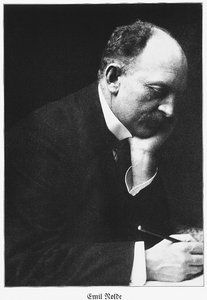
1867–1956, Dänemark
Emil Nolde
Das Leben und die Identität von Emil Nolde Geboren als Hans Emil Hansen am 7. August 1867, wuchs der Mann, der später als Emil Nolde weltberühmt werden sollte, nahe dem Dorf Nolde im Herzogtum Schleswig auf. Seine frühen Jahre waren tief geprägt vom ländlichen, agrarischen Leben seiner Familie. Doch er entschied sich schließlich gegen diesen vorgezeichneten Pfad und fand seine Bestimmung in der Arbeit als Holzschnitzer und Möbeldekorer.
Ebenfalls von Emil Nolde
 Sonnenuntergang
 Meer mit rotem Himmel
 Paar am Strand1903
 Masks1911
Essays zu Sea
 18. Jahrhundert deutsche MalerEntdecken Sie Meisterwerke von Caspar David Friedrich und mehr. Erleben Sie erstklassige Reproduktionen auf OriginalUniqueArt.com.
 Emil Nolde: Die 25 kraftvollsten Meisterwerke des ExpressionismusEntdecken Sie die 25 besten Werke von Emil Nolde. Erleben Sie die Kraft des Expressionismus. Jetzt die Kollektion auf OriginalUniqueArt.com…
 Expressionismus vs. Neue Sachlichkeit: Emotion vs. Präzision in der deutschen KunstErfahren Sie alles über den Kontrast zwischen Expressionismus und Neuer Sachlichkeit. Jetzt die Unterschiede entdecken.