

 In echtem Maßstab anzeigen
 Versenden als Grußkarte
 Teilen
 Details anzeigen
 Leitfaden öffnen

 Herunterladen
 Ähnliche Objekte
 Röntgenaufnahme
 Diashow
 Besucherstatistiken
Mismatched Couple


 Mehr anzeigen
Giclée / Kunstdruck
Giclée- oder Leinwanddruck in Museumsqualität mit schneller Produktion und flexiblen Veredelungsoptionen. ( Handgemalte Reproduktion kaufen Zum digitalen Bild wechseln)




P118B €10

P118H €10

P118W €10

P438Z €10

P508JH €12

P508YH €12

P805H €10

P805Z €10

P919BZ €10

P919G €10

P919XJ €10

P959ZH €10

P968JZ €12

W106C €8

W218G €10

W218JH €8

W218Y €10

W307PJ €10

W316G €10

W316PJ €8

W316Y €10

W398PJ €8

W4111J €10

W500HY €15

W500JH €15

W692G €12

W849H €8

W940BG €15

W953PJ €8




Wählen Sie aus unseren vordefinierten Formaten, die den ursprünglichen Proportionen des Kunstwerks entsprechen.

Type the width and the height you need, to fit your frame or your wall. A print can only be cut, never made bigger than the picture, so a size with a different shape loses a part of the image. We send you a digital mockup to approve before we print anything. The picture shown on this page does not show the real cut — only the mockup does.
Weltweiter Versand () innerhalb von 2 Wochen statt der üblichen 4/5 Wochen. (15 Oktober)

Kostenloser weltweiter Expressversand

Hochwertige Leinenleinwand

Vollständiger Versicherungsschutz beim Versand

Zollgebühren-Rückerstattungsgarantie

Garantie für exakte Farbtreue

100-tägiges Rückgaberecht (nur bei Mängeln)

100% Geld-zurück-Garantie

Angebot für Mengenrabatt
 Die Glasoption ist nur für Größen unter 110 cm verfügbar.

Mismatched Couple
Giclée / Kunstdruck
Format der Reproduktion
-


Gesamtpreis
€ 69
A Portrait of Discord: Unpacking Emile Nolde’s ‘Mismatched Couple’
Emile Nolde's “Mismatched Couple” is not merely a depiction of two individuals; it’s a raw, visceral exploration of human connection – or perhaps disconnection – rendered with the uncompromising intensity characteristic of Expressionism. Painted in 1923, this work immediately confronts the viewer with its unsettling composition and emotionally charged palette, inviting contemplation on themes of intimacy, conflict, and the inherent complexities of relationships. Nolde’s masterful manipulation of color and form transcends simple portraiture, offering a glimpse into the turbulent depths of the human psyche.
Composition and Technique: A Deliberate Distortion
- The asymmetrical arrangement is immediately arresting. The dominant presence of the male figure on the left side contrasts sharply with the partially obscured female form to the right, creating a palpable sense of imbalance. This deliberate disruption of traditional perspective underscores Nolde’s rejection of objective realism in favor of conveying subjective experience.
- Nolde employs thick, gestural brushstrokes – almost violent in their application – to define the figures' forms. These lines aren’t smooth or refined; they are deliberately rough and expressive, contributing significantly to the painting’s overall energy and emotional impact. The simplification and distortion of features further amplify this effect, pushing beyond mere representation towards a powerful expression of inner turmoil.
- The medium – likely watercolor or gouache on paper – lends itself beautifully to Nolde's technique. The fluidity of the paint allows for dynamic layering and blending, while the visible texture adds another layer of tactile interest and reinforces the painting’s raw, unfinished quality.
Chromatic Intensity: A Language of Emotion
The color palette in “Mismatched Couple” is anything but subtle. Deep purples, fiery reds, vibrant greens, and bold yellows collide with a deliberate lack of naturalistic harmony. These colors aren’t used to depict reality; instead, they serve as a potent language of emotion, intensifying the painting's dramatic effect. The stark contrast between the dark tones of the man’s face and body and the bright red and yellow hues of the woman’s head creates a visual tension that mirrors the potential conflict within the relationship. This unconventional use of color aligns perfectly with Nolde’s Expressionist sensibilities, prioritizing emotional impact over accurate representation.
Symbolism and Interpretation: A Portrait of Unease
The title itself, “Mismatched Couple,” immediately suggests a discordance – a fundamental incompatibility between the two figures. While the subject matter is ostensibly a portrait, it transcends simple identification. The distorted features and intense colors contribute to a pervasive sense of unease, hinting at deeper psychological complexities. It’s possible that Nolde intended to represent not just a specific couple but rather the universal struggle for connection amidst inherent differences. The painting's ambiguity invites viewers to project their own interpretations onto the scene, adding to its enduring power and resonance.
Historical Context and Artistic Legacy
Created in 1923, “Mismatched Couple” reflects the broader artistic currents of the Expressionist movement. Nolde, a key figure in this movement, was deeply influenced by artists like Vincent van Gogh and Paul Gauguin, particularly their use of bold color and expressive brushwork. His work often explored themes of spirituality, mythology, and folklore, reflecting his deep connection to German traditions. “Mismatched Couple” stands as a testament to Nolde’s unique vision – a powerful and unsettling portrait that continues to captivate viewers with its raw emotion and enduring psychological depth.
Fragen & Antworten
Ist ein Download für "Mismatched Couple" verfügbar?
"Mismatched Couple" von Emil Nolde kann auf der Download-Seite des Kunstwerks als ein hochauflösender digitaler Bild-Download heruntergeladen werden.
Wo kann ich eine digitale Abbildung von "Mismatched Couple" von Emil Nolde kaufen?
"Mismatched Couple" is available as ein hochauflösender digitaler Bild-Download, purchased directly on its Digital Image page.
Ist "Mismatched Couple" von Emil Nolde gemeinfrei, und warum?
Der Urheberrechtsstatus von "Mismatched Couple" – gemeinfrei – das Urheberrecht ist abgelaufen – ergibt sich aus dem Todesjahr des Künstlers im Jahr 1956.
Biografie des Künstlers
Emil Nolde: Leben und Werk
Frühes Leben und künstlerische Anfänge
Emil Nolde, ein renommierter deutscher-dänischer Maler, wurde am 7. August 1867 in Nolde, Schleswig-Holstein, Deutschland, als Hans Emil Hansen geboren. Er stammte aus einer Familie mit starken Bindungen an das ländliche Leben und religiösen Glauben, Faktoren, die seine künstlerische Vision maßgeblich beeinflussten. Trotz anfänglicher Widerstände seiner Eltern, die ihm einen konventionelleren Beruf vorzogen, verfolgte Nolde unaufhörlich seine Leidenschaft für die Kunst. Zunächst arbeitete er als Holzschnitzer und Möbeldekorer, bevor er sich in seinen späten Zwanzigern voll und ganz der Malerei widmete.
Künstlerische Entwicklung und Einflüsse
Noldes künstlerischer Weg war von autodidaktischem Lernen und Erkundung geprägt. Er reiste vielseitig und ließ sich von verschiedenen Kulturen und Kunstformen inspirieren. Frühe Einflüsse waren Vincent van Gogh, Paul Gauguin und traditionelle Volkskunst – insbesondere die ausdrucksstarke Kraft primitiver Masken und Schnitzereien. Diese Begegnungen weckten sein Interesse an kräftigen Farben, vereinfachten Formen und emotional aufgeladenem Motivmaterial. Er experimentierte zunächst mit Realismus und Impressionismus, entwickelte sich aber schnell zu einem subjektiveren und expressiveren Stil.
Die Brücke und der Expressionistische Durchbruch
Im Jahr 1905 gründete Nolde Die Brücke (Die Brücke), eine entscheidende Gruppe deutscher Expressionisten. Diese Kollektiv bildete sich aus, um sich von akademischen Traditionen zu lösen und innere Emotionen durch radikale künstlerische Experimente auszudrücken. Noldes Beitrag zur Brücke war bedeutend; seine intensive Verwendung von Farbe und verzerrten Formen verschob die Grenzen der Darstellung. Dennoch verfolgte er innerhalb der Gruppe einen eher unabhängigen Weg, indem er sich oft in Bezug auf Themen und stilistische Herangehensweise unterschied.
Schlüsselthemen und künstlerischer Stil
Noldes Œuvre ist durch mehrere wiederkehrende Themen gekennzeichnet: religiöse Szenen, Landschaften, Seenaspekte und Porträts. Er war besonders fasziniert von der Macht von Masken – sowohl als physische Objekte als auch als symbolische Darstellungen ursprünglicher Emotionen. Sein künstlerischer Stil wird durch folgende Elemente definiert:
- Kräftige, leuchtende Farben, die emotionale Intensität vermitteln
- Verzerrte Formen, die Ausdruck statt realistischer Darstellung betonen
- Impasto-Technik – dicke Aufträge von Farbe, die Textur erzeugen
- Eine Konzentration auf die Erfassung psychologischer Zustände
Bekannte Werke und Leistungen
Während seiner Karriere schuf Nolde einen umfangreichen Œuvre. Einige seiner bekanntesten Gemälde sind:
- Masken (1906-1907) – zeigend seine Faszination für die primitive Kunst
- Die Kreuzigung des Bruders Christi (1909) – eine kraftvolle und emotional aufgeladene religiöse Szene
- Herbstmeer (1908) - demonstrierend seine ausdrucksstarke Landschaftsmalerei.
- Blumen Garten (Mädchen und Waschen) (1907)
- Tanz um den goldenen Büffel (1909)
Trotz Kritik und Zensur durch die Nationalsozialisten – seine Werke wurden als “degeneriert” bezeichnet – setzte Nolde weiterhin heimlich in der Malerei fort. Er produzierte während dieser Zeit eine bedeutende Anzahl von Aquarellen, die sein unerschütterliches Engagement für künstlerischen Ausdruck demonstrierte.
Historische Bedeutung und Vermächtnis
Emil Noldes innovative Verwendung von Farbe und expressiver Pinseltechnik beeinflusste Generationen von Künstlern nachhaltig. Sein Werk schloss die Lücke zwischen traditioneller repräsentativer Kunst und den nachfolgenden abstrakten Bewegungen. Er bleibt eine zentrale Figur in der Geschichte des deutschen Expressionismus, gefeiert für seine emotionale Intensität, sein kühnes Experimentieren und seine dauerhafte künstlerische Vision. Sein Vermächtnis inspiriert Künstler und Kunstliebhaber auf der ganzen Welt weiterhin.
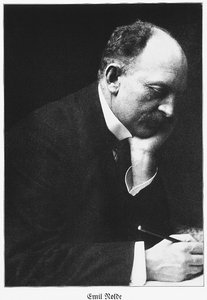
Emil Nolde
1867 - 1956 , Deutschland
Eckdaten zum Künstler
- Artistic Movement Or Style: Expressionismus
- Artists Who Influenced This Artist:
- Vincent van Gogh
- Paul Gauguin
- Date Of Birth: August 7, 1867
- Date Of Death: April 13, 1956
- Full Name: Hans Emil Hansen
- Nationality: Deutsch-Dänisch
- Notable Artworks:
- Masken
- Die Verurteilung des Heiligen
- Blumenwiese (Mädchen und Waschen)
- Herbstmeer
- Tanz um den goldenen Büffel
- Place Of Birth: Nolde, Schleswig-Holstein
Verwandte Artikel
Expressionismus: Die 10 Meisterwerke, die eine Ära prägten – Kunst für Ihr Zuhause |
Entdecken Sie die 10 prägendsten Meisterwerke des Expressionismus! Von Munch bis Kandinsky – erfahren Sie die Geschichten hinter den berühmtesten Gemälde und Künstler. Hochwertige Kunstdrucke online bei kaufen & Ihr Zuhause mit Emotionen füllen.
Emil Nolde: Eine Reise ins Expressionistische Naturerlebnis und zum Ur-Selbst
Entdecken Sie Emil Noldes faszinierende Reise ins Expressionistische! Analysieren Sie seine frühen Werke, den Einfluss des Primitivismus und sein Schicksal im Nationalsozialismus. Expertenwissen zur deutschen Malerei.

Deutsche Expressionismus Meisterwerke: Die 10 wichtigsten Kunstwerke für Ihr Zuhause
Entdecken Sie die 10 bedeutendsten Werke des Deutschen Expressionismus! Kirchner, Nolde & Co. – ihre Geschichten, Techniken und zeitlose Schönheit. Hochwertige Kunstdrucke auf OriginalUniqueArt.com kaufen und Ihr Zuhause mit emotionaler Kunst bereichern. Jetzt entdecken!
Mark Rothkos Meisterwerke: Die Top 25 für Kunstliebhaber | OriginalUniqueArt
Entdecken Sie die 25 Meisterwerke von Mark Rothko! Tauchen Sie ein in die Welt der abstrakten Kunst, des Expressionismus und der Farbfeldmalerei. Hochwertige Kunstdrucke & Reproduktionen auf OriginalUniqueArt.com – für Ihre Wohnräume.

Crimson Threads of Narrative: Exploring Symbolism & Representation in Artworks Featuring the Red Dress
Explore the rich symbolism of the red dress in art history! From ancient power displays to iconic portraits like Cézanne’s 'Madame Cezanne', discover the cultural and artistic significance behind this captivating color. Expert analysis & insights.


