

 In echtem Maßstab anzeigen
 Versenden als Grußkarte
 Teilen
 Details anzeigen
 Leitfaden öffnen

 Herunterladen
 Ähnliche Objekte
 Röntgenaufnahme
 Diashow
 Besucherstatistiken
Masks


 Mehr anzeigen
Giclée / Kunstdruck
Giclée- oder Leinwanddruck in Museumsqualität mit schneller Produktion und flexiblen Veredelungsoptionen. ( Handgemalte Reproduktion kaufen Zum digitalen Bild wechseln)




P118B €10

P118H €10

P118W €10

P438Z €10

P508JH €12

P508YH €12

P805H €10

P805Z €10

P919BZ €10

P919G €10

P919XJ €10

P959ZH €10

P968JZ €12

W106C €8

W218G €10

W218JH €8

W218Y €10

W307PJ €10

W316G €10

W316PJ €8

W316Y €10

W398PJ €8

W4111J €10

W500HY €15

W500JH €15

W692G €12

W849H €8

W940BG €15

W953PJ €8




Wählen Sie aus unseren vordefinierten Formaten, die den ursprünglichen Proportionen des Kunstwerks entsprechen.

Geben Sie die Breite und die Höhe an, die Sie benötigen, damit der Druck perfekt in Ihren Rahmen oder an Ihre Wand passt. Ein Druck kann nur beschnitten werden und niemals größer als das Originalbild gemacht werden; daher verliert ein Format mit einer anderen Proportion einen Teil des Bildes. Wir senden Ihnen ein digitales Mockup zur Freigabe, bevor wir den Druck ausführen. Das auf dieser Seite gezeigte Bild zeigt nicht den tatsächlichen Beschnitt – dies ist nur im Mockup ersichtlich.
Weltweiter Versand () innerhalb von 2 Wochen statt der üblichen 4/5 Wochen. (21 Oktober)

Kostenloser weltweiter Expressversand

Hochwertige Leinenleinwand

Vollständiger Versicherungsschutz beim Versand

Zollgebühren-Rückerstattungsgarantie

Garantie für exakte Farbtreue

100-tägiges Rückgaberecht (nur bei Mängeln)

100% Geld-zurück-Garantie

Angebot für Mengenrabatt
 Die Glasoption ist nur für Größen unter 110 cm verfügbar.

Masks
Giclée / Kunstdruck
Format der Reproduktion
-


Gesamtpreis
€ 70
The Enigmatic Dance of Masks – A Study in Emil Nolde’s Expressionist Vision
Emil Nolde's "Masks," painted in 1911, isn’t merely a depiction of carnival revelry; it’s a profound exploration of identity, hidden desires, and the unsettling duality inherent within human nature. Created during his time as a key member of Die Brücke – “The Bridge” – a group pushing the boundaries of German Expressionism in Dresden and Berlin, the painting embodies the movement's core tenets: a rejection of academic realism in favor of raw emotion, bold color, and a focus on subjective experience. Nolde himself described his interest in "the grotesque expression of power" and “elemental force,” sentiments powerfully realized within this captivating composition.
The scene unfolds against a deceptively simple blue background, immediately drawing the viewer’s eye to the central figures – five distinct masks suspended in an ambiguous space. Each mask isn't simply a representation of a face; it’s a carefully constructed symbol, radiating a potent emotional charge. The leftmost mask, a dark red and toothy visage, hints at aggression and perhaps even menace. Nearby, an upside-down pink mask suggests vulnerability and a suppressed sadness. Nolde masterfully employs a technique reminiscent of primitive tribal art – particularly the masks of Solomon Islands and Yoruna Indians from Brazil – drawing inspiration from non-Western cultures to amplify the painting’s primal energy. These references weren't merely decorative; they represented a deliberate attempt to tap into fundamental human emotions, divorced from rational thought.
A Symphony of Color and Impasto
Nolde’s masterful use of color is central to the painting’s impact. He abandons subtle gradations in favor of vibrant, almost jarring hues – fiery oranges, deep blues, and stark reds – applied with a thick impasto technique. This layering of paint creates a tactile surface, inviting the viewer to reach out and feel the energy contained within each mask. The brushstrokes are visible, deliberate, and intensely expressive, mirroring the turbulent emotions conveyed by the figures. This physicality of the paint itself contributes significantly to the painting’s unsettling atmosphere; it feels as though the masks are not merely objects on a canvas but living entities, pulsating with hidden power.
The composition is deliberately unbalanced, further enhancing the sense of unease. The placement of the masks – some close to the viewer, others receding into the distance – creates a dynamic tension, suggesting a perpetual state of shifting identities and concealed motivations. Nolde’s decision to depict these masks in isolation amplifies their symbolic weight, forcing the viewer to confront each one individually and contemplate its hidden meaning.
Historical Context and Lasting Resonance
“Masks” was painted during a period of intense social and political upheaval in Germany – a time marked by rapid industrialization, growing anxieties about modernity, and the rise of nationalist ideologies. Die Brücke’s rejection of traditional artistic conventions reflected a broader cultural rebellion against established norms. Following World War I, Nolde's work became increasingly introspective and emotionally charged, often exploring themes of isolation, mortality, and the darker aspects of human experience.
Interestingly, the painting was confiscated by the Nazi regime in 1937 due to its perceived “degenerate” nature – a label applied to works deemed unsuitable for German culture. Despite this suppression, "Masks" endured, eventually finding its way into private collections and, ultimately, onto the walls of The Nelson-Atkins Museum of Art in Kansas City. Its continued presence speaks to the enduring power of Nolde’s vision and its ability to resonate with viewers across generations.
A Timeless Exploration of Identity
“Masks” remains a profoundly evocative work, inviting endless interpretation. It's not simply a depiction of carnival masks; it’s an allegory for the masks we all wear in our daily lives – the facades we present to the world, concealing our true selves beneath layers of social expectation and personal insecurity. Nolde’s bold colors, expressive brushwork, and unsettling imagery combine to create a timeless meditation on identity, illusion, and the hidden depths of the human psyche. Reproductions capture only a fraction of the painting's raw emotional power, but they offer a valuable opportunity to engage with this remarkable work of Expressionist art.
Fragen & Antworten
Gibt es einen Leitfaden für "Masks" von Emil Nolde?
Eine Leitfaden-Seite ist für "Masks" von Emil Nolde verfügbar: ein druckbares Infoblatt zum Kunstwerk, konzipiert für Schüler und den Einsatz im Unterricht.
Welche Platzierung passt zum Format von "Masks" von Emil Nolde?
Format (Quadratisch) und der empfohlene Raum (Wohnbereich) sind die zwei festgehaltenen Platzierungsdetails für "Masks" von Emil Nolde.
Wie treffen Bewegung und Epoche in "Masks" von Emil Nolde aufeinander?
"Masks" gehört der Expressionist Landscape-Strömung an, und sein Schöpfer war in der Ära der – 19. Jahrhundert tätig.
Biografie des Künstlers
Emil Nolde: Leben und Werk
Frühes Leben und künstlerische Anfänge
Emil Nolde, ein renommierter deutscher-dänischer Maler, wurde am 7. August 1867 in Nolde, Schleswig-Holstein, Deutschland, als Hans Emil Hansen geboren. Er stammte aus einer Familie mit starken Bindungen an das ländliche Leben und religiösen Glauben, Faktoren, die seine künstlerische Vision maßgeblich beeinflussten. Trotz anfänglicher Widerstände seiner Eltern, die ihm einen konventionelleren Beruf vorzogen, verfolgte Nolde unaufhörlich seine Leidenschaft für die Kunst. Zunächst arbeitete er als Holzschnitzer und Möbeldekorer, bevor er sich in seinen späten Zwanzigern voll und ganz der Malerei widmete.
Künstlerische Entwicklung und Einflüsse
Noldes künstlerischer Weg war von autodidaktischem Lernen und Erkundung geprägt. Er reiste vielseitig und ließ sich von verschiedenen Kulturen und Kunstformen inspirieren. Frühe Einflüsse waren Vincent van Gogh, Paul Gauguin und traditionelle Volkskunst – insbesondere die ausdrucksstarke Kraft primitiver Masken und Schnitzereien. Diese Begegnungen weckten sein Interesse an kräftigen Farben, vereinfachten Formen und emotional aufgeladenem Motivmaterial. Er experimentierte zunächst mit Realismus und Impressionismus, entwickelte sich aber schnell zu einem subjektiveren und expressiveren Stil.
Die Brücke und der Expressionistische Durchbruch
Im Jahr 1905 gründete Nolde Die Brücke (Die Brücke), eine entscheidende Gruppe deutscher Expressionisten. Diese Kollektiv bildete sich aus, um sich von akademischen Traditionen zu lösen und innere Emotionen durch radikale künstlerische Experimente auszudrücken. Noldes Beitrag zur Brücke war bedeutend; seine intensive Verwendung von Farbe und verzerrten Formen verschob die Grenzen der Darstellung. Dennoch verfolgte er innerhalb der Gruppe einen eher unabhängigen Weg, indem er sich oft in Bezug auf Themen und stilistische Herangehensweise unterschied.
Schlüsselthemen und künstlerischer Stil
Noldes Œuvre ist durch mehrere wiederkehrende Themen gekennzeichnet: religiöse Szenen, Landschaften, Seenaspekte und Porträts. Er war besonders fasziniert von der Macht von Masken – sowohl als physische Objekte als auch als symbolische Darstellungen ursprünglicher Emotionen. Sein künstlerischer Stil wird durch folgende Elemente definiert:
- Kräftige, leuchtende Farben, die emotionale Intensität vermitteln
- Verzerrte Formen, die Ausdruck statt realistischer Darstellung betonen
- Impasto-Technik – dicke Aufträge von Farbe, die Textur erzeugen
- Eine Konzentration auf die Erfassung psychologischer Zustände
Bekannte Werke und Leistungen
Während seiner Karriere schuf Nolde einen umfangreichen Œuvre. Einige seiner bekanntesten Gemälde sind:
- Masken (1906-1907) – zeigend seine Faszination für die primitive Kunst
- Die Kreuzigung des Bruders Christi (1909) – eine kraftvolle und emotional aufgeladene religiöse Szene
- Herbstmeer (1908) - demonstrierend seine ausdrucksstarke Landschaftsmalerei.
- Blumen Garten (Mädchen und Waschen) (1907)
- Tanz um den goldenen Büffel (1909)
Trotz Kritik und Zensur durch die Nationalsozialisten – seine Werke wurden als “degeneriert” bezeichnet – setzte Nolde weiterhin heimlich in der Malerei fort. Er produzierte während dieser Zeit eine bedeutende Anzahl von Aquarellen, die sein unerschütterliches Engagement für künstlerischen Ausdruck demonstrierte.
Historische Bedeutung und Vermächtnis
Emil Noldes innovative Verwendung von Farbe und expressiver Pinseltechnik beeinflusste Generationen von Künstlern nachhaltig. Sein Werk schloss die Lücke zwischen traditioneller repräsentativer Kunst und den nachfolgenden abstrakten Bewegungen. Er bleibt eine zentrale Figur in der Geschichte des deutschen Expressionismus, gefeiert für seine emotionale Intensität, sein kühnes Experimentieren und seine dauerhafte künstlerische Vision. Sein Vermächtnis inspiriert Künstler und Kunstliebhaber auf der ganzen Welt weiterhin.
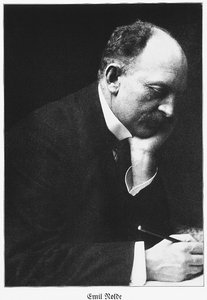
Emil Nolde
1867 - 1956 , Deutschland
Eckdaten zum Künstler
- Artistic Movement Or Style: Expressionismus
- Artists Who Influenced This Artist:
- Vincent van Gogh
- Paul Gauguin
- Date Of Birth: August 7, 1867
- Date Of Death: April 13, 1956
- Full Name: Hans Emil Hansen
- Nationality: Deutsch-Dänisch
- Notable Artworks:
- Masken
- Die Verurteilung des Heiligen
- Blumenwiese (Mädchen und Waschen)
- Herbstmeer
- Tanz um den goldenen Büffel
- Place Of Birth: Nolde, Schleswig-Holstein
Verwandte Artikel
The Raw Emotion of Expressionism: A Deep Dive into its History, Characteristics & Enduring Influence
Explore the raw emotion of Expressionism with OriginalUniqueArt. Discover its history, key artists like Kirchner & Munch, and lasting influence on modern art. Expert insights for collectors & enthusiasts.
Unveiling the Mystery: A Journey Through the World's Most Iconic Mask Artworks
Embark on a profound journey through the world's most iconic mask artworks. Explore the spiritual depth, intricate craftsmanship, and rich cultural heritage of global traditions, from Chhau to Gomira, in this expert-led exploration of ancestral artistry and symbolic beauty.

Deutsche Expressionismus Meisterwerke: Die 10 wichtigsten Kunstwerke für Ihr Zuhause
Entdecken Sie die 10 bedeutendsten Werke des Deutschen Expressionismus! Kirchner, Nolde & Co. – ihre Geschichten, Techniken und zeitlose Schönheit. Hochwertige Kunstdrucke auf OriginalUniqueArt.com kaufen und Ihr Zuhause mit emotionaler Kunst bereichern. Jetzt entdecken!

Unmasking Emotion: A Journey Through the Raw Power and Visceral Beauty of German Expressionism
Explore the raw emotional power of German Expressionism. From Kirchner to Die Brücke, discover how artists used distortion and vibrant color to unmask the human psyche. A deep dive into art history for the discerning collector and enthusiast.
The Visceral Cry of a Nation: Exploring Emotion & Distortion in German Expressionism
Explore the powerful world of German Expressionism with OriginalUniqueArt. Discover Kirchner, Nolde & Die Brücke's emotive masterpieces. Learn about this pivotal art movement and its lasting impact on modern art.


