

 In echtem Maßstab anzeigen
 Versenden als Grußkarte
 Teilen
 Details anzeigen
 Leitfaden öffnen

 Herunterladen
 Ähnliche Objekte
 Röntgenaufnahme
 Diashow
 Besucherstatistiken
Constanze Mozart
 Oil On Canvas
- WallArt
- Expressionism
 1802
1802 Die Mozart-Museen der Internationalen Mozarteum-Stiftung Salzburg
 Mehr anzeigen
Handgefertigte Ölreproduktion
Handgemaltes Ölgemälde auf Leinwand in Ihrer Wunschgröße und mit Rahmen, auf Bestellung von unseren Künstlern angefertigt. ( Zum Druck wechseln Zum digitalen Bild wechseln)




P118B €10

P118H €10

P118W €10

P438Z €10

P508JH €12

P508YH €12

P805H €10

P805Z €10

P919BZ €10

P919G €10

P919XJ €10

P959ZH €10

P968JZ €12

W106C €8

W218G €10

W218JH €8

W218Y €10

W307PJ €10

W316G €10

W316PJ €8

W316Y €10

W398PJ €8

W4111J €10

W500HY €15

W500JH €15

W692G €12

W849H €8

W940BG €15

W953PJ €8




Wählen Sie aus unseren vordefinierten Formaten, die den ursprünglichen Proportionen des Kunstwerks entsprechen.

Geben Sie die Breite und die Höhe an, die Sie für Ihren Rahmen oder Ihre Wand benötigen. Da dieses Werk handgemalt ist, kann der Künstler bei einer anderen Form etwas mehr um das Bild herum malen oder etwas abschneiden – Sie entscheiden. Wir senden Ihnen ein digitales Mockup zur Freigabe, bevor mit dem Malen begonnen wird. Das auf dieser Seite gezeigte Bild stellt nicht das tatsächliche Ergebnis dar – dies tut nur das Mockup.
Nach der Bestellung wird das OriginalUniqueArt.com-Team dem Kunden Anweisungen per E-Mail zusenden und eine Mockup-Vorschau bereitstellen.
Weltweiter Versand () in nur 3 bis 4 Wochen statt der üblichen 5 Wochen. (25 Oktober). Keine Kompromisse bei der Qualität.

Kostenloser weltweiter Expressversand

Hochwertige Leinenleinwand

Vollständiger Versicherungsschutz beim Versand

Zollgebühren-Rückerstattungsgarantie

Garantie für exakte Farbtreue

100-tägiges Rückgaberecht (nur bei Mängeln)

100% Geld-zurück-Garantie

Angebot für Mengenrabatt
 Die Glasoption ist nur für Größen unter 110 cm verfügbar.

Constanze Mozart
Reproduktionsmedium
Format der Reproduktion
-


Gesamtpreis
€ 263
The Enigmatic Figure: An Exploration of Emil Nolde’s “Constanze Mozart”
Emil Nolde's "Constanze Mozart," painted in 1902, isn’t merely a portrait; it’s a carefully constructed distillation of memory, emotion, and the lingering echoes of a bygone era. Nolde, a pivotal figure within the Die Brücke movement, eschewed photographic realism in favor of an intensely subjective approach to representation – a strategy that profoundly shaped his distinctive visual language. This particular work, housed within the Mozart-Museums of Salzburg, immediately draws the viewer into a world steeped in quiet contemplation and a subtle undercurrent of sadness. The subject herself, Constanze Mozart, is rendered with a remarkable degree of intimacy, her gaze direct yet veiled, suggesting both vulnerability and an inner strength.
Nolde’s technique here is immediately arresting. He employs a bold, almost aggressively applied palette dominated by deep blues and browns – colors that evoke the twilight hours, the shadows of memory, and perhaps even the melancholy associated with Mozart's own life. The brushstrokes are thick and impastoed, creating a tactile surface that invites close inspection. Notice how he utilizes broken color—small, distinct patches of hue rather than smooth transitions—to build up form and texture. This technique isn’t about replicating reality; it’s about conveying feeling – the weight of experience, the fragility of beauty, and the enduring power of a single, poignant image.
Echoes of Salzburg: Historical Context and Artistic Influences
To fully appreciate “Constanze Mozart,” one must consider the artistic climate in which it was created. Nolde’s early career was deeply influenced by the radical Expressionist group Die Brücke, a collective dedicated to rejecting academic conventions and exploring the raw emotions of modern life. This movement sought to capture not just what *was* seen, but what *felt* – a philosophy perfectly embodied in Nolde's work. His use of intense color and distorted forms can be traced back to his encounters with artists like Vincent van Gogh and Paul Gauguin, both of whom championed the expressive potential of color as a vehicle for conveying emotion. Furthermore, Nolde’s fascination with primitive art – particularly masks and carvings from various cultures – is evident in the painting's simplified forms and symbolic weight.
The portrait itself is rooted in a specific historical context: Salzburg during the late 19th century, a city inextricably linked to the legacy of Mozart. Constanze’s presence within this setting adds another layer of complexity to the work. She represents not only a real woman but also an idealized image of feminine grace and resilience – qualities that resonated deeply with Nolde's artistic sensibilities.
Symbolism and Emotional Resonance: A Portrait Beyond Representation
Beyond its formal elements, “Constanze Mozart” is rich in symbolic meaning. The book she holds isn’t simply a prop; it represents knowledge, contemplation, and perhaps even a yearning for understanding. Her direct gaze invites the viewer to engage with her inner world – to share in her thoughts and emotions. The muted lighting and somber color palette contribute to a sense of melancholy, suggesting that this portrait is not merely a likeness but an exploration of memory and loss. It’s a quiet meditation on beauty, fragility, and the enduring power of the past.
Nolde masterfully avoids sentimentality, instead offering a nuanced portrayal of a woman caught between worlds – between the idealized image of Mozart's wife and the complexities of her own life. “Constanze Mozart” is a testament to Nolde’s ability to transform a simple portrait into a profound statement about human experience, leaving the viewer with a lingering sense of both beauty and sadness.
Fragen & Antworten
Wie kann ich eine digitale Datei von "Constanze Mozart" von Emil Nolde erhalten?
Um eine digitale Datei von "Constanze Mozart" von Emil Nolde zu erhalten, bestellen Sie ein hochauflösender digitaler Bild-Download auf der Seite Digitales Bild.
In welche Phase von Emil Noldes Schaffen lässt sich "Constanze Mozart" einordnen?
Innerhalb der Schaffensperiode von Emil Nolde lässt sich „Constanze Mozart“ der Late Period zuordnen. Diese Phase ermöglicht einen Vergleich mit anderen Werken des Künstlers.
Gibt es ein Factsheet zu "Constanze Mozart" von Emil Nolde für Studierende?
Eine Leitfaden-Seite ist für "Constanze Mozart" von Emil Nolde verfügbar: ein druckbares Infoblatt zum Kunstwerk, konzipiert für Schüler und den Einsatz im Unterricht.
Biografie des Künstlers
Emil Nolde: Leben und Werk
Frühes Leben und künstlerische Anfänge
Emil Nolde, ein renommierter deutscher-dänischer Maler, wurde am 7. August 1867 in Nolde, Schleswig-Holstein, Deutschland, als Hans Emil Hansen geboren. Er stammte aus einer Familie mit starken Bindungen an das ländliche Leben und religiösen Glauben, Faktoren, die seine künstlerische Vision maßgeblich beeinflussten. Trotz anfänglicher Widerstände seiner Eltern, die ihm einen konventionelleren Beruf vorzogen, verfolgte Nolde unaufhörlich seine Leidenschaft für die Kunst. Zunächst arbeitete er als Holzschnitzer und Möbeldekorer, bevor er sich in seinen späten Zwanzigern voll und ganz der Malerei widmete.
Künstlerische Entwicklung und Einflüsse
Noldes künstlerischer Weg war von autodidaktischem Lernen und Erkundung geprägt. Er reiste vielseitig und ließ sich von verschiedenen Kulturen und Kunstformen inspirieren. Frühe Einflüsse waren Vincent van Gogh, Paul Gauguin und traditionelle Volkskunst – insbesondere die ausdrucksstarke Kraft primitiver Masken und Schnitzereien. Diese Begegnungen weckten sein Interesse an kräftigen Farben, vereinfachten Formen und emotional aufgeladenem Motivmaterial. Er experimentierte zunächst mit Realismus und Impressionismus, entwickelte sich aber schnell zu einem subjektiveren und expressiveren Stil.
Die Brücke und der Expressionistische Durchbruch
Im Jahr 1905 gründete Nolde Die Brücke (Die Brücke), eine entscheidende Gruppe deutscher Expressionisten. Diese Kollektiv bildete sich aus, um sich von akademischen Traditionen zu lösen und innere Emotionen durch radikale künstlerische Experimente auszudrücken. Noldes Beitrag zur Brücke war bedeutend; seine intensive Verwendung von Farbe und verzerrten Formen verschob die Grenzen der Darstellung. Dennoch verfolgte er innerhalb der Gruppe einen eher unabhängigen Weg, indem er sich oft in Bezug auf Themen und stilistische Herangehensweise unterschied.
Schlüsselthemen und künstlerischer Stil
Noldes Œuvre ist durch mehrere wiederkehrende Themen gekennzeichnet: religiöse Szenen, Landschaften, Seenaspekte und Porträts. Er war besonders fasziniert von der Macht von Masken – sowohl als physische Objekte als auch als symbolische Darstellungen ursprünglicher Emotionen. Sein künstlerischer Stil wird durch folgende Elemente definiert:
- Kräftige, leuchtende Farben, die emotionale Intensität vermitteln
- Verzerrte Formen, die Ausdruck statt realistischer Darstellung betonen
- Impasto-Technik – dicke Aufträge von Farbe, die Textur erzeugen
- Eine Konzentration auf die Erfassung psychologischer Zustände
Bekannte Werke und Leistungen
Während seiner Karriere schuf Nolde einen umfangreichen Œuvre. Einige seiner bekanntesten Gemälde sind:
- Masken (1906-1907) – zeigend seine Faszination für die primitive Kunst
- Die Kreuzigung des Bruders Christi (1909) – eine kraftvolle und emotional aufgeladene religiöse Szene
- Herbstmeer (1908) - demonstrierend seine ausdrucksstarke Landschaftsmalerei.
- Blumen Garten (Mädchen und Waschen) (1907)
- Tanz um den goldenen Büffel (1909)
Trotz Kritik und Zensur durch die Nationalsozialisten – seine Werke wurden als “degeneriert” bezeichnet – setzte Nolde weiterhin heimlich in der Malerei fort. Er produzierte während dieser Zeit eine bedeutende Anzahl von Aquarellen, die sein unerschütterliches Engagement für künstlerischen Ausdruck demonstrierte.
Historische Bedeutung und Vermächtnis
Emil Noldes innovative Verwendung von Farbe und expressiver Pinseltechnik beeinflusste Generationen von Künstlern nachhaltig. Sein Werk schloss die Lücke zwischen traditioneller repräsentativer Kunst und den nachfolgenden abstrakten Bewegungen. Er bleibt eine zentrale Figur in der Geschichte des deutschen Expressionismus, gefeiert für seine emotionale Intensität, sein kühnes Experimentieren und seine dauerhafte künstlerische Vision. Sein Vermächtnis inspiriert Künstler und Kunstliebhaber auf der ganzen Welt weiterhin.
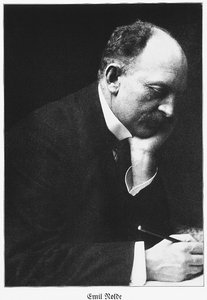
Emil Nolde
1867 - 1956 , Deutschland
Eckdaten zum Künstler
- Artistic Movement Or Style: Expressionismus
- Artists Who Influenced This Artist:
- Vincent van Gogh
- Paul Gauguin
- Date Of Birth: August 7, 1867
- Date Of Death: April 13, 1956
- Full Name: Hans Emil Hansen
- Nationality: Deutsch-Dänisch
- Notable Artworks:
- Masken
- Die Verurteilung des Heiligen
- Blumenwiese (Mädchen und Waschen)
- Herbstmeer
- Tanz um den goldenen Büffel
- Place Of Birth: Nolde, Schleswig-Holstein
Verwandte Artikel

Ephemeral Visions: Exploring the Artistic Legacy & Nuances of Watercolor Painting
Explore the captivating world of watercolor painting! Discover its rich history, essential techniques, influential artists & collecting tips from art experts. A comprehensive guide for enthusiasts.

Flüchtige Visionen: Die Geschichte und emotionale Resonanz der Aquarellmalerei
Entdecken Sie die faszinierende Welt der Aquarellmalerei! Von historischen Ursprüngen bis zu modernen Techniken – wir bieten Expertenwissen, Inspiration und Tipps für Anfänger & Fortgeschrittene.

Ephemeral Visions: Exploring the Artistic Legacy & Contemporary Practice of Watercolor Painting
Explore the captivating world of watercolor painting! Discover its rich history, essential techniques, influential artists & collecting tips. A comprehensive guide for art enthusiasts from OriginalUniqueArt.

Die 10 legendärsten Aquarellwerke der Kunstgeschichte – Meisterwerke für Ihr Zuhause
Entdecken Sie die 10 legendärsten Aquarellwerke der Kunstgeschichte! Von Turner bis Monet – erleben Sie die Geschichten, Techniken & Farben dieser Meisterwerke. Finden Sie hochwertige Kunstdrucke auf OriginalUniqueArt.com und gestalten Sie Ihr Zuhause mit zeitloser Eleganz.

Die zeitlose Anziehungskraft der Aquarellmalerei: Geschichte, Techniken und zeitgenössische Praxis
Entdecken Sie die faszinierende Welt der Aquarellmalerei! Geschichte, Techniken & zeitgenössische Kunst – Expertenwissen von für Kunstliebhaber.


