In echtem Maßstab anzeigen
 Versenden als Grußkarte
 Teilen
 Details anzeigen
 Leitfaden öffnen

 Herunterladen
 Ähnliche Objekte
 Röntgenaufnahme
 Diashow
 Besucherstatistiken
Four (arithmetic) actions


 Mehr anzeigen
Handgefertigte Ölreproduktion
Handgemaltes Ölgemälde auf Leinwand in Ihrer Wunschgröße und mit Rahmen, auf Bestellung von unseren Künstlern angefertigt. ( Zum Druck wechseln Zum digitalen Bild wechseln)




P118B €10

P118H €10

P118W €10

P438Z €10

P508JH €12

P508YH €12

P805H €10

P805Z €10

P919BZ €10

P919G €10

P919XJ €10

P959ZH €10

P968JZ €12

W106C €8

W218G €10

W218JH €8

W218Y €10

W307PJ €10

W316G €10

W316PJ €8

W316Y €10

W398PJ €8

W4111J €10

W500HY €15

W500JH €15

W692G €12

W849H €8

W940BG €15

W953PJ €8




Wählen Sie aus unseren vordefinierten Formaten, die den ursprünglichen Proportionen des Kunstwerks entsprechen.

Geben Sie die Breite und die Höhe an, die Sie für Ihren Rahmen oder Ihre Wand benötigen. Da dieses Werk handgemalt ist, kann der Künstler bei einer anderen Form etwas mehr um das Bild herum malen oder etwas abschneiden – Sie entscheiden. Wir senden Ihnen ein digitales Mockup zur Freigabe, bevor mit dem Malen begonnen wird. Das auf dieser Seite gezeigte Bild stellt nicht das tatsächliche Ergebnis dar – dies tut nur das Mockup.
Nach der Bestellung wird das OriginalUniqueArt.com-Team dem Kunden Anweisungen per E-Mail zusenden und eine Mockup-Vorschau bereitstellen.
Weltweiter Versand () in nur 3 bis 4 Wochen statt der üblichen 5 Wochen. (22 Oktober). Keine Kompromisse bei der Qualität.

Kostenloser weltweiter Expressversand

Hochwertige Leinenleinwand

Vollständiger Versicherungsschutz beim Versand

Zollgebühren-Rückerstattungsgarantie

Garantie für exakte Farbtreue

100-tägiges Rückgaberecht (nur bei Mängeln)

100% Geld-zurück-Garantie

Angebot für Mengenrabatt
 Die Glasoption ist nur für Größen unter 110 cm verfügbar.

Four (arithmetic) actions
Reproduktionsmedium
Format der Reproduktion
-


Gesamtpreis
€ 263
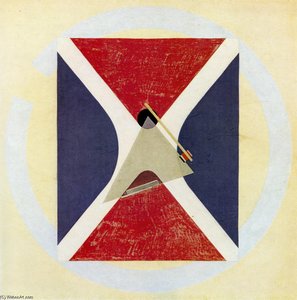
El Lissitzky’s “Four (Arithmetic) Actions”: A Constructivist Meditation on Form and Number
El Lissitzky's "Four (Arithmetic) Actions," painted in 1928, is more than just a depiction of four stacked figures; it’s a potent distillation of the core tenets of Russian Constructivism. This striking black-and-white image, born from Lissitzky’s revolutionary vision, embodies his belief that art could be a tool for social and intellectual transformation – a concept deeply rooted in the burgeoning modernist movement of the time. The painting's stark simplicity belies its complex engagement with mathematical principles, presenting them not as abstract concepts but as tangible forms demanding rigorous investigation.
Constructivist Principles and Geometric Abstraction
Created during a period of intense artistic experimentation following the Russian Revolution, “Four (Arithmetic) Actions)” exemplifies Constructivism’s rejection of traditional representational art. Lissitzky, along with other key figures like Vladimir Tatlin, sought to build a new visual language based on geometric abstraction and industrial forms. The painting's composition – the deliberate layering of the red figures – is a direct manifestation of this approach. Each figure isn't merely a representation of an action; it’s a carefully constructed element contributing to a larger, dynamic whole. The use of bold, primary colors—a conscious choice reflecting the era’s embrace of industrial materials and machine aesthetics—further emphasizes this geometric sensibility.
Symbolism Within the Structure
The numerical markings associated with each figure are crucial to understanding the artwork's deeper meaning. These aren’t arbitrary additions; they represent fundamental mathematical operations – addition, subtraction, multiplication, and division. Lissitzky was interested in exploring how visual forms could embody abstract concepts, transforming mathematics from a theoretical discipline into an accessible and engaging aesthetic experience. The larger figure, visually dominant, can be interpreted as representing the culmination of these actions—the result or outcome of the mathematical process. This layering creates a sense of progression and hierarchy, mirroring the sequential nature of calculation itself.
Historical Context and Artistic Legacy
"Four (Arithmetic) Actions)" was created in 1928, a pivotal year for Lissitzky’s career. It reflects his growing interest in exploring the relationship between art, architecture, and technology – themes that would become central to his later work. The painting's influence extends far beyond its immediate historical context. Lissitzky’s pioneering use of geometric abstraction paved the way for subsequent developments in modern art, including Suprematism and De Stijl. Today, “Four (Arithmetic) Actions)” remains a powerful example of Constructivism’s ambition – a testament to the idea that art can be both intellectually stimulating and profoundly beautiful.
Fragen & Antworten
Für welchen Raum wird "Four (arithmetic) actions" von El Lissitzky empfohlen?
Eine Reproduktion von „Four (arithmetic) actions“ passt hervorragend in ein Living Room.
Wie treffen Bewegung und Epoche in "Four (arithmetic) actions" von El Lissitzky aufeinander?
"Four (arithmetic) actions" von El Lissitzky lässt sich der Constructivism-Strömung innerhalb der Moderne-Ära seines Schöpfers zuordnen.
In welche Phase von El Lissitzkys Schaffen lässt sich "Four (arithmetic) actions" einordnen?
"Four (arithmetic) actions" repräsentiert die Early Period von El Lissitzky.
Biografie des Künstlers
frühes Leben und Ausbildung
El Lissitzky, ein renommierter russischer Künstler, Designer, Fotograf, Typograf, Polemik und Architekt, wurde am 23. November 1890 in Pochinok, Russland, geboren. Sein frühes Leben war geprägt von einem angeborenen Interesse am Zeichnen, das ihn dazu veranlasste, Unterricht bei Yehuda Pen, einem lokalen jüdischen Künstler, im Alter von 13 Jahren zu erhalten.Karriere und Einflüsse
Lissitzkys Karriere war durch seine Zusammenarbeit mit Kazimierz Malevich bei der Entwicklung der Suprematistik gekennzeichnet und beeinflusste maßgeblich die Bauhaus- und Konstruktivismusbewegungen. Seine Werke, die über verschiedene Medien erstreckten, spielten eine entscheidende Rolle bei der Gestaltung des Grafikdesigns im 20. Jahrhundert.- Wichtige Beiträge:
- Entwicklung der suprematistischen Kunstgruppe Unovis mit Kazimierz Malevich
- Erstellung der Reihe "Proun", eine Variante der suprematistischen Serie
- Dienst als russischer Kulturbotschafter in Weimar, Deutschland, und Einfluss auf wichtige Persönlichkeiten des Bauhaus- und De Stijl-Bewegung
- Innovationen:
- Typografie
- Ausstellungsdesign
- Fotomontage
- Buchgestaltung
Bekannte Werke und Vermächtnis
Zu Lissitzkys bekanntesten Werken gehören:- Der Baumeister (1924), ein Fotomontage-Selbstporträt mit wiederkehrenden Themen wie der Hand Gottes und einer Verknüpfung seines jüdischen Erbes mit zeitgenössischen künstlerischen Bewegungen.
- Ein sowjetisches Propaganda-Plakat (1941), eines seiner letzten Werke, das die Bevölkerung aufforderte, mehr Panzer für den Kampf gegen Nazi-Deutschland zu bauen.
Museen und Sammlungen
Lissitzkys Werk befindet sich in verschiedenen Museen, darunter:- Taganrogs Kunstmuseum, Russland /de/art/show/art-d3bb5m-de/
- Novokuznetsks Kunstmuseum, Russland /de/art/show/art-d3akex-de/
Stiftung und Werkverzeichnis
Im Jahr 2014 wurde die Lissitzky-Stiftung in Zusammenarbeit mit dem Van Abbemuseum und führenden internationalen Wissenschaftlern gegründet, um das Erbe des Künstlers zu bewahren und ein Werkverzeichnis seines Oeuvres vorzubereiten.- Für weitere Informationen über El Lissitzky besuchen Sie bitte: https://OriginalUniqueArt.com/@/el-lissitzky
- Erkunden Sie die in Taganrogs Kunstmuseum ausgestellten Werke: /de/art/show/to-explore-the-artworks-exhibited-in-taganrog-art-museum/
Referenzen:
- https://en.wikipedia.org/wiki/el_lissitzky
- https://OriginalUniqueArt.com/@/el-lissitzky

El Lissitzky
1890 - 1941 , Russland
Eckdaten zum Künstler
- Artistic Movement Or Style:
- Suprematismus
- Konstruktivismus
- Artists Or Movements Influenced By This Artist:
- Bauhaus
- De Stijl
- Artists Who Influenced This Artist: ['Kazimir Malevich']
- Date Of Birth: 23. November 1890
- Date Of Death: 1941
- Full Name: El Lissitzky
- Nationality: Russisch/Jüdisch
- Notable Artworks:
- Der Baumeister (1924)
- Proun-Serie
- Sowjetisches Propaganda-Plakat
- Place Of Birth (City And Country): Pochinki, Russland
Verwandte Artikel

Constructivism: A Revolutionary Aesthetic – Ideology, Form & Impact on 20th-Century Art
Explore the revolutionary world of Constructivism! Discover key artists like Malevich & Lissitzky, its impact on modern art & design, and guidance for building a valuable collection. Expert insights at OriginalUniqueArt.

El Greco: Die 25 Meisterwerke – Kunst für Ihr Zuhause | OriginalUniqueArt
Entdecken Sie die 25 bedeutendsten Meisterwerke von El Greco! Erleben Sie die spirituelle Tiefe und den dramatischen Stil des griechischen Malers. Hochwertige Kunstdrucke & Inspiration für Ihr Zuhause auf OriginalUniqueArt.com.

Die Top 10 berühmter Gemälde im Reich der dunklen Töne |
Entdecken Sie die Top 10 berühmter Gemälde, beherrscht von dunklen Tönen! Von Caravaggio bis Manet – erfahren Sie die Geschichten hinter Meisterwerken der Kunstgeschichte. Finden Sie Ihre perfekte Reproduktion auf .
Kazimir Malevich: Die 25 Meisterwerke des Suprematismus für Ihr Zuhause | OriginalUniqueArt
Entdecken Sie die 25 Meisterwerke von Kazimir Malevich! Tauchen Sie ein in die Welt des Suprematismus, abstrakter Kunst & geometrischer Formen. Hochwertige Kunstdrucke und Reproduktionen auf OriginalUniqueArt.com – für Ihr Zuhause.

The Gilded Age Reimagined: Exploring the Aesthetic Principles & Enduring Legacy of Art Deco
Explore the captivating world of Art Deco! Discover its origins, defining features, cultural impact & enduring legacy. Expert insights for collectors and design enthusiasts. Shop handmade reproductions at OriginalUniqueArt.