Zum Druck wechseln
 Weiterlesen







































 Bei Kunstwerken oder Reproduktionen, die an einer Seite größer als 105 cm (ca. 41 Zoll) sind, wird der Rahmen zerlegt als Bausatz geliefert. Diese Methode gewährleistet eine sichere Zustellung und verhindert Schäden während des Transports.


El Lissitzky’s “Flying Sun”: A Dance of Geometry and Spirit
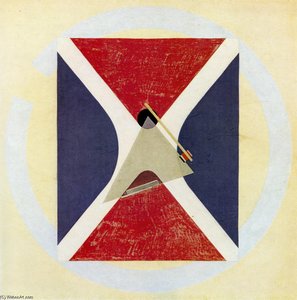
El Lissitzky's "Flying Sun," created in 1916, isn't merely a depiction of a sun; it’s an embodiment of the revolutionary spirit surging through early 20th-century art. Born Lazar Markovich Lissitzky in Pochinki, Russia, he was a pivotal figure in the avant-garde movement, driven by a profound belief that art could actively shape and reflect the dynamism of the modern world. This particular work, executed during his period exploring Suprematism and Cubo-Futurism, encapsulates this ambition with remarkable intensity. It’s a visual poem—a fragmented yet powerfully cohesive exploration of flight, energy, and perhaps even spiritual ascension.
The artwork immediately commands attention through its stark monochrome palette – primarily black and white – which amplifies the impact of the bold geometric forms. Lissitzky masterfully employs lines as his primary tool, constructing a dynamic composition dominated by angular shapes: triangles, rectangles, and curves that intersect and overlap with an almost restless energy. These aren’t representational forms; instead, they are distilled to their purest essence – building blocks of a new visual language. The central figure, depicted in mid-flight, is not rendered realistically but as a stylized bird-like form, radiating upward movement and embodying the aspiration inherent in the title. Surrounding this core element are architectural fragments—suggesting buildings or stylized trees—further enriching the composition’s complexity and hinting at a merging of nature and constructed space.
The Language of Suprematism
“Flying Sun” is deeply rooted in the principles of Suprematism, a movement Lissitzky co-founded with Kazimir Malevich. Suprematists rejected representational art entirely, believing that pure geometric forms – squares, circles, triangles – held the key to expressing fundamental truths about the universe. In this piece, Lissitzky utilizes these basic shapes not as static elements but as dynamic components of a flowing composition. The deliberate flattening of perspective—a characteristic of Suprematism—further emphasizes the two-dimensionality of the artwork and directs the viewer’s eye across the fragmented yet balanced arrangement of forms. The use of hatching and cross-hatching adds subtle textural variations, creating an illusion of shading and depth without resorting to traditional modeling techniques.
Symbolism and Spiritual Resonance
Beyond its formal qualities, “Flying Sun” is rich in symbolic potential. The title itself—"Flying Sun"—evokes themes of flight, transcendence, and perhaps even spiritual ascension. The sun, a potent symbol across cultures, represents life, energy, and enlightenment. Lissitzky’s depiction of it in mid-flight suggests a journey towards something higher, a striving for a new state of being. The angular forms surrounding the central figure could be interpreted as representing obstacles or challenges overcome during this ascent. Considering Lissitzky's broader artistic philosophy—his belief in art’s capacity to transform society—it’s reasonable to suggest that “Flying Sun” embodies a vision of progress and renewal, reflecting the hopes and anxieties of a rapidly changing world.
Craftsmanship and Reproduction
The artwork was likely executed using pencil or charcoal on paper, lending it a tactile quality. Lissitzky's skillful manipulation of line creates a sense of immediacy and dynamism. The subtle tonal variations achieved through hatching and cross-hatching contribute to the illusion of three-dimensionality, suggesting light and shadow while maintaining the overall flatness of the composition. A high-quality reproduction, such as those offered by OriginalUniqueArt.com, allows one to appreciate the meticulous detail and expressive power of Lissitzky’s technique. The careful rendering of lines and textures—a testament to his artistic skill—makes this a truly captivating piece for any art collection or interior space.
Fragen & Antworten
Wie intensiv und gesättigt sind die Farben von "Fliegender Sonn" von El Lissitzky?
Die Farbsättigung von "Fliegender Sonn" beträgt Gedämpft bei einer Intensität von Monochrom.
Für welche Verwendung und welchen Raum wird "Fliegender Sonn" von El Lissitzky empfohlen?
Empfohlene Verwendung (Statement-Piece) und Raum (Wohnbereich) sind die zwei Empfehlungen für "Fliegender Sonn" von El Lissitzky.
Ist "Fliegender Sonn" insgesamt eher hell oder eher dunkel?
Die aufgezeichneten Werte für "Fliegender Sonn" von El Lissitzky sind: strahlend Helligkeit, Helle Balance Luminanz.
 Vorschau anzeigen
 Versenden
 Teilen
 Details anzeigen
 Leitfaden

 Herunterladen
 Ähnliche Objekte
 Röntgenaufnahme
 Diashow
 Fragen & Antworten
 Statistiken