 Vorschau anzeigen
 Versenden
 Teilen
 Details anzeigen

 Herunterladen
 Ähnliche Objekte
 Röntgenaufnahme
 Diashow
Berg Sinai
 Öl auf Holztafel
- Mannerism
 1570
1570- Renaissance
 41.0 x 47.0 cm
 Historisches Museum Kreta
 Weiterlesen
Handgefertigte Ölreproduktion
Handgemaltes Ölgemälde auf Leinwand in Ihrer Wunschgröße und mit Rahmen, auf Bestellung von unseren Künstlern angefertigt. ( Druck bestellen Bild kaufen)




P118B $10

P118H $10

P118W $10

P438Z $10

P508JH $12

P508YH $12

P805H $10

P805Z $10

P919BZ $10

P919G $10

P919XJ $10

P959ZH $10

P968JZ $12

W106C $8

W218G $10

W218JH $8

W218Y $10

W307PJ $10

W316G $10

W316PJ $8

W316Y $10

W398PJ $8

W4111J $10

W500HY $15

W500JH $15

W692G $12

W849H $8

W940BG $15

W953PJ $8




Wählen Sie aus unseren vordefinierten Formaten, die den ursprünglichen Proportionen des Kunstwerks entsprechen.

Sie können Ihre eigenen Maße eingeben, um einen bestimmten Rahmen oder Platz auszufüllen. Wenn die gewählte Größe nicht den Proportionen des Originalbildes entspricht, werden wir das Kunstwerk entweder beschneiden oder das Gemälde durch zusätzliche, handgemalte Elemente erweitern. Ein digitales Mockup wird Ihnen zur Genehmigung zugesandt, bevor die Produktion beginnt.
Bitte beachten Sie, dass die Bildschirmvorschau nicht die tatsächliche Beschneidung oder Erweiterung widerspiegelt. Nur das Mockup zeigt die endgültige Komposition exakt an.
Obwohl Sondermaße verfügbar sind, empfehlen wir, eine Größe aus der vordefinierten Liste zu wählen, um die ursprünglichen Proportionen beizubehalten.
Nach der Bestellung wird das OriginalUniqueArt.com-Team dem Kunden Anweisungen per E-Mail zusenden und eine Mockup-Vorschau bereitstellen.
Weltweiter Versand () in nur 3 bis 4 Wochen statt der üblichen 5 Wochen. (6 September). Keine Kompromisse bei der Qualität.

Kostenloser weltweiter Expressversand

Hochwertige Leinenleinwand

Umfassender Versicherungsschutz beim Versand

Zollgebühren-Rückerstattungsgarantie

Garantie für exakte Farbtreue

100 Tage Rückgaberecht (nur bei Mängeln)

100% Geld-zurück-Garantie

Mengenrabatt verfügbar
 Die Glasoption ist nur für Größen unter 110 cm verfügbar.

Berg Sinai
Art der Reproduktion
Format der Reproduktion
-


Gesamtpreis
$ 300
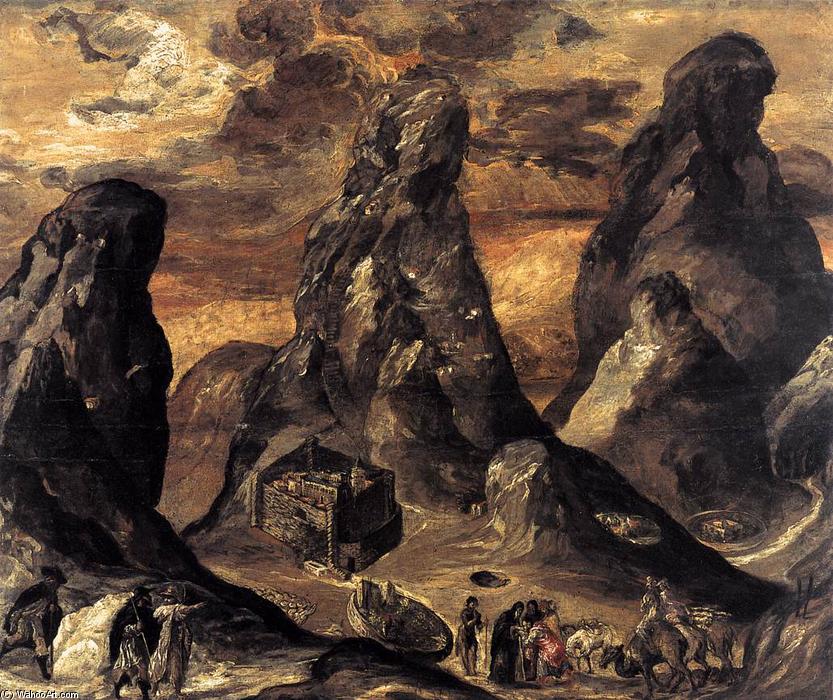
El Greco’s “Mount Sinai”: A Dance Between Byzantine Reverence and Renaissance Innovation
El Greco’s “Mount Sinai,” painted circa 1570, is not merely a depiction of a biblical landscape; it's a profound meditation on faith, humanity, and the divine. This remarkable work, housed in the Historical Museum of Crete in Iraklion, offers a captivating glimpse into the artist’s unique vision – a synthesis of his rigorous Byzantine training with the burgeoning dynamism of Renaissance art. Measuring just 41 x 47 cm, the painting belies its intimate scale with an astonishing depth and emotional intensity. The scene unfolds against a dramatic, almost apocalyptic sky, dominated by three colossal rocks that immediately draw the eye. These aren’t simply geological formations; they are anthropomorphic figures, their faces etched into the stone – a deliberate choice that injects a potent layer of symbolism, hinting at the presence of the divine amidst the earthly realm.
The composition is strikingly unconventional for its time. El Greco masterfully employs perspective to create a sense of vastness and drama, pulling the viewer directly into the heart of the landscape. Two horses are strategically placed within the scene – one on the right, adding a touch of movement and vitality, while another, more centrally located, anchors the composition with a grounding presence. Scattered throughout the terrain are several figures, some standing in quiet contemplation near the rocks, others seemingly lost in the immensity of the vista. These human elements serve as a crucial counterpoint to the monumental nature of the mountain itself, reminding us of humanity’s place within a larger, spiritual narrative. The use of gold leaf, characteristic of his Byzantine heritage, subtly illuminates key areas – particularly the faces of the rocks and certain sections of the landscape – lending an ethereal quality to the scene.
A Fusion of Styles: Byzantine Roots, Renaissance Echoes
El Greco’s artistic style in “Mount Sinai” is a fascinating testament to his eclectic training. While undeniably rooted in the traditions of Byzantine iconography—noticeable in the elongated figures, the use of rich color palettes (though muted here), and the overall sense of spiritual solemnity – he skillfully incorporates elements of Renaissance technique. The detailed rendering of the rocks, with their meticulously sculpted surfaces, demonstrates a newfound attention to naturalism that was gaining prominence during this period. Furthermore, the dynamic brushwork and expressive handling of light suggest an influence from Venetian masters like Titian and Tintoretto, artists known for their dramatic use of color and emotional intensity. This skillful blending of influences is what truly defines El Greco’s unique style – a synthesis of the sacred and the secular, the spiritual and the earthly.
Symbolism and Spiritual Depth
“Mount Sinai” is rich in symbolic meaning. The three rocks with faces are arguably the painting's most potent symbol, representing the divine presence at this pivotal location. It’s a direct reference to the biblical narrative of Moses receiving the Ten Commandments from God on Mount Horeb (often identified with Mount Sinai). The inclusion of animals – particularly the horses – further reinforces this connection between the earthly and the divine, suggesting a realm beyond human comprehension. The landscape itself can be interpreted as a metaphor for the soul’s journey towards enlightenment, with the mountain representing the ultimate goal—a state of spiritual union with God. The overall mood is one of reverence and awe, inviting contemplation on themes of faith, obedience, and the relationship between humanity and the divine.
A Legacy of Innovation: El Greco's Enduring Influence
El Greco’s prolific output spanned a remarkable career, producing numerous works that showcased his distinctive style. Alongside “Mount Sinai,” other notable paintings include "Christ Healing the Blind," a poignant depiction of Christ’s miraculous act, and a series of depictions of the Apostles, such as “Apostle St Peter” and “Apostle St Simon.” These works further demonstrate El Greco's ability to infuse religious subjects with intense emotion and dramatic visual impact. His legacy extends far beyond his own time, influencing generations of artists who followed in his footsteps – from Expressionists like Kirchner and Heckel to Cubists like Picasso. El Greco’s willingness to break with convention, to prioritize emotional expression over strict realism, cemented his place as one of the most innovative and influential figures in Western art history. For those seeking a high-quality reproduction of this masterpiece, OriginalUniqueArt.com offers meticulously crafted hand-painted reproductions that faithfully capture the painting's beauty and depth.
Über den Künstler
**frühes Leben und Ausbildung**
El Greco (Doménikos Theotokopoulos), ein renommierter griechischer Maler, Bildhauer und Architekt, wurde 1541 in Kreta geboren, das damals unter venezianischer Herrschaft stand. Sein Geburtsname war Doménikos Theotokopoulos. El Grecos frühe Ausbildung als Ikonenmaler der kreter Schule, einem führenden Zentrum für byzantinische Kunst nach dem Fall des Reiches, legte den Grundstein für seine zukünftigen künstlerischen Bemühungen.**Künstlerische Entwicklung und Einflüsse**
El Gredos künstlerischer Stil wurde durch seine Reisen nach Venedig und Rom geprägt, wo er Manierismus- und Renaissance-Stile aufnahm, insbesondere von Tintoretto und Tizian beeinflusst. Seine Umsiedlung nach Toledo, Spanien, im Jahr 1577 markierte eine Periode fruchtbarer Schaffenskraft, die zu Meisterwerken wie Ansicht von Toledo und das Öffnen des fünften Siegels führte.**Bekannte Werke und Stil**
* Allegorie der Camaldulitenorden (Manierismus, Öl) – ein Zeugnis für El Gredos einzigartige Mischung aus byzantinischen Traditionen und westlichen stilistischen Elementen. * Fabel (Manierismus, Öl) – demonstriert seine Verwendung ungewöhnlicher, lebhafter Farben. * Giacomo Bosio (Manierismus, Öl) – zeigt El Gredos Meisterschaft im Manierismus-Stil.**Vermächtnis und Einfluss**
El Gredos dramatischer und expressiver Stil, der durch verlängerte Figuren und fantastische Pigmentierung gekennzeichnet ist, war eine Quelle der Inspiration für Dichter und Schriftsteller. Er gilt als Vorläufer des Expressionismus und Kubismus. Für mehr Informationen über das Leben und Werk von El Greco besuchen Sie [https://OriginalUniqueArt.com/@/el-greco-(domenikos-theotokopoulos)](https://OriginalUniqueArt.com/@/el-greco-(domenikos-theotokopoulos)).- **Betrachten Sie El Gredos Gemälde** unter [https://OriginalUniqueArt.com/@@/85fr95-el-greco-(domenikos-theotokopoulos)-allegory-of-the-camaldolite-order](https://OriginalUniqueArt.com/@@/85fr95-el-greco-(domenikos-theotokopoulos)-allegory-of-the-camaldolite-order)
- **Erfahren Sie mehr über das Leben und Werk von El Greco** unter [https://en.wikipedia.org/wiki/el_greco](https://en.wikipedia.org/wiki/el_greco)
- **Entdecken Sie das Hellenische Institut für byzantinische und post-byzantinische Studien**, das eine breite Palette von Artefakten umfasst, die das reiche künstlerische Erbe Byzants zu reflektieren, unter /de/art/show/art-d3b8bv-de/

El Greco
1541 - 1614 , Griechenland
Kurzinfos
- Beeinflusste Künstler:
- Tintoretto
- Tizian
- Bemerkenswerte Werke:
- Grablegung des Grafen Orgaz
- Blick auf Toledo
- Öffnung des fünften Siegels
- Geburtsdatum: 1541
- Geburtsort: Kreta, Griechenland
- Künstlerische Richtung: Manierismus, Spanische Renaissance
- Nationalität: Griechisch-Spanisch
- Todatum: 1614
- Vollständiger Name: El Greco (Doménikos Theotokópoulos)
- Von Künstlern Beeinflusst: ['Byzantinische Traditionen']
Ähnliche Artikel

El Greco: Die 25 Meisterwerke – Kunst für Ihr Zuhause | OriginalUniqueArt
Entdecken Sie die 25 bedeutendsten Meisterwerke von El Greco! Erleben Sie die spirituelle Tiefe und den dramatischen Stil des griechischen Malers. Hochwertige Kunstdrucke & Inspiration für Ihr Zuhause auf OriginalUniqueArt.com.
El Greco: Spiritualität, Stil und Innovation – Das Vermächtnis eines Renaissance-Meisters
Entdecken Sie das faszinierende Werk von El Greco! Erfahren Sie mehr über seine einzigartigen Stilmerkmale, den Manierismus und sein spirituelles Vermächtnis. Expertenwissen zur Renaissance-Malerei.
Mannerism Unveiled: The Dramatic Evolution of Renaissance Art and the Visionary Legacy of El Greco
Explore the dramatic transition from High Renaissance harmony to Mannerist tension. Discover how masters like El Greco redefined art through distortion and spiritual intensity. An expert guide for art enthusiasts seeking deep historical context and museum-quality inspiration.

The Enduring Legacy of Oil on Canvas: Technique, History & Aesthetic Impact
Explore the rich history & techniques of oil painting – from Renaissance masters to Impressionism. Discover pigments, layering methods, and why this timeless medium endures. Expert insights for artists & art enthusiasts.

Öl auf Leinwand: Eine historische und technische Erkundung eines zeitlosen künstlerischen Mediums
Entdecken Sie die faszinierende Welt der Ölmalerei! Von historischen Techniken bis zur modernen Anwendung – wir bieten Expertenwissen, Restaurierungstipps und hochwertige Reproduktionen. Jetzt informieren!