 Vorschau anzeigen
 Versenden
 Teilen
 Details anzeigen

 Herunterladen
 Ähnliche Objekte
 Röntgenaufnahme
 Diashow
 Stats
StatsPeaceable Kingdom


 Weiterlesen
Giclée / Kunstdruck
Giclée- oder Leinwanddruck in Museumsqualität mit schneller Produktion und flexiblen Veredelungsoptionen. ( Handgemalte Reproduktion bestellen Switch to Digital Image)




P118B $10

P118H $10

P118W $10

P438Z $10

P508JH $12

P508YH $12

P805H $10

P805Z $10

P919BZ $10

P919G $10

P919XJ $10

P959ZH $10

P968JZ $12

W106C $8

W218G $10

W218JH $8

W218Y $10

W307PJ $10

W316G $10

W316PJ $8

W316Y $10

W398PJ $8

W4111J $10

W500HY $15

W500JH $15

W692G $12

W849H $8

W940BG $15

W953PJ $8




Wählen Sie aus unseren vordefinierten Formaten, die den ursprünglichen Proportionen des Kunstwerks entsprechen.

Sie können Ihre eigenen Maße eingeben, um ein bestimmtes Format oder einen speziellen Platz einzupassen. Wenn das von Ihnen gewählte Format nicht den Proportionen des Originalbildes entspricht, werden wir das Kunstwerk entweder beschneiden oder das Bild mit einem gespiegelten oder einfarbigen Rand erweitern. Ein digitaler Entwurf wird Ihnen zur Genehmigung zugesandt, bevor die Produktion beginnt.
Bitte beachten Sie, dass die Vorschau auf dem Bildschirm nicht den tatsächlichen Zuschnitt oder die Erweiterung widerspiegelt. Nur der Entwurf zeigt die endgültige Komposition präzise an.
Obwohl Sondermaße verfügbar sind, empfehlen wir die Auswahl eines Maßes aus der vordefinierten Liste, um die ursprünglichen Proportionen zu bewahren.
Weltweiter Versand () innerhalb von 2 Wochen statt der üblichen 4/5 Wochen. (8 September)

Kostenloser weltweiter Expressversand

Hochwertige Leinenleinwand

Umfassender Versicherungsschutz beim Versand

Zollgebühren-Rückerstattungsgarantie

Garantie für exakte Farbtreue

100-Tage-Rückgaberecht (nur bei Mängeln)

100% Geld-zurück-Garantie

Mengenrabatt verfügbar
 Die Glasoption ist nur für Größen unter 110 cm verfügbar.

Peaceable Kingdom
Giclée / Kunstdruck
Format der Reproduktion
-


Gesamtpreis
$ 80
A Pastoral Vision of Dominion: Edward Hicks’ “Peaceable Kingdom”
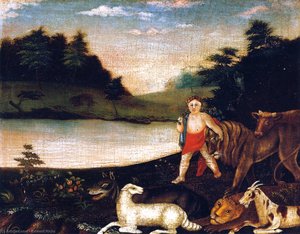
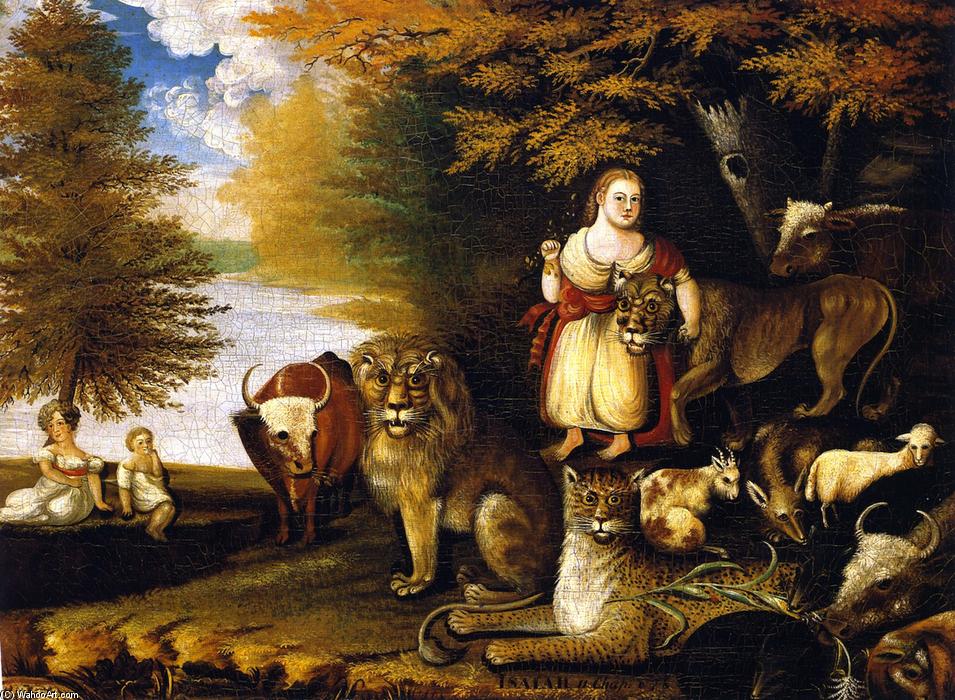
Edward Hicks' "Peaceable Kingdom," painted in 1830, is more than just a beautiful depiction of a rural landscape; it’s a profound meditation on faith, power, and the delicate balance between humanity and nature. This monumental oil painting, now a cornerstone of American art history, offers a glimpse into the heart of Quaker belief and Hicks' uniquely expressive artistic vision. The scene unfolds with an almost overwhelming sense of serenity – a vast meadow teeming with life, dominated by a central female figure holding aloft a symbolic crown or scepter. Lions, bulls, leopards, sheep, and cows gather around her, seemingly rendered docile and content under her watchful gaze. It’s a tableau that immediately evokes the grandeur of Renaissance allegories while retaining a distinctly American sensibility.
The Quaker Narrative: Faith as Foundation
Understanding Hicks' artistic practice requires acknowledging his deep connection to the Religious Society of Friends, or Quakers. Born into an Anglican family but raised by the devout Matron Elizabeth Twining, Hicks’ life was fundamentally shaped by their core tenets – simplicity, peace, and a belief in the “inner light” – that resided within each individual. "Peaceable Kingdom" isn't simply a landscape; it’s a visual representation of this spiritual philosophy. The central figure is often interpreted as representing Christ or Providence, embodying divine authority and offering a message of reconciliation and harmony. The animals, traditionally symbols of earthly power and potential conflict, are rendered peaceful and obedient, suggesting that true dominion comes not through force but through grace and understanding.
Technique and Composition: A Masterclass in Detail
Hicks’ masterful technique is immediately apparent upon close inspection. The painting is executed in the rich, layered style of oil paint, utilizing a meticulous approach to detail that was characteristic of his work. He employs a carefully constructed composition, drawing the eye towards the central figure through strategic use of light and shadow. The receding planes of land and trees create a sense of depth, while the vibrant colors – dominated by warm golds, browns, and reds – contribute to the painting’s overall warmth and inviting quality. Noticeably, Hicks utilizes impasto in certain areas, particularly within the foliage and animal fur, adding textural richness and emphasizing the tactile nature of the scene. The flattened perspective, reminiscent of earlier Renaissance styles, is skillfully balanced by a dynamic arrangement of figures and elements, preventing the composition from feeling static.
Symbolism Unveiled: A Tapestry of Meaning
Beyond its immediate visual appeal, “Peaceable Kingdom” is laden with symbolic meaning. The animals themselves carry significant weight – the lion representing strength, the bull symbolizing fertility and earthly power, the leopard embodying cunning and vigilance, while sheep represent innocence and vulnerability. The woman’s crown or scepter isn't merely a symbol of authority; it represents the divine right to rule, not through coercion but through benevolent guidance. The presence of two women seated beneath the tree on the left side adds another layer of interpretation, potentially representing the role of female wisdom and nurturing within this harmonious landscape. Even the body of water reflecting the sky reinforces the theme of interconnectedness – mirroring the heavens in the earth below.
“Peaceable Kingdom” remains a powerful testament to Edward Hicks’ artistic vision and his unwavering faith. It's a painting that invites contemplation, prompting viewers to consider their own relationship with nature, power, and the enduring promise of peace. Reproductions offer an accessible way to experience this remarkable work of art, bringing its serene beauty and profound symbolism into any space.
Über den Künstler
Frühes Leben und Hintergrund
- Geboren: 4. April 1780 in Attleboro (heute Langhorne), Bucks County, Pennsylvania
- Gestorben: 23. August 1849
- Seine Eltern waren Anglikaner, aber er wurde von Matron Elizabeth Twining, einer Quäkerin, aufgezogen. Dies führte ihn schon in jungen Jahren an die quakerischen Glaubensvorstellungen heran.
- Im Alter von dreizehn Jahren begann er eine Lehre bei den Karrenbauern William und Henry Tomlinson und lernte dort Karrenmaltechniken.
- Er verließ die Firma im Jahr 1800, um als unabhängiger Haus- und Karrenmaler zu arbeiten.
Quäkerisches Wirken und künstlerische Entwicklung
- Er wurde 1803 in die Religious Society of Friends aufgenommen und begann regelmäßig an Quäkerversammlungen teilzunehmen.
- Er heiratete Sarah Worstall, ebenfalls eine Quäkerin, und wurde im ganzen Philadelphia ein reisender Prediger.
- Um seine Familie zu unterstützen, erweiterte er seine Malerei um Haushaltsgegenstände, landwirtschaftliche Geräte und Wirtshausschilder.
- Er gab 1815 aufgrund finanzieller Schwierigkeiten kurzzeitig die Zierdekorationsmalerei auf, nahm sie aber 1816 wieder auf.
Künstlerischer Stil und Hauptwerke
- Autodidakt: Hicks war weitgehend autodidaktisch tätig und entwickelte einen einzigartigen Folk-Art-Stil.
- Quäkerische Einflüsse: Seine Arbeit spiegelte die quäkerischen Glaubensvorstellungen vom "Inneren Licht" wider, wobei er persönliche spirituelle Erfahrungen betonte. Dies zeigt sich in seinen einfachen Kompositionen und seinem Fokus auf die Natur.
- Die Friedensreich-Serie: Seine berühmteste Serie umfasst 62 Versionen und stellt eine Vision der Harmonie zwischen Mensch und Tier dar, die Frieden und Koexistenz symbolisiert.
- Bemerkenswerte Gemälde:
- Friedensreich (31) – Beherbergt in der Yale University Art Gallery
- Niagarafälle – Beherbergt im Abby Aldrich Rockefeller Folk Art Center
- George Washington mit seiner Armee, die den Delaware überquert – Ebenfalls beherbergt im Abby Aldrich Rockefeller Folk Art Center
- Friedensreich (34) - Stellt in einem ruhigen Ölgemälde Noahs Arche dar.
- Grab von William Penn in Jordans, England - Eine Darstellung ländlicher englischer Szenerie, die das quäkerische Erbe zeigt.
Vermächtnis und historische Bedeutung
- Folk-Art-Ikone: Edward Hicks gilt als bedeutende Figur der amerikanischen Folk Art, bekannt für seinen unverwechselbaren Stil und seine wiederkehrenden Themen.
- Darstellung quäkerischer Werte: Seine Gemälde geben wertvolle Einblicke in die Glaubensvorstellungen und Werte der Religious Society of Friends im 19. Jahrhundert.
- Einzigartige künstlerische Vision: Hicks verband religiösen Glauben mit künstlerischem Ausdruck und schuf ein Werk, das sowohl optisch ansprechend als auch spirituell bedeutsam ist.
- Fortwährende Wertschätzung: Seine Werke werden in wichtigen Museen ausgestellt und werden weiterhin für ihre historische und künstlerische Bedeutung studiert und geschätzt.

Edward Hicks
1780 - 1849 , Vereinigte Staaten von Amerika
Kurzinfos
- Artistic Movement Or Style: Volkskunst
- Date Of Birth: 4. April 1780
- Date Of Death: 23. August 1849
- Full Name: Edward Hicks
- Nationality: Amerikanisch
- Notable Artworks:
- Peaceable Kingdom (31)
- Falls of Niagara
- George Washington Crossing Delaware
- Peaceable Kingdom (34)
- Grave of William Penn
- Place Of Birth (City And Country): Attleboro, USA
Ähnliche Artikel

Edward Hicks’ ‘Peaceable Kingdom’: American Folk Art & the Shaping of a National Identity
Explore the profound symbolism & historical context of Edward Hicks’ ‘Peaceable Kingdom.’ Discover how this iconic American folk art masterpiece reflects Quaker values and shaped a nation's identity. Learn more at OriginalUniqueArt.
The Soul of Tradition: Exploring the Vibrant Heritage and Naive Mastery of Global Folk Art
Discover the profound beauty of folk art through a cultural lens. Explore how naive masterpieces and vibrant global traditions preserve heritage, offering timeless inspiration for collectors and art enthusiasts seeking authenticity and soul in every brushstroke.

Meisterwerke des 19. Jahrhunderts: Kunst für Ihr Zuhause | OriginalUniqueArt
Entdecken Sie die 10 bedeutendsten Kunstwerke des 19. Jahrhunderts! Von Impressionismus bis Realismus – erleben Sie die Geschichten berühmter Maler und ihre Meisterwerke. Hochwertige Reproduktionen für Ihr Zuhause auf OriginalUniqueArt.com.
Edward Hopper: Die 25 Meisterwerke des amerikanischen Realismus | OriginalUniqueArt
Entdecken Sie die 25 Meisterwerke von Edward Hopper! Tauchen Sie ein in amerikanische Kunst, Realismus & Isolation. Hochwertige Reproduktionen & Inspiration für Ihr Zuhause bei OriginalUniqueArt.com.
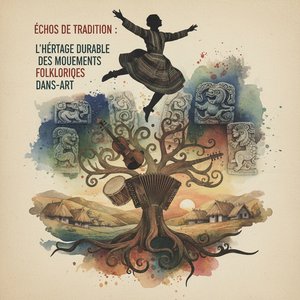
Echoes of Tradition: Exploring the Enduring Legacy of Folk Art Movements
Explore the rich history of folk art movements worldwide! Discover definitions, notable artists, and the enduring legacy of this captivating tradition. Expert insights & high-quality reproductions at OriginalUniqueArt.