

 In echtem Maßstab anzeigen
 Versenden als Grußkarte
 Teilen
 Details anzeigen
 Leitfaden öffnen

 Herunterladen
 Ähnliche Objekte
 Röntgenaufnahme
 Diashow
 Besucherstatistiken
Le Bailarin

 Mehr anzeigen
Erwerben Sie ein hochauflösendes, optimiertes digitales Bild, das der Online-Vorschau weit überlegen ist.
Jede Datei wird von unseren hauseigenen Spezialisten mit modernsten Werkzeugen und fachmännischer manueller Retusche sorgfältig vorbereitet. Wir stellen sicher, dass jedes Bild eine außergewöhnliche Klarheit, präzise Farbgenauigkeit und feinste Details aufweist.
Die endgültige Datei wird innerhalb von 72 Stunden per E-Mail zugestellt und ist für den sofortigen Einsatz in professionellen, redaktionellen und Druckumgebungen optimiert. Es handelt sich um dieselbe Qualität, der führende Designstudios, Verlage und Galerien vertrauen.
Digitales Bild
Laden Sie eine hochauflösende Datei für die persönliche Präsentation, den Druck und kreative Projekte herunter. ( Zum Druck wechseln Handgemalte Reproduktion kaufen)
In jeder Bestellung digitaler Bilder enthalten
Professionelle digitale Bereitstellung, garantiert
Wenn Sie sich für OriginalUniqueArt.com entscheiden, erhalten Sie nicht nur ein Bild – Sie erhalten ein professionell aufbereitetes digitales Kunstwerk, das mit höchster Präzision erstellt und durch eine Zufriedenheitsgarantie abgesichert wird. Hier ist alles, was automatisch mit Ihrer Bestellung geliefert wird:

Schnelle E-Mail-Zustellung
Ihre hochauflösende digitale Bilddatei wird Ihnen innerhalb von 72 Stunden nach der Bestellung per E-Mail zugestellt – bereit zur sofortigen Verwendung.

KI-optimierte digitale Datei
Ihre Kunstwerke werden professionell mithilfe fortschrittlicher KI-Tools und manueller Bearbeitung optimiert, um maximale Detailtreue, Klarheit und Farbgenauigkeit zu gewährleisten.

Kostenloser lebenslanger Neudruckservice
Datei versehentlich gelöscht oder verloren? Keine Sorge – wir senden sie Ihnen jederzeit kostenlos erneut zu.

Keine Einfuhrgebühren – jemals
Genießen Sie Ihr Kunstwerk sofort ohne Zollgebühren, Einfuhrabgaben oder Versandkosten – digitale Downloads sind immer steuerfrei.

Garantierte Farbtreue
Wir garantieren, dass Ihr digitales Bild mithilfe professioneller Werkzeuge und Farbmanagement die Originalfarben so präzise wie möglich wiedergibt.

100-Tage-Zufriedenheitsgarantie
Sollten Sie mit Ihrem digitalen Bild nicht zufrieden sein, werden wir es überarbeiten oder 100% innerhalb von 100 Tagen erstatten – ohne Wenn und Aber.

100% Geld-zurück-Garantie
Nicht zufrieden? Erhalten Sie innerhalb von 100 Tagen nach Erhalt Ihrer digitalen Datei eine vollständige Rückerstattung – ohne Wenn und Aber.

Rabatte bei Großbestellungen
3 Bilder kaufen, 10% sparen – 5 Bilder kaufen, 15% sparen – Ab 10 Bildern 20% sparen. Ideal für kreative Projekte, Galerien und Agenturen.
Édouard Manet’s ‘Le Bailarin’: A Parisian Snapshot of Grace and Intrigue
Édouard Manet's “Le Bailarin” – originally titled “Don Mariano Camprubi” – is more than just a black-and-white drawing; it’s a meticulously crafted window into 19th-century Parisian life. Completed around 1862, this work encapsulates the spirit of a rapidly changing city, blending elements of realism with Manet's signature stylistic choices and a subtle undercurrent of theatricality. The image depicts a man in formal attire – a dark suit, a striking mustache, and a jaunty hat – standing on one leg while confidently holding a sword. A tie and a book peek out from the lower left corner, adding layers to the scene’s narrative potential. It's a moment frozen in time, radiating an aura of quiet dignity and perhaps even a touch of calculated performance.
Manet was a revolutionary figure in the art world, deliberately challenging the established conventions of academic painting. He wasn’t interested in simply replicating historical or mythological subjects; instead, he sought to capture the immediacy and complexity of modern Parisian life – its social dynamics, its urban bustle, and even its inherent contradictions. “Le Bailarin” exemplifies this approach. The subject himself is an enigmatic figure, a ‘bailarín’ (dancer) from the Royal Theatre of Madrid, whose presence immediately invites questions about his profession, his status, and perhaps even his story. The drawing isn't a portrait in the traditional sense; it feels more like a carefully observed study of a single, compelling individual within a specific context.
Technique and Style: A Masterclass in Line and Shadow
Manet’s masterful use of etching is central to the work’s impact. The stark black lines create a remarkably detailed image, capturing the texture of the man's clothing, the curve of his stance, and the subtle nuances of his expression. He employed a technique known as ‘drypoint,’ which produces a velvety tonal range – a characteristic that lends the drawing its distinctive richness and depth. Notice how he uses varying line weights to suggest form and volume; heavier lines define the solid areas, while lighter lines delineate shadows and contours. This careful attention to detail is indicative of Manet’s rigorous artistic process—he dissected the techniques of Old Masters like Caravaggio and Velázquez, learning from their mastery of light and shadow to sculpt form on the plate.
Furthermore, Manet's style departs significantly from the smooth, polished surfaces favored by academic painters. His lines are often loose and expressive, conveying a sense of immediacy and spontaneity. This deliberate roughness contributes to the drawing’s raw energy and its departure from idealized representations. The composition itself is deliberately asymmetrical, creating a dynamic tension that draws the viewer's eye across the image.
Symbolism and Context: A Glimpse into Parisian Society
Beyond the immediate depiction of the dancer, “Le Bailarin” offers clues about the social landscape of 19th-century Paris. The presence of a theatre performer suggests a vibrant entertainment scene – a world of glamour, spectacle, and perhaps also exploitation. The book in the lower left corner hints at intellectual pursuits and cultural engagement, contrasting with the more tangible world of performance. The sword, held with such assuredness, could symbolize power, status, or even danger—a potent visual metaphor within the context of Parisian society.
Manet’s work reflects a period of significant social and political change in France. The Second Empire (1852-1870) was marked by rapid industrialization, urbanization, and growing social inequalities. Manet's art often engaged with these themes, offering critical perspectives on the realities of modern life. “Le Bailarin” can be interpreted as a subtle commentary on the complexities of Parisian society – its contradictions, its aspirations, and its inherent tensions.
Emotional Impact and Artistic Legacy
Despite its seemingly simple subject matter, “Le Bailarin” evokes a powerful emotional response. The dancer’s posture exudes confidence and self-possession, yet there's also an element of vulnerability in his gaze. The drawing invites us to contemplate the individual within the crowd, to consider his story, and to reflect on our own place within the larger social fabric. Manet’s work paved the way for Impressionism and subsequent modern art movements, challenging traditional notions of beauty and representation.
Reproductions of “Le Bailarin” offer a remarkable opportunity to experience this seminal artwork firsthand. A high-quality reproduction captures the intricate details of Manet's etching, allowing viewers to appreciate his technical skill and artistic vision. It’s a piece that continues to resonate with audiences today, reminding us of the enduring power of art to capture the essence of human experience.
Fragen & Antworten
Wofür wird eine Reproduktion von "Le Bailarin" von Édouard Manet empfohlen?
Eine Reproduktion von "Le Bailarin" von Édouard Manet wird für Statement-Piece empfohlen. Dieser Vorschlag ergibt sich aus dem Motiv, der Stimmung und den Farben des Werkes.
Wer verkauft handgemalte Kopien von "Le Bailarin" von Édouard Manet?
Handgemalte Kopien von "Le Bailarin" von Édouard Manet werden auf diese Website verkauft: eine handgemalte Ölreproduktion auf Leinenleinwand, bestellbar über die Seite Handgemalte Reproduktion.
Welche Druckgröße von "Le Bailarin" von Édouard Manet passt in den empfohlenen Raum?
Für einen Wohnbereich ist die empfohlene Druckgröße von "Le Bailarin" von Édouard Manet Großformatig.
Künstlerbiografie
frühes Leben und Karriere
Édouard Manet, ein französischer modernistischer Maler, wurde am 23. Januar 1832 in Paris geboren. Er widersetzte sich seinen bürgerlichen Wurzeln und einem vorgezeichneten Seekriegspfad und etablierte sich als mutiger französischer Modernist, dessen Leinwände die Lebendigkeit des 19. Jahrhunderts einfingen. Er wird weithin für seine Rolle bei der Pionierarbeit des Impressionismus gelobt, der die Kunst von der Malerei in unbekannte Gebiete lenkte.Bekannte Werke
Manets frühe Meisterwerke, Das Picknick auf der Wiese (Le déjeuner sur l'herbe) (1863) und Olympia (1865), waren radikal, stellten künstlerische Normen in Frage und lösten Empörung bei Traditionalisten aus. Diese provokanten Werke wurden von fortschrittlichen Kollegen anerkannt und säten die Saat des Impressionismus. * Das Picknick auf der Wiese (Le déjeuner sur l'herbe) (1863) - ein Gemälde, das sowohl bei Kritikern als auch bei der Kunstakademie für Kontroversen sorgte. * Olympia (1865) – ein Werk, das aufgrund seiner Darstellung einer nackten weißen Frau in Begleitung einer schwarzen Dienstmädchen große Aufregung auslöste.Museen und Sammlungen
Manets Werke befinden sich in verschiedenen Museen auf der ganzen Welt, darunter: * Musée d'Orsay (Paris, Frankreich) – beherbergt eine umfangreiche Sammlung von Manets Gemälden, darunter Olympia. * Museum of Fine Arts (Boston, USA) – zeigt Manets Porträt von Victorine Meurent, ein bemerkenswertes Werk seines Oeuvres.Vermächtnis und Einfluss
Manets innovativer Stil, der durch breite, schnelle Pinselstriche, Studiobeleuchtung und geringe Tiefenwirkung gekennzeichnet ist, hat zukünftige Maler maßgeblich beeinflusst. Sein Vermächtnis kann in den Werken zahlreicher Künstler gesehen werden, die auf seinen Füßen folgen.- Impressionismus: Seine Pionierarbeit in diesem Stil hat ihn zu einer bekannten Figur unter Kunstliebhabern gemacht.
- Realismus: Seine Ablehnung traditioneller realistischer Ansätze ebnete den Weg für eine neue Generation von Künstlern.
- Moderne Kunst: Manets Beiträge zur Entwicklung der modernen Kunst sind unbestreitbar und festigen seinen Platz in den Annalen der Kunstgeschichte.
Weitere Literatur und Erkundung
* Entdecken Sie mehr über das Leben und Werk von Édouard Manet auf OriginalUniqueArt. * Erkunden Sie die Musée d'Orsay Sammlung, die eine umfangreiche Auswahl von Manets Gemälden, darunter Olympia, auf OriginalUniqueArt’s Museum Seite bietet.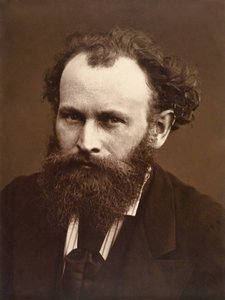
Édouard Manet
1832 - 1883 , Frankreich
Kurzprofil
- Beeinflusste Künstler:
- Claude Monet
- Pierre-Auguste Renoir
- Edgar Degas
- Bemerkenswerte Werke:
- Le Déjeuner sur l'herbe
- Olympia
- A Bar at the Folies-Bergère
- Einflussreiche Künstler:
- Caravaggio
- Diego Velázquez
- Gustave Courbet
- Geburtsdatum: 23. Januar 1832
- Geburtsort: Paris, Frankreich
- Künstlerische Richtung: Impressionismus, Realismus
- Nationalität: Französisch
- Todatum: 1883
- Vollständiger Name: Édouard Manet