Zum Druck wechseln
 Weiterlesen







































 Bei Kunstwerken oder Reproduktionen, die an einer Seite größer als 105 cm (ca. 41 Zoll) sind, wird der Rahmen zerlegt als Bausatz geliefert. Diese Methode gewährleistet eine sichere Zustellung und verhindert Schäden während des Transports.


The Luminous Pursuit of Knowledge
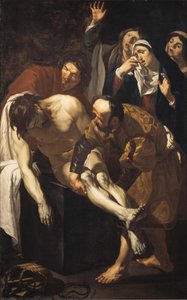
To stand before this depiction of a philosopher is to step directly into the hushed, candlelit chambers of profound thought. The scene unfolds with an almost palpable weight of contemplation, dominated by a masterful use of chiaroscuro that seems less like mere technique and more like an emotional spotlight. An elderly scholar, rendered with meticulous detail, occupies the frame, his gaze meeting the viewer’s not with challenge, but with the deep, knowing calm of one who has wrestled long with the great questions of existence. The entire composition is steeped in a somber palette—rich blacks, earthy browns, and midnight blues—allowing only the illuminated planes of skin, brow, and open book to sing with life.
Baroque Drama and Intellectual Depth
The style whispers of the Baroque era, an age where art served as both mirror and catalyst for intense human experience. The dramatic lighting is not accidental; it is narrative. A single, unseen source casts deep shadows that carve out the contours of the man’s face, emphasizing every wrinkle etched by years of study and thought. This theatrical illumination draws the eye inexorably toward the open book held in his hands—a repository of architectural drawings and philosophical musings. The way the light catches the vellum and the edges of the diagrams suggests a moment suspended in time: the instant just before an epiphany, or perhaps the quiet culmination of a lifetime’s research.
Symbolism Woven into Form
Every element within this painting seems imbued with symbolic resonance. The book itself is the primary symbol of learning and accumulated wisdom, while the architectural drawings hint at humanity's desire to structure and understand the physical world through reason. Furthermore, the light source transcends mere illumination; it functions as a potent metaphor for enlightenment or divine inspiration breaking through the darkness of ignorance. The strong diagonal lines formed by the book and the folds of his heavy robe guide the viewer’s eye upward and inward, mirroring the intellectual journey from confusion to clarity.
Mastery in Technique and Texture
The technical execution speaks to a profound level of artistry, characteristic of masters like Dirck van Baburen. The oil paint application is breathtakingly detailed; one can almost feel the rough texture of the scholar’s robe against the smooth, aged surface of the paper. The artist has achieved depth not through expansive landscape, but through the careful layering of objects and the dramatic contrast between what is seen and what remains shrouded in shadow. This commitment to rendering tangible textures—fabric, wood grain, brittle paper—elevates the piece from a mere portrait to an immersive study in material reality.
An Object for Contemplation
For the collector or designer seeking art that speaks volumes without uttering a word, this reproduction offers unparalleled depth. It is not simply decoration; it is an intellectual anchor for any space—a library, a study, or a grand hall where deep thought is valued. Owning this piece means inviting a sense of solemnity and enduring curiosity into your home, celebrating the timeless human quest to know more.
Fragen & Antworten
Wo kann ich einen Druck von "Ein Philosoph" von Dirck Van Baburen kaufen?
"Ein Philosoph" ist als ein Fine Art Print auf Baumwollkanvas oder Archiv-Leinwandpapier erhältlich. Bestellungen können in der gewünschten Größe auf der Kunstdruck in Premiumqualität-Seite aufgegeben werden.
Wie intensiv und gesättigt sind die Farben von "Ein Philosoph" von Dirck Van Baburen?
"Ein Philosoph" von Dirck Van Baburen zeichnet sich durch eine Sättigung von Gedämpft und eine Intensität von Monochrom aus.
Erlaubt das Urheberrecht von "Ein Philosoph" von Dirck Van Baburen Reproduktionen?
Der Urheberrechtsstatus von "Ein Philosoph" von Dirck Van Baburen ist eindeutig: Das Werk ist gemeinfrei – das Urheberrecht ist abgelaufen. Seine Präsenz in der Biennale Internazionale dell'Antiquariato di Firenze ändert nichts an diesem Status.
 Vorschau anzeigen
 Versenden
 Teilen
 Details anzeigen
 Leitfaden

 Herunterladen
 Ähnliche Objekte
 Röntgenaufnahme
 Diashow
 Fragen & Antworten
 Statistiken