In echtem Maßstab anzeigen
 Versenden als Grußkarte
 Teilen
 Details anzeigen
 Leitfaden öffnen

 Herunterladen
 Ähnliche Objekte
 Röntgenaufnahme
 Diashow
 Besucherstatistiken
A Scene from 'Undine'
 Acrylic On Canvas
- WallArt
- Romantic Historical Painting
 1843
1843 45.0 x 61.0 cm
 Royal Collection
 Mehr anzeigen
Giclée / Kunstdruck
Giclée- oder Leinwanddruck in Museumsqualität mit schneller Produktion und flexiblen Veredelungsoptionen. ( Handgemalte Reproduktion kaufen Zum digitalen Bild wechseln)




P118B $10

P118H $10

P118W $10

P438Z $10

P508JH $12

P508YH $12

P805H $10

P805Z $10

P919BZ $10

P919G $10

P919XJ $10

P959ZH $10

P968JZ $12

W106C $8

W218G $10

W218JH $8

W218Y $10

W307PJ $10

W316G $10

W316PJ $8

W316Y $10

W398PJ $8

W4111J $10

W500HY $15

W500JH $15

W692G $12

W849H $8

W940BG $15

W953PJ $8




Wählen Sie aus unseren vordefinierten Formaten, die den ursprünglichen Proportionen des Kunstwerks entsprechen.

Sie können Ihre eigenen Maße eingeben, um ein bestimmtes Format oder einen speziellen Platz einzupassen. Wenn das von Ihnen gewählte Format nicht den Proportionen des Originalbildes entspricht, werden wir das Kunstwerk entweder beschneiden oder das Bild mit einem gespiegelten oder einfarbigen Rand erweitern. Ein digitaler Entwurf wird Ihnen zur Genehmigung zugesandt, bevor die Produktion beginnt.
Bitte beachten Sie, dass die Vorschau auf dem Bildschirm nicht den tatsächlichen Zuschnitt oder die Erweiterung widerspiegelt. Nur der Entwurf zeigt die endgültige Komposition präzise an.
Obwohl Sondermaße verfügbar sind, empfehlen wir die Auswahl eines Maßes aus der vordefinierten Liste, um die ursprünglichen Proportionen zu bewahren.
Weltweiter Versand () innerhalb von 2 Wochen statt der üblichen 4/5 Wochen. (26 September)

Kostenloser weltweiter Expressversand

Hochwertige Leinenleinwand

Vollständiger Versicherungsschutz beim Versand

Zollgebühren-Rückerstattungsgarantie

Garantie für exakte Farbtreue

100-tägiges Rückgaberecht (nur bei Mängeln)

100% Geld-zurück-Garantie

Angebot für Mengenrabatt
 Die Glasoption ist nur für Größen unter 110 cm verfügbar.

A Scene from 'Undine'
Giclée / Kunstdruck
Format der Reproduktion
-


Gesamtpreis
$ 80
A Scene from ‘Undine’ by Daniel Maclise – A Victorian Romance of Water and Soul
Daniel Maclise's “A Scene from ‘Undine’,” painted in 1843, is more than a mere depiction of a fairy tale; it’s a meticulously crafted tableau brimming with Romantic ideals, symbolic weight, and the burgeoning anxieties of Victorian society. This captivating work, now housed within the Royal Gallery at the Palace of Westminster, transports us to a shadowed forest glen, where a young knight, Huldbrand, confronts the elemental forces embodied by Undine, a water spirit yearning for a soul. Maclise’s masterful handling of light, color, and composition creates an atmosphere both alluring and subtly unsettling, reflecting the complex interplay between beauty, danger, and the eternal quest for redemption.
The painting is deeply rooted in Friedrich de la Motte Fouqué's 1819 novella of the same name – a story that resonated powerfully with Victorian audiences. The narrative centers on Undine’s desire to transcend her watery existence and attain a human soul through marriage. Maclise doesn’t simply illustrate the plot; he amplifies its themes of transformation, sacrifice, and the struggle between opposing forces. The scene depicted captures a pivotal moment – Huldbrand's resolute defense against Kuhleborn, the malevolent water spirit who seeks to prevent Undine from achieving her goal. This confrontation isn’t merely physical; it represents a battle for the very essence of existence.
A Symphony of Color and Detail
Maclise was renowned for his meticulous attention to detail and his ability to render textures with astonishing realism. “A Scene from ‘Undine’” exemplifies this skill, showcasing a rich tapestry of colors and intricate details. The deep greens and browns of the forest floor contrast sharply with the ethereal blues and whites of Undine's watery realm. Notice the careful rendering of the foliage – each leaf, branch, and root meticulously depicted to create a sense of depth and immersion. The figures themselves are rendered with remarkable precision; Huldbrand’s determined expression, Undine’s delicate beauty, and Father Heilmann’s solemnity are all conveyed through subtle shifts in posture and facial expression.
Technically, Maclise employed a combination of oil paints on canvas. He was particularly adept at capturing the effects of light and shadow, creating a dramatic chiaroscuro that emphasizes the scene's emotional intensity. The use of glazing techniques – applying thin layers of translucent paint over dried underlayers – allowed him to build up color gradually, achieving remarkable luminosity and depth. Furthermore, Maclise’s background elements are not merely decorative; they contribute significantly to the overall narrative, hinting at the hidden world of spirits and folklore that underlies the story.
Symbolism and Victorian Anxieties
Beyond its surface beauty, “A Scene from ‘Undine’” is laden with symbolism. Undine herself represents a yearning for transcendence – a desire to escape the limitations of her watery existence and achieve something more meaningful. Huldbrand embodies courage and determination, willing to risk his life to protect her. Kuhleborn, the antagonist, symbolizes the destructive forces that threaten to thwart this transformation. The presence of Father Heilmann suggests the influence of Christian morality in guiding the characters towards a virtuous path.
The painting also reflects the anxieties prevalent in Victorian society – particularly those surrounding nature and the supernatural. The Romantic movement had instilled a fascination with the wild, untamed aspects of the natural world, while simultaneously fostering a sense of unease about its potential dangers. Maclise’s depiction of the forest as both alluring and menacing captures this duality perfectly. The inclusion of elves, goblins, and water nymphs further reinforces the painting's connection to folklore and mythology – themes that were experiencing a resurgence during the Victorian era.
A Legacy of Beauty and Intrigue
“A Scene from ‘Undine’,” completed in 1843, remains a powerful testament to Daniel Maclise’s artistic skill and his ability to capture the spirit of his time. Its enduring appeal lies not only in its technical brilliance but also in its evocative storytelling and profound exploration of universal themes. Today, reproductions of this masterpiece continue to captivate audiences, offering a glimpse into a world where romance, danger, and the eternal quest for redemption converge.
Consider commissioning a high-quality reproduction from OriginalUniqueArt.com – a faithful recreation that will bring the drama and beauty of Maclise’s “A Scene from ‘Undine’” to your home or office.
Biografie des Künstlers
Frühes Leben und Ausbildung
- Geboren: 25. Januar 1806, Cork, Irland
- Gestorben: 25. April 1870, London, England
- Eltern: Alexander McLish (Gerberei/Schuhmacher) und Rebecca McLeish
- Frühkindliche Ausbildung in Cork; zeigte schon früh künstlerisches Talent.
- Studierte an der Cork School of Art mit Schwerpunkt auf Zeichnen und Anatomie.
- Selbstfinanzierte Umzug nach London im Jahr 1827, um seine Studien zu verfolgen.
- Trat 1828 in die Royal Academy Schools ein und zeichnete sich dort in Aktzeichnen und Historienmalerei aus.
Karriere und Hauptwerke
- Erlangte schnell Anerkennung für seine Porträtkünste, insbesondere durch Darstellungen von Charles Kean und Niccolò Paganini.
- Leistete bedeutende Beiträge zu *Fraser's Magazine* unter dem Pseudonym "Alfred Croquis" und schuf eine Reihe von Charakterporträts, die seinen Ruf steigerten.
- Wurde 1835 zum Associate der Royal Academy und 1840 zum ordentlichen Mitglied gewählt.
- Hauptwerke:
- Das Treffen von Wellington und Blücher nach der Schlacht von Waterloo (befindet sich im Palace of Westminster)
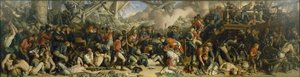
- Der Tod Nelsons (befindet sich im Palace of Westminster) – Ein monumentales Fresko, das als eines seiner Meisterwerke gilt.
- Das Ritterliche Gelöbnis der Damen und des Pfaues
- Illustrationen für Charles Dickens' Weihnachtsbücher und andere Werke.
Künstlerischer Stil und Einflüsse
- Maclises Stil vermischte historische Erzählungen mit Elementen des Realismus und der Porträtmalerei.
- Beeinflusst von französischer und klassischer Kunst, insbesondere nach seinem Besuch in Paris im Jahr 1830.
- Seine Werke stellten oft Szenen aus Geschichte, Literatur (Shakespeare) und Mythologie dar.
- Zeigte ein scharfes Auge für Details und Charakterisierung sowohl in Porträts als auch in historischen Kompositionen.
Späteres Leben und Vermächtnis
- Die intensive Hingabe an seine Kunst forderte seinen Tribut auf seine Gesundheit.
- Lehnte 1865 das Präsidium der Royal Academy aufgrund seines sinkenden Gesundheitszustands ab.
- Starb 1870 in Chelsea, London.
- Eine Biographie wurde 1871 von William Justin O'Driscoll veröffentlicht.
- Maclises Fresken im Palace of Westminster sind bedeutende Beiträge zur britischen Kunst und Architektur.
- Seine Illustrationen für Dickens trugen dazu bei, die Werke des Autors zu popularisieren.
- Gilt als eine Schlüsselfigur der viktorianischen Historienmalerei, die die Lücke zwischen Neoklassizismus und Realismus schloss.
Historische Bedeutung
- Maclise spielte eine entscheidende Rolle bei der Dokumentation wichtiger historischer Ereignisse und Persönlichkeiten für ein breiteres Publikum.
- Seine Arbeit spiegelt die kulturellen und künstlerischen Trends des 19. Jahrhunderts wider, insbesondere das viktorianische Zeitalter's Faszination für Geschichte und Literatur.
- Er trug dazu bei, die Tradition der großformatigen Erzählmale innerhalb der britischen Kunst zu etablieren.
- Seine Beiträge zur Dekoration des Palace of Westminster sind integraler Bestandteil der Ästhetik und symbolischen Bedeutung des Gebäudes.

Daniel Maclise
1806 - 1870 , Irland
Eckdaten zum Künstler
- Bemerkenswerte Werke:
- Die Schlacht von Waterloo
- Der Tod Nelsons
- Das Ritterliche Gelübde
- Einflussreiche Künstler: ['Sir Walter Scott']
- Geburtsdatum: 25. Januar 1806
- Geburtsort: Cork, Irland
- Künstlerische Richtung: Historienmalerei, Porträtkunst
- Nationalität: Irisch
- Sterbedatum: 25. April 1870
- Vollständiger Name: Daniel Maclise
Verwandte Artikel

10 Meisterwerke des Romantischen Realismus: Wenn Emotion auf Wahrheit trifft
Entdecken Sie 10 Meisterwerke des Romantischen Realismus. Erleben Sie die emotionale Tiefe von Künstlern wie Constable und Friedrich – perfekt als Inspiration für Ihre Kunstsammlung oder Wandgestaltung. Finden Sie museale Reproduktionen auf OriginalUniqueArt.com.
Fluid Reflections: Exploring Water's Symbolism in Art History – From Myth to Impressionism
Explore the rich symbolism of water in art history – from ancient myths to Impressionism's fleeting beauty. Discover masterpieces & find your perfect serene artwork with OriginalUniqueArt.com.

Dante Gabriel Rossetti: Die 25 Meisterwerke des Präraffelitismus | OriginalUniqueArt
Entdecken Sie die 25 schönsten Gemälde von Dante Gabriel Rossetti! Tauchen Sie ein in die Welt der Präraffeliten, symbolistischer Kunst & viktorianischer Romantik. Hochwertige Reproduktionen für Ihr Zuhause – jetzt bei OriginalUniqueArt.com!

Daniel Maclise: Historische Erzählungen und romantische Ideale der britischen Kunst des 19. Jahrhunderts
Entdecken Sie das Werk von Daniel Maclise und die faszinierende Welt der Historienmalerei im viktorianischen England. Analysen, Hintergrundinformationen & Expertenwissen auf OriginalUniqueArt.
Thomas Edwin Mostyn: A Victorian Genre Painter's Journey from Realism to Romantic Enchantment
Discover the captivating world of Thomas Edwin Mostyn (1864-1930), a Victorian artist renowned for his romantic garden scenes and evocative portraits. Explore his artistic journey, legacy & find high-quality reproductions at OriginalUniqueArt.