In echtem Maßstab anzeigen
 Versenden als Grußkarte
 Teilen
 Details anzeigen
 Leitfaden öffnen

 Herunterladen
 Ähnliche Objekte
 Röntgenaufnahme
 Diashow
 Besucherstatistiken
Self Portrait


 Mehr anzeigen
Giclée / Kunstdruck
Giclée- oder Leinwanddruck in Museumsqualität mit schneller Produktion und flexiblen Veredelungsoptionen. ( Handgemalte Reproduktion kaufen Zum digitalen Bild wechseln)




P118B €10

P118H €10

P118W €10

P438Z €10

P508JH €12

P508YH €12

P805H €10

P805Z €10

P919BZ €10

P919G €10

P919XJ €10

P959ZH €10

P968JZ €12

W106C €8

W218G €10

W218JH €8

W218Y €10

W307PJ €10

W316G €10

W316PJ €8

W316Y €10

W398PJ €8

W4111J €10

W500HY €15

W500JH €15

W692G €12

W849H €8

W940BG €15

W953PJ €8




Wählen Sie aus unseren vordefinierten Formaten, die den ursprünglichen Proportionen des Kunstwerks entsprechen.

Geben Sie die Breite und die Höhe an, die Sie benötigen, damit der Druck perfekt in Ihren Rahmen oder an Ihre Wand passt. Ein Druck kann nur beschnitten werden und niemals größer als das Originalbild gemacht werden; daher verliert ein Format mit einer anderen Proportion einen Teil des Bildes. Wir senden Ihnen ein digitales Mockup zur Freigabe, bevor wir den Druck ausführen. Das auf dieser Seite gezeigte Bild zeigt nicht den tatsächlichen Beschnitt – dies ist nur im Mockup ersichtlich.
Weltweiter Versand () innerhalb von 2 Wochen statt der üblichen 4/5 Wochen. (22 Oktober)

Kostenloser weltweiter Expressversand

Hochwertige Leinenleinwand

Vollständiger Versicherungsschutz beim Versand

Zollgebühren-Rückerstattungsgarantie

Garantie für exakte Farbtreue

100-tägiges Rückgaberecht (nur bei Mängeln)

100% Geld-zurück-Garantie

Angebot für Mengenrabatt
 Die Glasoption ist nur für Größen unter 110 cm verfügbar.

Self Portrait
Giclée / Kunstdruck
Format der Reproduktion
-


Gesamtpreis
€ 70
Charles Willson Peale’s “The Artist in His Museum” – A Window into Early American Identity
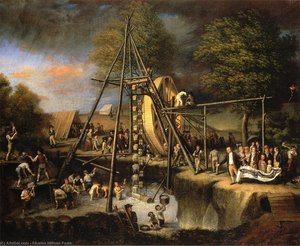
Charles Willson Peale's 1822 self-portrait, "The Artist in His Museum," is far more than a simple depiction of an aging painter. It’s a meticulously constructed tableau vivant—a staged scene brimming with symbolism and offering a profound glimpse into the burgeoning identity of early America. Painted during a period of intense national formation, Peale sought to capture not just his own likeness but also the spirit of a nation striving to define itself through art, science, and a celebration of its natural heritage.
The painting immediately draws the eye with its dramatic lighting—a stark contrast between the deep crimson curtain concealing the museum’s interior and the softer illumination that highlights Peale's face. This theatrical effect wasn’t merely for aesthetic appeal; it served to elevate the artist, positioning him as a central figure within this carefully curated world. The composition is layered, inviting the viewer to explore multiple levels of meaning. In the foreground, we see Peale himself, his silver hair and thoughtful expression suggesting both wisdom and a touch of melancholy. He’s not simply posing; he's actively engaging with his surroundings, as if presenting them to an unseen audience.
A Cabinet of Curiosities: Symbolism and Natural History
Beyond Peale’s portrait lies the meticulously arranged collection within the museum—a veritable cabinet of curiosities that speaks volumes about the era's fascination with both the natural world and the pursuit of knowledge. A dead wild turkey, carefully taxidermied alongside Peale’s tools, represents a connection to American wilderness and a celebration of its bounty. Nearby, a majestic bald eagle, also preserved in meticulous detail, embodies national pride and the ideals of freedom. These specimens aren't merely decorative; they are tangible reminders of America’s unique natural resources and the burgeoning scientific spirit that sought to understand and classify them.
The inclusion of a paddlefish from the Allegheny River—a relatively obscure specimen—demonstrates Peale’s commitment to showcasing both familiar and exotic elements within his collection. Even more striking is the mastodon skeleton, a relic of a prehistoric past, symbolizing America's vastness and its place in the grand sweep of geological time. These objects weren’t simply displayed; they were presented as evidence of American progress—a testament to the nation’s ability to both preserve the past and embrace the future.
Neoclassical Portraiture and a Reflection on Time
Technically, “The Artist in His Museum” is a prime example of Neoclassical portraiture, characterized by its realistic representation and emphasis on capturing likeness. Peale employs smooth brushstrokes and subtle gradations of tone to create a sense of depth and volume, particularly in the rendering of his own face. The muted earth tones of the palette—dominated by browns, reds, and creams—lend the painting a dignified and contemplative mood. The inclusion of a partially visible paintbrush hints at Peale’s profession as a painter, further anchoring the scene within the realm of artistic creation.
However, the painting transcends mere portraiture. It's also a meditation on time and legacy. Peale, nearing eighty years old, is depicted not as a fading figure but as an active participant in his own museum—a guardian of knowledge and a symbol of American ingenuity. The scene suggests that art and science are inextricably linked, both serving to illuminate the human experience and preserve it for posterity.
A Legacy of Innovation and Artistic Vision
Charles Willson Peale’s “The Artist in His Museum” is more than just a painting; it's a microcosm of early America—a testament to the nation’s burgeoning identity, its embrace of scientific inquiry, and its celebration of artistic achievement. Peale’s vision extended beyond simply creating beautiful images; he sought to educate and inspire, establishing the Philadelphia Museum as one of the first American museums and laying the foundation for a new era of cultural exploration. Reproductions of this iconic work offer a captivating window into a pivotal moment in American history—a reminder that art can be both a reflection of our past and a vision of our future.
Fragen & Antworten
Warum ist der Urheberrechtsstatus von "Self Portrait" so, wie er ist?
"Self Portrait" von Charles Willson Peale ist gemeinfrei – das Urheberrecht ist abgelaufen. Die Urheberrechtsfristen werden ab dem Todesjahr des Künstlers berechnet, und Charles Willson Peale verstarb im Jahr 1827.
Welche Platzierung passt zum Format von "Self Portrait" von Charles Willson Peale?
Format (Portrait) und der empfohlene Raum (Living Room) sind die zwei festgehaltenen Platzierungsdetails für "Self Portrait" von Charles Willson Peale.
Welche Stimmung würde "Self Portrait" in einen Raum bringen?
Mit seiner Nostalgic Stimmung wird „Self Portrait“ für ein Living Room empfohlen.
Biografie des Künstlers
Charles Willson Peale: Ein Leben zwischen Kunst, Wissenschaft und Patriotismus
- Geboren: 15. April 1741, Chester, Queen Anne's County, Maryland
- Gestorben: 22. Februar 1827, Philadelphia, Pennsylvania
Frühes Leben und künstlerische Ausbildung
- Peales frühes Leben war von finanziellen Schwierigkeiten geprägt, nachdem sein Vater gestorben war. Er absolvierte eine Lehre als Sattler, bevor er seine Leidenschaft für die Kunst entdeckte.
- Er erhielt zunächst Unterricht bei John Hesselius und studierte kurzzeitig bei John Singleton Copley, was ein frühes Talent für Porträts zeigte.
- Eine entscheidende Phase seiner Entwicklung war seine Zeit unter Benjamin West in London (1767-1770). Diese Begegnung mit europäischen Kunsttrends beeinflusste seinen Stil maßgeblich.
Künstlerische Karriere und Hauptwerke
- Porträtmalerei: Peale ist vor allem für seine Porträts bedeutender Persönlichkeiten der Amerikanischen Revolution bekannt, darunter zahlreiche Darstellungen von George Washington (insgesamt fast sechzig). Diese Porträts sind wertvolle historische Dokumente neben künstlerischen Leistungen.
- Stil: Sein Stil entwickelte sich im Laufe der Zeit weiter, anfänglich beeinflusst vom neoklassizistischen Ansatz Wests, später wurden jedoch Elemente des Realismus und das Bestreben nach einer genauen Wiedergabe des Likeness integriert.
- Bemerkenswerte Werke:
- George Washington (1772): Markierte den Beginn seiner langjährigen Verbindung zu Washington.
- Die Treppengruppe (ca. 1795): Ein beeindruckendes Beispiel für Trompe-l'oeil, das seine Söhne Raphael und Titian so darstellt, als wären sie Teil der architektonischen Umgebung.
Wissenschaftliche Bestrebungen und Peales American Museum
- Peale war ein leidenschaftlicher Naturforscher und Wissenschaftler und organisierte Expeditionen zur Erforschung der Naturgeschichte.
- Er gründete Peales American Museum in Philadelphia (1784), eines der ersten Museen in den Vereinigten Staaten. Es beherbergte botanische, biologische und archäologische Exponate.
- Das Museum spielte eine wichtige Rolle bei der Popularisierung von Wissenschaft und Bildung in Amerika. Er war besonders bekannt für seine Ausstellungen von Mammutknochen, die er bei einer Expedition im Jahr 1801 erworben hatte.
- Er lehrte sich selbst Taxidermie, um Exponate für das Museum zu konservieren, was seine vielfältigen Fähigkeiten demonstrierte.
Vermächtnis und historische Bedeutung
- Peales Werk überbrückt die Kluft zwischen Kunst und Wissenschaft und spiegelt die Ideale der Aufklärung seiner Zeit wider.
- Seine Porträts liefern unschätzbare visuelle Aufzeichnungen von Schlüsselfiguren in der amerikanischen Geschichte.
- Die Gründung von Peales American Museum war ein bahnbrechender Versuch, das Museum als eine wichtige Institution für Bildung und wissenschaftliche Erforschung zu etablieren.
- Er beeinflusste nachfolgende Generationen von Künstlern und Wissenschaftlern und trug wesentlich zur Entwicklung der amerikanischen Kultur bei.
- Sein Familienvermächtnis setzte sich durch seine Söhne fort, darunter James Peale und Rubens Peale, die ebenfalls talentierte Künstler wurden und zur Sammlung des Museums beitrugen.

Charles Willson Peale
1741 - 1827 , Vereinigtes Königreich
Eckdaten zum Künstler
- Beeinflusste Künstler:
- John Hesselius
- John Singleton Copley
- Benjamin West
- Bemerkenswerte Werke:
- Staircase Group
- George Washington Porträts
- Geburtsdatum: 15. April 1741
- Geburtsort: Chester, Vereinigtes Königreich
- Künstlerische Bewegung: Neoklassische Malerei
- Nationalität: Amerikanisch
- Todatum: 22. Februar 1827
- Vollständiger Name: Charles Willson Peale
Verwandte Artikel
Titian Ramsay Peale: Präzision und künstlerische Innovation in der frühen amerikanischen botanischen Malerei
Entdecken Sie das Werk von Titian Ramsay Peale, einem Pionier der amerikanischen botanischen Malerei! Erfahren Sie mehr über seine präzisen Illustrationen, die Long-Expedition und seinen Beitrag zur Naturforschung. OriginalUniqueArt.

Charles Bird King: Capturing Native American Dignity Through Portraiture & Cultural Exchange
Explore the captivating portraits of Charles Bird King, renowned for his depictions of Native American leaders. Discover the historical context, artistic techniques, and collecting value of these significant 19th-century artworks.

Grant Wood und der amerikanische Regionalismus: Identität, Mythos und die ländliche Landschaft
Entdecken Sie Grant Wood und den amerikanischen Regionalismus! Erfahren Sie mehr über 'American Gothic', Woods Leben, Einflüsse und sein Vermächtnis in der Kunstgeschichte. Expertenwissen & hochwertige Reproduktionen.

Charles Willson Peale: Porträtmalerei, Aufklärungsideale und die Gestaltung amerikanischer Identität
Entdecken Sie das Leben und Werk von Charles Willson Peale – Porträtmaler, Naturforscher und Begründer des ersten amerikanischen Museums. Erfahren Sie mehr über seine Bedeutung für die Kunstgeschichte der USA und die Ideale der Aufklärung.
Reflecting the Self: A History of Portraiture & Psychological Insight
Explore the fascinating history of self-portraiture from Renaissance masters like Dürer & Rembrandt to modern interpretations. Discover the psychological insights and artistic techniques behind these iconic works. Expert analysis for art enthusiasts.