Vorschau anzeigen
 Versenden
 Teilen
 Details anzeigen
 Leitfaden

 Herunterladen
 Ähnliche Objekte
 Röntgenaufnahme
 Diashow
 Fragen & Antworten
 Statistiken
Dieppe


 Weiterlesen
Giclée / Kunstdruck
Giclée- oder Leinwanddruck in Museumsqualität mit schneller Produktion und flexiblen Veredelungsoptionen. ( Handgemalte Reproduktion bestellen Zum digitalen Bild wechseln)




P118B €10

P118H €10

P118W €10

P438Z €10

P508JH €12

P508YH €12

P805H €10

P805Z €10

P919BZ €10

P919G €10

P919XJ €10

P959ZH €10

P968JZ €12

W106C €8

W218G €10

W218JH €8

W218Y €10

W307PJ €10

W316G €10

W316PJ €8

W316Y €10

W398PJ €8

W4111J €10

W500HY €15

W500JH €15

W692G €12

W849H €8

W940BG €15

W953PJ €8




Wählen Sie aus unseren vordefinierten Formaten, die den ursprünglichen Proportionen des Kunstwerks entsprechen.

Geben Sie die benötigte Breite und Höhe an, damit der Druck perfekt in Ihren Rahmen oder an Ihre Wand passt. Ein Druck kann nur beschnitten, aber niemals größer als das Originalbild angefertigt werden; daher verliert ein Format mit anderen Proportionen einen Teil des Bildes. Wir senden Ihnen ein digitales Mockup zur Freigabe, bevor wir den Druck ausführen. Das auf dieser Seite gezeigte Bild zeigt nicht den tatsächlichen Beschnitt – dies ist nur im Mockup ersichtlich.
Weltweiter Versand () innerhalb von 2 Wochen statt der üblichen 4/5 Wochen. (5 November)

Kostenloser weltweiter Expressversand

Hochwertige Leinenleinwand

Umfassender Versicherungsschutz beim Versand

Zollgebühren-Rückerstattungsgarantie

Garantie für exakte Farbtreue

100 Tage Rückgaberecht (nur bei Mängeln)

100% Geld-zurück-Garantie

Mengenrabatt verfügbar
 Die Glasoption ist nur für Größen unter 110 cm verfügbar.

Dieppe
Giclée / Kunstdruck
Format der Reproduktion
-


Endpreis
€ 72
The Scene Unfolds: A Seaside Moment Captured
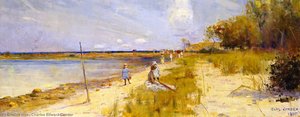
Charles Edward Conder’s “Dieppe,” painted in 1895, isn't merely a depiction of a coastal scene; it’s an immersion into a fleeting moment of tranquility and observation. The canvas breathes with the muted palette of a late afternoon – a symphony of blues deepening towards the horizon, punctuated by the warm ochres and yellows of the sand and distant buildings. The composition immediately draws the eye along a gentle diagonal path created by the sandy track leading toward the figures strolling along the beach. This isn’t a dramatic seascape; rather, it's an invitation to pause, to contemplate the quiet rhythm of daily life unfolding against the vastness of the sea.
The subject matter itself is deceptively simple: a group of people enjoying a seaside walk. Yet Conder elevates this commonplace activity through his masterful use of Impressionistic techniques. He’s less concerned with precise representation and more interested in capturing the *feeling* of the scene – the diffused light, the sense of warmth, the subtle interplay of color and texture. The figures are rendered with loose brushstrokes, their forms dissolving into the atmosphere, suggesting a momentary impression rather than a detailed portrait.
Impressionistic Techniques: A Dance of Light and Color
Conder’s approach is deeply rooted in Impressionism, a movement that sought to capture the subjective experience of light and color. Notice how he employs broken brushstrokes – short, distinct marks applied side-by-side rather than blended smoothly. This creates a shimmering effect, mimicking the way sunlight dances on water and reflects off surfaces. The layering of paint is equally significant; visible texture adds depth and richness to the canvas, inviting the viewer to examine the surface closely.
The color choices are deliberately restrained, contributing to the overall mood of serenity. He avoids bright, saturated hues, opting instead for a harmonious blend of blues, yellows, and browns. This creates a sense of atmospheric perspective – distant elements appear paler and less distinct, reinforcing the feeling of depth and distance. The use of complementary colors—the blue sky contrasted with the warm sand—further enhances the visual interest and vibrancy of the scene.
Historical Context: The Heidelberg School and Australian Modernism
To understand “Dieppe,” it’s crucial to consider Conder's place within the broader context of Australian art. He was a key figure in the Heidelberg School, a group of artists who developed a distinctly Australian style influenced by Impressionism and Post-Impressionism. Based in Melbourne, the Heidelberg School sought to capture the unique landscapes and light conditions of Victoria’s rural areas.
Conder's move to Sydney in 1884 marked a pivotal moment in his career. He quickly established himself as a talented landscape painter, experimenting with new techniques and styles. “Dieppe” reflects this period of artistic exploration, showcasing Conder’s growing mastery of Impressionistic principles while retaining a distinctly Australian sensibility. The painting's subject matter – a seaside scene – resonated deeply with the Heidelberg School’s focus on capturing the beauty of the natural world.
Symbolism and Emotional Resonance: A Moment of Quiet Reflection
Beyond its technical merits, “Dieppe” possesses a subtle yet powerful symbolic resonance. The figures strolling along the beach represent leisure, connection, and the simple pleasures of life. The vast expanse of the sea symbolizes both opportunity and uncertainty – a reminder of the world beyond our immediate surroundings. The painting evokes a sense of quiet contemplation, inviting the viewer to slow down and appreciate the beauty of the present moment.
Ultimately, “Dieppe” is more than just a landscape; it’s a meditation on light, color, and human experience. It's a testament to Conder's artistic vision and his ability to capture the essence of a fleeting scene with remarkable sensitivity and skill. A reproduction of this work offers a beautiful addition to any collection, bringing a touch of Impressionistic serenity into your home.
Fragen & Antworten
Wer ist der Urheber von "Dieppe" und aus welchem Jahr stammt das Werk?
"Dieppe" wurde von Charles Edward Conder im Jahr 1895 geschaffen.
Ist "Dieppe" von Charles Edward Conder im Hoch-, Quer- oder Quadratformat angeordnet?
Das Format von „Dieppe“ ist Landscape. Dies ist hilfreich bei der Planung, wo eine Reproduktion platziert werden soll.
Was stellt "Dieppe" von Charles Edward Conder dar?
Die Themen in "Dieppe" von Charles Edward Conder umfassen seaside, beach, landscape, impressionism, leisure, tranquility, figures, atmosphere und fassen gemeinsam den Gegenstand des Kunstwerks zusammen.
Künstlerbiografie
Frühes Leben und künstlerischer Werdegang
Charles Edward Conder, ein in Großbritannien geborener Maler, Lithograf und Designer, hinterließ einen bleibenden Eindruck auf die Kunstwelt. Geboren am 24. Oktober 1868 in Tottenham, Middlesex, war Conder's frühes Leben von dem Tod seiner Mutter in Indien geprägt, als er gerade vier Jahre alt war.Künstlerische Karriere in Australien
Im Jahr 1884 zog Conder im Alter von 16 Jahren nach Sydney, Australien, und arbeitete für seinen Onkel als Landvermesser. Er entdeckte jedoch bald seine wahre Leidenschaft im Zeichnen der Landschaft statt in der Vermessung. Bereits 1886 wurde er Künstler für die Illustrated Sydney News, zusammen mit namhaften Künstlern wie Albert Henry Fullwood und Frank Mahony.Die Heidelberg School und bedeutende Werke
Conders Meisterwerk, Departure of the Orient – Circular Quay (1888), demonstrierte seine neu gewonnene Meisterschaft in Form und Pinselstrich. Diese Hafenszene, die das geschäftige Treiben am Sydney Cove darstellt, wurde schnell von der Art Gallery of New South Wales erworben und wurde damit Conders erstes Werk, das in eine öffentliche Sammlung gelangte.- A Holiday at Mentone (1888), ein fröhliches Gemälde, das Männer und Frauen beim Entspannen am Strand zeigt, ist ein weiteres bemerkenswertes Beispiel für Conders Werk.
- Conders Verbindung mit G. P. Nerli, einem wandernden italienischen Maler, beeinflusste seine künstlerische Entwicklung maßgeblich.
- Sein Beitrag zur 9 by 5 Impression Exhibition in Melbourne, zusammen mit Tom Roberts und Arthur Streeton, festigte seine Position innerhalb der Heidelberg School Bewegung.
Vermächtnis und spätere Jahre
Conders späte Jahre waren von gesundheitlichen Problemen geplagt, darunter Lähmungen und ein Delirium tremens. Trotzdem malte er weiter und hinterließ ein Vermächtnis als eine Schlüsselfigur der Heidelberg School. Seine Kunst wurde in England besser aufgenommen als in Paris, wobei sein Porträt von Henri de Toulouse-Lautrec im Jahr 1892 gemalt wurde. Betrachten Sie Conders Werke in der Art Gallery of New South Wales oder erkunden Sie mehr über die Heidelberg School auf OriginalUniqueArts Charles Edward Conder Seite.- Erfahren Sie mehr über Conders Leben und Werk auf der Wikipedia-Seite von Charles Conder.
- Entdecken Sie OriginalUniqueArts Sammlung von Conders Gemälden, darunter A Holiday at Mentone (1888) und Departure of the Orient – Circular Quay (1888), auf OriginalUniqueArts Webseite.
Schlussfolgerung
Charles Edward Conders Einfluss auf den australischen Impressionismus ist unbestreitbar. Sein Vermächtnis, das durch seine fesselnden Gemälde und seine Verbindung zur Heidelberg School gekennzeichnet ist, inspiriert weiterhin Kunstliebhaber weltweit.
Charles Edward Conder
1868 - 1909 , Vereinigtes Königreich
Kurzinfos
- Bemerkenswerte Werke:
- Departure of the Orient
- A Holiday at Mentone
- Geburtsdatum: 24. Oktober 1868
- Geburtsort (Stadt, Land): Tottenham, Vereinigtes Königreich
- Künstler, Die Diesen Künstler Beeinflussten: ['G. P. Nerli']
- Künstlerische Bewegung/Stil: Heidelberg School, Impressionismus
- Nationalität: Britisch
- Sterbedatum: 1909
- Vollständiger Name: Charles Edward Conder
Ähnliche Artikel
Capturing the Soul: The Most Emotionally Moving Impressionist and Post-Impressionist Masterpieces
Discover the profound emotional depth of Impressionist and Post-Impressionist masterpieces. Explore how legends like Monet, Van Gogh, and Gauguin captured light and soul through evocative landscapes and vibrant brushwork for a timeless connection to art history.

Beyond the Horizon: A Curated Guide to Integrating Post-Impressionist Landscapes into Modern Interiors
Transform your home with the emotive power of Post-Impressionist landscapes. Discover expert tips on selecting hand-painted oil reproductions to create a soulful, vibrant interior that reflects your unique style and connection to nature.

Impressionistische Landschaften: Die 10 Meisterwerke, die eine Kunstrichtung prägten | OriginalUniqueArt
Entdecken Sie die 10 Meisterwerke des Impressionismus! Von Monet bis Van Gogh – erleben Sie die Geschichten hinter berühmten Landschaftsbildern. Hochwertige Kunst Reproduktionen für Ihr Zuhause auf OriginalUniqueArt.com.
Golden Fields & Sun-Drenched Meadows: Capturing the Soul of Impressionist Landscapes
Immerse yourself in the luminous world of Impressionist landscapes. Discover how masters like Monet and Gauguin captured ephemeral light through plein air painting, and learn to bring the soul of sun-drenched meadows into your home with exquisite, hand-painted oil reproductions.

Impressionistische Landschaften: Die 10 Meisterwerke, die eine Epoche prägten | OriginalUniqueArt
Entdecken Sie die 10 Meisterwerke des Impressionismus! Von Monet bis Renoir – erleben Sie die Geschichte, Technik und zeitlose Schönheit ikonischer Landschaftsbilder. Hochwertige Kunstdrucke auf OriginalUniqueArt.com. Jetzt entdecken!