
 Vorschau anzeigen
 Versenden
 Teilen
 Details anzeigen

 Herunterladen
 Ähnliche Objekte
 Röntgenaufnahme
 Diashow
Paisaje extemporal


 Weiterlesen
Giclée / Kunstdruck
Giclée- oder Leinwanddruck in Museumsqualität mit schneller Produktion und flexiblen Veredelungsoptionen. ( Handgemalte Reproduktion bestellen Bild kaufen)




































Wählen Sie aus unseren vordefinierten Formaten, die den ursprünglichen Proportionen des Kunstwerks entsprechen.

Sie können Ihre eigenen Maße eingeben, um ein bestimmtes Format oder einen speziellen Platz einzupassen. Wenn das von Ihnen gewählte Format nicht den Proportionen des Originalbildes entspricht, werden wir das Kunstwerk entweder beschneiden oder das Bild mit einem gespiegelten oder einfarbigen Rand erweitern. Ein digitaler Entwurf wird Ihnen zur Genehmigung zugesandt, bevor die Produktion beginnt.
Bitte beachten Sie, dass die Vorschau auf dem Bildschirm nicht den tatsächlichen Zuschnitt oder die Erweiterung widerspiegelt. Nur der Entwurf zeigt die endgültige Komposition präzise an.
Obwohl Sondermaße verfügbar sind, empfehlen wir die Auswahl eines Maßes aus der vordefinierten Liste, um die ursprünglichen Proportionen zu bewahren.
Weltweiter Versand () innerhalb von 2 Wochen statt der üblichen 4/5 Wochen. (14 August)

Kostenloser weltweiter Expressversand

Hochwertige Leinenleinwand

Umfassender Versicherungsschutz beim Versand

Zollgebühren-Rückerstattungsgarantie

Garantie für exakte Farbtreue

60 Tage Rückgaberecht (nur bei Mängeln)

100% Geld-zurück-Garantie

Mengenrabatt verfügbar
 Die Glasoption ist nur für Größen unter 110 cm verfügbar.

Paisaje extemporal
Giclée / Kunstdruck
Format der Reproduktion
-


Gesamtpreis
$ 80
Sammlerstück-Beschreibung
A Symphony of Light and Geometry
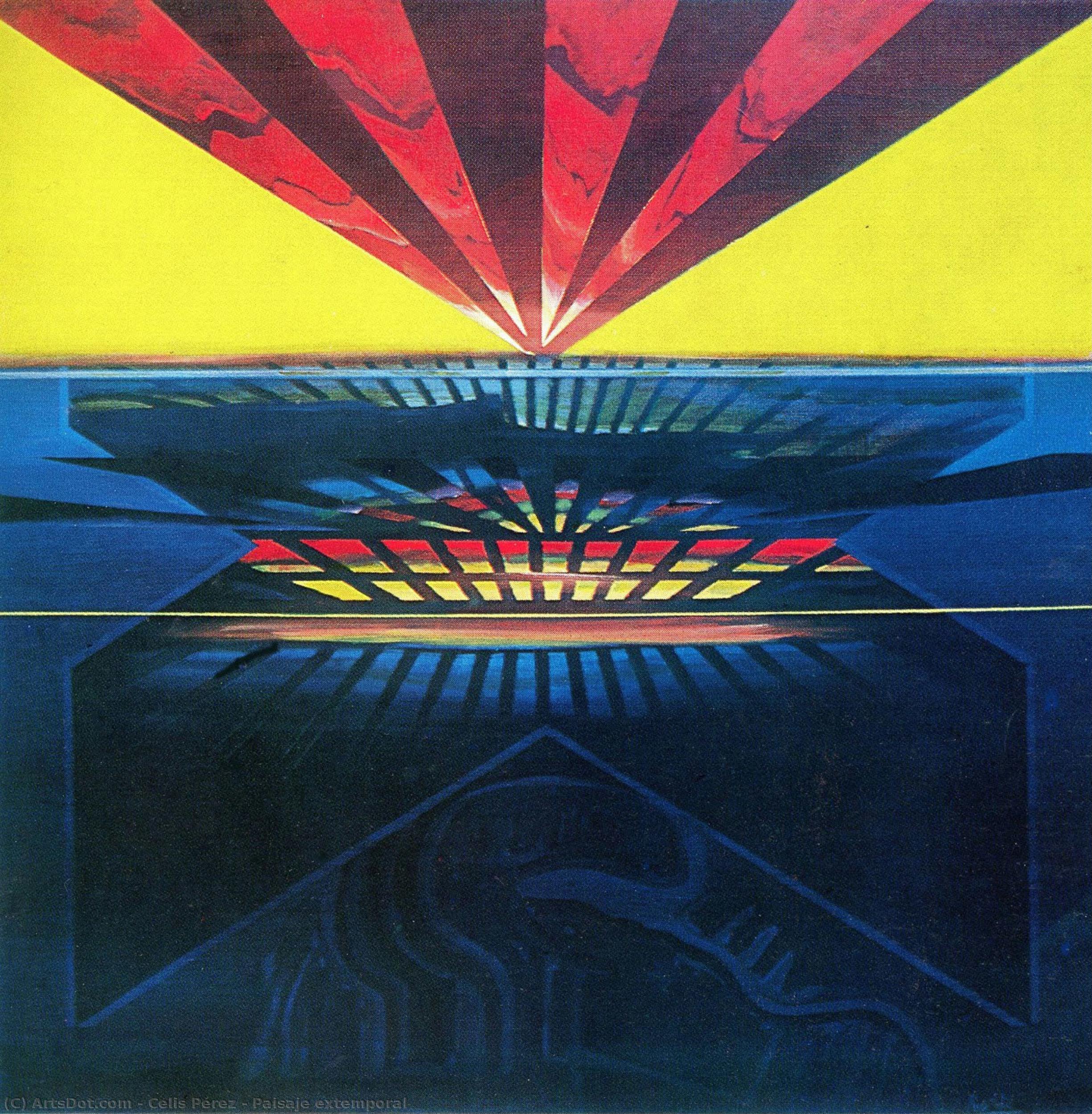
In the evocative masterpiece Paisaje extemporal, created in 1968, the Argentine master Celis Pérez invites us into a realm where the boundaries between landscape and abstraction dissolve into pure emotion. This work serves as a breathtaking meditation on the essence of light, capturing a moment that feels both timeless and fleeting. At first glance, the viewer is greeted by a radiant, sun-drenched atmosphere, dominated by a luminous yellow background that seems to pulse with the warmth of a rising or setting sun. Red accents dance across the canvas, injecting a rhythmic vitality that mimics the flickering heat of a summer twilight. It is not merely a depiction of a sunset, but an exploration of the very energy that light imparts to the world.
The composition is a masterful study in balance and structural intrigue. Pérez utilizes a sophisticated interplay of geometric forms to guide the eye through a dreamlike topography. A striking yellow triangle, accented with delicate red strokes, floats above the horizon line, acting as a celestial anchor that disrupts the traditional landscape perspective. This use of geometry creates a tension between the organic feeling of a sunset and the calculated precision of abstract art. The foreground is particularly captivating, featuring an intricate pattern of light and shadow that lends a profound sense of depth to the piece. These shadows are not merely dark spaces but are textured layers that invite the viewer to step into the painting, discovering new nuances with every glance.
The Legacy of Argentine Abstraction
To understand Paisaje extemporal, one must look toward the rich artistic heritage of Celis Pérez. Born in the historic San Telmo district of Buenos Aires, Pérez was a pivotal figure in the evolution of Latin American abstraction. His technique reflects a deep engagement with the visual language of his era, blending the structural rigor found in geometric abstraction with a soulful, almost lyrical approach to color. By 1968, when this piece was executed, Pérez had refined his ability to use color as a primary narrative tool, moving away from literal representation toward a more spiritualized version of reality. The painting stands as a testament to his ability to translate the physical sensation of light into a permanent, visual rhythm.
For the discerning collector or interior designer, this artwork offers much more than mere decoration; it provides a focal point of intellectual and emotional depth. The warm palette of golds, yellows, and reds makes it an ideal centerpiece for spaces designed to evoke warmth, creativity, and sophistication. Whether placed in a contemporary gallery setting or a curated residential lounge, the painting’s ability to manipulate light and space creates an atmosphere of serene contemplation. Owning a reproduction of such a significant work allows one to bring the vibrant spirit of Argentine modernism into the home, offering a daily encounter with the sublime beauty of a world captured in perfect, geometric harmony.
Über den Künstler
A Life Immersed in Geometry and Light: The World of Celis Pérez
Celis Pérez, born in the vibrant heart of San Telmo, Argentina, in 1939, emerged as a significant voice in Latin American abstract art. His journey wasn’t one of immediate acclaim but rather a gradual unfolding, beginning with correspondence courses that ignited an early passion and blossoming through formal studies at the Belgrano School of Fine Arts in 1954. Even as a young boy, working as a newsboy, he was absorbing the visual world around him, unknowingly laying the foundation for his future explorations of form and color. Pérez wasn’t simply creating art; he was constructing a visual language rooted in both personal experience and a deep engagement with the artistic currents of his time. His early exposure to drawing and painting through these formative lessons would prove pivotal, setting him on a path toward becoming one of Argentina’s most celebrated abstract artists.The Vasarely Spark and the Rise of Geometric Abstraction
A watershed moment in Pérez’s artistic development arrived with a 1957 retrospective dedicated to Victor Vasarely at the National Fine Arts Museum. This encounter proved transformative, igniting within him a fascination with geometric abstraction that would define much of his subsequent work. Vasarely’s precise and systematic approach resonated deeply, prompting Pérez to embark on his own exploration of this visual vocabulary. It wasn’t mere imitation; rather, he absorbed the principles of geometric construction and began to infuse them with his unique sensibility. This influence culminated in 1962 with *Fuerza América*, his first mural—a bold statement that signaled his arrival as a force within the Argentine art scene. This early work wasn’t just an aesthetic exercise; it was a declaration of intent, showcasing his commitment to pushing boundaries and forging a new visual language. The impact of this initial foray into large-scale geometric compositions would reverberate throughout his career. He began using Rhythmic brushwork, bold colors, a focus on form, and nuanced textures he is able to create movement and convey temporality.A Global Dialogue: Exhibitions and Recognition
Pérez’s artistic vision transcended national borders, finding resonance in galleries and museums across the globe. He participated in over 120 solo exhibitions, a testament to the enduring appeal of his work. These weren’t confined to Latin America; he showcased his art at prestigious institutions like the Museo Nacional de Bellas Artes in Argentina and even the Musée d’Orsay in Paris—a remarkable achievement for an artist deeply rooted in Argentine identity. His ability to connect with diverse audiences speaks to the universality of his artistic concerns: the interplay of form, color, and light; the exploration of spatial relationships; and the evocation of emotional responses through abstract means. This international recognition wasn’t simply about exposure; it was a validation of his unique contribution to the broader conversation within modern art. His works became interwoven with the fabric of everyday life, demonstrating the power of art to transcend elitist boundaries and connect with people from all walks of life. ## Notable Works and Artistic Style Among Pérez’s most celebrated creations are *Guerra Santa*, a monumental mural reflecting his profound engagement with themes of conflict and resilience, and *Bird in the Space Gold*, which exemplifies his masterful manipulation of color and texture to convey a sense of ethereal beauty. These pieces stand as enduring symbols of his artistic prowess and underscore his unwavering dedication to exploring the expressive potential of geometric abstraction. His distinctive style—characterized by rhythmic brushwork, bold hues, and meticulous attention to form—continues to inspire artists today. ## Legacy and Influence Pérez Celis passed away in 2008 at the age of 69 after battling leukemia, leaving behind a legacy that extends far beyond his artistic output. His influence can be seen in the work of numerous contemporary artists who embrace geometric abstraction as a means of conveying complex ideas and emotions. He remains an exemplar of Argentine art history, demonstrating how an artist can forge a path toward innovation while maintaining a deep connection to cultural traditions. His enduring contribution to abstract art ensures that his vision—one rooted in both intellectual rigor and artistic sensitivity—will continue to resonate for generations to come.
Celis Pérez
1939 - 2008 , Argentinien
Kurzinfos
- Beeinflusste Künstler: ['Victor Vasarely']
- Bemerkenswerte Werke:
- Guerra Santa
- Bird in the Space Gold
- Geburtsdatum: 15. Januar 1939
- Geburtsort: San Telmo, Argentinien
- Künstlerischer Stil: Abstrakte Kunst, Geometrisch
- Nationalität: Argentinier
- Todatum: 2. August 2008
- Vollständiger Name: Celis Pérez
Ähnliche Artikel

Geometrische Abstraktion: Die 10 Meisterwerke, die Kunstgeschichte prägten | OriginalUniqueArt.com
Entdecken Sie die 10 Meisterwerke der geometrischen Abstraktion! Von Kandinsky bis Mondrian – erleben Sie die Geschichte, Farben & Formen dieser revolutionären Kunstrichtung. Hochwertige Kunstreproduktionen auf OriginalUniqueArt.com

Kandinsky: Die 25 Meisterwerke des Abstrakten – Kunst für Ihr Zuhause | OriginalUniqueArt
Entdecken Sie die 25 bedeutendsten Gemälde von Wassily Kandinsky! Tauchen Sie ein in die Welt der abstrakten Kunst, des Expressionismus und der Farbkomposition. Hochwertige Kunstdrucke & Inspiration für Ihr Zuhause auf OriginalUniqueArt.com.

Neo-Abstract Art: The High-Impact Evolution of Modern Visual Energy and Geometric Sophistication
Discover the power of Neo-Abstract art. Explore how bold geometric forms and high-impact visual energy are redefining modern design. Learn to curate sophisticated, high-energy spaces with the latest trends in contemporary abstraction and structural color.

Beyond Form & Color: Geometric Abstraction's Evolution in 20th/21st Century Art
Explore the evolution of geometric abstraction from Cubism to contemporary art. Discover key artists like Malevich & Mondrian, investment insights, and expert collecting advice at OriginalUniqueArt.

Mark Rothkos Meisterwerke: Die Top 25 für Kunstliebhaber | OriginalUniqueArt
Entdecken Sie die 25 Meisterwerke von Mark Rothko! Tauchen Sie ein in die Welt der abstrakten Kunst, des Expressionismus und der Farbfeldmalerei. Hochwertige Kunstdrucke & Reproduktionen auf OriginalUniqueArt.com – für Ihre Wohnräume.

