Zum Druck wechseln
 Weiterlesen







































 Bei Kunstwerken oder Reproduktionen, die an einer Seite größer als 105 cm (ca. 41 Zoll) sind, wird der Rahmen zerlegt als Bausatz geliefert. Diese Methode gewährleistet eine sichere Zustellung und verhindert Schäden während des Transports.


Cecilia Beaux’s Ernesta: A Portrait of Quiet Dignity
Cecilia Beaux (1855-1942) stands as a monumental figure in American portraiture, particularly during the opulent era of the Gilded Age. Her artistic journey began amidst considerable personal hardship—the premature loss of her mother at just twelve days old profoundly influenced her worldview and subtly guided her creative path. Raised by her maternal grandmother and aunts in Philadelphia, Beaux experienced childhood marked by both stability and a poignant absence of parental presence; her father’s extended absences fostered a familial dynamic characterized by detachment. Yet, despite these challenges, Beaux nurtured her artistic inclinations through instruction with Catherine Ann Drinker, an accomplished artist who served as an early mentor—a connection that would prove invaluable to her burgeoning talent.The Painting's Subject and Composition
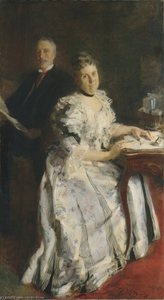
“Ernesta Beaux Drinker,” completed in 1914, depicts a woman seated gracefully on a chair before a table adorned with a vase of flowers – primarily white lilies—a deliberate choice reflecting purity and elegance. Beaux meticulously captured her subject’s posture: hands clasped together, conveying composure and inner reflection. The gaze directed towards the viewer suggests not merely observation but perhaps a subtle acknowledgment of connection, hinting at an unspoken intimacy. Behind Ernesta sits a couch, grounding the figure within a domestic setting, while another chair adds depth to the composition. Beaux skillfully utilizes light—primarily diffused natural illumination—to sculpt the woman’s form and illuminate the vase, enhancing its visual impact.Stylistic Influences and Technique
Beaux's style aligns closely with Impressionism, albeit tempered by a refined academic sensibility. Like her contemporaries, she prioritized capturing fleeting moments of light and color, yet eschewed the unrestrained spontaneity favored by some Impressionists. Beaux’s technique involved layering thin glazes over toned canvases—a hallmark of American Impressionism—resulting in luminous surfaces that convey subtle nuances of texture and tone. The artist's meticulous attention to detail is evident in the rendering of fabrics—particularly Ernesta’s dress—which appears to shimmer with understated brilliance, demonstrating Beaux’s mastery of color and brushwork.Historical Context and Symbolism
Painted during a period of considerable social change and artistic experimentation, “Ernesta” reflects Beaux's engagement with the prevailing aesthetic trends of her time. The portrait exemplifies Beaux’s commitment to portraying individuals within their environment—a stylistic choice that underscores the importance of context in interpreting art. White lilies symbolize purity, innocence, and remembrance – motifs frequently employed by Beaux to convey dignity and grace. Furthermore, Ernesta’s contemplative gaze speaks to a broader exploration of inner life and psychological depth—a characteristic ambition of Beaux's oeuvre.Emotional Resonance and Legacy
“Ernesta Beaux Drinker” transcends mere representation; it embodies Beaux’s profound understanding of human emotion and her ability to convey subtle nuances of character. The painting evokes a sense of serenity, quiet contemplation—a testament to Beaux's artistic vision. Beaux’s enduring legacy rests upon her unwavering dedication to portraying the complexities of human experience with sensitivity and grace—a contribution that continues to inspire artists and collectors alike. Her work stands as an emblem of American Impressionism’s elegance and intellectual rigor.Fragen & Antworten
Welche Art von Kunstwerk ist "Ernesta" von Cecilia Beaux?
"Ernesta" ist ein Werk der Gattung WallArt.
Für welchen Raum wird "Ernesta" von Cecilia Beaux empfohlen?
"Ernesta" von Cecilia Beaux wird für ein Living Room empfohlen. Dieser Vorschlag basiert auf dem Motiv, den Farben und der Stimmung des Werkes.
Wo kann man "Ernesta" von Cecilia Beaux heute besichtigen?
"Ernesta" von Cecilia Beaux wird im Metropolitan Museum of Art, New York, United States of America ausgestellt. Die Museumsangabe bezieht sich auf das Originalwerk, nicht auf Reproduktionen.
 Vorschau anzeigen
 Versenden
 Teilen
 Details anzeigen
 Leitfaden

 Herunterladen
 Ähnliche Objekte
 Röntgenaufnahme
 Diashow
 Fragen & Antworten
 Statistiken