Zum Druck wechseln
 Weiterlesen







































 Bei Kunstwerken oder Reproduktionen, die an einer Seite größer als 105 cm (ca. 41 Zoll) sind, wird der Rahmen zerlegt als Bausatz geliefert. Diese Methode gewährleistet eine sichere Zustellung und verhindert Schäden während des Transports.


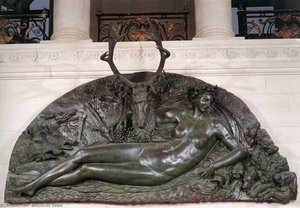
The Embodiment of Mythic Grace: Ganymede by Benvenuto Cellini
To stand before Benvenuto Cellini's bronze depiction of Ganymede is to encounter a moment suspended between divine beauty and youthful vulnerability. This masterful sculpture, executed in the vibrant spirit of the Italian Renaissance, does more than merely represent a mythological figure; it captures an ephemeral breath—a sudden gesture caught forever in oxidized bronze. Ganymede himself, the beautiful youth destined for Olympus, is rendered here with breathtaking naturalism. Observe the exquisite tension in his pose: one hand raised near his head, suggesting a startled awareness or perhaps a moment of profound contemplation, while his other rests upon the powerful form of an eagle beneath him. The entire composition vibrates with implied narrative energy.
Mastery in Bronze: Technique and Craftsmanship
Cellini’s technical prowess is undeniable, evident in every curve and fold. Working in bronze, a medium that demands both immense strength and delicate handling, he achieved a level of detail that speaks to his reputation as a polymath craftsman. The musculature beneath the drapery is articulated with an almost anatomical precision, giving the figure a palpable sense of life. Furthermore, the patina—the rich, variegated surface resulting from age and oxidation—is not merely wear; it is a historical record etched onto the metal, lending the piece an undeniable gravitas that only centuries of existence can bestow. The craftsmanship invites close inspection, rewarding the viewer with details in the hair, the tension in the limbs, and the texture of the bronze itself.
Symbolism and Renaissance Spirit
The choice of subject matter is deeply resonant within the context of Renaissance humanism. Ganymede himself symbolizes idealized beauty, youth, and the transition from mortal life to divine favor. His association with the eagle further layers this symbolism, connecting him to Jupiter’s domain and the elevated status of Olympus. Cellini, a man whose own life was as dramatic and complex as his art, infused this piece with the characteristic flair of Mannerism—a style that favored emotional intensity and sophisticated complexity over pure classical repose. It is a work steeped in allegory, inviting us to ponder the nature of beauty itself: is it inherent, or is it recognized by those who look upon it?
A Focal Point for Elevated Interiors
For the discerning collector or designer seeking an anchor piece that speaks volumes without shouting, Ganymede offers unparalleled depth. Whether placed against a muted wall to let the bronze tones dominate, or grouped with other classical elements, its presence elevates any space from mere room to curated environment. Owning a reproduction of this work allows one to connect intimately with the golden age of Italian art—to bring home not just an object, but a tangible piece of artistic history and mythic romance. It is a statement of taste that appreciates both technical brilliance and enduring narrative power.
Fragen & Antworten
Sind die Farben in "Ganymede" von Benvenuto Cellini eher gesättigt oder gedämpft?
Die Farbpalette von "Ganymede" weist eine Sättigung von Muted auf.
Wann und mit welchen Materialien wurde "Ganymede" geschaffen?
"Ganymede" von Benvenuto Cellini ist eine Bronze, die auf 1548 datiert wird.
Ist ein hochauflösender Download von "Ganymede" verfügbar?
Um eine digitale Datei von "Ganymede" von Benvenuto Cellini zu erhalten, bestellen Sie hochauflösender digitaler Bild-Download auf der Seite Digitales Kunstwerk.
 Versenden
 Teilen
 Details anzeigen
 Leitfaden

 Herunterladen
 Ähnliche Objekte
 Diashow
 Q&A
Q&A Statistiken