Vorschau anzeigen
 Versenden
 Teilen
 Details anzeigen
 Leitfaden

 Herunterladen
 Ähnliche Objekte
 Röntgenaufnahme
 Diashow
 Q&A
Q&A Statistiken
The Drummond Brothers


 Weiterlesen
Giclée / Kunstdruck
Giclée- oder Leinwanddruck in Museumsqualität mit schneller Produktion und flexiblen Veredelungsoptionen. ( Handgemalte Reproduktion bestellen Zum digitalen Bild wechseln)




P118B €10

P118H €10

P118W €10

P438Z €10

P508JH €12

P508YH €12

P805H €10

P805Z €10

P919BZ €10

P919G €10

P919XJ €10

P959ZH €10

P968JZ €12

W106C €8

W218G €10

W218JH €8

W218Y €10

W307PJ €10

W316G €10

W316PJ €8

W316Y €10

W398PJ €8

W4111J €10

W500HY €15

W500JH €15

W692G €12

W849H €8

W940BG €15

W953PJ €8




Wählen Sie aus unseren vordefinierten Formaten, die den ursprünglichen Proportionen des Kunstwerks entsprechen.

Geben Sie die benötigte Breite und Höhe an, damit der Druck perfekt in Ihren Rahmen oder an Ihre Wand passt. Ein Druck kann nur beschnitten, aber niemals größer als das Originalbild angefertigt werden; daher verliert ein Format mit anderen Proportionen einen Teil des Bildes. Wir senden Ihnen ein digitales Mockup zur Freigabe, bevor wir den Druck ausführen. Das auf dieser Seite gezeigte Bild zeigt nicht den tatsächlichen Beschnitt – dies ist nur im Mockup ersichtlich.
Weltweiter Versand () innerhalb von 2 Wochen statt der üblichen 4/5 Wochen. (31 Oktober)

Kostenloser weltweiter Expressversand

Hochwertige Leinenleinwand

Umfassender Versicherungsschutz beim Versand

Zollgebühren-Rückerstattungsgarantie

Garantie für exakte Farbtreue

100 Tage Rückgaberecht (nur bei Mängeln)

100% Geld-zurück-Garantie

Mengenrabatt verfügbar
 Die Glasoption ist nur für Größen unter 110 cm verfügbar.

The Drummond Brothers
Giclée / Kunstdruck
Format der Reproduktion
-


Endpreis
€ 71
Benjamin West (1738-1820): A Pioneer Bridging Worlds
Benjamin West was considered the most prominent artist in the English-speaking world of the late Eighteenth Century. Born in 1738 near Springfield, Pennsylvania, the youngest of ten children, West manifested a talent for painting at an early age, and was encouraged to draw by his parents. By fifteen he was already recognized for his talent in portraiture, and by 1756 had attracted the attention of Dr. William Smith, provost of the College of Philadelphia, who enrolled him in the school and devised a special program of classical studies for him. These early studies instilled within him a spirit of innovation that would characterize his entire career. He quickly established himself as a sought-after portraitist in Philadelphia and New York, but a thirst for deeper artistic knowledge propelled him From humble beginnings—his father an innkeeper—West’s innate talent was nurtured by exposure to Native American art forms before receiving formal training. This unconventional start fueled his ambition to master the techniques of European masters, particularly those practicing Neoclassicism. He embarked on a transformative journey to Italy in 1760, immersing himself in the artistic fervor of Rome, Florence, and Venice, where he honed his skills under renowned instructors and absorbed the ideals of Enlightenment thought. This formative experience would profoundly influence his subsequent work, shaping his stylistic choices and thematic concerns.- Style: West’s oeuvre is predominantly characterized by Neoclassicism, a movement that sought to revive the grandeur and moral seriousness of Classical antiquity—specifically Greek and Roman art—as a reaction against the excesses of Rococo. He meticulously adhered to idealized forms and balanced compositions, reflecting the humanist values championed during the Enlightenment era.
- Technique: West excelled in oil painting on canvas, utilizing meticulous brushwork and subtle tonal gradations to achieve remarkable realism and depth. His mastery of chiaroscuro—the dramatic interplay between light and shadow—created a palpable sense of atmosphere and conveyed profound emotional resonance within his subjects.
The Drummond Brothers: A Portrait Steeped in Symbolism
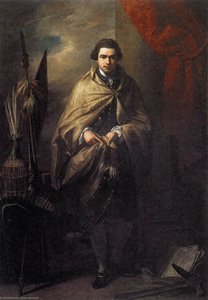
“The Drummond Brothers” depicts two men standing side by side, one gesturing emphatically towards the other. The man on the left holds his hand aloft, conveying authority and perhaps a desire to direct attention—a gesture common in portraits of prominent figures during West’s time. Simultaneously, the man on the right looks downward, suggesting humility or contemplation. These postures are carefully considered, reflecting broader societal ideals about leadership and virtue prevalent in the mid-18th century. The painting's setting contributes significantly to its symbolic meaning. The inclusion of a chair, dining table, and clock underscores themes of domestic tranquility and intellectual pursuits—values highly esteemed by West’s aristocratic patrons. These objects serve as visual anchors, grounding the figures within a recognizable social context while simultaneously hinting at deeper philosophical ideas about time, memory, and human experience.Historical Context & Legacy
Painted in 1767, “The Drummond Brothers” emerged during a period of considerable artistic ferment—the burgeoning Neoclassical movement was reshaping European art and culture. West’s work aligns with the broader intellectual currents of the Enlightenment, which emphasized reason, observation, and moral responsibility. He skillfully captured the spirit of his era, reflecting its fascination with classical ideals and its commitment to portraying human dignity and virtue. West's influence extended far beyond his own lifetime. He served as president of the Royal Academy of Arts for decades, fostering a vibrant artistic community and championing innovative approaches to painting. His students included luminaries such as Charles Willson Peale, Gilbert Stuart, and John Trumbull—artists who would carry West’s stylistic legacy into subsequent generations. Today, “The Drummond Brothers” remains a testament to West's artistic genius and his enduring contribution to the history of art. Its meticulous realism, balanced composition, and subtle symbolism continue to inspire admiration and provoke contemplation among viewers worldwide.Where to Find Reproductions
You can admire this masterpiece in high-resolution reproductions at William Vareika Fine Arts LTD: https://vareikafinearts.com/product/the-drummond-brothers/Fragen & Antworten
Ist "The Drummond Brothers" als Kunstdruck erhältlich?
Einen Druck von "The Drummond Brothers" von Benjamin West können Sie direkt auf der entsprechenden Kunstdruck in Premiumqualität-Seite bestellen: ein Fine Art Print auf Baumwollkanvas oder Archiv-Leinwandpapier.
Ist "The Drummond Brothers" von Benjamin West ein helles oder ein dunkles Kunstwerk?
"The Drummond Brothers" weist eine Gesamthelligkeit von deep_shadow auf, und die Luminanz beträgt Dark.
Wie stellt "The Drummond Brothers" von Benjamin West eine Verbindung zwischen Neoclassical Movement und dem Heimatland des Künstlers her?
"The Drummond Brothers" wurde von Benjamin West geschaffen, der in Vereinigte Staaten von Amerika geboren wurde, und ist der Neoclassical Movement-Bewegung zuzuordnen. Die Herkunft des Künstlers verbindet das Werk mit der Neoclassical Movement, wie sie von Künstlern aus Vereinigte Staaten von Amerika praktiziert wird.
Künstlerbiografie
Benjamin West: Ein Pionier der amerikanischen Kunst
- Geboren: 10. Oktober 1738, Springfield, Vereinigte Staaten von Amerika
- Gestorben: 11. März 1820
Frühes Leben und künstlerische Entwicklung
- Benjamin West wurde in eine bescheidene Familie in Springfield, Pennsylvania, geboren. Sein Vater betrieb eine Herberge, und die Familie zog später nach Newtown Square.
- West zeigte schon in jungen Jahren ein bemerkenswertes künstlerisches Talent und soll von Ureinwohnern Amerikas grundlegende Maltechniken gelernt haben.
- Er erhielt nur eine begrenzte formale Ausbildung, verfolgte aber seine künstlerische Leidenschaft unabhängig.
- Seine frühe Karriere konzentrierte sich auf Porträts in Pennsylvania.
- Ein entscheidender Moment kam mit der Ermutigung, "Der Tod des Sokrates" zu malen, was sich deutlich von der ursprünglichen Gravur unterschied und einen Wendepunkt in seiner Karriere markierte.
- Im Jahr 1760 reiste er nach Italien, studierte direkt die Werke von Meistern wie Tizian und Raffael und begegnete neoklassizistischen Künstlern wie Anton Rafael Mengs, Gavin Hamilton und Angelica Kauffmann.
Karriere in London und die Royal Academy
- West zog 1763 nach London und wurde schnell zu einer prominenten Figur in der britischen Kunstszene.
- Er wurde Mitglied der Royal Academy gewählt und diente von 1792 bis zu seinem Tod im Jahr 1820 als deren Präsident.
- Seine historischen Gemälde, wie "Die Trennung des Regulus", erlangten große Anerkennung und brachten ihm den Spitznamen „der amerikanische Raffael“ ein.
- Er setzte sich für einen Stil ein, der historische Szenen mit zeitgenössischer Kleidung verband, was insbesondere in "Der Tod von General Wolfe" deutlich wird, das traditionelle künstlerische Konventionen herausforderte und Debatten auslöste.
Künstlerischer Stil und Hauptwerke
- West's Stil entwickelte sich von frühen neoklassizistischen Einflüssen zu einer späteren Aufnahme von Elementen des Romantik.
- Bemerkenswerte Werke sind:
- Der Tod von General Wolfe (1770) – Ein bahnbrechendes Werk, das historische Erzählungen mit zeitgenössischer Kleidung verband.
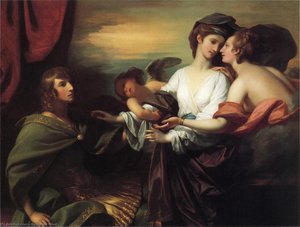
- Thetis bringt Achilles die Rüstung – Demonstriert die Beherrschung klassischer Themen und Kompositionen.
- Die drei Schwestern – Zeigt seine Fähigkeit, allegorische Themen darzustellen.
- Die Furcht des Astyanax – Eine dramatische Darstellung einer mythologischen Szene.
- Die Höhle der Verzweiflung – Verkörpert seinen sich entwickelnden romantischen Stil.
- Seine Arbeit zeichnet sich durch ihre Ambition, detaillierte Komposition und die Erforschung historischer und mythologischer Themen aus.
Vermächtnis und historische Bedeutung
- Benjamin West hinterließ einen bleibenden Eindruck in der amerikanischen Kunst, indem er das Genre der Geschichtsmalerei begründete und Generationen von Künstlern beeinflusste.
- Er spielte eine entscheidende Rolle bei der Gestaltung des Identitätsbewusstseins künstlerischen Ausdrucks Amerikas.
- Seine Präsidentschaft der Royal Academy trug wesentlich zur Entwicklung der britischen Kunst bei.
- West's Vermächtnis geht über seine einzelnen Werke hinaus; er förderte ein Umfeld, das aufstrebende amerikanische Künstler unterstützte, die im Ausland studierten, darunter Allston, Copley und Morse.
- Sein innovativer Ansatz in der Geschichtsmalerei ebnete den Weg für zukünftige künstlerische Bewegungen und inspiriert weiterhin zeitgenössische Künstler und Kunstliebhaber.

Benjamin West
1738 - 1820 , Vereinigte Staaten von Amerika
Kurzinfos
- Beeinflusste Künstler:
- Tiziano
- Rafael
- Bemerkenswerte Werke:
- Der Tod des General Wolfe
- Thetis bringt die Rüstung
- Die drei Schwestern
- Die Furcht des Astyanax
- Die Höhle der Verzweiflung
- Geburtsdatum: 10. Oktober 1738
- Geburtsort: Springfield, USA
- Künstlerische Richtung: Neoklassizismus, Historienmalerei
- Nationalität: Amerikanisch
- Sterbedatum: 11. März 1820
- Vollständiger Name: Benjamin West
- Von Ihm Beeinflusste Künstler:
- Edward W. J. Savage
- Copley
- Allston
- Morse
Ähnliche Artikel

Illuminating the Enlightenment: Artistic Expression in 18th-Century Europe
Explore the artistic brilliance of the Enlightenment era! Discover Rococo's elegance & Neoclassicism’s virtue with expert insights into 18th-century masterpieces. Learn about David, Kauffmann & more.
Illuminating the Enlightenment: Art & Sociopolitical Context of the 18th Century
Explore the art of the Enlightenment! Discover Rococo's elegance, Neoclassicism’s virtue, & David’s revolutionary masterpieces. Uncover the sociopolitical context shaping 18th-century European painting.
Neoclassicism Explained: The Timeless Elegance of Order, Reason, and the Classical Ideal
Explore the profound elegance of Neoclassicism. Discover how the Enlightenment era embraced Greek and Roman ideals of order, reason, and symmetry to redefine art history through masters like Mengs and Hamilton. A definitive guide for history lovers and art collectors.

Benjamin West: Transatlantische Ambitionen und die Gestaltung der amerikanischen Kunst
Entdecken Sie das faszinierende Leben und Werk von Benjamin West, dem Pionier der amerikanischen Kunst! Erfahren Sie mehr über seinen Einfluss auf den Neoklassizismus und die Förderung junger Künstler in Europa. Jetzt lesen!

The Enduring Legacy of Formal Portraiture: Power, Identity & Artistic Exploration
Explore the rich history of formal portraiture & its enduring power to capture identity and shape perception. Discover investment-worthy artworks, expert appraisals, and custom reproduction services at OriginalUniqueArt.