In echtem Maßstab anzeigen
 Versenden als Grußkarte
 Teilen
 Details anzeigen
 Leitfaden öffnen

 Herunterladen
 Ähnliche Objekte
 Röntgenaufnahme
 Diashow
 Besucherstatistiken
Guitar lesson
 Oil On Canvas
- WallArt
- Surrealist Art
 1934
1934 161.0 x 138.0 cm
 Mehr anzeigen
Die auf dieser Seite dargestellten Kunstwerke sind urheberrechtlich geschützt, was bedeutet, dass wir keine identische Reproduktion rechtmäßig erstellen oder verkaufen dürfen. Dieser Schutz wird durch internationale Abkommen wie die Berner Übereinkunft und durch nationale Gesetze, einschließlich derer, die von den ... festgelegt wurden US-Urheberrecht – Titel 17.
Diese Methode entspricht vollumfänglich den Urheberrechtsbestimmungen, da sie keine Kopie oder Vervielfältigung des geschützten Kunstwerks darstellt. Stattdessen handelt es sich um eine kreative Neuinterpretation – ein neues Gemälde, das vom Original inspiriert, aber nicht identisch mit ihm ist.
Giclée / Kunstdruck
Giclée- oder Leinwanddruck in Museumsqualität mit schneller Produktion und flexiblen Veredelungsoptionen. ( Handgemalte Reproduktion kaufen Zum digitalen Bild wechseln)




P118B €10

P118H €10

P118W €10

P438Z €10

P508JH €12

P508YH €12

P805H €10

P805Z €10

P919BZ €10

P919G €10

P919XJ €10

P959ZH €10

P968JZ €12

W106C €8

W218G €10

W218JH €8

W218Y €10

W307PJ €10

W316G €10

W316PJ €8

W316Y €10

W398PJ €8

W4111J €10

W500HY €15

W500JH €15

W692G €12

W849H €8

W940BG €15

W953PJ €8




Wählen Sie aus unseren vordefinierten Formaten, die den ursprünglichen Proportionen des Kunstwerks entsprechen.

Geben Sie die Breite und die Höhe an, die Sie benötigen, damit der Druck perfekt in Ihren Rahmen oder an Ihre Wand passt. Ein Druck kann nur beschnitten werden und niemals größer als das Originalbild gemacht werden; daher verliert ein Format mit einer anderen Proportion einen Teil des Bildes. Wir senden Ihnen ein digitales Mockup zur Freigabe, bevor wir den Druck ausführen. Das auf dieser Seite gezeigte Bild zeigt nicht den tatsächlichen Beschnitt – dies ist nur im Mockup ersichtlich.
Weltweiter Versand () innerhalb von 2 Wochen statt der üblichen 4/5 Wochen. (25 Oktober)

Kostenloser weltweiter Expressversand

Hochwertige Leinenleinwand

Vollständiger Versicherungsschutz beim Versand

Zollgebühren-Rückerstattungsgarantie

Garantie für exakte Farbtreue

100-tägiges Rückgaberecht (nur bei Mängeln)

100% Geld-zurück-Garantie

Angebot für Mengenrabatt
 Die Glasoption ist nur für Größen unter 110 cm verfügbar.

Guitar lesson
Giclée / Kunstdruck
Format der Reproduktion
-


Gesamtpreis
€ 70
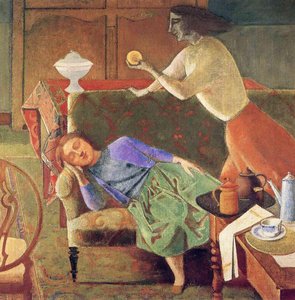
A Portrait of Intimacy: Exploring Balthus’s “Guitar Lesson”
The painting "Guitar Lesson," created by Polish-French artist Balthus in 1934, stands as an arresting testament to surrealist art's ability to delve beneath surface appearances and confront viewers with profound psychological complexities. Measuring 161 x 138 cm and executed in oil on canvas, it’s more than just a depiction of two women; it’s a carefully constructed tableau brimming with symbolic resonance and reflecting the anxieties of its time. Balthus deliberately eschewed the prevailing stylistic conventions of his era, prioritizing meticulous observation and capturing fleeting moments of human emotion—a characteristic that distinguishes him from many of his contemporaries.Style and Technique: Classical Revival Infused with Modern Sensibility
Balthus’s approach to painting was rooted in a deep admiration for the Old Masters, particularly Rembrandt and Vermeer. However, he wasn't simply replicating their techniques; rather, he skillfully adapted them to express his own distinctive vision. The artist employed a technique characterized by subtle gradations of color and painstaking brushwork—a hallmark of his oeuvre—creating an illusionistic depth that draws the eye into the scene. Unlike Impressionists who sought to capture atmospheric effects, Balthus focused on portraying figures with unflinching realism, prioritizing anatomical accuracy and conveying psychological nuance rather than superficial beauty. The muted palette contributes to the painting’s contemplative mood, emphasizing texture and form over vibrant hues.Historical Context: Navigating Uncertainty Amidst Artistic Shifts
“Guitar Lesson” emerged during a period of significant artistic upheaval in Europe—the aftermath of World War I and the burgeoning influence of Surrealism. While Surrealists championed dreamlike imagery and irrational juxtapositions, Balthus resisted these trends, opting for a more restrained aesthetic that nonetheless conveyed a palpable sense of unease. The painting reflects the anxieties surrounding gender roles and societal expectations prevalent in the 1930s—a time when women’s liberation movements were gaining momentum but traditional norms persisted. This tension is subtly communicated through the posture of the seated woman, whose expansive legs suggest vulnerability while simultaneously embodying a quiet defiance.Symbolism: Music, Vulnerability, and Hidden Narratives
The inclusion of a guitar and violin serves as more than just decorative elements; they are potent symbols representing harmony and creativity—concepts that Balthus consistently explored in his work. The woman playing the guitar embodies artistic expression and perhaps hints at an unspoken desire for connection. Simultaneously, her posture conveys vulnerability, mirroring the psychological complexities inherent in human relationships. The empty chair beside her underscores the solitude of experience and invites contemplation about unspoken emotions. These subtle visual cues elevate “Guitar Lesson” beyond a simple portrait, transforming it into a meditation on intimacy and emotional truth.Emotional Impact: A Masterpiece of Psychological Observation
Ultimately, "Guitar Lesson" succeeds in capturing a moment of profound psychological observation—a feat rarely achieved by artists of its time. Balthus’s masterful rendering of human anatomy and emotion compels viewers to confront uncomfortable truths about desire, vulnerability, and the unspoken dynamics of interpersonal connections. It's a painting that lingers in the mind long after viewing, prompting reflection on the complexities of human experience and reaffirming Balthus’s enduring legacy as one of the most perceptive and unsettlingly beautiful artists of the 20th century.Fragen & Antworten
Wie stark ist der Kontrast in "Guitar lesson" von Balthus?
"Guitar lesson" von Balthus zeigt einen Statement Kontrast zwischen seinen hellen und dunklen Bereichen.
Welche Farbe prägt die Komposition von "Guitar lesson" von Balthus?
Die dominante Farbe von "Guitar lesson" von Balthus ist Walnut (#7e471e).
Wer verkauft handgemalte Kopien von "Guitar lesson" von Balthus?
Handgemalte Kopien von "Guitar lesson" von Balthus werden auf diese Website verkauft: eine handgemalte Ölreproduktion auf Leinenleinwand, bestellbar über die Seite Handgemalte Reproduktion.
Biografie des Künstlers
Frühe Jahre und Einflüsse
Balthasar Klossowski de Rola, bekannt unter dem Pseudonym Balthus, wurde am 29. Februar 1908 in Paris geboren. Seine frühen Jahre waren geprägt von den Einflüssen seiner Familie, die zur kulturellen Elite gehörte. Balthus' Vater, Erich Klossowski, war Kunsthistoriker und Autor eines Buches über Daumier, und seine Mutter Elisabeth Dorothea Spiro (bekannt als Malerin Baladine Klossowska) war Teil der Pariser Kulturszene.Künstlerische Laufbahn
Balthus’ künstlerische Karriere begann im Jahr 1934 mit seiner ersten Ausstellung in Paris, die Werke wie „Die Gitarrenstunde“ zeigte, welche aufgrund ihrer sexuellen Darstellung Kontroversen auslöste. Diese frühen Arbeiten wurden von der Kunst des Frührenaissance und den Schriften von Emily Brontë, Lewis Carroll und Simone Martini beeinflusst.- „La Rue“ (1933) und „La Toilette de Cathy“ (1933) sind bemerkenswerte Werke aus dieser Zeit, die Balthus' einzigartigen Stil zeigen.
- Sein Lieblingskomponist war Wolfgang Amadeus Mozart, was seine Wertschätzung für das Klassische und die sinnlichen Aspekte der Kunst widerspiegelt.
Kontroversen und Späteres Leben
Balthus’ späteres Leben war von Kontroversen um seinen familiären Hintergrund geprägt. Trotz Behauptungen, keine jüdischen Vorfahren zu haben, bleibt die wahre Abstammung seiner Mutter ein Diskussionspunkt.- Balthus' Beziehung zu seiner japanischen Frau Setsuko Ideta, die er 1967 heiratete, trug zum Mysterium um seine Person bei.
- Die Balthus-Stiftung, die 1998 von seiner Witwe, Gräfin Setsuko Klossowska de Rola, gegründet wurde, fördert weiterhin sein Werk und sein Erbe.
Vermächtnis und Einfluss
Balthus' Einfluss ist in verschiedenen zeitgenössischen Künstlern sichtbar, darunter Jan Saudek, Will Barnet, Duane Michals, John Currin, Eli Levin, Emile Chambon und Elena Zolotnitsky.- Sein Stil, vorwiegend klassisch, wurde von zahlreichen Künstlern beeinflusst, darunter Masaccio, Piero della Francesca, Simone Martini, Poussin, Jean-Étienne Liotard, Joseph Reinhardt, Géricault, Ingres, Goya, Jean-Baptiste Camille Corot, Courbet, Edgar Degas, Félix Vallotton und Paul Cézanne.
- Als wichtiger Künstler des 20. Jahrhunderts wird Balthus' Werk weiterhin weithin anerkannt und geschätzt.
Bemerkenswerte Werke und Ausstellungen
- „Mädchen am Fenster“ (1957), das in François Truffauts Film „Domicile Conjugal“ (1970) zu sehen war.
- Ausstellungen im Museum of Modern Art (1956) und der Galerie Pierre Matisse (1934) zeigten Balthus' einzigartigen Stil.
- Erfahren Sie mehr über die Werke von Balthus auf OriginalUniqueArt: https://OriginalUniqueArt.com/@/balthasar-klossowski
- Entdecken Sie die Sammlung des Museum of Modern Art auf OriginalUniqueArt: https://OriginalUniqueArt.com/@@/a@d3aqwm-the-museum-of-modern-art-(united-states)-a-comprehensive-overview
- Erfahren Sie mehr über Balthus' Leben und Werk auf Wikipedia: https://en.wikipedia.org/wiki/balthazar_klossowski

Balthus
1908 - 2001 , Frankreich
Eckdaten zum Künstler
- Bemerkenswerte Kunstwerke:
- Mädchen mit Katze
- Die Straße
- Roberte im Spiegel
- Geburtsdatum: 29. Februar 1908
- Geburtsort (Stadt, Land): Paris, Frankreich
- Künstler Oder Bewegungen, Die Von Diesem Künstler Beeinflusst Wurden:
- Jan Saudek
- Will Barnet
- Künstler, Die Diesen Künstler Beeinflussten:
- Masaccio
- Piero della Francesca
- Simone Martini
- Künstlerische Bewegung Oder Stil: Figurative Malerei, Klassizismus
- Nationalität: Französisch
- Sterbedatum: 18. Februar 2001
- Vollständiger Name: Balthasar Klossowski de Rola
Verwandte Artikel

The Soul of Impressionism: Why Oil on Canvas Captures Eternal Light and Timeless Emotion
Discover the enchanting alchemy of Impressionism. Explore how the mastery of oil on canvas, through glazing and impasto, captures eternal light and emotion. Perfect for lovers of Monet and Van Gogh seeking the profound depth of hand-painted fine art.

Das bleibende Erbe der Ölmalerei: Technik, Geschichte und zeitgenössische Praxis
Entdecken Sie die faszinierende Geschichte der Ölmalerei – von den frühen Techniken bis zur modernen Kunst. Expertenwissen, detaillierte Analysen und Inspiration für Sammler & Kunstliebhaber.

Öl auf Leinwand: Die 10 Meisterwerke, die Kunst für immer veränderten |
Entdecken Sie die 10 legendärsten Öl auf Leinwand Meisterwerke! Von Van Gogh bis Monet – erfahren Sie die Geschichten hinter ikonischen Gemälden und lassen Sie sich von Kunstgeschichte inspirieren. Hochwertige Reproduktionen für Ihr Zuhause finden Sie auf .

The Enduring Legacy of Oil on Canvas: Technique, History & Aesthetic Impact
Explore the rich history & techniques of oil painting – from Renaissance masters to Impressionism. Discover pigments, layering methods, and why this timeless medium endures. Expert insights for artists & art enthusiasts.

Öl auf Leinwand: Eine historische und technische Erkundung eines zeitlosen künstlerischen Mediums
Entdecken Sie die faszinierende Welt der Ölmalerei! Von historischen Techniken bis zur modernen Anwendung – wir bieten Expertenwissen, Restaurierungstipps und hochwertige Reproduktionen. Jetzt informieren!