- Startseite

- Ölgemälde-Reproduktion
- August Macke
- Three acts

 Druck bestellen Bild kaufen
 Versenden
 Teilen
 Details anzeigen
 Zu Favoriten hinzufügen

 Herunterladen
 Ähnliche Objekte
 Röntgenaufnahme
 Diashow anzeigen
Three acts
 Oil On Canvas
- WallArt
- German Expressionism
 1913
1913- Modern
 82.0 x 51.0 cm
 Weiterlesen
Handgefertigte Öl-Reproduktion
Handgemaltes Ölgemälde auf Leinwand in Ihrer Wunschgröße und mit Rahmen, auf Bestellung von unseren Künstlern angefertigt.




P118B $10

P118H $10

P118W $10

P438Z $10

P508JH $12

P508YH $12

P805H $10

P805Z $10

P919BZ $10

P919G $10

P919XJ $10

P959ZH $10

P968JZ $12

W106C $8

W218G $10

W218JH $8

W218Y $10

W307PJ $10

W316G $10

W316PJ $8

W316Y $10

W398PJ $8

W4111J $10

W500HY $15

W500JH $15

W692G $12

W849H $8

W940BG $15

W953PJ $8




Wählen Sie aus unseren vordefinierten Größen, die den ursprünglichen Proportionen des Kunstwerks entsprechen.

Sie können Ihre eigenen Maße eingeben, um einen bestimmten Rahmen oder Platz auszufüllen. Wenn die gewählte Größe nicht den Proportionen des Originalbildes entspricht, werden wir das Kunstwerk entweder beschneiden oder das Gemälde durch zusätzliche, handgemalte Elemente erweitern. Ein digitales Mockup wird Ihnen zur Genehmigung zugesandt, bevor die Produktion beginnt.
Bitte beachten Sie, dass die Bildschirmvorschau nicht die tatsächliche Beschneidung oder Erweiterung widerspiegelt. Nur das Mockup zeigt die endgültige Komposition exakt an.
Obwohl Sondermaße verfügbar sind, empfehlen wir, eine Größe aus der vordefinierten Liste zu wählen, um die ursprünglichen Proportionen beizubehalten.
Nach der Bestellung wird das OriginalUniqueArt.com-Team dem Kunden Anweisungen per E-Mail zusenden und eine Mockup-Vorschau bereitstellen.
Weltweiter Versand () in nur 3 bis 4 Wochen statt der üblichen 5 Wochen. (19 Juli). Keine Kompromisse bei der Qualität.

Kostenloser weltweiter Expressversand

Hochwertige Leinenleinwand

Umfassender Versicherungsschutz beim Versand

Zollsteuer-Rückerstattungsgarantie

Garantie für echte Farbtreue

60-Tage-Rückgaberecht (nur bei Mängeln)

100% Geld-zurück-Garantie

Mengenrabatt verfügbar
 Die Glasoption ist nur in Größen unter 110 cm verfügbar.

Three acts
Art der Reproduktion
Größe der Reproduktion
-


Endpreis aller Optionen
-
Beschreibung des Kunstwerks
A Symphony of Color and Form
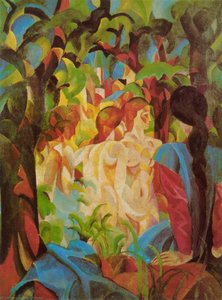
In the vibrant tapestry of German Expressionism, few works capture the ephemeral beauty of life as poignantly as August Macke’s Three Acts. Painted in 1913, this masterpiece serves as a window into a world where color is not merely a descriptive tool but an emotional language. The canvas presents a breathtaking scene of three naked women standing amidst a lush, natural setting, their forms harmoniously integrated with the surrounding trees and foliage. There is an undeniable sense of rhythm in the composition; the way the figures are positioned—one partially obscuring another—creates a captivating visual dance that draws the eye through the depth of the forest. This arrangement does more than just showcase the human form; it establishes an intimate connection between the subjects, suggesting a shared moment of peace and profound togetherness.
The technique employed by Macke is nothing short of luminous. Utilizing bold brushstrokes and a palette of rich, saturated hues, he breathes life into the canvas, imbuing the scene with a palpable energy. The interplay of light and shadow across the skin of the women and the verdant leaves of the backdrop creates a sense of movement, as if a gentle breeze is passing through the clearing. For the discerning collector or interior designer, this painting offers a dynamic focal point that can transform a room, bringing an infusion of vitality and warmth to any sophisticated space.
The Spirit of Expressionism and Historical Resonance
To understand Three Acts, one must look toward the historical currents that shaped Macke’s brief but brilliant career. As a key figure associated with the Der Blaue Reiter movement, Macke was deeply influenced by the avant-garde explorations of his contemporaries, such as Franz Marc and Robert Delaunay. His work sits at a fascinating intersection of Fauvism and Orphism, where the structural integrity of form meets the wild, uninhibited use of color. This specific piece, created just a year before Macke’s untimely death in the First World War, embodies the optimistic, experimental spirit of pre-war European modernism.
The symbolism within the painting transcends the literal depiction of a pastoral scene. The "three acts" suggested by the title can be interpreted as a celebration of the cycles of nature or perhaps a metaphorical representation of stages of life and connection. By stripping the figures of clothing, Macke removes the distractions of social class or era, presenting a universalized vision of humanity in its most natural state. This raw, unadorned beauty, paired with the distorted yet graceful forms characteristic of Expressionism, evokes an emotional intensity that resonates deeply with the viewer, inviting contemplation on the harmony between the human spirit and the natural world.
An Invitation to Timeless Elegance
Owning a piece of art history is a profound experience, and a high-quality reproduction of Three Acts offers an opportunity to bring this era of German Expressionism into the modern home. Whether you are an art historian captivated by the technical nuances of Macke’s brushwork or an interior designer seeking to add a layer of sophisticated narrative to a curated collection, this artwork provides endless inspiration. The painting's ability to balance vibrant energy with a serene, meditative atmosphere makes it a versatile treasure for any decor style, from contemporary minimalism to classic luxury.
Investing in a hand-painted reproduction allows the enduring legacy of August Macke to live on within your personal sanctuary. Each stroke of the brush in a faithful recreation seeks to honor the original's texture and light, ensuring that the emotional impact of those three figures in the forest remains as potent today as it was in 1913. It is more than just a decoration; it is an invitation to experience a moment of eternal summer, frozen in a masterpiece of color and soul.
Biografie des Künstlers
Frühes Leben und künstlerische Karriere
August Robert Ludwig Macke, ein renommierter deutscher Expressionist, wurde am 3. Januar 1887 in Meschede, Westfalen geboren. Sein künstlerischer Werdegang begann an der Kunstakademie Düsseldorf (1904-1906) unter Adolf Maennchen. Mackes Stil wurde von französischem Impressionismus und Postimpressionismus geprägt, später beeinflusst durch den Fauvismus.Künstlerische Einflüsse und Stil
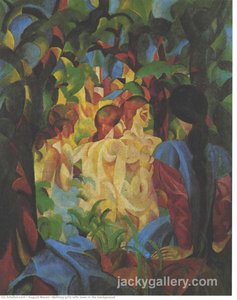
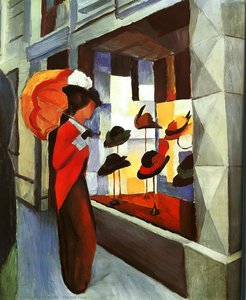
Macke traf 1912 in Paris Robert Delaunay, was ihn dem chromatischen Kubismus, auch Orphismus genannt, näherbrachte. Dieser Einfluss zeigt sich in seinem Gemälde Shops Windows, einer persönlichen Interpretation von Delaunays Stil kombiniert mit der Simultaneität von Bildern, die man im italienischen Futurismus findet. Macke war Teil der deutschen Expressionisten-Gruppe Der Blaue Reiter (Die Blaue Reiter), zusammen mit Wassily Kandinsky, Franz Marc und Paul Klee. Seine Gemälde, wie z.B. Bathing Girls with Town in the Background (100 x 80 cm, Staatsgalerie Moderner Kunst, München), zeigen seinen einzigartigen Stil, der durch lebendige Farben und kühne Linienführung gekennzeichnet ist.Bemerkenswerte Werke und Vermächtnis
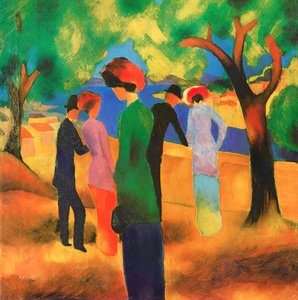
- Woman in a Green Jacket (1913, Museum Ludwig Köln), ein Paradebeispiel des Expressionismus.
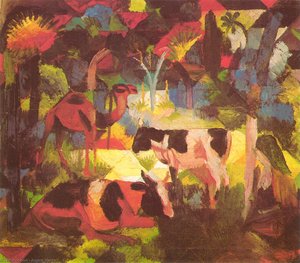
- Landscape with Cows and Camel (1914, Kunsthaus Zürich), ein typisches Beispiel für Mackes Stil.
- Türkisches Café (1914), ein Meisterwerk, das seinen luministischen Ansatz während seiner letzten Periode zeigt.
Tragisches Ende und bleibender Einfluss
Mackes Leben wurde abrupt beendet, als er am 26. September 1914 an der Front in Champagne, Frankreich, starb. Sein letztes Gemälde, Abschied, fängt die Stimmung der Trauer ein, die sich während des Ersten Weltkriegs über Europa legte. Erkunden Sie weitere Werke von August Macke und der deutschen Expressionismus-Bewegung auf OriginalUniqueArt: * Woman in a Green Jacket * Franz Marc's Fighting Forms (zeigt die Zusammenarbeit innerhalb der Gruppe Der Blaue Reiter) * August Mackes Künstlerseite auf OriginalUniqueArt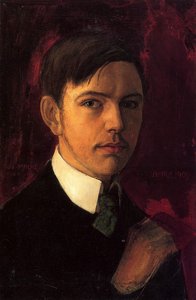
August Macke
1887 - 1914 , Deutschland
Kurzinfos
- Bemerkenswerte Werke:
- Frau in einem grünen Kleid
- Türkisches Café
- Landschaft mit Kühen und Kamel
- Einflüsse:
- Robert Delaunay
- Franz Marc
- Paul Klee
- Geburtsdatum: 3. Januar 1887
- Geburtsort: Meschede, Deutschland
- Künstlerische Bewegung: Expressionismus, Orphismus
- Nationalität: Deutsch
- Sterbedatum: 26. September 1914
- Vollständiger Name: August Macke
Ähnliche Artikel
Pierre-Auguste Renoir: Die 25 Meisterwerke des Impressionismus für Ihr Zuhause | OriginalUniqueArt
Entdecken Sie die 25 schönsten Meisterwerke von Pierre-Auguste Renoir! Tauchen Sie ein in die Welt des Impressionismus, erleben Sie berühmte Gemälde wie 'Bal au moulin de la Galette' und finden Sie hochwertige Kunstdrucke für Ihr Zuhause. Jetzt auf OriginalUniqueArt.com!

Deutsche Expressionismus Meisterwerke: Die 10 wichtigsten Kunstwerke für Ihr Zuhause
Entdecken Sie die 10 bedeutendsten Werke des Deutschen Expressionismus! Kirchner, Nolde & Co. – ihre Geschichten, Techniken und zeitlose Schönheit. Hochwertige Kunstdrucke auf OriginalUniqueArt.com kaufen und Ihr Zuhause mit emotionaler Kunst bereichern. Jetzt entdecken!
August Macke: Ausdrucksstarke Visionen von Harmonie und Moderne
Entdecken Sie das faszinierende Werk von August Macke! Erfahren Sie mehr über seine Rolle im Expressionismus, Der Blaue Reiter und seinen einzigartigen Stil. Jetzt lesen & hochwertige Reproduktionen finden.
Expressionismus: Die 10 Meisterwerke, die eine Ära prägten – Kunst für Ihr Zuhause |
Entdecken Sie die 10 prägendsten Meisterwerke des Expressionismus! Von Munch bis Kandinsky – erfahren Sie die Geschichten hinter den berühmtesten Gemälde und Künstler. Hochwertige Kunstdrucke online bei kaufen & Ihr Zuhause mit Emotionen füllen.
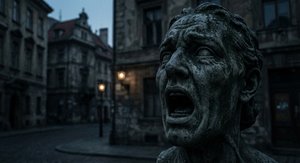
The Visceral Cry of a Nation: Exploring Emotion & Distortion in German Expressionism
Explore the powerful world of German Expressionism with OriginalUniqueArt. Discover Kirchner, Nolde & Die Brücke's emotive masterpieces. Learn about this pivotal art movement and its lasting impact on modern art.