

 In echtem Maßstab anzeigen
 Versenden als Grußkarte
 Teilen
 Details anzeigen
 Leitfaden öffnen

 Herunterladen
 Ähnliche Objekte
 Röntgenaufnahme
 Diashow
 Besucherstatistiken
People by the Lake


 Mehr anzeigen
Giclée / Kunstdruck
Giclée- oder Leinwanddruck in Museumsqualität mit schneller Produktion und flexiblen Veredelungsoptionen. ( Handgemalte Reproduktion kaufen Zum digitalen Bild wechseln)




P118B €10

P118H €10

P118W €10

P438Z €10

P508JH €12

P508YH €12

P805H €10

P805Z €10

P919BZ €10

P919G €10

P919XJ €10

P959ZH €10

P968JZ €12

W106C €8

W218G €10

W218JH €8

W218Y €10

W307PJ €10

W316G €10

W316PJ €8

W316Y €10

W398PJ €8

W4111J €10

W500HY €15

W500JH €15

W692G €12

W849H €8

W940BG €15

W953PJ €8




Wählen Sie aus unseren vordefinierten Formaten, die den ursprünglichen Proportionen des Kunstwerks entsprechen.

Geben Sie die Breite und die Höhe an, die Sie benötigen, damit der Druck perfekt in Ihren Rahmen oder an Ihre Wand passt. Ein Druck kann nur beschnitten werden und niemals größer als das Originalbild gemacht werden; daher verliert ein Format mit einer anderen Proportion einen Teil des Bildes. Wir senden Ihnen ein digitales Mockup zur Freigabe, bevor wir den Druck ausführen. Das auf dieser Seite gezeigte Bild zeigt nicht den tatsächlichen Beschnitt – dies ist nur im Mockup ersichtlich.
Weltweiter Versand () innerhalb von 2 Wochen statt der üblichen 4/5 Wochen. (23 Oktober)

Kostenloser weltweiter Expressversand

Hochwertige Leinenleinwand

Vollständiger Versicherungsschutz beim Versand

Zollgebühren-Rückerstattungsgarantie

Garantie für exakte Farbtreue

100-tägiges Rückgaberecht (nur bei Mängeln)

100% Geld-zurück-Garantie

Angebot für Mengenrabatt
 Die Glasoption ist nur für Größen unter 110 cm verfügbar.

People by the Lake
Giclée / Kunstdruck
Format der Reproduktion
-


Gesamtpreis
€ 70
People by the Lake – An Expressionist Echo of Summer’s Embrace
The painting “People by the Lake,” created in 1913 by August Macke, isn't merely a depiction of a tranquil lakeside scene; it’s a visceral embodiment of Expressionism’s core tenets—a fervent distillation of emotion and experience rendered with audacious color and fractured form. Situated at the Staatliche Kunsthalle Karlsruhe, this oil on canvas masterpiece captures a moment suspended in time, inviting viewers to contemplate not just what they see but how it feels. Macke's stylistic trajectory was marked by an initial fascination with Impressionism’s shimmering light effects, evident in his early landscapes. However, he swiftly abandoned these conventions for the revolutionary language of Expressionism, championed by artists like Ernst Ludwig Kirchner and Emil Nolde. This decisive shift reflected a broader cultural preoccupation with confronting anxieties surrounding modernity—the rapid industrialization, urbanization, and social upheaval that characterized Europe at the turn of the century. Macke sought to bypass rational representation altogether, prioritizing instead the conveyance of inner psychological states. The painting’s technique exemplifies this ambition brilliantly. Macke employs thick impasto – applying paint in heavy layers – creating a palpable textural surface that pulsates with energy. Bold brushstrokes dominate the composition, disrupting any semblance of smooth gradation and conveying a sense of restless movement. The palette is dominated by hues of blue and green—the colors of water and foliage—but these tones are intensified and distorted through chromatic modulation, injecting them with an unsettling vibrancy. Notice how Macke doesn’t strive for photographic accuracy; instead, he manipulates color to heighten emotional impact. Beyond its formal qualities, “People by the Lake” resonates deeply with symbolic meaning. The three figures positioned before the tree represent humanity grappling with the complexities of existence—a quiet contemplation punctuated by animated conversation. The tree itself symbolizes resilience and connection to nature, offering a counterpoint to the anxieties of urban life. Macke’s deliberate simplification of forms contributes to this overarching theme, stripping away extraneous detail to focus on essential gestures and expressions. Ultimately, “People by the Lake” transcends its visual description; it communicates an emotional landscape—a feeling of warmth, camaraderie, and fleeting beauty amidst a turbulent world. It's a painting that lingers in the mind long after viewing, prompting reflection on themes of human connection and the enduring power of artistic intuition. Its influence continues to inspire artists today who strive to capture the immediacy of experience with uncompromising honesty.- Artist: August Macke
- Year Created: 1913
- Medium: Oil on Canvas
- Location: Staatliche Kunsthalle Karlsruhe
Fragen & Antworten
Welches Gefühl vermittelt "People by the Lake" von August Macke?
Die festgehaltene Stimmung von "People by the Lake" von August Macke ist Gelassenheit, und ihr emotionaler Tonfall ist Beschaulich.
Inwiefern lässt sich der Stil von "People by the Lake" mit der Epoche seines Schöpfers in Verbindung bringen?
"People by the Lake" von August Macke lässt sich der Expressionism-Strömung innerhalb der Moderne-Ära seines Schöpfers zuordnen.
Wie hell ist "People by the Lake" insgesamt?
Insgesamt wird „People by the Lake“ mit einer Helligkeit von ausgewogen erfasst. Die wahrgenommene Helligkeit beschreibt, wie hell oder dunkel das Werk erscheint.
Biografie des Künstlers
Frühes Leben und künstlerische Karriere
August Robert Ludwig Macke, ein renommierter deutscher Expressionist, wurde am 3. Januar 1887 in Meschede, Westfalen geboren. Sein künstlerischer Werdegang begann an der Kunstakademie Düsseldorf (1904-1906) unter Adolf Maennchen. Mackes Stil wurde von französischem Impressionismus und Postimpressionismus geprägt, später beeinflusst durch den Fauvismus.Künstlerische Einflüsse und Stil
Macke traf 1912 in Paris Robert Delaunay, was ihn dem chromatischen Kubismus, auch Orphismus genannt, näherbrachte. Dieser Einfluss zeigt sich in seinem Gemälde Shops Windows, einer persönlichen Interpretation von Delaunays Stil kombiniert mit der Simultaneität von Bildern, die man im italienischen Futurismus findet. Macke war Teil der deutschen Expressionisten-Gruppe Der Blaue Reiter (Die Blaue Reiter), zusammen mit Wassily Kandinsky, Franz Marc und Paul Klee. Seine Gemälde, wie z.B. Bathing Girls with Town in the Background (100 x 80 cm, Staatsgalerie Moderner Kunst, München), zeigen seinen einzigartigen Stil, der durch lebendige Farben und kühne Linienführung gekennzeichnet ist.Bemerkenswerte Werke und Vermächtnis
- Woman in a Green Jacket (1913, Museum Ludwig Köln), ein Paradebeispiel des Expressionismus.
- Landscape with Cows and Camel (1914, Kunsthaus Zürich), ein typisches Beispiel für Mackes Stil.
- Türkisches Café (1914), ein Meisterwerk, das seinen luministischen Ansatz während seiner letzten Periode zeigt.
Tragisches Ende und bleibender Einfluss
Mackes Leben wurde abrupt beendet, als er am 26. September 1914 an der Front in Champagne, Frankreich, starb. Sein letztes Gemälde, Abschied, fängt die Stimmung der Trauer ein, die sich während des Ersten Weltkriegs über Europa legte. Erkunden Sie weitere Werke von August Macke und der deutschen Expressionismus-Bewegung auf OriginalUniqueArt: * Woman in a Green Jacket * Franz Marc's Fighting Forms (zeigt die Zusammenarbeit innerhalb der Gruppe Der Blaue Reiter) * August Mackes Künstlerseite auf OriginalUniqueArt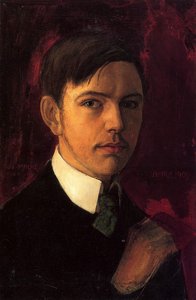
August Macke
1887 - 1914 , Deutschland
Eckdaten zum Künstler
- Bemerkenswerte Werke:
- Frau in einem grünen Kleid
- Türkisches Café
- Landschaft mit Kühen und Kamel
- Einflüsse:
- Robert Delaunay
- Franz Marc
- Paul Klee
- Geburtsdatum: 3. Januar 1887
- Geburtsort: Meschede, Deutschland
- Künstlerische Bewegung: Expressionismus, Orphismus
- Nationalität: Deutsch
- Sterbedatum: 26. September 1914
- Vollständiger Name: August Macke
Verwandte Artikel
August Macke: Ausdrucksstarke Visionen von Harmonie und Moderne
Entdecken Sie das faszinierende Werk von August Macke! Erfahren Sie mehr über seine Rolle im Expressionismus, Der Blaue Reiter und seinen einzigartigen Stil. Jetzt lesen & hochwertige Reproduktionen finden.
Pierre-Auguste Renoir: Die 25 Meisterwerke des Impressionismus für Ihr Zuhause | OriginalUniqueArt
Entdecken Sie die 25 schönsten Meisterwerke von Pierre-Auguste Renoir! Tauchen Sie ein in die Welt des Impressionismus, erleben Sie berühmte Gemälde wie 'Bal au moulin de la Galette' und finden Sie hochwertige Kunstdrucke für Ihr Zuhause. Jetzt auf OriginalUniqueArt.com!
The Raw Emotion of Expressionism: A Deep Dive into its History, Characteristics & Enduring Influence
Explore the raw emotion of Expressionism with OriginalUniqueArt. Discover its history, key artists like Kirchner & Munch, and lasting influence on modern art. Expert insights for collectors & enthusiasts.
Figurative Expressionism: Emotional Intensity & Subjective Reality in 20th-Century Art
Explore the powerful world of Figurative Expressionism with OriginalUniqueArt. Discover key artists like Kirchner & Beckmann, understand its emotional depth, and learn how to collect this influential 20th-century art movement.
Expressionismus: Die 10 Meisterwerke, die eine Ära prägten – Kunst für Ihr Zuhause |
Entdecken Sie die 10 prägendsten Meisterwerke des Expressionismus! Von Munch bis Kandinsky – erfahren Sie die Geschichten hinter den berühmtesten Gemälde und Künstler. Hochwertige Kunstdrucke online bei kaufen & Ihr Zuhause mit Emotionen füllen.


