Vorschau anzeigen
 Versenden
 Teilen
 Details anzeigen

 Herunterladen
 Ähnliche Objekte
 Röntgenaufnahme
 Diashow
 Stats
StatsSelf Portrait
 Acrylic On Canvas
- WallArt
- Neoclassical Painting
 1774
1774 562.0 x 735.0 cm
 Walker Art Gallery
 Weiterlesen
Giclée / Kunstdruck
Giclée- oder Leinwanddruck in Museumsqualität mit schneller Produktion und flexiblen Veredelungsoptionen. ( Handgemalte Reproduktion bestellen Switch to Digital Image)




P118B $10

P118H $10

P118W $10

P438Z $10

P508JH $12

P508YH $12

P805H $10

P805Z $10

P919BZ $10

P919G $10

P919XJ $10

P959ZH $10

P968JZ $12

W106C $8

W218G $10

W218JH $8

W218Y $10

W307PJ $10

W316G $10

W316PJ $8

W316Y $10

W398PJ $8

W4111J $10

W500HY $15

W500JH $15

W692G $12

W849H $8

W940BG $15

W953PJ $8




Wählen Sie aus unseren vordefinierten Formaten, die den ursprünglichen Proportionen des Kunstwerks entsprechen.

Sie können Ihre eigenen Maße eingeben, um ein bestimmtes Format oder einen speziellen Platz einzupassen. Wenn das von Ihnen gewählte Format nicht den Proportionen des Originalbildes entspricht, werden wir das Kunstwerk entweder beschneiden oder das Bild mit einem gespiegelten oder einfarbigen Rand erweitern. Ein digitaler Entwurf wird Ihnen zur Genehmigung zugesandt, bevor die Produktion beginnt.
Bitte beachten Sie, dass die Vorschau auf dem Bildschirm nicht den tatsächlichen Zuschnitt oder die Erweiterung widerspiegelt. Nur der Entwurf zeigt die endgültige Komposition präzise an.
Obwohl Sondermaße verfügbar sind, empfehlen wir die Auswahl eines Maßes aus der vordefinierten Liste, um die ursprünglichen Proportionen zu bewahren.
Weltweiter Versand () innerhalb von 2 Wochen statt der üblichen 4/5 Wochen. (8 September)

Kostenloser weltweiter Expressversand

Hochwertige Leinenleinwand

Umfassender Versicherungsschutz beim Versand

Zollgebühren-Rückerstattungsgarantie

Garantie für exakte Farbtreue

100-Tage-Rückgaberecht (nur bei Mängeln)

100% Geld-zurück-Garantie

Mengenrabatt verfügbar
 Die Glasoption ist nur für Größen unter 110 cm verfügbar.

Self Portrait
Giclée / Kunstdruck
Format der Reproduktion
-


Gesamtpreis
$ 80
The Enigmatic Gaze: Unpacking Anton Raphael Mengs’ “Self Portrait”
Anton Raphael Mengs' "Self Portrait," painted in 1774, isn’t merely a likeness; it’s a carefully constructed tableau of intellectual ambition and introspective melancholy. Captured with the precision characteristic of the Neoclassical movement, this painting offers a rare glimpse into the mind of an artist grappling with his burgeoning fame and the weighty expectations placed upon him. The image immediately draws the eye to the subject's face – a man in his mid-forties, rendered with a remarkable sensitivity that belies the formality of the attire. His mouth is slightly open, a subtle gesture hinting at contemplation or perhaps even a quiet sadness; it’s an expression that invites prolonged observation and fuels speculation about the thoughts swirling within him.
The composition itself speaks volumes. Mengs sits three-quarters to his right, a pose favored by portrait painters of the era, suggesting both dignity and engagement with the viewer. The rich brown coat, meticulously detailed, anchors him in a world of established artistic circles, while the scarf draped loosely around his neck adds a touch of understated elegance. Yet, it’s the lighting – masterful chiaroscuro reminiscent of Rembrandt – that truly elevates the piece. Dark shadows pool beneath his eyes and across his shoulders, creating a sense of depth and drawing attention to the delicate lines of his face. The light catches the texture of his clothing and highlights the subtle nuances of his expression, transforming a simple portrait into a study in mood and atmosphere.
A Bridge Between Worlds: Mengs’ Artistic Genesis
Mengs' journey to this moment was profoundly shaped by his lineage and the intellectual currents of the Enlightenment. Born in 1728 in Ústí nad Labem, Bohemia – a region now part of the Czech Republic – he inherited a legacy of artistic talent from his father, Ismael Mengs, a Danish painter who found patronage at the Dresden court. This early exposure to the refined tastes and exacting standards of the German aristocracy instilled within young Anton a deep appreciation for classical ideals and meticulous technique. Crucially, in 1741, he was sent to Rome – a pivotal decision that irrevocably shaped his artistic development.
Immersed in the heart of the Roman art world, Mengs spent years studying the masterpieces of Raphael, Michelangelo, and other Renaissance giants. He meticulously copied their works, absorbing not just their technical skill but also their profound understanding of human anatomy, perspective, and composition. This immersion in classical antiquity would become the bedrock of his artistic style – a commitment to clarity, balance, and idealized beauty that defined Neoclassicism. The influence is immediately apparent in “Self Portrait,” where Mengs consciously adopts a pose reminiscent of ancient Roman portraiture, signaling his ambition to emulate the masters and establish himself as a leading figure in the revival of classical art.
Symbolism and Context: The Weight of Ambition
Beyond its technical brilliance, “Self Portrait” is laden with symbolic meaning. The open mouth, as previously noted, suggests introspection – perhaps a moment of self-doubt amidst the pressures of his career. The carefully chosen attire—the brown coat, the scarf—reflects his position within European artistic circles, signaling both his status and his adherence to established conventions. However, there’s also an underlying sense of weariness in Mengs' gaze, hinting at the sacrifices required to achieve success and the loneliness inherent in a life devoted to art.
Painted just three years before his untimely death at the age of 51, the portrait captures a man on the cusp of greatness but also burdened by mortality. Mengs was a celebrated artist throughout Europe, a key figure in the creation of Neoclassicism, yet he faced constant challenges – financial difficulties, professional rivalries, and the relentless demands of his patrons. “Self Portrait” offers a poignant glimpse into the inner life of an artist grappling with these complexities, reminding us that even the most accomplished figures are subject to human vulnerability and uncertainty.
A Timeless Reflection: Reproduction and Artistic Legacy
Reproductions of Mengs’ “Self Portrait” continue to resonate today, offering a window into the artistic sensibilities of the 18th century. The painting's masterful use of light and shadow, combined with its psychologically astute portrayal of the subject, ensures its enduring appeal. Whether displayed in a grand salon or a contemporary art space, this work serves as a powerful reminder of the transformative power of art – its ability to capture not just likeness but also essence, emotion, and the complexities of the human experience. Consider commissioning a hand-painted reproduction to bring this captivating piece into your own home, preserving Mengs’ legacy for generations to come.
Über den Künstler
Anton Raphael Mengs: Ein Pionier der Neoklassischen Malerei
- Geboren: 22. März 1728, Ústí nad Labem (Aussig), Böhmen (heute Tschechische Republik)
- Gestorben: 29. Juni 1779, Rom, Italien
Anton Raphael Mengs war ein deutsch-böhmischer Maler, der den Übergang von der Rokoko- zur Neoklassischen Malerei maßgeblich beeinflusste. Er war vor allem in Rom, Madrid und Sachsen tätig, seine Werke verkörpern eine Mischung aus Barockpracht und aufkommenden klassischen Idealen und etablierten ihn als eine zentrale Figur der Kunst des 18. Jahrhunderts.
Frühes Leben und Ausbildung: Im Schatten Ismael Mengs
Mengs’ künstlerische Reise begann unter der Anleitung seines Vaters, Ismael Mengs, einem dänischen Maler, der sich in Dresden niedergelassen hatte. Ismael erkannte sein frühzeitig sein Talent und brachte ihn 1741 nach Rom. Diese prägende Erfahrung umfasste das Kopieren von Werken Raffaels für den Kurfürsten von Sachsen, was Anton Raphaels ästhetische Sensibilität tiefgreifend formte. Die Auseinandersetzung mit Raffaels Meisterschaft weckte in ihm eine tiefe Wertschätzung für klassische Formen und Kompositionen, die zu Kennzeichen seines eigenen Stils werden sollten.
Künstlerisches Schaffen: Fresken, Porträts und Klassische Ideale
Mengs’ Karriere blühte am Hof mehrerer europäischer Höfe auf. 1749 wurde er zum ersten Maler Friedrich Augusts, Kurfürst von Sachsen, ernannt, eine Position, die ihm beträchtliche Förderung ermöglichte, während er seinen römischen Standort beibehielt. Sein bekanntestes Werk ist wohl das Fresko Parnass in der Villa Albani in Rom, das weitreichenden Beifall erhielt und seinen Ruf als führender Künstler festigte. Weitere bedeutende Aufträge umfassten ein hervorragendes Fresko auf der Kuppel der Kirche Sant’Eusebio in Rom, das seine Fähigkeiten bei monumentalen Dekorationen unter Beweis stellte, sowie die Decke des Bankettsaals des Königspalastes von Madrid, der als eine seiner besten Leistungen gilt.
- Bemerkenswerte Werke: Parnass (Villa Albani), Fresken in Sant’Eusebio, Decke des Bankettsaals (Königspalast, Madrid), Johann Joachim Winckelmann (1717–1768)
Obwohl er von der römischen Barocktradition beeinflusst war, nahm Mengs zunehmend die Ideale der klassischen Antike an. Dieser Wandel wurde maßgeblich durch seine enge Zusammenarbeit mit Johann Joachim Winckelmann befördert, einem bedeutenden Kunsthistoriker und Theoretiker, der die Wiederbelebung griechischer und römischer Ästhetik propagierte. Gemeinsam plädierten sie für eine Rückkehr zu Einfachheit, Klarheit und idealisierten Formen in der Kunst und legten damit den Grundstein für die Neoklassizistische Bewegung.
Wichtige Aspekte & Rivalitäten
- Konversion und Rolle an der Vatikanischen Malerschule: Mengs konvertierte 1754 zum Katholizismus und wurde anschließend Direktor der Vatikanischen Malerschule, was seine Position innerhalb der künstlerischen Elite weiter festigte.
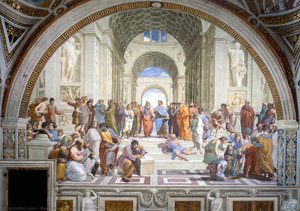
- Die Schule der Athener: Er malte "Die Schule der Athener" für den Duke of Northumberland (heute im Victoria and Albert Museum), ein bedeutendes Werk, das seine Beherrschung klassischer Themen und Kompositionen demonstriert.
- Winckelmann-Zusammenarbeit: Seine Partnerschaft mit Winckelmann war maßgeblich an der Gestaltung neoklassizistischer künstlerischer Prinzipien beteiligt.
- Rivalität & Freundschaft: Mengs erlebte sowohl Rivalitäten (insbesondere mit Pompeo Batoni) als auch Freundschaften (mit Giacomo Casanova), was die komplexen Dynamiken der römischen Kunstszene seiner Zeit widerspiegelte.
Vermächtnis und Historische Bedeutung
Anton Raphael Mengs starb 1779 in Rom und hinterließ ein umfangreiches Werk, das die Kluft zwischen Barock- und Neoklassizistischen Stilen überbrückte. Sein Schwerpunkt auf klassischen Idealen, gepaart mit seinem technischen Können, machte ihn zu einer entscheidenden Figur bei der Entwicklung des Neoklassizismus. Er wird nicht nur für seine beeindruckenden Fresken und Porträts erinnert, sondern auch für seine intellektuellen Beiträge zur Kunsttheorie durch seine Zusammenarbeit mit Winckelmann. Sein Einfluss ist in nachfolgenden Generationen von Künstlern sichtbar, die die Klarheit, Ordnung und idealisierten Formen annahmen, die die neoklassische Malerei auszeichneten.

Anton Raphael Mengs
1728 - 1779 , Böhmen
Kurzinfos
- Beeinflusste Künstler: ['Raphael']
- Bemerkenswerte Werke:
- Parnassus (Villa Albani)
- Fresken Sant’Eusebio
- Decke des Bankettsaals, Madrid
- Geburtsdatum: 22. März 1728
- Geburtsort: Ústí nad Labem, Tschechien
- Künstlerische Richtung: Neoklassizismus
- Nationalität: Deutsch-Böhmisch
- Todatum: 29. Juni 1779
- Vollständiger Name: Anton Raphael Mengs
- Von Künstlern Beeinflusst:
- Barock
- Rococo
Ähnliche Artikel
Die emotionale Tiefe Van Goghs entschlüsseln: Meisterhafte Reproduktionen und künstlerische Analyse
Entdecken Sie die emotionale Tiefe von Vincent van Gogh! Hochwertige Reproduktionen & fundierte Analysen seiner Meisterwerke. Für Kunstsammler und Liebhaber.

Rembrandts Meisterwerke: Die Top 25 Kunstwerke für Ihr Zuhause | OriginalUniqueArt
Entdecken Sie Rembrandts 25 berühmteste Kunstwerke! Tauchen Sie ein in die Welt des Barock, Licht und Schatten & historischer Porträts. Hochwertige Reproduktionen für Ihr Zuhause – jetzt auf OriginalUniqueArt.com!
Reflecting the Self: A History of Portraiture & Psychological Insight
Explore the fascinating history of self-portraiture from Renaissance masters like Dürer & Rembrandt to modern interpretations. Discover the psychological insights and artistic techniques behind these iconic works. Expert analysis for art enthusiasts.
Postimpressionismus: Die 10 Meisterwerke, die eine Ära prägten –
Entdecken Sie die 10 Meisterwerke des Postimpressionismus! Van Gogh, Cézanne & Co. – ihre Geschichten, Techniken und zeitlose Schönheit. Kunstdrucke in Museumsqualiät auf . Jetzt entdecken!
Adriaen van Ostade: A Master of Dutch Genre Painting & Social Commentary
Explore the life & work of Adriaen van Ostade, a leading Dutch Golden Age painter. Discover his realistic genre scenes, social commentary, and lasting influence on art history. Learn more at OriginalUniqueArt.