 In echtem Maßstab anzeigen
 Versenden als Grußkarte
 Teilen
 Details anzeigen
 Leitfaden öffnen

 Herunterladen
 Ähnliche Objekte
 Röntgenaufnahme
 Diashow
 Besucherstatistiken
Philip II
 Oil
Oil- WallArt
- Spanish Renaissance
 1570
1570- Early Modern
 115.0 x 93.0 cm
 Pollok House
 Mehr anzeigen
Handgefertigte Ölreproduktion
Handgemaltes Ölgemälde auf Leinwand in Ihrer Wunschgröße und mit Rahmen, auf Bestellung von unseren Künstlern angefertigt. ( Zum Druck wechseln Zum digitalen Bild wechseln)




P118B €10

P118H €10

P118W €10

P438Z €10

P508JH €12

P508YH €12

P805H €10

P805Z €10

P919BZ €10

P919G €10

P919XJ €10

P959ZH €10

P968JZ €12

W106C €8

W218G €10

W218JH €8

W218Y €10

W307PJ €10

W316G €10

W316PJ €8

W316Y €10

W398PJ €8

W4111J €10

W500HY €15

W500JH €15

W692G €12

W849H €8

W940BG €15

W953PJ €8




Wählen Sie aus unseren vordefinierten Formaten, die den ursprünglichen Proportionen des Kunstwerks entsprechen.

Geben Sie die Breite und die Höhe an, die Sie für Ihren Rahmen oder Ihre Wand benötigen. Da dieses Werk handgemalt ist, kann der Künstler bei einer anderen Form etwas mehr um das Bild herum malen oder etwas abschneiden – Sie entscheiden. Wir senden Ihnen ein digitales Mockup zur Freigabe, bevor mit dem Malen begonnen wird. Das auf dieser Seite gezeigte Bild stellt nicht das tatsächliche Ergebnis dar – dies tut nur das Mockup.
Nach der Bestellung wird das OriginalUniqueArt.com-Team dem Kunden Anweisungen per E-Mail zusenden und eine Mockup-Vorschau bereitstellen.
Weltweiter Versand () in nur 3 bis 4 Wochen statt der üblichen 5 Wochen. (25 Oktober). Keine Kompromisse bei der Qualität.

Kostenloser weltweiter Expressversand

Hochwertige Leinenleinwand

Vollständiger Versicherungsschutz beim Versand

Zollgebühren-Rückerstattungsgarantie

Garantie für exakte Farbtreue

100-tägiges Rückgaberecht (nur bei Mängeln)

100% Geld-zurück-Garantie

Angebot für Mengenrabatt
 Die Glasoption ist nur für Größen unter 110 cm verfügbar.

Philip II
Reproduktionsmedium
Format der Reproduktion
-


Gesamtpreis
€ 263
The Majesty of Sovereignty: A Glimpse into the Spanish Golden Age
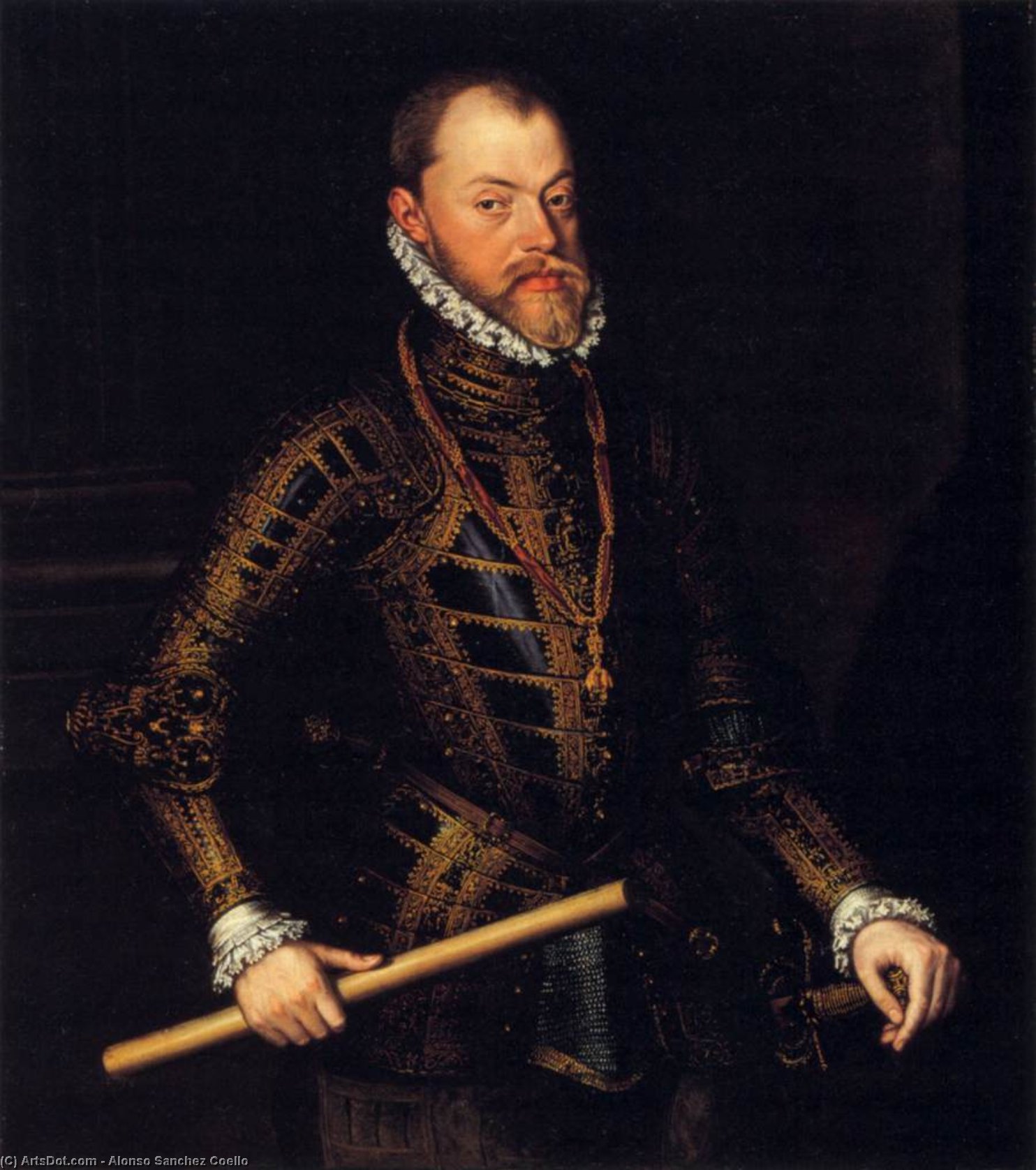
In the profound stillness of Alonso Sánchez Coello’s 1570 portrait, Philip II emerges not merely as a man, but as the very embodiment of imperial authority. To gaze upon this masterpiece is to step through a portal into the heart of the sixteenth-century Spanish Court, where every brushstroke serves to reinforce the divine right of kings. The subject stands with a commanding presence, his gaze steady and resolute, framed by the intricate textures of a period defined by opulence and rigid social hierarchy. As a premier court painter, Coello possessed the rare ability to capture the weight of a crown without the need for a literal diadem, using instead the subtle language of posture and attire to communicate power.
The composition is a masterclass in focused intensity. By utilizing a deep, somber background, Coello ensures that the viewer’s eye is immediately drawn to the luminous details of the monarch's personage. The play of light across the ruffled collar—a hallmark of Renaissance aristocratic fashion—creates a rhythmic interplay of shadow and brilliance, highlighting the meticulous craftsmanship of the textile. This technique, which blends the objective precision of the Flemish tradition with a certain Venetian warmth, allows the textures of the fabric and the sheen of the steel to feel almost tactile, inviting the observer to appreciate the material wealth of the era.
Symbolism and the Art of Presence
Every element within this portrait is a deliberate symbol of the Spanish Empire's zenith. The sword held by Philip II is far more than a mere accessory; it is a potent signifier of his role as the defender of the faith and the arbiter of justice across vast territories. It introduces an element of latent strength into the composition, suggesting that beneath the refined elegance of his suit lies the iron will required to govern a global superpower. The meticulous rendering of his beard and mustache further emphasizes a mature, seasoned leadership, projecting an image of stability and wisdom to both contemporary subjects and modern viewers alike.
For the discerning collector or interior designer, this piece offers more than just historical interest; it provides a profound emotional anchor for any space. The painting exudes a sense of timeless dignity and quiet confidence. When placed within a curated collection or as a focal point in a sophisticated study, the portrait commands respect and fosters an atmosphere of intellectual depth. It is a work that does not shout for attention but rather earns it through its sheer, understated gravity, making it an ideal selection for those looking to infuse their environment with the grandeur of classical European history.
A Legacy Captured in Oil
The technical brilliance of Alonso Sánchez Coello lies in his ability to balance the individual's humanity with the iconographic requirements of royalty. Through a sophisticated use of chiaroscuro, he sculpts the features of Philip II, giving the face a three-dimensional vitality that has endured for centuries. This mastery of light and shadow ensures that the portrait remains dynamic, shifting in character as the ambient light of a room changes throughout the day. It is this enduring quality—this ability to breathe life into the pigments—that makes a high-quality reproduction of this work such a captivating investment for lovers of fine art.
Owning a piece that echoes the splendor of the Spanish Golden Age allows one to participate in a long tradition of aesthetic appreciation. Whether you are drawn to the historical narrative of the Habsburg dynasty or the exquisite technical execution of the Renaissance masters, this portrait serves as a window into a world of unparalleled elegance. It is an invitation to surround oneself with the echoes of greatness, bringing the sophisticated soul of the sixteenth century into the contemporary home.
Fragen & Antworten
Wo kann ich eine handgemalte Reproduktion von "Philip II" von Alonso Sánchez Coello kaufen?
"Philip II" ist als eine handgemalte Ölreproduktion auf Leinenleinwand erhältlich. Die Bestellung kann auf der Seite Handgemalte Reproduktion mit einer Auswahl an verschiedenen Größen vorgenommen werden.
Darf die Abbildung von "Philip II" von Alonso Sánchez Coello frei reproduziert werden?
Die urheberrechtliche Situation für "Philip II" von Alonso Sánchez Coello: Das Werk ist gemeinfrei – das Urheberrecht ist abgelaufen. Dies bestimmt, ob Reproduktionen des Bildes frei erstellt werden dürfen.
Für wen ist "Philip II" von Alonso Sánchez Coello ein schönes Geschenk?
"Philip II" von Alonso Sánchez Coello wird als Geschenk für Corporate Gift empfohlen, insbesondere für Focal. Eine Reproduktion des Kunstwerks eignet sich hervorragend als Präsent.
Biografie des Künstlers
Frühes Leben und Ausbildung
- Geboren: Benifaió, Spanien (1531)
- Verbrachte Kindheit in der Nähe von Valencia bis zum Tod seines Vaters.
- Um 1541/42 zog er nach Portugal, um bei seinem Großvater zu leben, einem Adligen im Dienst der portugiesischen Monarchen.
- Studierte um 1550 bei Anthonis Mor (Antonio Moro) in Flandern.
- Erhielt die Unterstützung von Antoine de Granville, Bischof von Arras, ebenfalls Förderer von Mor.
Karriere am spanischen Hof
- Arbeitete für die portugiesische Königsfamilie und später für den Hof von João Manuel, Prinz von Portugal.
- Zog 1555 an den spanischen Hof Philipps II., empfohlen von Juana, Schwester Philipps II.
- Wurde 1560 Hofmaler.
- Vermählte sich um 1560/61 mit Louisa Reyaltes, der Tochter eines Silberschmieds.
- Seine Tochter, Isabel Sánchez, wurde ebenfalls Malerin und assistierte in seiner Werkstatt.
- Zog mit dem Hof nach Toledo und ließ sich 1561 in Madrid nieder.
Künstlerischer Stil und Einflüsse
- Stil: Kombinierte flämische Objektivität mit venezianischer Sinnlichkeit.
- Einflüsse: Vor allem beeinflusst von Anthonis Mor und Tizian.
- Er lernte Präzision von Mor.
- Inkorporierte venezianische Goldtöne, großzügige Verarbeitung und die Verwendung von Licht von Tizian.
- Bekannt für Porträts, die durch eine leichte Pose, Würde, Nüchternheit und warme Farbgebung gekennzeichnet sind.
Hauptwerke und Errungenschaften
- Produzierte sowohl Porträts als auch religiöse Gemälde.
- Religiöse Werke waren konventionell, zeigten aber einen asketischen Stil.
- Bemerkenswerte Porträts:
- Philipp II mit Rosenkranz (1573)
- Porträts der Infantin Isabel Clara Eugenia (1571)
- Serie von Gemälden, die die Kinder Philipps II. darstellen.
- Doppelporträt der Infantinnen Isabella Clara Eugenia und Catalina Micaela (1568–9).
- Malte religiöse Werke für El Escorial.
- Erstellte eine topographische Ansicht des Hafens von Sevilla.
Vermächtnis und historische Bedeutung
- Sein Ruf als Porträtist wurde durch zahlreiche Kopien und Imitationen kompliziert.
- Gilt als bedeutende Figur in der spanischen Renaissancekunst, insbesondere für seine Hofporträts.
- Seine Arbeit beeinflusste spätere Künstler, darunter Velázquez, hinsichtlich der Darstellung von Texturen wie Rüstungen und Stoffen.
- Starb am 8. August 1588 in Madrid.

Alonso Sánchez Coello
1531 - 1588 , Spanien
Eckdaten zum Künstler
- Beeinflusste Künstler:
- Anthonis Mor
- Titian
- Bemerkenswerte Werke:
- Philipp II mit Rosenkranz
- Porträt einer Dame
- Anna von Österreich
- Don Juan von Österreich
- Katharina von Österreich
- Geburtsdatum: ca. 1531
- Geburtsort: Benifaió, Spanien
- Künstlerischer Stil: Spanische Renaissance
- Nationalität: Iberisch
- Sterbedatum: 1588
- Vollständiger Name: Alonso Sánchez Coello
- Von Künstlern Beeinflusst:
- Juan Pantoja de la Cruz
- Felipe de Liaño
Verwandte Artikel

Mastering the Shadows: A Journey Through the Chiaroscuro and Soul of Iconic Spanish Painting
Embark on a sophisticated exploration of Spanish art history, from the chiaroscuro mastery of Velázquez to the profound shadows of Goya. Discover how the dramatic light and emotional depth of Spain's greatest masters continue to inspire collectors and connoisseurs today.
Diego Velázquez: Meister der spanischen Goldenen Ära – Technik, Einfluss und die Porträtkunst des Hofes
Entdecken Sie Diego Velázquez, den Meister des spanischen Barock! Expertenwissen über seine Technik, berühmte Werke wie Las Meninas und seinen Einfluss auf die Kunstgeschichte. Hochwertige Reproduktionen bei OriginalUniqueArt.
Rafael de Penagos: A Study in Spanish Portraiture & Artistic Identity
Explore the life & art of Rafael de Penagos, a leading Spanish Art Deco illustrator. Discover his iconic 'Penagos Woman', commercial work, and lasting legacy. Learn about this pivotal figure in 20th-century Spanish art history.
The Golden Age Reforged: Dramatic Realism & Religious Zeal in Spanish Baroque Art
Explore the dramatic world of Spanish Baroque art! Discover masters like Zurbarán & the powerful influence of religious zeal on painting techniques – a guide for collectors and enthusiasts.
Museo del Prado: Die 25 Meisterwerke – Kunst für Ihr Zuhause | OriginalUniqueArt
Entdecken Sie die 25 Meisterwerke des Museo del Prado! Von Velázquez bis Goya – Kunstgeschichte, Techniken & Geschichten berühmter Gemälde. Finden Sie hochwertige Reproduktionen für Ihr Zuhause auf OriginalUniqueArt.com.