Vorschau anzeigen
 Versenden
 Teilen
 Details anzeigen

 Herunterladen
 Ähnliche Objekte
 Röntgenaufnahme
 Diashow
 Statistiken
Taking the
 Watercolor
- WallArt
- Contemporary Realism
 1837
1837- 19th Century
 27.0 x 20.0 cm
 Amon Carter Museum of American Art
 Weiterlesen
Giclée / Kunstdruck
Giclée- oder Leinwanddruck in Museumsqualität mit schneller Produktion und flexiblen Veredelungsoptionen. ( Handgemalte Reproduktion bestellen Zum digitalen Bild wechseln)




P118B $10

P118H $10

P118W $10

P438Z $10

P508JH $12

P508YH $12

P805H $10

P805Z $10

P919BZ $10

P919G $10

P919XJ $10

P959ZH $10

P968JZ $12

W106C $8

W218G $10

W218JH $8

W218Y $10

W307PJ $10

W316G $10

W316PJ $8

W316Y $10

W398PJ $8

W4111J $10

W500HY $15

W500JH $15

W692G $12

W849H $8

W940BG $15

W953PJ $8




Wählen Sie aus unseren vordefinierten Formaten, die den ursprünglichen Proportionen des Kunstwerks entsprechen.

Sie können Ihre eigenen Maße eingeben, um ein bestimmtes Format oder einen speziellen Platz einzupassen. Wenn das von Ihnen gewählte Format nicht den Proportionen des Originalbildes entspricht, werden wir das Kunstwerk entweder beschneiden oder das Bild mit einem gespiegelten oder einfarbigen Rand erweitern. Ein digitaler Entwurf wird Ihnen zur Genehmigung zugesandt, bevor die Produktion beginnt.
Bitte beachten Sie, dass die Vorschau auf dem Bildschirm nicht den tatsächlichen Zuschnitt oder die Erweiterung widerspiegelt. Nur der Entwurf zeigt die endgültige Komposition präzise an.
Obwohl Sondermaße verfügbar sind, empfehlen wir die Auswahl eines Maßes aus der vordefinierten Liste, um die ursprünglichen Proportionen zu bewahren.
Weltweiter Versand () innerhalb von 2 Wochen statt der üblichen 4/5 Wochen. (12 September)

Kostenloser weltweiter Expressversand

Hochwertige Leinenleinwand

Umfassender Versicherungsschutz beim Versand

Zollgebühren-Rückerstattungsgarantie

Garantie für exakte Farbtreue

100-Tage-Rückgaberecht (nur bei Mängeln)

100% Geld-zurück-Garantie

Mengenrabatt verfügbar
 Die Glasoption ist nur für Größen unter 110 cm verfügbar.

Taking the
Giclée / Kunstdruck
Format der Reproduktion
-


Gesamtpreis
$ 80
Taking the Hump Rib
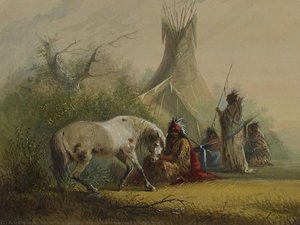
Alfred Jacob Miller’s “Taking the Hump Rib” stands as an arresting testament to the Romantic spirit of American art—specifically, its fascination with the untamed frontier and the portrayal of indigenous cultures amidst the grandeur of the Rocky Mountains. Completed in 1837, this watercolor painting captures a pivotal moment during William Drummond Stewart's expedition into the West, documenting not merely scenery but also the complex interactions between European observers and Native American communities. The artwork’s composition immediately draws the eye to a central scene: a group of men—likely fur traders—engaged in assisting a horseman struggling to ascend a steep incline, aptly named “Hump Rib.” Miller skillfully employs watercolor techniques—characterized by delicate washes and subtle gradations of color—to convey both the ruggedness of the landscape and the palpable tension within the tableau. The muted palette—dominated by browns, greens, and blues—reflects the prevailing atmospheric conditions of the region during that time, lending an air of authenticity to the depiction. Beyond its technical prowess, “Taking the Hump Rib” resonates with deeper symbolic significance. It embodies the Romantic ideal of confronting nature’s challenges head-on, mirroring Stewart's ambition to explore and document the wilderness while simultaneously acknowledging the vulnerability of human endeavor against its formidable forces. The horseman represents not only physical exertion but also the pursuit of progress—a theme central to the burgeoning American Westward expansion. Simultaneously, Miller subtly portrays the collaborative spirit between Europeans and Native Americans, highlighting the necessity of mutual respect and understanding in navigating unfamiliar territories. The painting’s emotional impact is undeniable. It evokes a sense of immediacy and drama, transporting viewers back to 1837 and immersing them in the sights and sounds of the expedition. Miller's meticulous observation—evident in the detailed rendering of clothing, equipment, and facial expressions—transforms the scene into more than just a visual record; it becomes a window into the human experience within the context of an era defined by exploration, discovery, and cultural exchange.- Artist: Alfred Jacob Miller
- Year Created: 1837
- Medium: Watercolor
- Dimensions: 27 x 20 cm
- Location: Private Collection
Historical Context: The Fur Trade Era and Stewart’s Expedition
The painting emerged during the height of the fur trade era—a period marked by intense competition between European nations for control over lucrative trading routes in North America. William Drummond Stewart's expedition aimed to establish a foothold for the American Fur Company (AFC) among Native American tribes, primarily the Crow and Pawnee. Miller’s artwork serves as invaluable documentation of this undertaking, capturing not only the physical landscape but also the social dynamics inherent in intercultural encounters. The AFC sought to forge alliances with indigenous peoples while simultaneously exploiting their resources—a complex relationship that fueled both economic prosperity and cultural disruption.Technique: Watercolor Rendering and Observational Detail
Miller’s masterful watercolor technique—characterized by layering translucent washes of pigment—allowed him to achieve remarkable luminosity and tonal subtlety. He meticulously studied the effects of light on the terrain, skillfully capturing the rugged contours of the mountains and the diffuse glow of twilight. Furthermore, Miller's keen eye for detail extended beyond mere topographical representation; he painstakingly rendered clothing, equipment, and facial expressions, conveying a profound understanding of human behavior within the context of an unfamiliar environment.Symbolism: Confrontation with Nature and Collaboration Between Cultures
“Taking the Hump Rib” embodies several symbolic motifs that encapsulate the Romantic worldview prevalent during Miller’s time. The arduous climb represents humanity's struggle against nature—a recurring theme in Romantic art—while simultaneously symbolizing ambition and aspiration. Simultaneously, the collaborative effort between Stewart and his men underscores the importance of mutual respect and understanding in navigating intercultural relations—a sentiment particularly pertinent to the historical context of the fur trade era.Über den Künstler
Alfred Jacob Miller: Ein Pionier der amerikanischen Westernkunst
- Geboren: 2. Januar 1810, Baltimore, Vereinigte Staaten von Amerika
- Gestorben: 1874
Frühes Leben und künstlerische Ausbildung
Alfred Jacob Miller begann seine Reise in Baltimore, Maryland, wo er als eines von neun Kindern in einer Familie geboren wurde. Sein Vater, ein Kaufmann und Wirtshausbesitzer, sorgte für einen stabilen Hintergrund. Obwohl er an der John D. Craig’s Academy nicht formell Kunstunterricht erhielt, wird angenommen, dass er frühe Lektionen vom renommierten Künstler Thomas Sully erhielt, was die Grundlage für seine zukünftigen künstlerischen Bestrebungen legte. Ein entscheidender Moment kam 1832, als Miller nach Paris reiste, um Kunst zu studieren. Er wurde als Zuhörer in die Lebenszeichenkurse an der École des Beaux-Arts aufgenommen und tauchte so in europäische künstlerische Traditionen ein und verbesserte seine Fähigkeiten durch sorgfältige Beobachtung und Übung.Die Westliche Expedition und Künstlerischer Durchbruch
Millers Karriere nahm einen dramatischen Wendepunkt, als er Sir William Drummond Stewart traf, einen schottischen Aristokraten mit einer Leidenschaft für den amerikanischen Westen. 1837 beauftragte Stewart Miller, ihn auf eine Jagdexpedition in die Rocky Mountains zu begleiten, um die Landschaften und Kulturen entlang des Weges zu dokumentieren. Diese Reise erwies sich als transformativ für Millers künstlerische Entwicklung. Er fertigte sorgfältig Szenen von Ureinwohnern, Trappern, Wildtieren und Pionierleben an und fing so das Wesen des amerikanischen Westens mit bemerkenswerter Detailtreue und Sensibilität ein. Nach seiner Rückkehr nach New Orleans verwandelte Miller diese Skizzen in eine Reihe von Gemälden, die seinen Ruf als bedeutende Figur in der amerikanischen Kunst festigten.Stil und Bemerkenswerte Werke
Millers künstlerischer Stil zeichnet sich durch seine einzigartige Mischung aus Realismus und Romantik aus. Er stellte die Details des Pionierlebens – Kleidung, Ausrüstung, Landschaften – akribisch dar und verlieh seinen Werken gleichzeitig ein Gefühl von Drama und Abenteuer. Zu seinen bekanntesten Gemälden gehören:- The Lake Her Lone Bosom Expands to the Sky
- Camp Scene (Sioux)
- Big Bowl (A Crow Chief)
- Argali - Mountain Sheep
- Snake Indians Shooting Elk
- Shoshone Indian and His Pet Horse
Vermächtnis und Historische Bedeutung
Alfred Jacob Millers Vermächtnis als Pionier der amerikanischen Westernkunst ist fest etabliert. Er war einer der ersten Künstler, der den Geist und das Wesen des amerikanischen Westens mit solcher Authentizität und künstlerischer Fähigkeit einzufangen vermochte. Seine Gemälde inspirieren weiterhin Künstler und Kunstliebhaber gleichermaßen und bieten einen Einblick in eine vergangene Ära. Millers Werk wurde in Galerien und Museen in den Vereinigten Staaten ausgestellt, was seine Position als bedeutender Beitrag zur Entwicklung der amerikanischen Kunst festigte. Seine detaillierten Darstellungen von Ureinwohnern Amerikas liefern wertvolle historische Dokumente, während seine romantisierten Darstellungen die Anziehungskraft und das Abenteuer der Grenze einfangen.
Alfred Jacob Miller
1810 - 1874 , Vereinigte Staaten von Amerika
Kurzinfos
- Beeinflusste Künstler: ['Thomas Sully']
- Bemerkenswerte Werke:
- Lake Her Lone Bosom Expands
- Camp Scene (Sioux)
- Big Bowl (A Crow Chief)
- Geburtsdatum: 2. Januar 1810
- Geburtsort: Baltimore, USA
- Künstlerische Richtung: Realismus und Romantik
- Nationalität: Amerikanisch
- Sterbedatum: 1874
- Vollständiger Name: Alfred Jacob Miller
Ähnliche Artikel

Grant Wood und der amerikanische Regionalismus: Identität, Mythos und die ländliche Landschaft
Entdecken Sie Grant Wood und den amerikanischen Regionalismus! Erfahren Sie mehr über 'American Gothic', Woods Leben, Einflüsse und sein Vermächtnis in der Kunstgeschichte. Expertenwissen & hochwertige Reproduktionen.

Benjamin West: Transatlantische Ambitionen und die Gestaltung der amerikanischen Kunst
Entdecken Sie das faszinierende Leben und Werk von Benjamin West, dem Pionier der amerikanischen Kunst! Erfahren Sie mehr über seinen Einfluss auf den Neoklassizismus und die Förderung junger Künstler in Europa. Jetzt lesen!

Alfred Jacob Miller: Chronicling the American West Through Artistic Observation & Narrative
Explore the captivating art of Alfred Jacob Miller, chronicler of the American West. Discover his iconic paintings, techniques & lasting legacy – a valuable addition to any serious collection. Learn more at OriginalUniqueArt.

Sir Alfred James Munnings: Die 25 Meisterwerke des Pferdebildes | OriginalUniqueArt
Entdecken Sie die 25 Meisterwerke von Sir Alfred James Munnings! Erleben Sie seine beeindruckenden Pferdebilder, geprägt vom Impressionismus und Realismus. Hochwertige Kunstdrucke & Reproduktionen auf OriginalUniqueArt.com – für elegante Wandkunst & stilvolles Interieurdesign.
Alfred Henry Maurer: Reassessing the Pioneer of American Modernist Abstraction
Explore the groundbreaking work of Alfred Henry Maurer, a pivotal figure in American Modernism. Discover his Fauvist & Cubist paintings and understand his lasting influence on abstract art. Expert analysis for collectors.