Romanticism
Alpine Landscape (Alexandre Calame)
Alexandre Calame (1810–1864) schuf Alpine Landscape. Es gehört zur Romanticism-Strömung. Es ist aus Oil On Canvas gefertigt. Die Maße sind 45 × 31 cm.
- Oil On Canvas
- 45 × 31 cm

 Vorschau anzeigen

 Handgemaltes Ölgemälde
 Versenden
 Teilen
 Datenblatt


 Herunterladen
 Ähnliche Objekte
 Röntgenaufnahme
 Diashow
 Fragen & Antworten

 Statistiken
Alpine Landscape im Überblick
- Titel
- Alpine Landscape
- Künstler
- Alexandre Calame (1810–1864)
- Geburtsjahr des Künstlers
- Vevey, Schweiz
- Medium
- Oil On Canvas
- Maße
- 45 × 31 cm
- Bewegung
- Romanticism
- Epoche
- 19th Century
- Motiv
- alpine landscape, mountain scenery, swiss alps view, river valley scene, atmospheric perspective, landscape painting
Was stellt Alpine Landscape dar?
Identification of the Alpine Landscape
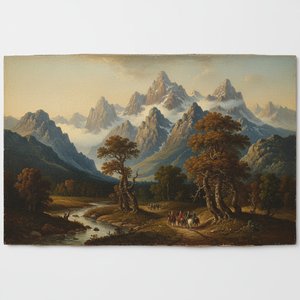
Alpine Landscape is an oil painting by the Swiss artist Alexandre Calame. The canvas captures a mountainous valley where a river winds through the terrain. A rocky outcrop anchors the left side of the scene, leading the eye toward distant, receding peaks. This work reflects the artist's lifelong preoccupation with the rugged topography of his homeland.
Alexandre Calame was born in 1810 in Vevey, Switzerland. He spent much of his life observing the textures of the Alps, from the weight of granite to the movement of mountain streams. The artist eventually passed away in 1864 in Menton, France. In this specific composition, the light remains diffused, as if filtered through an overcast sky or the soft glow of early morning.
The scene focuses on the scale of the natural world. Trees and shrubs ground the foreground, providing a sense of texture against the vastness of the background. The mountains rise in geometric triangles, their forms softening as they vanish into the atmospheric distance. A quiet stillness settles over the valley.
Composition and Visual Elements
A rocky outcrop anchors the left side of the frame, its jagged edges catching the light to pull the eye into the scene. From this stone threshold, the gaze follows a river as it winds through a mountainous valley. In the foreground, the earth is textured with the presence of shrubs and trees, grounding the viewer amidst the wild vegetation. These small, detailed forms provide a tactile entry point before the eye moves toward the vastness of the background.
The composition relies on a steady use of perspective to carve out a sense of immense depth. The mountains recede into the distance, their scale dwarfing the river and the greenery below. This arrangement emphasizes the sheer magnitude of the alpine terrain. The verticality of the peaks meets the horizontal flow of the water, creating a structured balance within the natural chaos. The light remains diffused, casting soft shadows across the mountain slopes and the valley floor. A quiet stillness settles over the stone and the stream.
Technique and Artistic Materials
Oil paint meets canvas in this landscape. The artist applied thin, translucent washes of pigment, layering them one after another in a sequence of glazes. This meticulous process builds a luminous depth, allowing light to settle within the layers. It is a slow accumulation of color. The surface holds the weight of the mountain and the softness of the air.
The brushwork captures the physical reality of the terrain. Roughness defines the stone of the rocky outcrop, while the texture of the foliage is rendered with precise, tactile strokes. Light enters the scene as a diffused glow, suggesting the quiet of an overcast day or the pale clarity of early morning. Shadows settle into the mountain crevices, creating a sense of immense scale through tonal modulation. The atmosphere feels heavy with moisture, as if the light itself is filtered through a mountain mist.
The Artistic Style of Calame
A sense of the sublime anchors this work, a hallmark of the Romanticism movement. Calame was a pivotal figure within the Düsseldorf School of Painting, bringing a disciplined eye to the untamed wilderness. He treats the mountains not as static stone, but as living, breathing entities. Through a mastery of atmospheric perspective, the distant peaks recede into a soft, hazy light, creating a profound sense of depth. This tonal modulation allows the viewer to feel the weight of the air between the rocky foreground and the far horizon.
The brushwork is expressive, capturing the rugged textures of the landscape. He uses these strokes to convey the emotional impact of nature, translating the scale of the valley into a felt experience. There is a palpable emotion in the way light hits the river and the cliffs, suggesting the solitude of the high Alps. His connection to these mountains is evident in the precise, almost tactile rendering of the terrain. The scene remains quiet, held in a delicate balance of light and shadow.
Related Works by Alexandre Calame
The artist’s hand often returned to the weight of the mountains and the movement of the air. In 1838, he captured the tension of a storm at Handeck, where the sky meets the jagged rock. This energy persists in his 1856 work, Storm in the Alps, a scene of chaotic weather and turbulent clouds. He also documented the specific topography of the Valley of Lauterbrunnen in 1856, rendering the deep clefts of the Swiss terrain. These works reflect a lifelong preoccupation with the raw power of the high passes.
Water remains a constant presence in his compositions, shifting from the violent to the still. He painted the Lake of the Four Cantons, near Brunnen, in 1853, finding a different rhythm in the alpine waters. His vision extended beyond the peaks to the warmth of the south, seen in Pozzuoli and the Bay of Naples, 1844. Even in more quiet studies, such as Landscape with Oaks, about 1859, the meticulous observation of nature remains central. The light continues to shift across the stone.
Hochauflösende Bilder von Alpine Landscape
Gemeinfrei: Der Künstler verstarb im Jahr 1864.
Alexandre Calame, Alpine Landscape.
Alexandre Calame (1810–1864), Alpine Landscape, oil on canvas. Gemeinfreiheit Bild: OriginalUniqueArt.com.
Fragen zu Alpine Landscape, beantwortet
Mit welcher Technik wurde "Alpine Landscape" erstellt?
"Alpine Landscape" wurde in Oil On Canvas ausgeführt.
Welche Maße hat "Alpine Landscape" von Alexandre Calame im Original?
Das Originalwerk "Alpine Landscape" hat die Maße 45 x 31 cm. Die Originalmaße dienen als hilfreiche Orientierungshilfe bei der Wahl der Reproduktionsgröße.
Was stellt "Alpine Landscape" von Alexandre Calame dar?
Die Themen in "Alpine Landscape" von Alexandre Calame umfassen alpine landscape, mountain scenery, swiss alps view, river valley scene, atmospheric perspective, landscape painting, nature’s grandeur” und fassen gemeinsam den Gegenstand des Kunstwerks zusammen.
Ist "Alpine Landscape" gemeinfrei?
"Alpine Landscape" von Alexandre Calame ist gemeinfrei – das Urheberrecht ist abgelaufen. Dieser Status bestimmt, wie das Bild des Werkes vervielfältigt werden darf.
Wer ist der Künstler hinter "Alpine Landscape"?
Der Künstler hinter „Alpine Landscape“ ist Alexandre Calame. Das Werk ist unter dem Namen von Alexandre Calame katalogisiert.
Welcher Kunstrichtung lässt sich "Alpine Landscape" von Alexandre Calame zuordnen?
„Alpine Landscape“ ist ein Werk der Romanticism. Die Stilrichtung gibt die künstlerische Tradition an, der das Werk angehört.
Aus welcher Schaffensperiode von Alexandre Calame stammt "Alpine Landscape"?
Innerhalb der Schaffensperiode von Alexandre Calame lässt sich „Alpine Landscape“ der Mature Period zuordnen. Diese Phase ermöglicht einen Vergleich mit anderen Werken des Künstlers.
Ist "Alpine Landscape" von Alexandre Calame gemeinfrei, und warum?
"Alpine Landscape" von Alexandre Calame ist gemeinfrei – das Urheberrecht ist abgelaufen. Die Urheberrechtsfristen werden ab dem Todesjahr des Künstlers berechnet, und Alexandre Calame verstarb im Jahr 1864.
Welche Gemeinsamkeiten weist "Alpine Landscape" mit dem restlichen Werk von Alexandre Calame auf?
"Alpine Landscape" gehört zu Alexandre Calames Werk der Romanticism-Epoche, dessen dokumentierte Themen unter anderem romantic nature's beauty, düsseldorf school influence, swiss landscape focus", alpine sublime ideal, detailed observation, calame's signature style, nature as spiritual space umfassen.
Über den Künstler, Alexandre Calame

1810–1864, Schweiz
Alexandre Calame
Alexandre Calame (1810 – 1864): Die Einfangung der alpinen Erhabenheit Alexandre Calame, geboren 1810 in Arabie (dem heutigen Vevey), Schweiz, war ein Schweizer Landschaftsmaler, der während der Epoche der Romantik zu beträchtlichem Ruhm gelangte und heute als eine zentrale Figur der Düsseldorfer Malerschule gilt. Sein künstlerischer Weg begann unter herausfordernden Umständen – der finanzielle Ruin seines Vaters verwehrte ihm den Zugang zu einer formalen Ausbildung und zwang ihn dazu, bereits in seiner Jugend als Bankangestellter zu arbeiten. Doch genau diese pragmatische Notwendigkeit nährte seine Leidenschaft für die Kunst, die durch eine Begegnung mit dem Bankier Diodati gefördert wurde. Dieser ermöglichte ihm eine unschätzbare Ausbildung unter François Diday, einem gefeierten Landschaftsmaler der Düsseldorfer Schule.
Über Alexandre Calame Bemerkenswerte Werke von Alexandre Calame
Ebenfalls von Alexandre Calame
 Wildbach in den Alpen1849
 Tal von Lauterbrunnen1856
 Die Mythen1861
 Landschaft1837
Essays zu Alpine Landscape
 Alpine Grandeur: A Study of Mountain Landscapes in Classical and Romantic ArtExplore the evolution of mountain landscapes from Flemish masters to German Expressionism. Discover the sublime power of Alpine art history.
 Schweizer Maler des 19. JahrhundertsEntdecken Sie Meisterwerke von Arnold Böcklin und Ferdinand Hodler. Finden Sie exklusive Kunstreproduktionen auf OriginalUniqueArt.com.
 Majestic Peaks on Canvas: A Historical & Artistic Exploration of Mountains in Fine ArtExplore the history of mountain painting! Discover Romantic masterpieces & key artists like Dahl & Calame. Learn about the Sublime & Pictur…