 Vorschau anzeigen
 Versenden
 Teilen
 Details anzeigen
 Leitfaden

 Herunterladen
 Ähnliche Objekte
 Röntgenaufnahme
 Diashow
 Fragen & Antworten
 Statistiken
Crucifixion

- 29.0 x 21.0 cm


 Weiterlesen
Giclée / Kunstdruck
Giclée- oder Leinwanddruck in Museumsqualität mit schneller Produktion und flexiblen Veredelungsoptionen. ( Handgemalte Reproduktion bestellen Zum digitalen Bild wechseln)




P118B €10

P118H €10

P118W €10

P438Z €10

P508JH €12

P508YH €12

P805H €10

P805Z €10

P919BZ €10

P919G €10

P919XJ €10

P959ZH €10

P968JZ €12

W106C €8

W218G €10

W218JH €8

W218Y €10

W307PJ €10

W316G €10

W316PJ €8

W316Y €10

W398PJ €8

W4111J €10

W500HY €15

W500JH €15

W692G €12

W849H €8

W940BG €15

W953PJ €8




Wählen Sie aus unseren vordefinierten Formaten, die den ursprünglichen Proportionen des Kunstwerks entsprechen.

Geben Sie die benötigte Breite und Höhe an, damit der Druck perfekt in Ihren Rahmen oder an Ihre Wand passt. Ein Druck kann nur beschnitten, aber niemals größer als das Originalbild angefertigt werden; daher verliert ein Format mit anderen Proportionen einen Teil des Bildes. Wir senden Ihnen ein digitales Mockup zur Freigabe, bevor wir den Druck ausführen. Das auf dieser Seite gezeigte Bild zeigt nicht den tatsächlichen Beschnitt – dies ist nur im Mockup ersichtlich.
Weltweiter Versand () innerhalb von 2 Wochen statt der üblichen 4/5 Wochen. (9 November)

Kostenloser weltweiter Expressversand

Hochwertige Leinenleinwand

Umfassender Versicherungsschutz beim Versand

Zollgebühren-Rückerstattungsgarantie

Garantie für exakte Farbtreue

100 Tage Rückgaberecht (nur bei Mängeln)

100% Geld-zurück-Garantie

Mengenrabatt verfügbar
 Die Glasoption ist nur für Größen unter 110 cm verfügbar.

Crucifixion
Giclée / Kunstdruck
Format der Reproduktion
-


Endpreis
€ 72
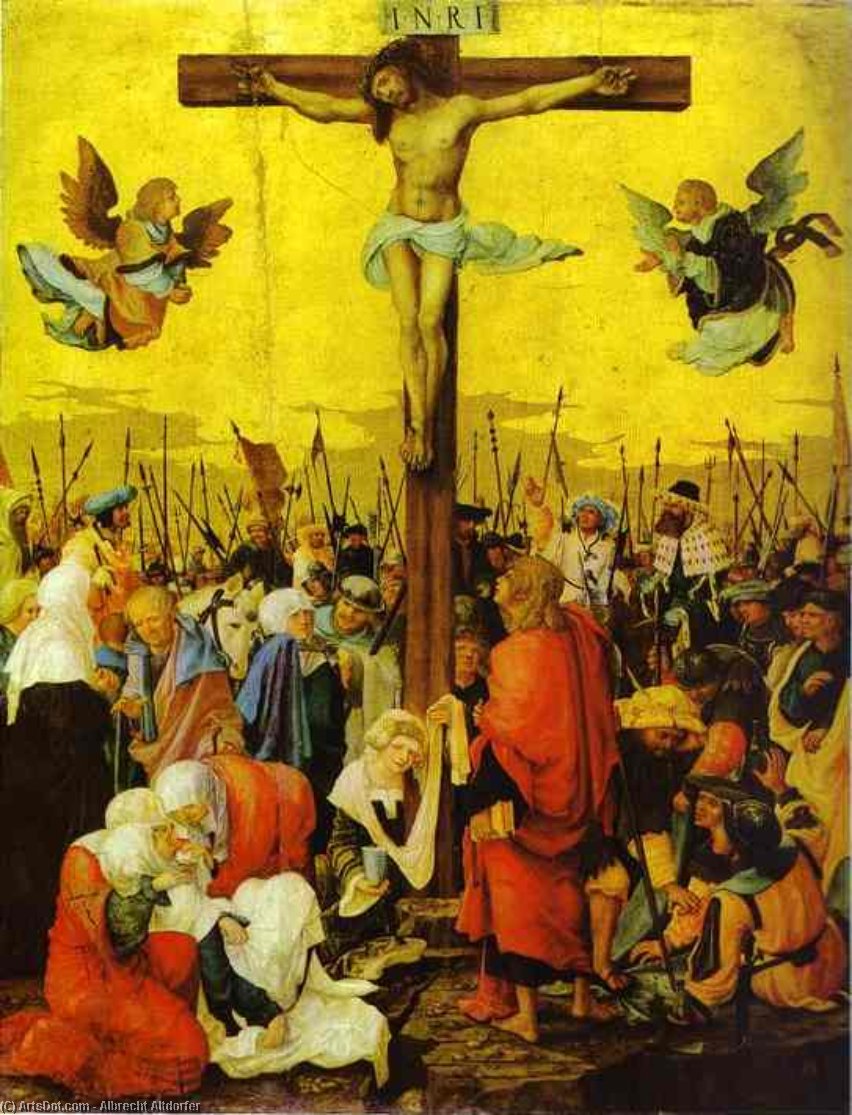
The Weight of Sorrow: Albrecht Altdorfer’s “Crucifixion”
Albrecht Altdorfer's "Crucifixion," painted in 1526, isn’t merely a depiction of a pivotal religious event; it’s a visceral experience. Emerging from the burgeoning German Renaissance, Altdorfer wasn’t simply replicating biblical narratives; he was forging a new visual language, one deeply rooted in the natural world yet imbued with profound spiritual intensity. This particular rendition transcends simple illustration, becoming a landscape saturated with grief and a haunting meditation on sacrifice. The painting immediately commands attention not through grand scale – it's remarkably intimate, measuring just 29 x 21 cm – but through its masterful manipulation of light, color, and composition to evoke an overwhelming sense of sorrow.
The scene unfolds against a dramatically rendered landscape—a brooding, almost primeval forest. The trees, rendered in thick, layered brushstrokes of deep greens, browns, and purples, seem to writhe with the weight of the event. This isn’t a picturesque vista; it's a wilderness imbued with an unsettling energy. Altdorfer deliberately eschews traditional depictions of serene backgrounds, instead presenting a landscape actively participating in the drama. The distant mountains, shrouded in mist and shadow, amplify the feeling of isolation and despair. Notice how the artist uses atmospheric perspective – lighter hues for objects further away – to create a sense of depth and distance, drawing the viewer’s eye into the heart of the scene.
A Pioneer of Landscape
Albrecht Altdorfer stands as a pivotal figure in art history, largely credited with establishing landscape painting as an independent artistic subject within Europe. Prior to his work, landscapes were typically relegated to mere backgrounds for religious or mythological scenes. However, Altdorfer recognized the power of the natural world to convey emotion and meaning. His meticulous observation of nature—evident in the detailed rendering of foliage, rocks, and atmospheric conditions—transformed the landscape from a passive backdrop into an active participant in the narrative. This shift was revolutionary, paving the way for later generations of landscape artists like Albert Bierstadt and Frederic Church.
His background as a town architect and council member further informs his artistic approach. Altdorfer possessed a keen eye for spatial relationships and a deep understanding of how to create a sense of harmony and balance within a composition. This skill is brilliantly demonstrated in “Crucifixion,” where the human figure—Jesus—is carefully positioned within the landscape, creating a dynamic interplay between the earthly realm and the divine.
Symbolism and Emotional Resonance
Beyond its technical brilliance, "Crucifixion" resonates deeply with viewers through its potent symbolism. The stark simplicity of Jesus’s pose – arms outstretched, head bowed – is profoundly moving. Altdorfer avoids any overtly dramatic or theatrical elements, opting instead for a quiet, understated portrayal of suffering. The figures surrounding the cross—angels and soldiers—are rendered in muted tones, emphasizing the central tragedy. Even the light itself seems to weep, casting long shadows across the landscape.
The choice of a dark, foreboding forest as the setting is particularly significant. Forests have historically been associated with death, mourning, and the unknown. In this context, it serves as a powerful metaphor for the spiritual darkness surrounding Jesus’s sacrifice. The painting isn't simply depicting an event; it’s exploring the profound emotional consequences of that event—the grief, despair, and sense of loss experienced by those who witnessed it.
A Timeless Masterpiece
“Crucifixion” is more than just a religious painting; it’s a testament to Altdorfer's artistic genius and his ability to capture the essence of human emotion. The meticulous detail, masterful use of color and light, and profound symbolism combine to create an unforgettable image that continues to resonate with viewers centuries after its creation. Reproductions, like this one, offer a remarkable opportunity to experience the power and beauty of this iconic work, bringing its haunting message into our own spaces.
Fragen & Antworten
Welcher Künstler und welcher Stil stecken hinter "Crucifixion"?
Albrecht Altdorfer schuf „Crucifixion“ im Rahmen der German Renaissance Landscape-Bewegung.
Für welchen Raum im Zuhause eignet sich eine Reproduktion von "Crucifixion" besonders gut?
Eine Reproduktion von „Crucifixion“ passt hervorragend in ein Wohnbereich.
Wie gesättigt ist die Farbpalette von "Crucifixion"?
"Crucifixion" von Albrecht Altdorfer zeichnet sich durch eine Deutliche Farbsättigung Sättigung aus.
Künstlerbiografie
Frühe Jahre und Karriere
Albrecht Altdorfer, ein renommierter deutscher Maler, Grafiker und Architekt, wurde um 1480 in Regensburg, Bayern, geboren. Sein Vater, Ulrich Altdorfer, ein Maler und Miniaturist, beeinflusste sein Interesse an der Kunst wahrscheinlich schon in jungen Jahren.Aufstieg zur Bedeutung
Altdorfers künstlerische Karriere gewann mit der Schaffung kleiner, intimer Werke in unkonventionellen Medien an Fahrt. Er ließ sich 1505 in Regensburg nieder und wurde schließlich Stadtarchitekt und Stadtrat. Seine ersten signierten Werke, darunter Stiche und Zeichnungen wie die *Stygmata des Heiligen Franziskus* und *Der heilige Hieronymus*, stammen aus dem Jahr um 1506.Beitrag zur Donauschule
Altdorfer gilt als einer der Hauptvertreter der Donauschule, einem Kreis, der die Landschaft als eigenständiges Genre in Süddeutschland begründete. Seine Reisen entlang des Donau-Flusses und in die Alpen im Jahr 1511 inspirierten ihn dazu, der erste Landschaftsmaler im modernen Sinne zu werden und leitete so die Donauschule ein.Bemerkenswerte Werke und Kooperationen
- Die Schlacht Alexanders von Issos (1529) für Herzog Wilhelm IV. von Bayern
- Zusammenarbeit mit Maximilian I. in Innsbruck ab 1513
- Beeinflusst von Künstlern wie Giorgione und Lucas Cranach, was sich in seinen Kreuzigungsdarstellungen zeigt
Museumsbestände und Vermächtnis
- Das Museum Ostdeutsche Galerie (Deutschland) beherbergt Altdorfers Werke, darunter die *Madonna (Schöne Maria von Regensburg)*
- Die Kunstsammlungen und Museen Augsburg (Österreich) zeigen ebenfalls seine Kunst
- Altdorfers Vermächtnis erstreckt sich über seine 55 Panels, 120 Zeichnungen und zahlreiche Stiche hinaus, mit einem bleibenden Einfluss auf die deutsche Renaissance.

Albrecht Altdorfer
1480 - 1538 , Deutschland
Kurzinfos
- Bemerkenswerte Kunstwerke:
- Die Schlacht Alexanders von Issos
- Madonna (Schöne Maria von Regensburg)
- Geburtsdatum: um 1480
- Geburtsort (Stadt, Land): Regensburg, Deutschland
- Künstler Oder Bewegungen, Die Von Diesem Künstler Beeinflusst Wurden: ['Deutsche Landschaftsmalerei']
- Künstler, Die Diesen Künstler Beeinflussten:
- Giorgione
- Lucas Cranach der Ältere
- Künstlerische Bewegung/Stil: Deutsche Renaissance, Donauschule
- Nationalität: Deutsch
- Todatum: 1538
- Vollständiger Name: Albrecht Altdorfer
Ähnliche Artikel

Evocations of Place: A Historical Journey Through Landscape Art
Explore the rich history of landscape art with OriginalUniqueArt. Discover renowned artists, movements like Impressionism & Romanticism, and expert guidance for collecting timeless pieces. Find your perfect serene escape today!

Romantische Landschaften: Die 10 Meisterwerke, die eine Epoche prägten | OriginalUniqueArt
Entdecken Sie die 10 Meisterwerke der Romantischen Landschaftsmalerei! Von Caspar David Friedrich bis Turner – erleben Sie die Kunst, Emotion & Natur. Hochwertige Reproduktionen auf OriginalUniqueArt.com

Meister der Renaissance: Die 25 bedeutendsten Kunstwerke von Albrecht Dürer
Entdecken Sie die 25 größten Meisterwerke von Albrecht Dürer. Erleben Sie die Renaissance auf OriginalUniqueArt.com.
Albrecht Altdorfer: Innovation, Spiritualität und die Landschaft der Nördlichen Renaissance
Entdecken Sie Albrecht Altdorfers revolutionäre Landschaftsmalerei und die spirituelle Tiefe der Donauschule. Expertenanalyse, historische Hintergründe & Einfluss auf die Kunstgeschichte – jetzt lesen!

Die 25 besten Kunstwerke von John Constable: Meisterwerke der englischen Landschaft
Entdecken Sie die 25 besten Werke von John Constable. Erleben Sie englische Romantik auf OriginalUniqueArt.com. Jetzt Meisterwerke online entdecken!


