

 In echtem Maßstab anzeigen
 Versenden als Grußkarte
 Teilen
 Details anzeigen
 Leitfaden öffnen

 Herunterladen
 Ähnliche Objekte
 Röntgenaufnahme
 Diashow
 Besucherstatistiken
Evening on the Prairie


 Mehr anzeigen
Giclée / Kunstdruck
Giclée- oder Leinwanddruck in Museumsqualität mit schneller Produktion und flexiblen Veredelungsoptionen. ( Handgemalte Reproduktion kaufen Zum digitalen Bild wechseln)




P118B €10

P118H €10

P118W €10

P438Z €10

P508JH €12

P508YH €12

P805H €10

P805Z €10

P919BZ €10

P919G €10

P919XJ €10

P959ZH €10

P968JZ €12

W106C €8

W218G €10

W218JH €8

W218Y €10

W307PJ €10

W316G €10

W316PJ €8

W316Y €10

W398PJ €8

W4111J €10

W500HY €15

W500JH €15

W692G €12

W849H €8

W940BG €15

W953PJ €8




Wählen Sie aus unseren vordefinierten Formaten, die den ursprünglichen Proportionen des Kunstwerks entsprechen.

Geben Sie die Breite und die Höhe an, die Sie benötigen, damit der Druck perfekt in Ihren Rahmen oder an Ihre Wand passt. Ein Druck kann nur beschnitten werden und niemals größer als das Originalbild gemacht werden; daher verliert ein Format mit einer anderen Proportion einen Teil des Bildes. Wir senden Ihnen ein digitales Mockup zur Freigabe, bevor wir den Druck ausführen. Das auf dieser Seite gezeigte Bild zeigt nicht den tatsächlichen Beschnitt – dies ist nur im Mockup ersichtlich.
Weltweiter Versand () innerhalb von 2 Wochen statt der üblichen 4/5 Wochen. (25 Oktober)

Kostenloser weltweiter Expressversand

Hochwertige Leinenleinwand

Vollständiger Versicherungsschutz beim Versand

Zollgebühren-Rückerstattungsgarantie

Garantie für exakte Farbtreue

100-tägiges Rückgaberecht (nur bei Mängeln)

100% Geld-zurück-Garantie

Angebot für Mengenrabatt
 Die Glasoption ist nur für Größen unter 110 cm verfügbar.

Evening on the Prairie
Giclée / Kunstdruck
Format der Reproduktion
-


Gesamtpreis
€ 70
A Symphony of Light and Wilderness: Albert Bierstadt’s “Evening on the Prairie”
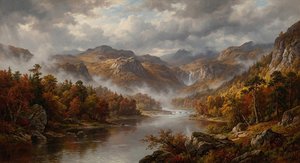
Albert Bierstadt's "Evening on the Prairie," painted in 1870, isn’t merely a landscape; it’s an immersive experience. It transports the viewer to the heart of the American West, capturing not just the visual grandeur but also the profound emotional resonance that defined the Romantic era and Bierstadt’s own artistic vision. This monumental canvas, currently residing in the Thyssen-Bornemisza Museum in Madrid, speaks volumes about America's burgeoning fascination with its untamed frontier and the artist’s ability to translate that wonder onto the canvas.
Bierstadt, a pivotal figure within the Hudson River School movement, rejected the strict realism of earlier landscape painters. Instead, he embraced a Romantic sensibility, prioritizing atmosphere, drama, and the sublime—the feeling of awe inspired by nature’s immense power. “Evening on the Prairie” exemplifies this perfectly. The scene unfolds as twilight descends upon a vast prairie, dominated by a winding river that acts as a powerful visual guide, drawing the eye into the distant, hazy horizon. The composition is meticulously balanced, utilizing horizontal lines of the riverbanks and hills to create a sense of stability against the turbulent energy of the sky.
Technique and Luminism: A Masterful Blend
Bierstadt’s technical skill is immediately apparent in the painting's rich detail and masterful use of light. He employed a technique often referred to as “luminism,” characterized by intense, saturated colors and dramatic contrasts between light and shadow. Thick impasto brushstrokes—noticeable particularly in the clouds and foliage—lend texture and depth to the scene, inviting the viewer to almost feel the roughness of the bark on the trees or the warmth of the setting sun. The artist’s careful layering of glazes creates a luminous quality, as if the light itself is emanating from within the canvas. The use of complementary colors – the deep blues and greens of the foreground contrasted with the fiery oranges and yellows of the sunset – intensifies the visual impact.
Furthermore, Bierstadt’s background in Düsseldorf instilled a rigorous attention to detail and an understanding of atmospheric perspective. Distant elements are rendered in paler hues, creating a convincing illusion of depth and distance. The solitary rider on horseback, positioned prominently in the foreground, serves as a poignant focal point, inviting contemplation about the vastness of the landscape and the human experience within it.
Symbolism and the American Ideal
Beyond its technical brilliance, “Evening on the Prairie” is laden with symbolic meaning. The prairie itself represents the untamed spirit of America—a land of opportunity, challenge, and boundless potential. The rider, often interpreted as a pioneer or explorer, embodies the westward expansion and the drive to conquer new frontiers. The dramatic sunset evokes feelings of both beauty and melancholy, suggesting the fleeting nature of time and the inherent loneliness of venturing into the unknown. It’s a scene that resonates with the American dream—the promise of prosperity and self-reliance in a vast and challenging landscape.
Interestingly, the painting draws parallels to European Romantic landscapes, particularly those influenced by Andreas Achenbach. Bierstadt skillfully blended these influences with his own unique vision, creating an image that is both familiar and strikingly original. The inclusion of elements like the low horizon line and the solitary figure further reinforce this connection to the pastoral traditions of German landscape painting.
A Legacy Endures: Reproductions and Inspiration
Today, “Evening on the Prairie” remains a celebrated masterpiece, captivating viewers with its breathtaking beauty and evocative power. High-quality reproductions are now available, allowing art lovers to bring this iconic image into their homes and offices. These meticulously crafted prints capture the essence of Bierstadt’s original work, offering a tangible connection to a pivotal moment in American art history. Whether you're an admirer of Romanticism, a collector of Western landscapes, or simply seeking a piece of art that inspires awe and wonder, “Evening on the Prairie” is a timeless treasure.
Fragen & Antworten
Welche Farbe prägt die Komposition von "Evening on the Prairie" von Albert Bierstadt?
Phthalogrün (#1a1710) ist die dominierende Farbe von "Evening on the Prairie" von Albert Bierstadt.
Wofür wird eine Reproduktion von "Evening on the Prairie" von Albert Bierstadt empfohlen?
Die empfohlene Verwendung eines Drucks von „Evening on the Prairie“ ist Statement-Piece.
Welche Grundfarbe durchzieht "Evening on the Prairie" von Albert Bierstadt?
Die dominante Farbe von "Evening on the Prairie" von Albert Bierstadt ist Ocker bis Sepia. Dieser Farbton bildet die Grundlage der Palette.
Biografie des Künstlers
Frühe Jahre und Ausbildung
Albert Bierstadt, ein renommierter deutsch-amerikanischer Maler, wurde am 7. Januar 1830 in Solingen, Preußen, geboren. Seine Familie wanderte aus, als er gerade einmal ein Jahr alt war, und ließ sich in New Bedford, Massachusetts, nieder. Bierstads frühes Leben war geprägt von seiner wachsenden Leidenschaft für die Kunst, und er begann bereits in jungen Jahren, clevere Kreidezeichnungen anzufertigen.Beruflicher Werdegang
Bierstads künstlerische Karriere nahm 1851 Fahrt auf, als er mit dem Malen in Öl begann. Er kehrte 1853 nach Deutschland zurück, um mehrere Jahre lang in Düsseldorf an seiner Maltechnik zu arbeiten, was seinen Stil maßgeblich beeinflusste. Nach seiner Rückkehr in die Vereinigten Staaten wurde Bierstadt Teil der Hudson River School, einer Gruppe von Gleichgesinnten, die sich darauf konzentrierten, die majestätischen Landschaften des Hudson River Valley festzuhalten. 1858 stellte Bierstadt ein großes Gemälde einer Schweizer Landschaft im National Academy of Design aus und erlangte positive Kritiken sowie eine Ehrennmitgliedschaft in der Akademie. Seine anschließenden Reisen in den amerikanischen Westen mit Frederick W. Lander und Fitz Hugh Ludlow inspirierten seine ikonischen Landschaften, die die Pracht des amerikanischen Westens zeigten.Wichtige Werke und Ausstellungen
- Western Landscape: Ein Beweis für Bierstads Können bei der Darstellung der weiten Landschaften des amerikanischen Westens.
- Coastal Scene: Demonstriert Bierstads Fähigkeit, die Schönheit der amerikanischen Küste zu vermitteln.
Einflüsse und Stilentwicklung
Bierstads technische Fertigkeiten, die er durch sein Studium europäischer Landschaftsmalerei erworben hatte, waren entscheidend für seinen Erfolg als Maler des amerikanischen Westens. Er wurde stark von der Hudson River School beeinflusst, insbesondere von Künstlern wie Thomas Cole und Frederic Church. Sein Stil zeichnete sich durch detaillierte Darstellungen, dramatische Lichteffekte und eine romantische Interpretation der Natur aus. Bierstadt war ein Meister des Luminismus, einer Maltechnik, die darauf abzielt, die subtilen Effekte von Licht und Atmosphäre einzufangen.Vermächtnis und Bedeutung
Bierstads immense Leinwände, entstanden nach seinen Reisen mit Lander und Ludlow, etablierten ihn als den herausragenden Maler der westamerikanischen Landschaft. Seine Werke trugen dazu bei, das Image des amerikanischen Westens im Bewusstsein der Öffentlichkeit zu prägen und die Romantik des unberührten Landes zu feiern. Obwohl Bierstads Kunst manchmal für ihre idealisierte Darstellung kritisiert wurde, bleibt er eine bedeutende Figur in der Geschichte der amerikanischen Kunst und ein wichtiger Vertreter der Hudson River School. Wichtige Fakten:- Geboren: 7. Januar 1830, Solingen, Preußen
- Gestorben: 18. Februar 1902
- Nationalität: Deutsch-Amerikaner
- Stil: Landschaftsmalerei, Hudson River School
- Bemerkenswerte Werke: Western Landscape, Coastal Scene

Albert Bierstadt
1830 - 1902 , Deutschland
Eckdaten zum Künstler
- Beeinflusste Künstler: ['Frederick W. Lander']
- Bemerkenswerte Werke:
- Western Landscape
- Coastal Scene
- Geburtsdatum: 7. Januar 1830
- Geburtsort: Solingen, Deutschland
- Künstlerische Richtung: Landschaftsmalerei, Hudson River School
- Nationalität: Deutsch-Amerikanisch
- Sterbedatum: 18. Februar 1902
- Vollständiger Name: Albert Bierstadt
- Von Künstlern Beeinflusst: ['Europäische Landschaftskunst']
Verwandte Artikel

Amerikanischer Realismus: Die 10 Meisterwerke, die eine Ära prägten | OriginalUniqueArt
Entdecken Sie die 10 Meisterwerke des Amerikanischen Realismus! Von Edward Hopper bis Winslow Homer – erleben Sie die Geschichten, Techniken & zeitlose Schönheit. Hochwertige Kunstdrucke auf OriginalUniqueArt.com.

Grant Wood und der amerikanische Regionalismus: Identität, Mythos und die ländliche Landschaft
Entdecken Sie Grant Wood und den amerikanischen Regionalismus! Erfahren Sie mehr über 'American Gothic', Woods Leben, Einflüsse und sein Vermächtnis in der Kunstgeschichte. Expertenwissen & hochwertige Reproduktionen.
Die 10 Meisterwerke der Hudson River School: Kunst für Ihr Zuhause | OriginalUniqueArt
Entdecken Sie die 10 prägendsten Meisterwerke der Hudson River School! Erfahren Sie mehr über Thomas Cole, Frederic Church & Co. und ihre atemberaubenden Landschaftsbilder. Hochwertige Kunstdrucke für Ihr Zuhause – jetzt auf OriginalUniqueArt.com!

Albert Bierstadt: Lichtmalerei der amerikanischen Landschaft und die Idealisierung des Westens
Entdecken Sie die beeindruckende Welt von Albert Bierstadt und der Hudson River School! Erfahren Sie mehr über Lichtmalerei, Idealisierung des Westens und den Einfluss dieser Künstler auf die amerikanische Kunstgeschichte. Jetzt lesen!

American Regionalism: The Soul of the Heartland and the Mastery of Grant Wood
Explore the profound history of American Regionalism. Discover how Grant Wood captured the heart of the Midwest through masterpieces like American Gothic. An expert guide to the movement, its cultural impact, and the enduring beauty of American Realism.


