In echtem Maßstab anzeigen
 Versenden als Grußkarte
 Teilen
 Details anzeigen
 Leitfaden öffnen

 Herunterladen
 Ähnliche Objekte
 Röntgenaufnahme
 Diashow
 Besucherstatistiken
The Disturbance


 Mehr anzeigen
Handgefertigte Ölreproduktion
Handgemaltes Ölgemälde auf Leinwand in Ihrer Wunschgröße und mit Rahmen, auf Bestellung von unseren Künstlern angefertigt. ( Zum Druck wechseln Zum digitalen Bild wechseln)




P118B €10

P118H €10

P118W €10

P438Z €10

P508JH €12

P508YH €12

P805H €10

P805Z €10

P919BZ €10

P919G €10

P919XJ €10

P959ZH €10

P968JZ €12

W106C €8

W218G €10

W218JH €8

W218Y €10

W307PJ €10

W316G €10

W316PJ €8

W316Y €10

W398PJ €8

W4111J €10

W500HY €15

W500JH €15

W692G €12

W849H €8

W940BG €15

W953PJ €8




Wählen Sie aus unseren vordefinierten Formaten, die den ursprünglichen Proportionen des Kunstwerks entsprechen.

Sie können Ihre eigenen Maße eingeben, um einen bestimmten Rahmen oder Platz auszufüllen. Wenn die gewählte Größe nicht den Proportionen des Originalbildes entspricht, werden wir das Kunstwerk entweder beschneiden oder das Gemälde durch zusätzliche, handgemalte Elemente erweitern. Ein digitales Mockup wird Ihnen zur Genehmigung zugesandt, bevor die Produktion beginnt.
Bitte beachten Sie, dass die Bildschirmvorschau nicht die tatsächliche Beschneidung oder Erweiterung widerspiegelt. Nur das Mockup zeigt die endgültige Komposition exakt an.
Obwohl Sondermaße verfügbar sind, empfehlen wir, eine Größe aus der vordefinierten Liste zu wählen, um die ursprünglichen Proportionen beizubehalten.
Nach der Bestellung wird das OriginalUniqueArt.com-Team dem Kunden Anweisungen per E-Mail zusenden und eine Mockup-Vorschau bereitstellen.
Weltweiter Versand () in nur 3 bis 4 Wochen statt der üblichen 5 Wochen. (13 Oktober). Keine Kompromisse bei der Qualität.

Kostenloser weltweiter Expressversand

Hochwertige Leinenleinwand

Vollständiger Versicherungsschutz beim Versand

Zollgebühren-Rückerstattungsgarantie

Garantie für exakte Farbtreue

100-tägiges Rückgaberecht (nur bei Mängeln)

100% Geld-zurück-Garantie

Angebot für Mengenrabatt
 Die Glasoption ist nur für Größen unter 110 cm verfügbar.

The Disturbance
Reproduktionsmedium
Format der Reproduktion
-


Gesamtpreis
€ 260
A Snapshot of Prussian Life: The Intimate Drama of "The Disturbance"
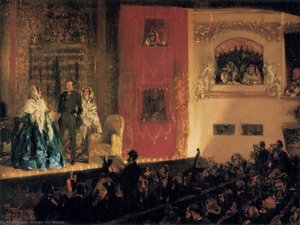
Adolph von Menzel’s “The Disturbance,” painted in 1846, isn't merely a portrait; it’s a meticulously observed slice of bourgeois life rendered with the precision and psychological depth characteristic of the German Realist movement. This intimate scene, housed within the State Art Gallery of Karlsruhe, captures a fleeting moment of domestic tension – a subtle discordance simmering beneath the veneer of polite society. The painting depicts two women seated in a dimly lit parlor, one at a piano while the other stands nearby, seemingly observing or perhaps even subtly challenging her companion’s focus. The room itself is richly detailed: a vase sits on a side table, suggesting an attempt to maintain order and elegance amidst the underlying unease, while a clock hangs above the piano, a silent reminder of the passage of time and the pressures of societal expectations.
Menzel's Masterclass in Detail and Observation
Menzel’s genius lay not just in his technical skill – though undeniably masterful – but in his ability to distill complex human emotions into deceptively simple compositions. He was a student of observation, spending countless hours sketching everyday scenes, from bustling marketplaces to quiet moments within private homes. This dedication is evident in the incredibly detailed rendering of the women’s clothing, the textures of the furniture, and even the subtle shadows that play across their faces. The artist's use of light and shadow creates a sense of depth and realism, drawing the viewer into this intimate tableau. Notably, Menzel employed a technique known as *pointillé*, using tiny dots of paint to build up texture and create an illusion of shimmering surface detail – a hallmark of his mature style.
A Window into 19th-Century Prussia
“The Disturbance” offers a fascinating glimpse into the social dynamics of mid-19th century Prussia. Menzel, deeply sympathetic to the Prussian monarchy and its values, frequently depicted scenes from Frederick the Great’s reign, but also sought to capture the complexities of everyday life within the kingdom. This painting reflects the growing interest in documenting the realities of bourgeois society – a shift away from idealized historical narratives towards a more nuanced portrayal of contemporary life. The scene speaks to the constraints placed upon women during this era, suggesting a subtle power dynamic and perhaps even a hint of suppressed rebellion. The quiet tension between the two figures hints at unspoken desires or unresolved conflicts, reflecting the anxieties and uncertainties of a rapidly changing society.
Symbolism and Emotional Resonance
While seemingly straightforward, “The Disturbance” is rich in symbolic meaning. The piano, often associated with domestic harmony and refinement, becomes a focal point of discord. The woman at the instrument represents perhaps a desire for creative expression or social engagement, while her companion’s stance suggests a degree of detachment or disapproval. The muted color palette – dominated by browns, grays, and creams – reinforces the atmosphere of quiet tension and unspoken emotions. Menzel masterfully uses these visual cues to evoke a sense of melancholy and introspection, inviting viewers to contemplate the hidden currents beneath the surface of everyday life. The painting’s enduring power lies in its ability to capture a universal human experience: the subtle complexities of relationships and the ever-present undercurrent of unspoken feelings.
Reproductions & Beyond
A faithful reproduction of “The Disturbance” brings this captivating scene into any space, offering a touch of understated elegance and intellectual depth. Available in various sizes, from compact 5x90cm prints to larger formats suitable for statement walls, these reproductions capture Menzel’s meticulous detail and evocative atmosphere. Consider framing options that complement the painting's muted tones – a simple black frame will highlight the artwork's inherent drama, while a warmer wood tone can add a touch of rustic charm. “The Disturbance” is more than just a beautiful image; it’s an invitation to engage with the complexities of human emotion and the enduring legacy of one of Germany’s greatest artists.
Fragen & Antworten
Ist "The Disturbance" von Adolph von Menzel ein helles oder ein dunkles Kunstwerk?
"The Disturbance" von Adolph von Menzel weist eine Helligkeit von deep_shadow mit einer Luminanz von Dark auf.
Wie stehen die Farben von "The Disturbance" zueinander?
Die Farben von "The Disturbance" von Adolph von Menzel zeigen eine Unified Palette Harmonie. Harmonie beschreibt, wie die Farben zueinander in Beziehung stehen.
Welche Proportionen hat "The Disturbance" von Adolph von Menzel und wie groß ist es?
Das Format von „The Disturbance“ ist Portrait und das Original hat die Maße 5 x 90 cm. Beides ist bei der Planung einer Reproduktion hilfreich.
Welche emotionale Stimmung vermittelt "The Disturbance" von Adolph von Menzel?
Die für "The Disturbance" von Adolph von Menzel festgelegte emotionale Stimmung ist Reflective. Sie fasst das Gefühl zusammen, das das Werk ausdrückt.
Wann und mit welchen Materialien wurde "The Disturbance" geschaffen?
"The Disturbance" entstand im Jahr 1846 mit der Technik Acrylic On Canvas. Material und Datum beschreiben, wie und wann das Original geschaffen wurde.
Wie kann ich einen Druck von "The Disturbance" von Adolph von Menzel erwerben?
"The Disturbance" ist als ein Fine Art Print auf Baumwollkanvas oder Archiv-Leinwandpapier erhältlich. Bestellungen können in der von Ihnen gewünschten Größe auf diese Seite aufgegeben werden.
Ist "The Disturbance" von Adolph von Menzel eine Porträt-, Landschafts- oder Quadratkomposition?
"The Disturbance" von Adolph von Menzel ist eine Komposition im Portrait-Format. Die Proportionen sollten vor der Wahl der Druckgröße überprüft werden.
Welche Größe sollte ich für den Druck von "The Disturbance" für mein Zimmer wählen?
Die ideale Kombination für "The Disturbance" von Adolph von Menzel: ein Druck im Format Medium für einen Living Room.
Biografie des Künstlers
Ein Leben voller künstlerischer Exzellenz (1815–1905)
Adolph Friedrich Erdmann von Menzel, ein deutscher Realist, hinterließ mit seinen Zeichnungen, Radierungen und Gemälden einen bleibenden Eindruck in der Kunstwelt. Geboren am 8. Dezember 1815 in Breslau, Schlesien (heute Wrocław, Polen), war Menzels Leben ein Beweis für seine Hingabe, die Essenz der Realität durch seine Kunst einzufangen.Frühes Leben und Ausbildung
Menzels Vater, ein Lithograph, beabsichtigte zunächst, dass sein Sohn Professor werden sollte. Adolphs Leidenschaft für die Kunst setzte sich jedoch durch, was zu einem kurzen Studium an der Berliner Akademie der Künste im Jahr 1833 führte. Anschließend machte er sich selbstständig und verbesserte seine Fähigkeiten durch unermüdliches Üben.Künstlerische Leistungen
- Die Eisenhütte (1872–1875): Ein Meisterwerk, das Menzels scharfe Beobachtungsgabe und handwerkliches Können demonstriert.
- Der Marktplatz in Verona: Ein Beweis für seine Fähigkeit, die Atmosphäre des täglichen Lebens einzufangen.
- Die Kanzelpredigt in der Pfarrkirche zu Innsbruck (1857): Ein beeindruckendes Beispiel für Menzels Meisterschaft, das in der Sammlung Hugo Fischer (Bühl, Deutschland) zu finden ist.
Einfluss und Bedeutung
Menzels Ruf wuchs posthum vor allem durch seine grafischen Arbeiten und informellen Gemälde. Sein Einfluss reichte über Deutschland hinaus; Edgar Degas bewunderte und kopierte seine Werke und nannte ihn den "größten lebenden Meister". Menzels Verbindung zur französischen und englischen Kunst zeigt sich in seinen Genreszenen, wie Das Französische Fenster und Der Palastgarten von Prinz Albert.Vermächtnis und Rezeption
Adolph von Menzel gilt als einer der bedeutendsten deutschen Maler des 19. Jahrhunderts. Seine Werke spiegeln die gesellschaftlichen und industriellen Veränderungen seiner Zeit wider und bieten einen einzigartigen Einblick in das Leben im Deutschland des 19. Jahrhunderts. Er beeinflusste nachfolgende Generationen von Künstlern und seine Arbeiten werden bis heute für ihre Detailgenauigkeit, ihren Realismus und ihre emotionale Tiefe geschätzt. Seine Fähigkeit, sowohl monumentale historische Szenen als auch intime Alltagsmomente mit gleicher Meisterschaft darzustellen, macht ihn zu einer Schlüsselfigur der realistischen Kunstbewegung.
Adolph von Menzel
1815 - 1905 , Polen
Eckdaten zum Künstler
- Beeinflusste Künstler: ['Edgar Degas']
- Bemerkenswerte Werke:
- Eisenwalzwerk (1872-1875)
- Marktplatz in Verona
- Deutsche Kanzelpredigt in Innsbruck
- Geburtsdatum: 8. Dezember 1815
- Geburtsort: Breslau, Polen
- Künstlerische Richtung: Realismus
- Nationalität: Deutsch
- Sterbedatum: 9. Februar 1905
- Vollständiger Name: Adolph Friedrich Erdmann von Menzel
- Von Künstlern Beeinflusst: ['Caspar David Friedrich']
Verwandte Artikel

The Enduring Legacy of Formal Portraiture: Power, Identity & Artistic Exploration
Explore the rich history of formal portraiture & its enduring power to capture identity and shape perception. Discover investment-worthy artworks, expert appraisals, and custom reproduction services at OriginalUniqueArt.
The Enduring Muse: Women as Subject & Symbol in Art History
Explore the rich history of women in art – from archetypal representations to contemporary voices challenging norms. Discover iconic artists & movements, and learn about reclaiming female narratives through painting and beyond.

Adolph von Menzel: Preußischer Realismus und die malerische Chronik einer Epoche
Entdecken Sie Adolph von Menzels Meisterwerke des Preußischen Realismus! Erfahren Sie mehr über seine Historienmalerei, soziale Kommentare und seinen Einfluss auf die deutsche Kunstgeschichte. Jetzt lesen!
Portrayals of Power & Perception: A Historical Survey of Women in Art
Explore the rich history of women in art – from iconic muses to groundbreaking artists. Discover feminist movements & reclaim female narratives with OriginalUniqueArt. Expert insights for discerning collectors.

The Enduring Muse: Women as Subject & Symbol in Art History
Explore the rich history of women in art – from iconic muses to groundbreaking artists. Discover feminist movements, global perspectives & reclaim female narratives with OriginalUniqueArt.