

 Vorschau anzeigen
 Versenden
 Teilen
 Details anzeigen
 Leitfaden

 Herunterladen
 Ähnliche Objekte
 Röntgenaufnahme
 Diashow
 Statistiken
Study for a Painting
 Oil On Canvas
- WallArt
- Abstract Geometric
 1939
1939- Modern
 10.0 x 13.0 cm
 Museum of Modern Art
 Weiterlesen
Die auf dieser Seite dargestellten Kunstwerke sind urheberrechtlich geschützt, was bedeutet, dass wir keine identische Reproduktion rechtmäßig erstellen oder verkaufen dürfen. Dieser Schutz wird durch internationale Abkommen wie die Berner Übereinkunft und durch nationale Gesetze, einschließlich derer, die von den US-Urheberrecht – Titel 17.
Als respektvolle und rechtlich einwandfreie Alternative bieten wir individuelle, handgemalte Kunstwerke an, die vom Original inspiriert sind. Unsere geschickten und professionellen Künstler studieren sorgfältig den Stil, die Stimmung und das künstlerische Wesen des Originals, um ein neues, einzigartiges Werk zu schaffen, das dasselbe Gefühl hervorruft – während es zugleich eine eigenständige Originalschöpfung bleibt.
Diese Methode entspricht vollumfänglich den Urheberrechtsbestimmungen, da sie keine Kopie oder Vervielfältigung des geschützten Kunstwerks darstellt. Stattdessen handelt es sich um eine kreative Neuinterpretation – ein neues Gemälde, das vom Original inspiriert, aber nicht identisch mit ihm ist.
Handgefertigte Ölreproduktion
Handgemaltes Ölgemälde auf Leinwand in Ihrer Wunschgröße und mit Rahmen, auf Bestellung von unseren Künstlern angefertigt. ( Zum Druck wechseln Zum digitalen Bild wechseln)




P118B €10

P118H €10

P118W €10

P438Z €10

P508JH €12

P508YH €12

P805H €10

P805Z €10

P919BZ €10

P919G €10

P919XJ €10

P959ZH €10

P968JZ €12

W106C €8

W218G €10

W218JH €8

W218Y €10

W307PJ €10

W316G €10

W316PJ €8

W316Y €10

W398PJ €8

W4111J €10

W500HY €15

W500JH €15

W692G €12

W849H €8

W940BG €15

W953PJ €8




Wählen Sie aus unseren vordefinierten Formaten, die den ursprünglichen Proportionen des Kunstwerks entsprechen.

Geben Sie die Breite und die Höhe an, die Sie für Ihren Rahmen oder Ihre Wand benötigen. Da dieses Werk handgemalt ist, kann der Künstler bei einer anderen Form etwas mehr um das Bild herum malen oder etwas abschneiden – Sie entscheiden. Wir senden Ihnen ein digitales Mockup zur Freigabe, bevor mit dem Malen begonnen wird. Das auf dieser Seite gezeigte Bild stellt nicht das tatsächliche Ergebnis dar – dies tut nur das Mockup.
Nach der Bestellung wird das OriginalUniqueArt.com-Team dem Kunden Anweisungen per E-Mail zusenden und eine Mockup-Vorschau bereitstellen.
Weltweiter Versand () in nur 3 bis 4 Wochen statt der üblichen 5 Wochen. (26 Oktober). Keine Kompromisse bei der Qualität.

Kostenloser weltweiter Expressversand

Hochwertige Leinenleinwand

Umfassender Versicherungsschutz beim Versand

Zollgebühren-Rückerstattungsgarantie

Garantie für exakte Farbtreue

100 Tage Rückgaberecht (nur bei Mängeln)

100% Geld-zurück-Garantie

Mengenrabatt verfügbar
 Die Glasoption ist nur für Größen unter 110 cm verfügbar.

Study for a Painting
Art der Reproduktion
Format der Reproduktion
-


Endpreis
€ 263
A Study in Pure Form: Ad Reinhardt’s Geometric Exploration
Ad Reinhardt's "Study for a Painting," created in 1939, offers a profound glimpse into the artist’s radical vision of art – one that prioritized conceptual purity above all else. This deceptively simple work, rendered in meticulous black, white, and shades of grey on paper, is far more than just a preparatory sketch; it's a distilled essence of Reinhardt’s evolving philosophy, a stepping stone towards his later, iconic monochrome paintings. The piece immediately commands attention with its stark geometric arrangement – a series of precisely defined planes and angular shapes that seem to float within the confines of the page. There is no illusion of depth or perspective here; instead, we are presented with a two-dimensional world constructed entirely from form and space.
The composition itself speaks volumes about Reinhardt’s intentions. The deliberate use of negative space isn't merely an aesthetic choice but a crucial element in establishing balance and visual interest. Each solid shape is carefully positioned to create a dynamic interplay with the surrounding emptiness, drawing the eye across the surface and inviting contemplation. The lines are crisp and unwavering, defining each form with absolute clarity – a characteristic that would become increasingly pronounced in his later work. This emphasis on geometric precision reflects a fascination with order and structure, a desire to strip away all extraneous detail and reveal the fundamental building blocks of visual experience.
Echoes of Cubism and Constructivism
“Study for a Painting” firmly situates itself within the context of early 20th-century abstract art. The influence of Cubism is undeniable, particularly in its fragmentation of form and its exploration of multiple viewpoints. However, Reinhardt’s approach transcends mere imitation; he takes these concepts to their logical extreme, reducing subjects to their most essential geometric components. There's also a subtle resonance with Constructivism, a Russian artistic movement that sought to create art through the manipulation of industrial materials and geometric forms. Both movements shared a commitment to abstraction and a belief in the power of form to convey meaning – though Reinhardt’s focus remained firmly on the inherent qualities of paint itself.
The choice of gouache on paper is significant. This medium, known for its opacity and smooth application, lends itself perfectly to Reinhardt's precise style. The surface appears remarkably flat, devoid of texture or brushstrokes – a deliberate decision designed to eliminate any distractions from the underlying forms. It’s as if Reinhardt sought to create a visual equivalent of silence, a space where the viewer could simply *see* without being led by preconceived notions of representation.
The Essence of Painting: A Conceptual Statement
By 1939, Ad Reinhardt was already articulating his radical ideas about art. He believed that painting should be divorced from any representational function, that it should exist solely for the sake of its own visual qualities – color, line, and form. “Study for a Painting” embodies this philosophy perfectly. It’s not an attempt to depict anything recognizable; rather, it's an exploration of the fundamental elements of painting itself. The work can be interpreted as a meditation on the nature of perception, inviting us to consider how we construct meaning from visual information.
Ultimately, “Study for a Painting” is more than just a preparatory sketch; it’s a powerful statement about the artist's commitment to pure abstraction. It demonstrates Reinhardt’s early experimentation with reducing art to its most essential components – a bold and influential step on his path towards creating paintings that would challenge conventional notions of beauty and representation, and continue to resonate with artists and viewers today.
Fragen & Antworten
Welcher Phase der Karriere von Ad Reinhardt ist „Study for a Painting“ (1939) zuzuordnen?
Angesichts seiner Datierung auf 1939 fällt "Study for a Painting" in die Early Modern von Ad Reinhardt.
Wie hoch ist der Kontrast von "Study for a Painting" von Ad Reinhardt?
Der Kontrastwert von "Study for a Painting" von Ad Reinhardt ist Statement.
Welche Grundfarbe prägt "Study for a Painting" von Ad Reinhardt?
Die dominante Farbe von "Study for a Painting" von Ad Reinhardt ist Warm Sunset Tones. Dieser Farbton bildet die Grundlage der Palette.
Künstlerbiografie
Frühes Leben und Ausbildung
- Geboren: Adolph Friedrich Reinhardt, 24. Dezember 1913, Buffalo, New York
- Familienhintergrund: Lebte im Riverside-Viertel am Niagara River. Enge Beziehung zu seinem Cousin Otto. Die Arbeit seines Vaters führte die Familie nach New York City.
- Ausbildung: Studierte Kunstgeschichte am Columbia College der Columbia University (1931-1935). Studierte bei Meyer Schapiro.
- Künstlerische Ausbildung: Malereiunterricht am Teachers College von Columbia. Studium der Malerei mit Carl Holty und Francis Criss an der American Artists School. Porträtstudien an der National Academy of Design unter Karl Anderson.
- Frühe künstlerische Entwicklung: Wurde schon in jungen Jahren als talentierte/r Maler/in erkannt und gewann Preise in der Grund- und Highschool. Glaubte, er/sie habe frühzeitig technische Fähigkeiten gemeistert.
Karriere und künstlerische Entwicklung
- WPA Federal Art Project (1936-1940): Akkreditiert als Maler/in von Burgoyne Diller, was ihm/ihr die Arbeit im WPA Easel Division ermöglichte.
- American Abstract Artists (AAA): Wurde Mitglied der AAA und stellte mit ihnen in den 1940er Jahren aus. Beschrieb seine/ihre Assoziation mit der Gruppe als "eine der größten Dinge, die jemals mit mir passiert sind".
- Betty Parsons Gallery: Stellte regelmäßig in der Galerie von Betty Parsons aus, beginnend mit Wakefield Bookshop und Mortimer Brandt Gallery.
- Künstlerische Progression: Frühe Werke zeigten geometrische Formen. Progression hin zu Arbeiten in verschiedenen Schattierungen derselben Farbe (alles Rot, alles Blau, alles Weiß) in den 1950er Jahren.
- "Schwarze" Gemälde (1960er Jahre): Wurde am bekanntesten für seine/ihre "schwarzen" oder "ultimativen" Gemälde – scheinbar monochrome Leinwände, die aus subtilen Variationen in Schwarz- und fast-Schwarz-Tönen bestanden. Erforschte Konzepte absoluter Grenzen innerhalb der Kunst.
Künstlerische Philosophie und Einflüsse
- Kunst als Kunst: Befürwortete eine Philosophie namens *Art-as-Art*, die die Autonomie der Kunst von externen Belangen oder Repräsentation betonte.
- Kritik an "Künstlern als Künstlern": Nutzte Schreiben und satirische Cartoons, um das zu kritisieren, was er/sie für problematische Praktiken durch Künstler hielt, die soziale oder politische Botschaften über rein ästhetische Erwägungen stellten.
- Einflüsse: Enge Freundschaften mit Robert Lax und Thomas Merton, teilten Konzepte der Einfachheit in unterschiedlichen künstlerischen Richtungen.
- Konzeptkunst, Minimalismus, Monochrome Malerei: Seine/ihre Arbeit beeinflusste maßgeblich die Entwicklung von Konzeptkunst, Minimal Art und monochromer Malerei.
Lehrtätigkeit und Vermächtnis
- Lehrpositionen: Lehrte am Brooklyn College (1947-1967), California School of Fine Arts, University of Wyoming, Yale University und Hunter College.
- Protestkunst: Beteiligt an dem Protest von 1940 gegen MoMA und dem "Irascibles"-Protest von 1950 gegen das Metropolitan Museum of Art. Erstellte einen Lithograph mit dem Titel „No War“ für den Artists and Writers Protest Against the Vietnam War (1967).
- Schreiben: Verfasste umfangreiche Schriften über Kunsttheorie und seine/ihre eigene Arbeit, gesammelt in *Art as Art* (1991).
- Vertretung: Der Ad Reinhardt Estate wird von der David Zwirner Gallery vertreten.
- Tod: Starb am 30. August 1967 in New York City.
Historische Bedeutung
- Pionier des Minimalismus und der monochromen Malerei: Reinhardt's "schwarze" Gemälde gelten als bahnbrechende Werke bei der Entwicklung minimalistischer und monochromer Kunstbewegungen.
- Einflussreicher Kunsttheoretiker: Seine/ihre Schriften über *Art-as-Art* stellten herkömmliche Vorstellungen über die Rolle der Kunst und ihr Verhältnis zur Gesellschaft in Frage und beeinflussten so nachfolgende Generationen von Künstlern und Kritikern.
- Schlüsselfigur des abstrakten Expressionismus: Als Mitglied der AAA und im Zusammenhang mit der Betty Parsons Gallery spielte Reinhardt eine bedeutende Rolle bei der Entwicklung des abstrakten Expressionismus.
- Nachhaltiger Einfluss: Seine/ihre Arbeit wird weiterhin ausgestellt und studiert, was seinen/ihren bleibenden Einfluss auf zeitgenössische Kunst und Theorie demonstriert.

Ad Reinhardt
1913 - 1967 , Vereinigte Staaten von Amerika
Kurzinfos
- Beeinflusste Künstler/Bewegungen:
- Konzeptkunst
- Minimal Art
- Bemerkenswerte Werke:
- Untitled (Rot und Grau)
- Nr. - (107)
- Studie für ein Gemälde
- Rotes Gemälde
- Wie man eine Spirale betrachtet
- Geburtsdatum: 24. Dezember 1913
- Geburtsort: Buffalo, USA
- Künstlerische Einflüsse:
- Carl Holty
- Francis Criss
- Künstlerische Richtung:
- Abstrakter Expressionismus
- Minimal Art
- Konzeptkunst
- Nationalität: Amerikanisch
- Todatum: 30. August 1967
- Vollständiger Name: Ad Reinhardt
Ähnliche Artikel

Kandinsky: Die 25 Meisterwerke des Abstrakten – Kunst für Ihr Zuhause | OriginalUniqueArt
Entdecken Sie die 25 bedeutendsten Gemälde von Wassily Kandinsky! Tauchen Sie ein in die Welt der abstrakten Kunst, des Expressionismus und der Farbkomposition. Hochwertige Kunstdrucke & Inspiration für Ihr Zuhause auf OriginalUniqueArt.com.
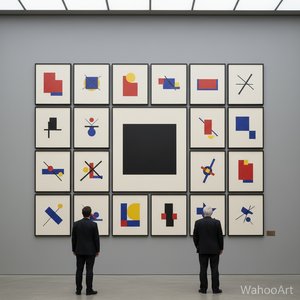
Kazimir Malevich: Die 25 Meisterwerke des Suprematismus für Ihr Zuhause | OriginalUniqueArt
Entdecken Sie die 25 Meisterwerke von Kazimir Malevich! Tauchen Sie ein in die Welt des Suprematismus, abstrakter Kunst & geometrischer Formen. Hochwertige Kunstdrucke und Reproduktionen auf OriginalUniqueArt.com – für Ihr Zuhause.

Neo-Abstract Art: The High-Impact Evolution of Modern Visual Energy and Geometric Sophistication
Discover the power of Neo-Abstract art. Explore how bold geometric forms and high-impact visual energy are redefining modern design. Learn to curate sophisticated, high-energy spaces with the latest trends in contemporary abstraction and structural color.

Geometrische Abstraktion: Die 10 Meisterwerke, die Kunstgeschichte prägten | OriginalUniqueArt.com
Entdecken Sie die 10 Meisterwerke der geometrischen Abstraktion! Von Kandinsky bis Mondrian – erleben Sie die Geschichte, Farben & Formen dieser revolutionären Kunstrichtung. Hochwertige Kunstreproduktionen auf OriginalUniqueArt.com

Beyond Form & Color: Geometric Abstraction's Evolution in 20th/21st Century Art
Explore the evolution of geometric abstraction from Cubism to contemporary art. Discover key artists like Malevich & Mondrian, investment insights, and expert collecting advice at OriginalUniqueArt.


