Portræt af Josef Albers

De 100 mest berømte Josef Albers-malerier, hver og en unik

Opdateret november 2026 · rangeret efter vores popularitetsscore (søgninger, besøg og ordrer for hvert værk) · 123 værker af Josef Albers i vores katalog

Kort sagt

Homage to the Square Midday (1957) er det maleri af Josef Albers, der fanger flest blikke. Derefter falder blikket på Multiplex D (1948) og Four Xs in Red (1938). Blandt de 123 værker af Josef Albers i vores katalog er disse 100 de mest berømte, hver især et unikt originalværk præsenteret med sit årstal, sit museum og årsagen til dets tidløse betydning.

1888 – 1976, Bottrop Flest værker: Modern Art Museum of Fort Worth

Top 10 malerier af Josef Albers, set gennem galleriets øjne

1
Homage to the Square Midday (1957) af Josef Albers

Homage to the Square Midday

1957 · Painting

To stand before Josef Albers’s Homage to the Square Midday is not merely to observe paint on canvas; it is to engage in a profound, almost meditative dialogue with color itself. This 1957 composition, executed at a commanding size of 102 x 102 cm, immediately arrests the viewer with its bold, structured simplicity. The piece presents a central square, vibrant with warm yellows and oranges, set against a deep, contrasting…

2
Multiplex D (1948) af Josef Albers

Multiplex D

1948 · Acrylic On Canvas · De Young Museum, San Francisco

Josef Albers’s Geometric Exploration of Color and Perception Josef Albers's "Multiplex D," created in 1948, stands as a cornerstone of American Abstract Expressionism while simultaneously embodying the principles of Bauhaus design—a testament to his multifaceted artistic vision. This deceptively simple woodcut print showcases nine squares meticulously arranged on a rectangular canvas, each square subtly offset from its neighbors, creating an illusion of depth and movement that transcends mere visual representation.…

3
Four Xs in Red (1938) af Josef Albers

Four Xs in Red

1938

To stand before Josef Albers’s Four Xs in Red is not merely to observe paint on a surface; it is to engage in a quiet, intellectual dialogue with color and form. This striking composition, executed in 1938, immediately arrests the viewer with its stark confrontation: four vibrant, assertive red crosses set against an abyss of absolute black. The power of this piece lies not just in the boldness of its…

4
Homage to the Square (La Tehuana) (1951) af Josef Albers

Homage to the Square (La Tehuana)

1951 · Oil On Board · Modern Art Museum of Fort Worth, Fort Worth

In the quiet contemplation of Josef Albers’s "Homage to the Square (La Tehuana)," one does not merely look at a painting; one enters into a profound dialogue with light and color. Created in 1951, this masterpiece serves as a mesmerizing meditation on how we perceive the world around us. At its heart, the work is an exploration of the Hard Edge aesthetic, a movement that sought to strip away the…

5
Homage to the Square Glow (1966) af Josef Albers

Homage to the Square Glow

1966 · Painting

To stand before Homage to the Square Glow is not merely to observe paint on canvas; it is to enter a meticulously constructed optical experience. This striking abstract composition, executed by the master color theorist Josef Albers in 1966, invites the viewer into a profound meditation on how color interacts with its neighbor. The piece commands attention with its vibrant field of red, serving as a rich, enveloping backdrop against…

6
Study for Homage to the Square Beaming (1963) af Josef Albers

Study for Homage to the Square Beaming

1963 · Oil On Board

The eye meets Study for Homage to the Square: Beaming, a work that exists in a precise square format. This 1963 creation by Josef Albers invites a quiet observation of how color behaves when placed in direct contact with itself. The painting presents a specific moment in the artist's long investigation into the way light and hue interact, stripping away all representational imagery to focus entirely on the relationship between…

7
El Lissitzky, Dessau (1932) af Josef Albers

El Lissitzky, Dessau

1932 · MoMA - Museum of Modern Art, New York City

The photograph presented here – “El Lissitzky, Dessau” – isn’t merely a portrait; it's a carefully constructed distillation of the spirit of early 20th-century artistic experimentation. Captured around 1930-1932 by Josef Albers, this image offers a glimpse into the world of El Lissitzky, a pivotal figure in the Russian avant-garde who bridged the gap between Suprematism and Constructivism. It’s a document of a man grappling with the fundamental questions of…

8
Astatic (1944) af Josef Albers

Astatic

1944 · Woodcut · Museum of Fine Arts, Boston

In the quiet, profound stillness of Josef Albers’s 1944 masterpiece, "Astatic," we encounter more than just a collection of shapes; we enter a realm of deep perceptual inquiry. This work serves as a mesmerizing window into the mind of one of the twentieth century's most influential architects of color and form. At its heart, the composition presents a striking equilateral triangle, bisected by a precise horizontal line, creating a structural…

10
Homage to the Square: Broad Call (1967) af Josef Albers

Homage to the Square: Broad Call

1967 · Oil On Canvas · MoMA - Museum of Modern Art, New York City

In the quiet contemplation of Josef Albers’s 1967 masterpiece, Homage to the Square: Broad Call, one discovers that simplicity is often the most profound form of complexity. At first glance, the viewer is met with a monumental red square, a bold and commanding presence that anchors the canvas with an almost gravitational force. Yet, to look merely at the surface is to miss the true magic of this Minimalist icon.…

Josef Alberss berømte malerier, nummer 11 til 100

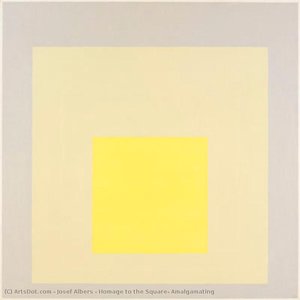
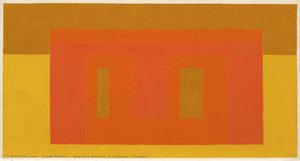
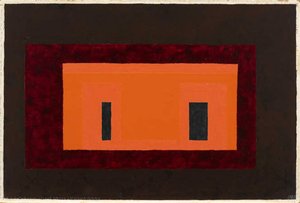
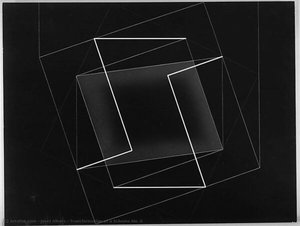
11Homage to the Square (1966) af Josef AlbersHomage to the Square1966 · Modern Art Museum of Fort Worth 12Homage to the Square: With Rays (1959) af Josef AlbersHomage to the Square: With Rays1959 13Homage to the Square: Soft Spoken (1969) af Josef AlbersHomage to the Square: Soft Spoken1969 14Homage to the Square (1967) af Josef AlbersHomage to the Square1967 · Modern Art Museum of Fort Worth 15Homage to the Square: Dilated (1969) af Josef AlbersHomage to the Square: Dilated1969 · Metropolitan Museum of Art 16Light Grey Wall (1958) af Josef AlbersLight Grey Wall1958 · Szépművészeti Múzeum 17Study for Homage to the Square: Beaming (1963) af Josef AlbersStudy for Homage to the Square: Beaming1963 · Tate Modern 18Interaction of Color af Josef AlbersInteraction of ColorBechtler Museum of Modern Art 19Homage to the Square, Sonorous af Josef AlbersHomage to the Square, SonorousMuseum Folkwang 20Multiplex A (1947) af Josef AlbersMultiplex A1947 · Museum of Fine Arts 21Homage to the Square: Amalgamating (1971) af Josef AlbersHomage to the Square: Amalgamating1971 22Vice Versa (B) (1943) af Josef AlbersVice Versa (B)1943 23Homage to the Square: Guarded (1952) af Josef AlbersHomage to the Square: Guarded1952 24Homage to the Square Elected II (1961) af Josef AlbersHomage to the Square Elected II1961 25Portrait Study (1918) af Josef AlbersPortrait Study1918 26El Lissitzky (1930) af Josef AlbersEl Lissitzky1930 27Two Structural Constellations (1959) af Josef AlbersTwo Structural Constellations1959 28Study for Homage to the Square Departing in Yellow (1964) af Josef AlbersStudy for Homage to the Square Departing in Yellow1964 29Study for Homage to the Square. Departing in Yellow (1964) af Josef AlbersStudy for Homage to the Square. Departing in Yellow1964 · Tate Modern 30Study for Homage to the Square Last Century (1956) af Josef AlbersStudy for Homage to the Square Last Century1956 31Pillars (1928) af Josef AlbersPillars1928 32Variant/Adobe (1948) af Josef AlbersVariant/Adobe1948 33Untitled (D2XAN8) (1901) af Josef AlbersUntitled (D2XAN8)1901 34Standing Bird, Front View (1917) af Josef AlbersStanding Bird, Front View1917 35Grid Mounted (1921) af Josef AlbersGrid Mounted1921 36Factory (1925) af Josef AlbersFactory1925 37Park (1924) af Josef AlbersPark1924 38Frontal (1927) af Josef AlbersFrontal1927 39Preliminary Study for Steps (1931) af Josef AlbersPreliminary Study for Steps1931 40Interior B (1929) af Josef AlbersInterior B1929 · The Phillips Collection 41Final Study for Steps (1931) af Josef AlbersFinal Study for Steps1931 42Skyscrapers on Transparent Yellow (1929) af Josef AlbersSkyscrapers on Transparent Yellow1929 43Final Study for Rolling After (1932) af Josef AlbersFinal Study for Rolling After1932 44Final Study for Void on Black (1931) af Josef AlbersFinal Study for Void on Black1931 45Untitled (​​Bullfight​,​ San Sebastian) (1930) af Josef AlbersUntitled (​​Bullfight​,​ San Sebastian)1930 46Final Study for 6 and 3 (1931) af Josef AlbersFinal Study for 6 and 31931 47Brackish Water Biarritz VIII (1929) af Josef AlbersBrackish Water Biarritz VIII1929 48Final Study for Piano Keys (1932) af Josef AlbersFinal Study for Piano Keys1932 49Final Study for K Trio (1932) af Josef AlbersFinal Study for K Trio1932 50Study for Tenayuca (1938) af Josef AlbersStudy for Tenayuca1938 51Study No.1 for Proto Form (B) (1938) af Josef AlbersStudy No.1 for Proto Form (B)1938 52Study for Proto Form (B, No. 2) (1938) af Josef AlbersStudy for Proto Form (B, No. 2)1938 53Proto Form (B) (1938) af Josef AlbersProto Form (B)1938 54Bent Black (B) (1940) af Josef AlbersBent Black (B)1940 55Graphic Tectonic (1941) af Josef AlbersGraphic Tectonic1941 56Variant/Adobe: Familiar Front (1948) af Josef AlbersVariant/Adobe: Familiar Front1948 57Variant/Adobe: Southern Climate (1948) af Josef AlbersVariant/Adobe: Southern Climate1948 58Variant/Adobe (1948) af Josef AlbersVariant/Adobe1948 59Tlaloc (1944) af Josef AlbersTlaloc1944 60Variant/Adobe (1947) af Josef AlbersVariant/Adobe1947 61Transformation of a Scheme No. 8 (1949) af Josef AlbersTransformation of a Scheme No. 81949 62Homage to the Square: Blue, White, Grey (1951) af Josef AlbersHomage to the Square: Blue, White, Grey1951 63Homage to the Square (1950) af Josef AlbersHomage to the Square1950 64Homage to the Square: Young (1951) af Josef AlbersHomage to the Square: Young1951 65Transformation of a Scheme No. 9 (1950) af Josef AlbersTransformation of a Scheme No. 91950 66Homage to the Square: Blue & Green (1950) af Josef AlbersHomage to the Square: Blue & Green1950 67Homage to the Square: Precinct (1951) af Josef AlbersHomage to the Square: Precinct1951 68Indicating Solids (1949) af Josef AlbersIndicating Solids1949 69Adobe (Variant): Luminous Day (1952) af Josef AlbersAdobe (Variant): Luminous Day1952 70Variant/Adobe (1956) af Josef AlbersVariant/Adobe1956 71Structural Constellation (1955) af Josef AlbersStructural Constellation1955 72Homage to the Square: Green Promise (1956) af Josef AlbersHomage to the Square: Green Promise1956 73Variant/Adobe: Settled (1954) af Josef AlbersVariant/Adobe: Settled1954 74Homage to the Square (Greek Island) (1957) af Josef AlbersHomage to the Square (Greek Island)1957 75Study for Homage to the Square: Light Rising (1959) af Josef AlbersStudy for Homage to the Square: Light Rising1959 76Study for Homage to the Square (Terrassed Foliage) (1960) af Josef AlbersStudy for Homage to the Square (Terrassed Foliage)1960 77Homage to the Square (1959) af Josef AlbersHomage to the Square1959 78Study for Homage to the Square New Pasture (1961) af Josef AlbersStudy for Homage to the Square New Pasture1961 79Homage to the Square: Enfolding (1965) af Josef AlbersHomage to the Square: Enfolding1965 80Homage to the Square (1964) af Josef AlbersHomage to the Square1964 81Homage to the Square (1963) af Josef AlbersHomage to the Square1963 82Homage to the Square: Autumn Climax (1963) af Josef AlbersHomage to the Square: Autumn Climax1963 83Homage to the Square: On Near Sky (1963) af Josef AlbersHomage to the Square: On Near Sky1963 84Study for Homage to the Square Nacre (1965) af Josef AlbersStudy for Homage to the Square Nacre1965 85Manhattan (1963) af Josef AlbersManhattan1963 86Variant/Adobe (1962) af Josef AlbersVariant/Adobe1962 87Study for Homage to the Square Profundo (1966) af Josef AlbersStudy for Homage to the Square Profundo1966 88Homage to the Square Chosen (1966) af Josef AlbersHomage to the Square Chosen1966 89Study for Homage to the Square (1964) af Josef AlbersStudy for Homage to the Square1964 90Homage to the Square # 853 (1967) af Josef AlbersHomage to the Square # 8531967 · Israel Museum 91Homage to the Square (1967) af Josef AlbersHomage to the Square1967 92Study for Homage to the Square Plaza Blanca (1968) af Josef AlbersStudy for Homage to the Square Plaza Blanca1968 93Never Before (1971) af Josef AlbersNever Before1971 94Homage to the Square: Frontal Backing (1970) af Josef AlbersHomage to the Square: Frontal Backing1970 95Study for Homage to the Square (1972) af Josef AlbersStudy for Homage to the Square1972 96I-S VVI and I-S VVII Prospectus (1971) af Josef AlbersI-S VVI and I-S VVII Prospectus1971 97I-S LXXIa and I-S LXXIb Prospectus (1971) af Josef AlbersI-S LXXIa and I-S LXXIb Prospectus1971 98Never Before Prospectus (1976) af Josef AlbersNever Before Prospectus1976 99Homage to the Square (1976) af Josef AlbersHomage to the Square1976 100Gray Instrumentation I Prospectus (1975) af Josef AlbersGray Instrumentation I Prospectus1975

Motiverne, der fangede Josef Alberss blik

De fire motiver, der optræder hyppigst i disse originaler, hver med sit fineste eksempel.

De museer, der udstiller Josef Alberss originalværker

De 8 museer, der rummer flest af malerierne på denne side.

Museum By Værker af Josef Albers Malerier fra denne liste
Modern Art Museum of Fort Worth, Fort WorthModern Art Museum of Fort Worth Fort Worth 3 Homage to the Square (La Tehuana), Homage to the Square, Homage to the Square
MoMA - Museum of Modern Art, New York CityMoMA - Museum of Modern Art New York City 2 El Lissitzky, Dessau, Homage to the Square: Broad Call
Museum of Fine Arts, BostonMuseum of Fine Arts Boston 2 Astatic, Multiplex A
Tate Modern, LondonTate Modern London 2 Study for Homage to the Square: Beaming, Study for Homage to the Square. Departing in Yellow
De Young Museum, San FranciscoDe Young Museum San Francisco 1 Multiplex D
Metropolitan Museum of Art, New YorkMetropolitan Museum of Art New York 1 Homage to the Square: Dilated
Szépművészeti Múzeum, BudapestSzépművészeti Múzeum Budapest 1 Light Grey Wall
Bechtler Museum of Modern Art, CharlotteBechtler Museum of Modern Art Charlotte 1 Interaction of Color

Josef Albers gennem årtierne: ét unikt originalværk til hver

Værker per årti

Vælg et årti for at se det originale værk, der definerer det.

Josef Alberss malerier: spørgsmål til galleriet

Hvad er det mest berømte værk af Josef Albers?Vis svaret

Homage to the Square Midday (1957). Derefter følger Multiplex D (1948) og Four Xs in Red (1938).

Hvilken alder havde Josef Albers, da Homage to the Square Midday blev skabt?Vis svaret

69 år gammel: Homage to the Square Midday er fra 1957, og Josef Albers blev født i 1888.

Hvilke ti malerier af Josef Albers er de mest berømte?Vis svaret

Homage to the Square Midday, Multiplex D, Four Xs in Red, Homage to the Square (La Tehuana), Homage to the Square Glow, Study for Homage to the Square Beaming, El Lissitzky, Dessau, Astatic, Study for Homage to the Square From the Soil og Homage to the Square: Broad Call. Ranglisten ovenfor viser det enkelte værks årstal og museum.

Hvor mange værker af Josef Albers er kendt?Vis svaret

Vores katalog indeholder 123 værker af Josef Albers, dateret fra 1901 til 1976.

Hvor kan de mest berømte originaler af Josef Albers ses?Vis svaret

Primært i Modern Art Museum of Fort Worth (Fort Worth), MoMA - Museum of Modern Art (New York City) og Museum of Fine Arts (Boston). Museumslisten ovenfor viser dem alle.

I hvilken periode skabte Josef Albers sine mest kendte malerier?Vis svaret

I 1960s: 27 af de 100 værker på denne side blev skabt dengang, herunder Homage to the Square Glow.

Hvilket berømt maleri af Josef Albers er det tidligste, og hvilket er det seneste?Vis svaret

På denne side er det tidligste Untitled (D2XAN8) (1901) og det seneste Never Before Prospectus (1976).

Hvilke motiver foretrak Josef Albers?Vis svaret

Geometric abstraction (17), Square composition (14) og Abstract art (12), fordelt på de 100 værker på denne side.

Hvilke materialer brugte Josef Albers mest til sine malerier?Vis svaret

Painting, for 8 af de 100 værker på denne side.

Hvilke originalværker af Josef Albers kan jeg se på Modern Art Museum of Fort Worth?Vis svaret

Homage to the Square (La Tehuana), Homage to the Square og Homage to the Square: Modern Art Museum of Fort Worth, Fort Worth har 3 af værkerne på denne side.

Josef Albers: et portræt af kunstneren

A Life Forged in Material: The Early Years and Bauhaus Formation

Josef Albers’s artistic journey began not amidst the rarefied air of established academies, but within the pragmatic world of his father’s contracting business in Bottrop, Germany. Born in 1888, young Josef absorbed a deep respect for materials – carpentry, plumbing, house-painting – skills that would fundamentally shape his aesthetic sensibility. This wasn't merely vocational training; it was an immersion into the very essence of making, understanding how forms materialized and the inherent qualities within each medium. He learned to appreciate the subtle nuances of wood grain, the precise application of paint, the structural integrity of brickwork—experiences that instilled in him a profound awareness of material properties. Before dedicating himself fully to art, Albers spent five years as a schoolteacher, honing patience and pedagogical skill—attributes that would later define his influential teaching career. Formal artistic training commenced at the Königliche Kunstschule in Berlin between 1913 and 1915, where he explored printmaking, painting, and, crucially, stained glass. His early commission, “Rosa Mystica Ora Pro Nobis” (1918), a stunning stained-glass window for a church in Berlin, foreshadowed his lifelong fascination with the interplay of light and color, hinting at the abstract explorations to come. This initial work wasn’t simply decorative; it was an investigation into how light *transformed* material, a theme that would resonate throughout his career – a delicate balance between form and illumination.

The Bauhaus Crucible: Color as Subject

A pivotal moment arrived in 1922 when Albers joined the faculty of the Bauhaus, a revolutionary school seeking to unify all artistic disciplines under Walter Gropius’s visionary leadership. Initially tasked with teaching the preliminary course – *Werklehre* (workshop practice) – he immersed himself in its core principles: functionalism, geometric abstraction, and material exploration. This period proved transformative. Albers began a systematic investigation into color perception, moving away from representational art towards an increasingly abstract vocabulary. He wasn’t interested merely in *what* colors were, but *how* they interacted, how they influenced each other, and how our eyes perceived them. The influence of fellow Bauhaus masters like Paul Klee and Wassily Kandinsky is discernible in his early work, yet Albers charted a unique course, prioritizing empirical observation over metaphysical interpretation. He wasn’t seeking spiritual truths through color; he was meticulously documenting its physical effects – a scientific rigor that became the hallmark of his artistic method. This focus on perception, on how we *see*, rather than what is *seen*, set him apart and laid the groundwork for his future explorations. The Bauhaus environment fostered experimentation with new materials and techniques, pushing Albers to explore glass, ceramics, and even photography – all viewed through the lens of color theory.

Homage to the Square: A Laboratory of Perception

Following a period teaching at Black Mountain College – where he fostered a generation of American artists including Robert Rauschenberg and Cy Twombly – Albers embarked on what would become his most iconic series in 1949: “Homage to the Square.” This ongoing project consisted of paintings featuring nested squares within squares, each iteration exploring subtle variations in color relationships. It’s a deceptively simple premise, but one that belies an incredibly complex and rigorous investigation. Albers began with a single square, then added another, and so on, creating increasingly intricate arrangements. The series wasn't intended as a celebration of geometry; rather, it was a laboratory for studying color perception. He meticulously documented his experiments, revealing how colors aren’t static entities but dynamic forces governing each other through internal logic – often misleading to the eye. A seemingly brighter square might appear to recede while a darker one advances, defying intuitive understanding. This research culminated in his seminal book, “Interaction of Color” (1963), a foundational text still studied by artists and designers today. The book isn’t a treatise on color theory; it's a series of exercises designed to demonstrate how our perception of color is relative and contextual – a testament to Albers’ belief that seeing is not passive, but an active process of interpretation. The meticulous documentation accompanying the paintings—detailed notes on pigments, varnishes, and proportions—further emphasized the scientific nature of his work.

Legacy and Enduring Influence

Josef Albers’s impact extends far beyond his paintings. His tenure as head of the design department at Yale University, from 1950 until his retirement in 1958, cemented his reputation as a profoundly influential teacher. He emphasized hands-on experimentation, critical observation, and relentless questioning of assumptions. Students weren't simply taught *what* to paint; they were taught *how* to see – to analyze, to deconstruct, and to understand the underlying principles governing visual experience. His pedagogical approach fostered independent thinking and encouraged students to develop their own unique artistic voices. Albers’s work continues to be exhibited internationally, and his book “Interaction of Color” remains a cornerstone of art education, shaping how generations understand color relationships. He is now recognized as a key figure in the development of abstract art, particularly geometric abstraction and minimalist aesthetics. Albers died on March 25, 1976, in New Haven, Connecticut, leaving behind a legacy that continues to inspire and challenge artists, designers, and educators alike – a testament to the power of observation, experimentation, and the enduring mystery of color.

Notable Works

  • Gray Instrumentation I Prospectus (1975): A minimalist monochrome painting exemplifying geometric balance and subtle tonal variations.
  • Study for Homage to the Square – Beaming (Date Unknown): A classic example of Albers’s exploration of color interaction within nested squares, evoking a sense of calm and spatial depth.
  • Rosa Mystica Ora Pro Nobis (1918): His early stained-glass commission, foreshadowing his lifelong fascination with light and color.