Constructivism · 1959
Two Structural Constellations (Josef Albers, 1959)
Josef Albers (1888–1976) har skabt Two Structural Constellations. Det er fra 1959. Det tilhører Constructivism-bevægelsen.
- 1959

 Se i rummet

 Håndmalet oliemalerie
 Del som kort
 Del
 Faktablad


 Download
 Lignende værker
 Røntgenundersøgelse
 Diasshow
 Spørgsmål og svar

 Statistikker
Two Structural Constellations kort fortalt
- Titel
- Two Structural Constellations
- Kunstner
- Josef Albers (1888–1976)
- Kunstner født i
- Bottrop, Tyskland
- Dato
- 1959
- Bevægelse
- Constructivism
Højopløselige billeder af Two Structural Constellations

Protected by copyright: these files are for personal reference, not a licence to republish.
Josef Albers, Two Structural Constellations (1959).
Spørgsmål om Two Structural Constellations besvaret
Hvornår er "Two Structural Constellations" af Josef Albers skabt?
"Two Structural Constellations" af Josef Albers blev skabt i 1959.
Er "Two Structural Constellations" fri for ophavsret?
Hvad angår ophavsret, er "Two Structural Constellations" stadig beskyttet af ophavsret.
Hvem er kunstneren bag "Two Structural Constellations"?
Kunstneren bag "Two Structural Constellations" er Josef Albers. Værket er katalogiseret under Josef Alberss navn.
Hvilken kunstretning tilhører "Two Structural Constellations" af Josef Albers?
"Two Structural Constellations" af Josef Albers tilhører Constructivism-bevægelsen. Denne bevægelse giver den stilistiske kontekst for værket.
Hvor gammel var Josef Albers, da vedkommende skabte "Two Structural Constellations"?
Josef Albers var 71 år gammel, da vedkommende skabte "Two Structural Constellations" i 1959. Alderen er beregnet ud fra kunstnerens fødselsår, 1888.
Hvorfor er ophavsretsstatus for "Two Structural Constellations" som den er?
"Two Structural Constellations" af Josef Albers er stadig beskyttet af ophavsret. Ophavsretten løber fra kunstnerens dødsår, som var 1976.
Om kunstneren, Josef Albers

1888–1976, Tyskland
Josef Albers
A Life Forged in Material: The Early Years and Bauhaus Formation Josef Albers’s artistic journey began not amidst the rarefied air of established academies, but within the pragmatic world of his father’s contracting business in Bottrop, Germany. Born in 1888, young Josef absorbed a deep respect for materials – carpentry, plumbing, house-painting – skills that would fundamentally shape his aesthetic sensibility. This wasn't merely vocational training; it was an immersion into the very essence of making, understanding how forms materialized and the inherent qualities within each medium. He learned to appreciate the subtle nuances of wood grain, the precise application of paint, the structural integrity of brickwork—experiences that instilled in him a profound awareness of material properties.
Også af Josef Albers
 Homage to the Square Midday1957
 Multiplex D1948
 Four Xs in Red1938
 Homage to the Square (La Tehuana)1951
Essays om Two Structural Constellations
 Beyond the Canvas: The Bold Geometry and Power of ConstructivismExplore the revolutionary power of Constructivism. From El Lissitzky to Malevich, discover how bold geometry and industrial aesthetics rede…
 Deconstructing Reality: Cubism's Revolutionary Impact on 20th-Century ArtExplore the revolutionary world of Cubism with OriginalUniqueArt. Discover Picasso & Braque's groundbreaking techniques, its philosophical …
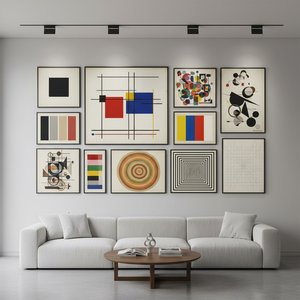 Geometrisk Abstraktion: Top 10 Kunstværker der Definerede Bevægelsen | OriginalUniqueArt.dkOplev de 10 mest ikoniske værker inden for geometrisk abstraktion! Fra Kandinsky til Mondrian – lær historierne bag disse banebrydende kuns…