Portræt af Bartolomé Esteban Murillo

De 100 mest berømte Bartolomé Esteban Murillo-malerier, hver og en unik

Opdateret oktober 2026 · rangeret efter vores popularitetsscore (søgninger, besøg og ordrer for hvert værk) · 454 værker af Bartolomé Esteban Murillo i vores katalog

Kort sagt

Soult's Udenlignelige Undfangelse (1678) er det maleri af Bartolomé Esteban Murillo, der vækker mest opsigt; originalen findes på Museo del Prado, Madrid. Derefter falder blikket på To børn der spiser en melon og vindruer (1646) og To kvinder ved et vindue (1660). Blandt de 454 værker af Bartolomé Esteban Murillo i vores katalog er disse 100 de mest berømte, hver især et unikt originalværk præsenteret med sit årstal, sit museum og årsagen til dets tidløse betydning.

1617 – 1682, Sevilla Barok Flest værker: Museo del Prado

Top 10 malerier af Bartolomé Esteban Murillo, set gennem galleriets øjne

1
Soult's Udenlignelige Undfangelse (1678) af Bartolomé Esteban Murillo

Soult's Udenlignelige Undfangelse

1678 · Olie på lærred · Museo del Prado, Madrid

Den Museo del Prado's berømte ”Immaculate Conception of Soult”, malet i 1678 af den ekstraordinære spanske kunstner Bartolomé Esteban Murillo, står som et højdepunkt inden for barokkunst. Med sine imponerende dimensioner på 274 x 190 cm transcenderer dette olie på lærred-værk simpel religiøs ikonografi; det er en dyb meditation over tro, renhed og guddommelig nåde, født ud af et turbulent historisk øjeblik. Maleriet blev bestilt af Justino de Neve, den…

2
To børn der spiser en melon og vindruer (1646) af Bartolomé Esteban Murillo

To børn der spiser en melon og vindruer

1646 · Olie på lærred · Bavarian State Painting Collections, München

To unge drenge sidder tæt sammen på den støvede jord, fortabt i den enkle, taktile nydelse ved deres måltid. Luften føles tung af varmen fra en eftermiddag i Sevilla, mens de deler det, som jorden har givet dem. Den ene dreng rækker ud efter en klase vindruer, hvor frugten måske føles kølig mod hans hud, mens hans ledsager koncentrerer sig om en skive melon. De holder deres tallerkener med en…

3
To kvinder ved et vindue (1660) af Bartolomé Esteban Murillo

To kvinder ved et vindue

1660 · Olie på lærred · National Gallery of Art, Washington

Bartolomé Esteban Murillo's To kvinder ved et vindue, malet i 1660, er mere end blot en afbildning af to kvinder; det er en rørende meditation over skønhed, uskyld og det stille drama i hverdagens liv i det 17. århundredes Spanien. Værket blev skabt i en periode med intens religiøs glød – en tid, hvor Murillos karakteristiske stil begyndte at tage form – og denne vertikale komposition tilbyder et sjældent indblik…

4
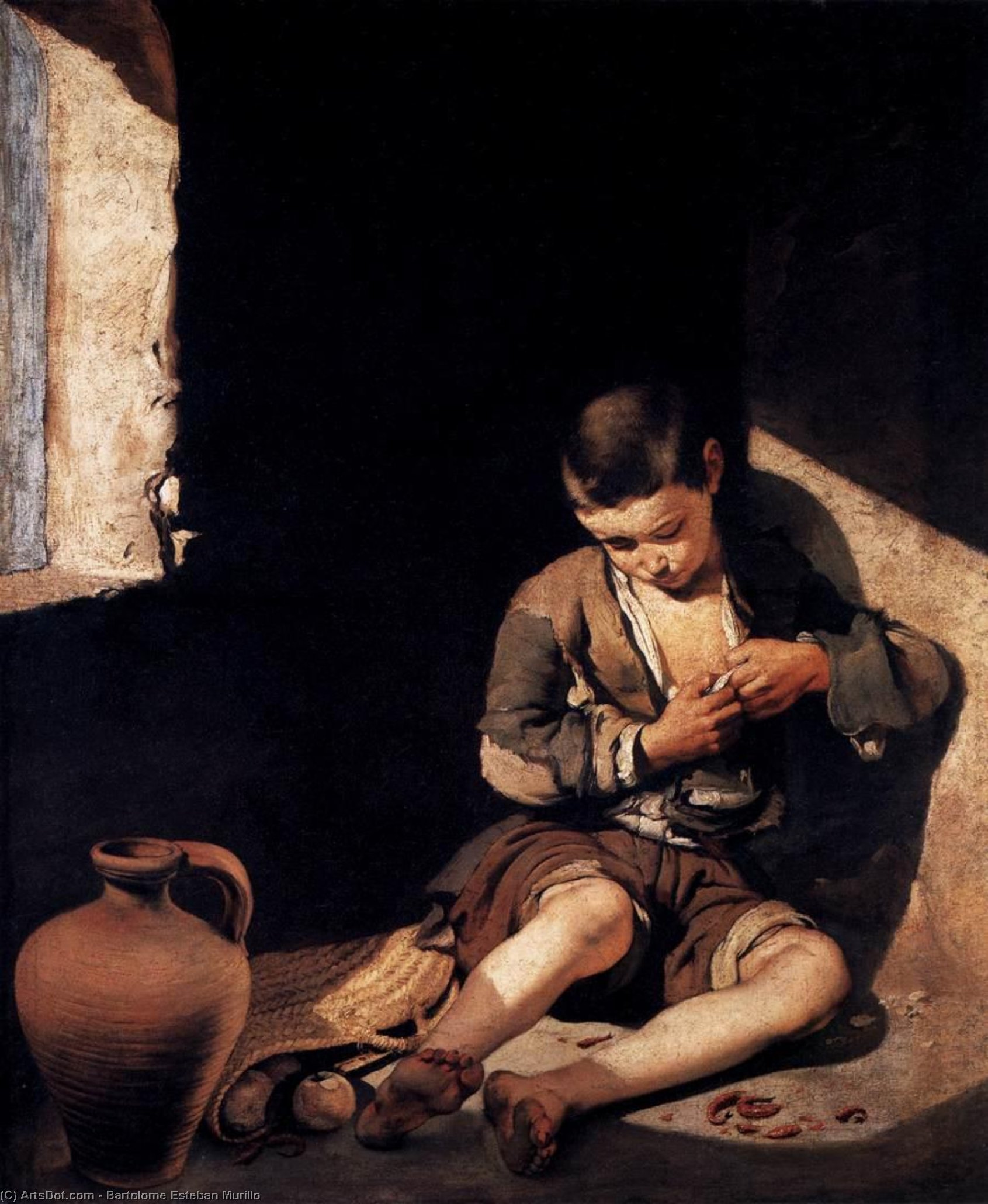
The Young Beggar (1650) af Bartolomé Esteban Murillo

The Young Beggar

1650 · Oil On Canvas

A single light source falls from above and to the right, striking the skin of a young boy seated on the ground. He occupies a dimly lit interior, his small frame positioned slightly off-center within the frame. His hands are occupied with a quiet, focused task: searching for and removing lice from his clothing. This act of self-grooming occurs amidst the debris of survival. To his left, a large earthenware…

5
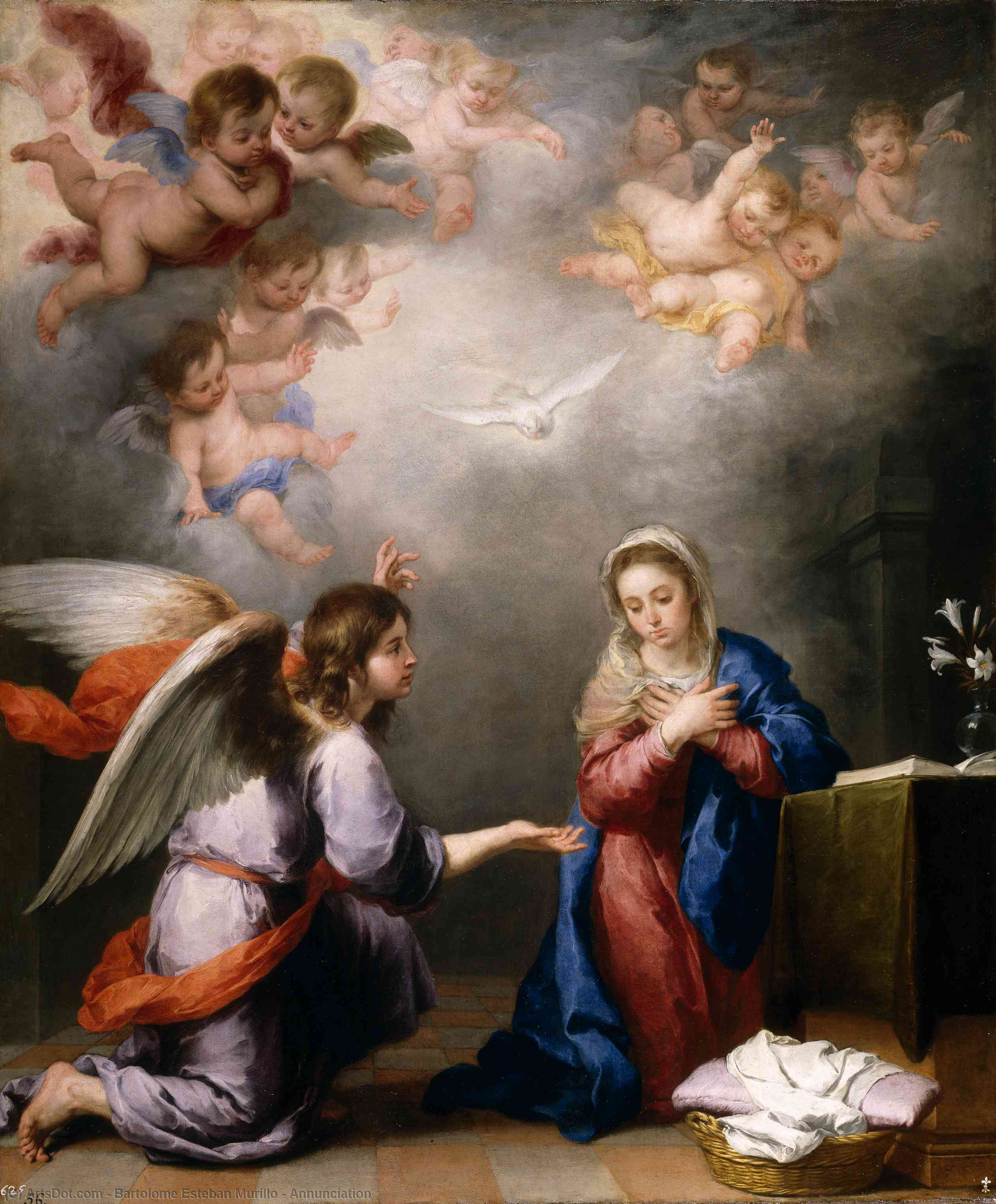
Annunciation af Bartolomé Esteban Murillo

Annunciation

Oil On Canvas · Hermitage Museum, Sankt Petersborg

The scene captures the moment Archangel Gabriel announces to Mary her role as the mother of Jesus Christ. Within a modestly furnished room, Mary kneels at a prie-dieu, her eyes cast downwards in a posture of profound reverence. A basket of handiwork sits aside, suggesting a quiet interruption of her daily labors. Above, the angel Gabriel appears with delicate wings and an expression of gentle authority, gesturing toward the dove…

6
The Baptism of Christ (1655) af Bartolomé Esteban Murillo

The Baptism of Christ

1655 · Oil On Canvas · Gemäldegalerie, Berlin

To stand before this depiction of The Baptism of Christ is to be transported across the centuries, into the very crucible of Christian narrative. Bartolomé Esteban Murillo masterfully captures not merely an event, but a profound spiritual transition. The scene unfolds along the banks of the Jordan River, centering on the intimate yet monumental encounter between Jesus and John the Baptist. Observe the composition: Jesus stands with a quiet dignity…

7
the immaculate conception af Bartolomé Esteban Murillo

the immaculate conception

Oil On Canvas · Detroit Institute of Arts, Detroit

Bartolomé Esteban Murillo's "The Immaculate Conception" isn’t merely a painting; it’s an immersion into the heart of 17th-century Spanish faith and artistic innovation. Completed around 1680, this oil on canvas masterpiece, currently residing in the Museo de Arte de Ponce in Puerto Rico, transcends its religious subject matter to become a profound meditation on grace, purity, and divine presence. Murillo, born in Seville amidst personal tragedy – the early loss…

8
The last supper af Bartolomé Esteban Murillo

The last supper

Oil On Canvas

To stand before a depiction of The Last Supper by Bartolomé Esteban Murillo is to step directly into a moment suspended between profound intimacy and impending tragedy. This masterpiece, steeped in the rich tradition of 17th-century Spanish Baroque art, does more than merely illustrate a biblical narrative; it captures the very breath held in the space before destiny changes everything. Murillo’s handling of this iconic scene is nothing short of…

9
Saint Francis Receiving the Stigmata (1650) af Bartolomé Esteban Murillo

Saint Francis Receiving the Stigmata

1650 · Oil On Canvas · English Heritage, London

To gaze upon Bartolomé Esteban Murillo's depiction of Saint Francis Receiving the Stigmata is to step directly into the heart of Spanish Baroque piety. This masterful oil painting, executed in 1650, transcends mere portraiture; it is a profound meditation on sacrifice, divine connection, and spiritual ecstasy. The central figure, Saint Francis of Assisi, is captured in a moment of breathtaking vulnerability and ultimate grace. His outstretched arms seem not merely…

10
Immaculate Conception (1680) af Bartolomé Esteban Murillo

Immaculate Conception

1680 · Oil On Canvas · Museo de Arte de Ponce, Ponce

In the heart of the Spanish Baroque, Bartolomé Esteban Murillo captured a moment of profound spiritual transcendence in his masterpiece, The Immaculate Conception. Created around 1680, this oil on canvas serves as a luminous meditation on purity and devotion. The painting is characterized by its ethereal atmosphere, where a radiant glow emanates from behind the Virgin Mary, bathing her in a light that seems to defy earthly constraints. Through his…

Bartolomé Esteban Murillos berømte malerier, nummer 11 til 100

11Virgin glorious af Bartolomé Esteban MurilloVirgin glorious 12Vision of St Antony of Padua (1670) af Bartolomé Esteban MurilloVision of St Antony of Padua1670 · Hermitage Museum 13Den fortabte søns hjemkomst (1670) af Bartolomé Esteban MurilloDen fortabte søns hjemkomst1670 · National Gallery of Art 14The Apparition of the Virgin to Saint Ildefonso (1655) af Bartolomé Esteban MurilloThe Apparition of the Virgin to Saint Ildefonso1655 · Museo del Prado 15The Immaculate Conception (1665) af Bartolomé Esteban MurilloThe Immaculate Conception1665 · National Gallery of Victoria 16Baptism of Christ (1665) af Bartolomé Esteban MurilloBaptism of Christ1665 17An Old Woman Holding a Distaff and Spindle (1660) af Bartolomé Esteban MurilloAn Old Woman Holding a Distaff and Spindle1660 18The Annunciation (1670) af Bartolomé Esteban MurilloThe Annunciation1670 · Wallace Collection 19The Immaculate Conception (1670) af Bartolomé Esteban MurilloThe Immaculate Conception1670 · Dayton Art Institute 20The Virgin of the Immaculate Conception (1670) af Bartolomé Esteban MurilloThe Virgin of the Immaculate Conception1670 · Walters Art Museum 21Mary and Child with Angels Playing Music (1675) af Bartolomé Esteban MurilloMary and Child with Angels Playing Music1675 22A Girl and her Duenna (1670) af Bartolomé Esteban MurilloA Girl and her Duenna1670 23Baking of Flat Cakes (1650) af Bartolomé Esteban MurilloBaking of Flat Cakes1650 · Hermitage Museum 24A Spanish Boy with a Dog (1665) af Bartolomé Esteban MurilloA Spanish Boy with a Dog1665 25The Virgin and Child with St. Rosalina (1670) af Bartolomé Esteban MurilloThe Virgin and Child with St. Rosalina1670 · Thyssen-Bornemisza Museum 26The Two Trinities (1682) af Bartolomé Esteban MurilloThe Two Trinities1682 27The Heavenly and Earthly Trinities (The Pedroso Murillo) (1675) af Bartolomé Esteban MurilloThe Heavenly and Earthly Trinities (The Pedroso Murillo)1675 28The Immaculate Conception (1665) af Bartolomé Esteban MurilloThe Immaculate Conception1665 29Adoration of the Shepherds (1668) af Bartolomé Esteban MurilloAdoration of the Shepherds1668 30Madonna in the Clouds (1660) af Bartolomé Esteban MurilloMadonna in the Clouds1660 31The Holy Family with the Infant Baptist (1670) af Bartolomé Esteban MurilloThe Holy Family with the Infant Baptist1670 · Wallace Collection 32Virgin and Child in Glory (1673) af Bartolomé Esteban MurilloVirgin and Child in Glory1673 · Walker Art Gallery 33Self portrait (1673) af Bartolomé Esteban MurilloSelf portrait1673 34A Knight of Alcántara or Calatrava (1650) af Bartolomé Esteban MurilloA Knight of Alcántara or Calatrava1650 · Metropolitan Museum of Art 35The Penintent Saint Jerome (1650) af Bartolomé Esteban MurilloThe Penintent Saint Jerome1650 · Museo del Prado 36Le jeune mendiant af Bartolomé Esteban MurilloLe jeune mendiantLouvre 37An Old Woman Spinning. (1650) af Bartolomé Esteban MurilloAn Old Woman Spinning.1650 · Museo del Prado 38The Immaculate Conception of the Virgin af Bartolomé Esteban MurilloThe Immaculate Conception of the VirginNational Gallery 39Saint Thomas of Villanueva Healing a Lame Man (Sketch) (1675) af Bartolomé Esteban MurilloSaint Thomas of Villanueva Healing a Lame Man (Sketch)1675 · Bavarian State Painting Collections 40The Vision of Saint Francis of Paola (1670) af Bartolomé Esteban MurilloThe Vision of Saint Francis of Paola1670 · J. Paul Getty Museum 41Le Christ au jardin des oliviers af Bartolomé Esteban MurilloLe Christ au jardin des oliviersLouvre 42San Agustín entre Cristo y la Virgen af Bartolomé Esteban MurilloSan Agustín entre Cristo y la VirgenMuseo del Prado 43Sleeping Christ Child with Angels (1650) af Bartolomé Esteban MurilloSleeping Christ Child with Angels1650 · Bavarian State Painting Collections 44L'apparition de l'Immaculée conception à six personnages af Bartolomé Esteban MurilloL'apparition de l'Immaculée conception à six personnagesLouvre 45Death of the Inquisitor Pedro de Arbues (1664) af Bartolomé Esteban MurilloDeath of the Inquisitor Pedro de Arbues1664 · Hermitage Museum 46Adoration of the Magi (1660) af Bartolomé Esteban MurilloAdoration of the Magi1660 · Toledo Museum of Art 47Two boys playing dice (1670) af Bartolomé Esteban MurilloTwo boys playing dice1670 · Academy of Fine Arts Vienna 48Self-Portrait (1650) af Bartolomé Esteban MurilloSelf-Portrait1650 · The Frick Collection 49Archangel Michael plunges the devil into the abyss (1666) af Bartolomé Esteban MurilloArchangel Michael plunges the devil into the abyss1666 · Kunsthistorisches Museum 50The Angels' Kitchen (1646) af Bartolomé Esteban MurilloThe Angels' Kitchen1646 51Saint Peter in prayer (1662) af Bartolomé Esteban MurilloSaint Peter in prayer1662 · Nationalmuseet i Warszawa 52The Adoration of the Magi (1670) af Bartolomé Esteban MurilloThe Adoration of the Magi1670 · Dulwich Picture Gallery 53Saint Anne teaching the Virgin to read (1655) af Bartolomé Esteban MurilloSaint Anne teaching the Virgin to read1655 · Museo del Prado 54St. Justa and St. Rufina (1665) af Bartolomé Esteban MurilloSt. Justa and St. Rufina1665 · National Museum of Western Art 55The Flight into Egypt (1650) af Bartolomé Esteban MurilloThe Flight into Egypt1650 · Detroit Institute of Arts 56Four Figures on a Step (1655) af Bartolomé Esteban MurilloFour Figures on a Step1655 · Kimbell Art Museum 57The Prodigal Son taking leave of his Home (1660) af Bartolomé Esteban MurilloThe Prodigal Son taking leave of his Home1660 · Museo del Prado 58Madonna and Child (1638) af Bartolomé Esteban MurilloMadonna and Child1638 59The Good Shepherd (1678) af Bartolomé Esteban MurilloThe Good Shepherd1678 · Städel Museum 60The Holy Family with the Little Bird (1650) af Bartolomé Esteban MurilloThe Holy Family with the Little Bird1650 · Museo del Prado 61Christ Bearing the Cross (1670) af Bartolomé Esteban MurilloChrist Bearing the Cross1670 · Philadelphia Museum of Art 62Two Franciscan Monks (1646) af Bartolomé Esteban MurilloTwo Franciscan Monks1646 · National Gallery of Canada 63The Virgin and Child with Saints (1655) af Bartolomé Esteban MurilloThe Virgin and Child with Saints1655 · Wallace Collection 64Laughing Shepherd Boy (1650) af Bartolomé Esteban MurilloLaughing Shepherd Boy1650 · Bavarian State Painting Collections 65The Prodigal Son squandering his Inheritance (1660) af Bartolomé Esteban MurilloThe Prodigal Son squandering his Inheritance1660 · Museo del Prado 66The Annunciation (1680) af Bartolomé Esteban MurilloThe Annunciation1680 · Rijksmuseum 67Portrait of a Nobleman (1670) af Bartolomé Esteban MurilloPortrait of a Nobleman1670 · National Gallery of Canada 68Saint Thomas of Villanueva Giving Alms to the Poor (1665) af Bartolomé Esteban MurilloSaint Thomas of Villanueva Giving Alms to the Poor1665 · Norton Simon Museum 69The Holy Family (1640) af Bartolomé Esteban MurilloThe Holy Family1640 · National Gallery of Ireland 70Sevillian Beggar Boys (Grape and Melon Eaters) (1650) af Bartolomé Esteban MurilloSevillian Beggar Boys (Grape and Melon Eaters)1650 · Bavarian State Painting Collections 71Infant Sleeping (1660) af Bartolomé Esteban MurilloInfant Sleeping1660 72Saint Mary Magdalene Renouncing the Worldly Life (1650) af Bartolomé Esteban MurilloSaint Mary Magdalene Renouncing the Worldly Life1650 73The Prodigal Son Feeding Swine (1660) af Bartolomé Esteban MurilloThe Prodigal Son Feeding Swine1660 · National Gallery of Ireland 74The Prodigal Son Driven Out (1660) af Bartolomé Esteban MurilloThe Prodigal Son Driven Out1660 · National Gallery of Ireland 75The Departure of the Prodigal Son (1660) af Bartolomé Esteban MurilloThe Departure of the Prodigal Son1660 · National Gallery of Ireland 76The Prodigal Son Receiving his Portion (1660) af Bartolomé Esteban MurilloThe Prodigal Son Receiving his Portion1660 · National Gallery of Ireland 77St. John the Baptist with the Scribes and Pharisees (1655) af Bartolomé Esteban MurilloSt. John the Baptist with the Scribes and Pharisees1655 · Fitzwilliam Museum 78Two Angels (1650) af Bartolomé Esteban MurilloTwo Angels1650 · Musée d'Arts de Nantes 79The Christ Good Pastor (private collection) (1660) af Bartolomé Esteban MurilloThe Christ Good Pastor (private collection)1660 80Virgin and Child, with rosary (1655) af Bartolomé Esteban MurilloVirgin and Child, with rosary1655 81Saint Lawrence (1660) af Bartolomé Esteban MurilloSaint Lawrence1660 82Adoration of the Sheperds (1655) af Bartolomé Esteban MurilloAdoration of the Sheperds1655 · Gemäldegalerie 83S. Augustin washes Christ's Feet (1650) af Bartolomé Esteban MurilloS. Augustin washes Christ's Feet1650 84The Infant Christ as the Good Shepherd (1650) af Bartolomé Esteban MurilloThe Infant Christ as the Good Shepherd1650 · The Hunterian Museum and Art Gallery 85Santa Rufina (1665) af Bartolomé Esteban MurilloSanta Rufina1665 86Laban Searching for his Stolen Household Gods (1665) af Bartolomé Esteban MurilloLaban Searching for his Stolen Household Gods1665 · Cleveland Museum of Art 87Virgin and Child in Glory (1500) af Bartolomé Esteban MurilloVirgin and Child in Glory1500 · Walker Art Gallery 88The Immaculate Conception (1670) af Bartolomé Esteban MurilloThe Immaculate Conception1670 89A Putto-Angel holding something red: a fragment (1664) af Bartolomé Esteban MurilloA Putto-Angel holding something red: a fragment1664 · Kingston Lacy 90The Nativity (1665) af Bartolomé Esteban MurilloThe Nativity1665 · Museum of Fine Arts, Houston 91The Young Christ as the Good Shepherd (1662) af Bartolomé Esteban MurilloThe Young Christ as the Good Shepherd1662 · Museum of Fine Arts 92Faith (1664) af Bartolomé Esteban MurilloFaith1664 93Dolorosa (1665) af Bartolomé Esteban MurilloDolorosa1665 94The Vision of Saint Anthony of Padua (1670) af Bartolomé Esteban MurilloThe Vision of Saint Anthony of Padua1670 · Birmingham Museum and Art Gallery 95The Infant Saint John Playing with a Lamb (1675) af Bartolomé Esteban MurilloThe Infant Saint John Playing with a Lamb1675 · National Gallery of Ireland 96Portrait of a gentleman, aged 34, presumably a member of the Ostigliani family (1677) af Bartolomé Esteban MurilloPortrait of a gentleman, aged 34, presumably a member of the Ostigliani family1677 97The Immaculate Conception (1680) af Bartolomé Esteban MurilloThe Immaculate Conception1680 · Cleveland Museum of Art 98The Virgin and Child (1680) af Bartolomé Esteban MurilloThe Virgin and Child1680 · Woburn Abbey 99Angel Raphael with a fish (1680) af Bartolomé Esteban MurilloAngel Raphael with a fish1680 100Virgin and Child (1680) af Bartolomé Esteban MurilloVirgin and Child1680

Bartolomé Esteban Murillos berømte malerier, periode for periode

Motiverne, der fangede Bartolomé Esteban Murillos blik

De fire motiver, der optræder hyppigst i disse originaler, hver med sit fineste eksempel.

De museer, der udstiller Bartolomé Esteban Murillos originalværker

De 8 museer, der rummer flest af malerierne på denne side.

Museum By Værker af Bartolomé Esteban Murillo Malerier fra denne liste
Museo del Prado, MadridMuseo del Prado Madrid 41 Soult's Udenlignelige Undfangelse, The Apparition of the Virgin to Saint Ildefonso, The Penintent Saint Jerome
National Gallery of Ireland, DublinNational Gallery of Ireland Dublin 10 The Holy Family, The Prodigal Son Feeding Swine, The Prodigal Son Driven Out
Bavarian State Painting Collections, MünchenBavarian State Painting Collections München 11 To børn der spiser en melon og vindruer, Saint Thomas of Villanueva Healing a Lame Man (Sketch), Sleeping Christ Child with Angels
Hermitage Museum, Sankt PetersborgHermitage Museum Sankt Petersborg 12 Annunciation, Vision of St Antony of Padua, Baking of Flat Cakes
Louvre, ParisLouvre Paris 10 Le jeune mendiant, Le Christ au jardin des oliviers, L'apparition de l'Immaculée conception à six personnages
Wallace Collection, LondonWallace Collection London 9 The Annunciation, The Holy Family with the Infant Baptist, The Virgin and Child with Saints
Gemäldegalerie, BerlinGemäldegalerie Berlin 4 The Baptism of Christ, Adoration of the Sheperds
National Gallery of Canada, OttawaNational Gallery of Canada Ottawa 3 Two Franciscan Monks, Portrait of a Nobleman

Bartolomé Esteban Murillo gennem årtierne: ét unikt originalværk til hver

Værker per årti

Vælg et årti for at se det originale værk, der definerer det.

Bartolomé Esteban Murillos malerier: spørgsmål til galleriet

Hvad er det mest berømte værk af Bartolomé Esteban Murillo?Vis svaret

Soult's Udenlignelige Undfangelse (1678), Museo del Prado, Madrid. Derefter følger To børn der spiser en melon og vindruer (1646) og To kvinder ved et vindue (1660).

Hvilken alder havde Bartolomé Esteban Murillo, da Soult's Udenlignelige Undfangelse blev skabt?Vis svaret

61 år gammel: Soult's Udenlignelige Undfangelse er fra 1678, og Bartolomé Esteban Murillo blev født i 1617.

Hvilke ti malerier af Bartolomé Esteban Murillo er de mest berømte?Vis svaret

Soult's Udenlignelige Undfangelse, To børn der spiser en melon og vindruer, To kvinder ved et vindue, The Young Beggar, Annunciation, The Baptism of Christ, the immaculate conception, The last supper, Saint Francis Receiving the Stigmata og Immaculate Conception. Ranglisten ovenfor viser det enkelte værks årstal og museum.

Hvor mange værker af Bartolomé Esteban Murillo er kendt?Vis svaret

Vores katalog indeholder 454 værker af Bartolomé Esteban Murillo, dateret fra 1638 til 1682.

Hvor kan de mest berømte originaler af Bartolomé Esteban Murillo ses?Vis svaret

Primært i Museo del Prado (Madrid), National Gallery of Ireland (Dublin) og Bavarian State Painting Collections (München). Museumslisten ovenfor viser dem alle.

I hvilken periode skabte Bartolomé Esteban Murillo sine mest kendte malerier?Vis svaret

I 1660s: 30 af de 100 værker på denne side blev skabt dengang, herunder To kvinder ved et vindue.

Hvilket berømt maleri af Bartolomé Esteban Murillo er det tidligste, og hvilket er det seneste?Vis svaret

På denne side er det tidligste Madonna and Child (1638) og det seneste The Two Trinities (1682).

Hvilke motiver foretrak Bartolomé Esteban Murillo?Vis svaret

Clouds (22), Woman (22) og Man (21), fordelt på de 100 værker på denne side.

Hvilke materialer brugte Bartolomé Esteban Murillo mest til sine malerier?Vis svaret

Oil On Canvas, for 79 af de 100 værker på denne side.

Hvilken stilart tilhører værkerne fra Bartolomé Esteban Murillo?Vis svaret

Barok, baseret på originalerne på denne side.

Hvilke originalværker af Bartolomé Esteban Murillo kan jeg se på Museo del Prado?Vis svaret

Soult's Udenlignelige Undfangelse, The Apparition of the Virgin to Saint Ildefonso og The Penintent Saint Jerome: Museo del Prado, Madrid har 9 af værkerne på denne side.

Bartolomé Esteban Murillo: et portræt af kunstneren

Tidligt liv, familie og uddannelse

Historien om Bartolomé Esteban Murillo begynder i hjertet af Sevilla, hvor han blev født i slutningen af december 1617. Han blev døbt den 1. januar 1618 og trådte ind i en verden, der snart ville stille store krav til ham. Hans far, Gaspar Esteban, arbejdede som barberkirurg, og hans mor var María Pérez Murillo. Livet for den lille dreng var præget af tidligt tab, da han blev forældreløs i sin barndom. Efter forældrenes død blev han taget ind af sin søster, Ana, og hendes mand, Juan Agustín Lagares. Hans stedfar var også barber, og det var inden for denne familiære cirkel, at drengen fandt stabilitet og en følelse af tilhørsforhold.

Den kunstneriske uddannelse for Bartolomé Esteban Murillo begyndte sandsynligvis, da han var mellem tolv og femten år gammel. Han trådte ind i værkstedet hos Juan del Castillo, en maler, der både var hans onkel og hans gudfar. Under Castillos vejledning lærte han sit håndværks grundlæggende færdigheder. Dette tidlige læretid gav det tekniske fundament, som skulle understøtte hans senere udvikling. Han bevægede sig til sidst ud over sin mentors værksted, efter at have erhvervet de nødvendige færdigheder til at følge sin egen vej som en spansk barokmaler.

Teknik og Stil

Murillos penselstrøg gennemgik en forunderlig forvandling i takt med hans modning, hvor han bevægede sig væk fra de tidlige års tunge og dysterrealisme mod en mere idealiseret måde at betragte verden på. I hans ungdom bar værkerne præg af den barokke traditions tyngde og alvor, men han fandt med tiden en metode til at blødgøre disse skarpe kanter. Denne udvikling førte ham mod en lettere og mere atmosfærisk stil i hans senere år. Han besad en særlig evne til at opbygge former gennem en lagdelt tilgang, hvor han benyttede delikate lasurer og subtilt penselarbejde til at skabe en overvældende dybde. Hans farvebrug var særdeles effektivt og skabte lysende effekter, der virkede til at udstråle fra selve lærredets indre.

På trods af kompleksiteten i disse lag var han en utrolig flittig maler, der ofte arbejdede alla prima. Dette gjorde det muligt for ham at færdiggøre malerier i relativt korte perioder, hvilket indfangede en følelse af umiddelbarhed og liv. Han støttede sig ikke til de mørke og tunge paletter, som man så hos nogle af hans samtidige; i stedet fokuserede hans teknik på en mesterlig manipulation af lys og skygge. Denne tilgang gav hans motiver en følelse af varme og tilgængelighed, som gjorde det guddommelige nærværende og det hverdagslige betydningsfuldt.

Værkernes kerne og motivverden

Bartolomé Esteban Murillos pensel søgte ofte mod det åndelige, hvor han fandt et særligt kald i sine skildringer af den ubesmittede undfangelse. Disse religiøse værker blev en central del af hans kunstneriske virke og afspejlede den dybe religiøse hengivenhed, der prægede hans samtid. Samtidig fandt han en dyb mening i ansigterne på de mennesker, der omgav ham, hvilket resulterede i mange malerier af tidens kvinder og børn. Disse motiver blev ofte fremstillet med en varme, der gjorde det hellige nærværende og det hverdagslige betydningsfuldt.

Ud over den religiøse hengivenheds stilhed rettede han sit blik direkte mod Sevillas sociale realiteter. Hans genrebilleder indfangede livene hos dem, der ofte blev overset af historien, såsom blomsterpiger, gadens unge og tiggere. I disse værker veg han ikke tilbage for fattigdommens barske realitet, men nærmede sig i stedet sine motiver med et roligt og empatisk blik. Denne interesse for den menneskelige tilstand er tydelig i værker som The Young Beggar, som findes i Musée du Louvre, og i hans Self-Portrait, som i dag befinder sig i The Frick Collection i New York City.

Hans evne til at balancere det guddommelige med det jordiske gjorde det muligt for ham at bevæge sig ubesværet mellem forskellige verdener. Han kunne med samme oprigtighed, som han brugte til at dokumentere et barns leg eller en tiggers bøn, skildre den himmelske nåde i The Annunciation, som findes i Wallace Collection i London. Denne alsidighed sikrede, at hans kunst talte til både kirkernes høje altre og byens travle, overfyldte gader.

Arv og indflydelse

Murillos rækkevidde strakte sig langt ud over Sevilles gader og satte et uudsletteligt præg på det europæiske kunstlandskab. Hans evne til at forene dyb religiøs hengivenhed med en gennemtrængende menneskelig varme betød, at hans indflydelse krydsede grænser og nåede frem til malere, der først trådte ind på scenen længe efter hans egen tid. Senere kunstnere, herunder Gainsborough og Greuze, anerkendte den betydning, hans lysende stil havde haft for deres egen tilgang til lys og form. Han malede ikke blot til sin egen tids umiddelbare behov; han skabte et visuelt sprog, der fortsat taler til mennesker på tværs af århundreder.

Hans værkers tidløshed er tydelig i den måde, hans malerier bevares og studeres på i dag. Hans lærreder har fundet vej til prestigefyldte museer over hele verden, hvilket sikrer, at hans perspektiv på den menneskelige tilstand forbliver tilgængeligt for eftertiden. Fra hans portræters stille værdighed til det bløde lys i hans religiøse scener, fortsætter hans kunst med at tilbyde noget dybt meningsfuldt til dem, der møder den. Selv århundreder efter hans død i 1682 står hans virke som en kilde til inspiration for dem, der drages mod det punkt, hvor nåde og hverdagslig virkelighed mødes.

Hvor man kan opleve værkerne i dag

For at møde den stille ynde i Bartolomé Esteban Murillos penselstrøg må man rejse gennem Europas store sale og langt derover. I Spanien rummer Museo del Prado i Madrid flere af hans malerier, hvilket tilbyder en direkte forbindelse til den spanske guldalders ånd. For dem, der besøger den sydlige kyst, bevarer Museum of Cádiz i Cádiz også hans unikke aftryk. Disse samlinger gør det muligt for os at se, hvordan hans stil udviklede sig fra ungdommens tunge realisme mod den blødere og mere lysende tilgang, der kom til at definere hans senere år.

Hans rækkevidde strakte sig langt over landegrænserne og efterlod et aftryk i mange af verdens mest betydningsfulde institutioner. I Frankrig huser Louvre i Paris værker, der afspejler hans evne til at indfange menneskelig emotion. Hermitage Museum i Sankt Petersborg vedligeholder ligeledes en samling af hans malerier, mens Wallace Collection i London tilbyder et rum til at iagttage hans detaljerige mesterskab. Selv i USA er hans indflydelse stadig synlig på Timken Museum of Art i San Diego.