Portræt af Richard Brakenburg

De 45 mest berømte Richard Brakenburg-malerier, en galleriselektion

Opdateret november 2026 · rangeret efter vores popularitetsscore (søgninger, besøg og ordrer for hvert værk) · 46 værker af Richard Brakenburg i vores katalog

Kort sagt

Af alle de originale værker, som Richard Brakenburg efterlod, er det mest berømte Tavern Scene (1692), som er en del af samlingen på Nationalmuseum i Stockholm. Lige efter følger Tavern interior with dancing peasants, (1690) og Interior with a company celebrating Twelfth Night, the Feast of Epiphany (1690). Vores katalog indeholder 46 værker af Richard Brakenburg; galleriet har bevaret de 45 værker, som verden beundrer mest, hver vist med sin dato, sit museum og sin historie.

1650 – 1702, Haarlem Dutch golden age Flest værker: Bavarian State Painting Collections

Richard Brakenburgs top 10 malerier: galleriets udvalg

1
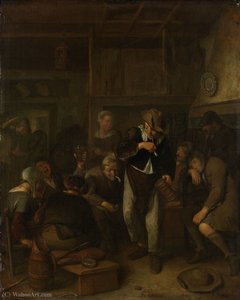
Tavern Scene (1692) af Richard Brakenburg

Tavern Scene

1692 · Oil On Canvas · Nationalmuseum, Stockholm

A single light source, perhaps a guttering candle, strikes the scene from the left. It catches the white fabric of a woman’s garment in the foreground, turning her into a bright anchor amidst a sea of ochre and deep brown. Around her, the tavern breathes with a heavy, crowded energy. Figures lean into one another, their postures shaped by the weight of conversation and the pull of drink. The air…

2
Tavern interior with dancing peasants, (1690) af Richard Brakenburg

Tavern interior with dancing peasants,

1690 · Oil On Canvas · Kunsthistorisches Museum, Wien

Step into the warmth of this 1690 tavern scene, where the air seems thick with the scent of spilled ale and the sound of rhythmic footsteps. Richard Brakenburgh has captured a fleeting moment of celebration among the peasantry, drawing us into a crowded, lively interior. The composition pulls the viewer through a deep perspective, moving from the immediate, tactile details of the foreground into a shadowy, bustling crowd that recedes…

3
Interior with a company celebrating Twelfth Night, the Feast of Epiphany (1690) af Richard Brakenburg

Interior with a company celebrating Twelfth Night, the Feast of Epiphany

1690 · Oil On Canvas · Kunsthistorisches Museum, Wien

In this work, titled Interior with a company celebrating Twelfth Night, the Feast of Epiphany, we find ourselves observing a quiet moment of communal gathering. Painted by Richard Brakenburgh in 1690, the scene captures a specific social ritual. It is a fine example of genre art, focusing on the everyday interactions and festivities of the period. The subject matter centers on a group of people gathered for the Twelfth Night…

4
Réunion dans un cabaret af Richard Brakenburg

Réunion dans un cabaret

Oil On Canvas

The air inside the cabaret feels thick, heavy with the scent of spilled ale and the warmth of too many bodies gathered in a single room. Light flickers from candles, casting long, dancing shadows that stretch across the floor and climb the walls. In the center of this swirling chaos, a group of figures moves in a rhythmic dance, their forms blurring slightly as they spin. Around them, the tavern…

5
Merry Company (1676) af Richard Brakenburg

Merry Company

1676 · Oil · Bavarian State Painting Collections, München

Richard Brakenburgh's Merry Company captures a lively social gathering, likely situated within a tavern or a domestic setting. The scene focuses on a group of people engaged in conversation and leisure, embodying the 'Merry Company' theme prevalent in Dutch Golden Age painting. This subject matter reflects the communal spirit and social interactions of the seventeenth century.

6
The Resurrection of Christ and the Visit of the Women to the Tomb (1676) af Richard Brakenburg

The Resurrection of Christ and the Visit of the Women to the Tomb

1676 · Oil · Bavarian State Painting Collections, München

In The Resurrection of Christ and the Visit of the Women to the Tomb, Richard Brakenburgh orchestrates a scene of intense, sudden movement. The composition follows a dynamic pyramidal structure that draws the eye upward toward a burst of light in the upper center. From this celestial radiance, a luminous, winged angelic figure descends, gesturing toward the earthly events unfolding below. The perspective is set slightly from below, which lends…

7
Drinkers and Musicians in a Cabaret, with Child with a Hoop (1675) af Richard Brakenburg

Drinkers and Musicians in a Cabaret, with Child with a Hoop

1675 · Oil On Canvas

The air in the room feels heavy with the scent of spilled ale and the low hum of conversation. Light spills from a large window on the left, cutting through the dimness to strike the faces of men gathered around a table. They are lost in the rhythm of the moment, some leaning into a drink, others lost to the music. In the corner, a child moves with a hoop,…

8
Monk's Entertainment in a Roman Cloister (1680) af Richard Brakenburg

Monk's Entertainment in a Roman Cloister

1680 · Oil On Canvas · Slovak National Gallery, Bratislava

In Monk's Entertainment in a Roman Cloister, Richard Brakenburgh employs a sophisticated chiaroscuro technique to define the cavernous interior. A single, unseen light source from the left casts strong highlights onto faces and hands, allowing them to emerge from deep, atmospheric shadows. This dramatic interplay of light and dark creates a sense of depth and bustling activity within the crowded space. Through precise perspective, the artist organizes the overlapping clusters…

9
Portrait of a young woman (1683) af Richard Brakenburg

Portrait of a young woman

1683 · Oil

In "Portrait of a young woman" by Richard Brakenburgh, the subject is captured in a three-quarter length pose. She sits centrally, anchored against a dark and atmospheric background that recedes into shadow. The color palette relies on deep blacks and browns, creating a somber foundation for the figure. This darkness pushes the subject forward, making her presence feel immediate and singular.

10
merry party (1686) af Richard Brakenburg

merry party

1686 · Oil · Museum Gouda, Gouda

The air in the room feels heavy with the scent of spilled ale and uninhibited laughter. A dense crowd of figures presses together in a crowded interior, their bodies caught in a moment of boisterous social indulgence. To the right, a large, heavy curtain hangs in deep folds, framing the scene like a stage set for a play that has already reached its climax. Light spills from the upper left,…

Richard Brakenburg-udvalget fortsætter, fra 11 til 45

11A Game of Cards at an Inn (1683) af Richard BrakenburgA Game of Cards at an Inn1683 · Statens Museum for Kunst 12Tavern Interior with a Maidservant and Drinkers (1680) af Richard BrakenburgTavern Interior with a Maidservant and Drinkers1680 · Hallwyl Museum 13Adoration of the Shepherds (1694) af Richard BrakenburgAdoration of the Shepherds1694 · Bavarian State Painting Collections 14An Interior with Figures (1689) af Richard BrakenburgAn Interior with Figures1689 · National Gallery of Ireland 15The Eve of Saint Nicholas (1690) af Richard BrakenburgThe Eve of Saint Nicholas1690 · Frans Hals Museet 16Dance in a Cottage (1699) af Richard BrakenburgDance in a Cottage1699 · Nationalmuseum 17merry party (1691) af Richard Brakenburgmerry party1691 · Frans Hals Museet 18A family on a terrace. (1691) af Richard BrakenburgA family on a terrace.1691 19The Feast of St. Nicholas (1698) af Richard BrakenburgThe Feast of St. Nicholas1698 20Family Scene (1680) af Richard BrakenburgFamily Scene1680 · Fitzwilliam-museet 21May Queen Festival (1700) af Richard BrakenburgMay Queen Festival1700 · Szépművészeti Múzeum 22Dutch Merchants Trading in a Chinese Harbor (1683) af Richard BrakenburgDutch Merchants Trading in a Chinese Harbor1683 · Groninger Museum 23Celebration of a Birth (1683) af Richard BrakenburgCelebration of a Birth1683 24Interior of a Farmhouse (1699) af Richard BrakenburgInterior of a Farmhouse1699 · Fitzwilliam-museet 25Intérieur d'auberge af Richard BrakenburgIntérieur d'aubergeLouvre 26Cabaret Interior af Richard BrakenburgCabaret InteriorPetit Palais 27Jolly Company af Richard BrakenburgJolly CompanyDet Kongelige Museum for Fin Kunst Antwerpen 28Figural scene against architecture af Richard BrakenburgFigural scene against architectureNationalmuseet i Warszawa 29INTERIEUR D'UN ESTAMINET af Richard BrakenburgINTERIEUR D'UN ESTAMINET 30SCENE GALANTE af Richard BrakenburgSCENE GALANTE 31LE LEVER DE LA MARIEE af Richard BrakenburgLE LEVER DE LA MARIEE 32Feast of St Nicholas af Richard BrakenburgFeast of St NicholasSzépművészeti Múzeum 33Family Portrait (1670) af Richard BrakenburgFamily Portrait1670 · The Art Museum RIGA BOURSE 34St Nicholas Eve (1685) af Richard BrakenburgSt Nicholas Eve1685 · Amstelkring Museum 35The doctor's visit. af Richard BrakenburgThe doctor's visit.Museum Boijmans Van Beuningen 36Moines et religieuses en goguette af Richard BrakenburgMoines et religieuses en goguette 37In the tavern. af Richard BrakenburgIn the tavern. 38Family Having Breakfast af Richard BrakenburgFamily Having Breakfast 39Merry company. af Richard BrakenburgMerry company.Museum Boijmans Van Beuningen 40Gallant scene at Palais des Beaux-Arts de Lille. af Richard BrakenburgGallant scene at Palais des Beaux-Arts de Lille. 41Celebration of a Birth af Richard BrakenburgCelebration of a BirthDulwich Picture Gallery 42Merry company af Richard BrakenburgMerry companySzépművészeti Múzeum 43The Feast of St. Nicholas af Richard BrakenburgThe Feast of St. NicholasRijksmuseum 44A Medical Practitioner Taking a Girl's Pulse and Holding a Flask of Her Urine af Richard BrakenburgA Medical Practitioner Taking a Girl's Pulse and Holding a Flask of Her Urine 45Peasant's inn af Richard BrakenburgPeasant's innRijksmuseum

Motiverne, der fangede Richard Brakenburgs blik

De fire motiver, der optræder hyppigst i disse originaler, hver med sit fineste eksempel.

De museer, der udstiller Richard Brakenburgs originalværker

De 8 museer, der rummer flest af malerierne på denne side.

Museum By Værker af Richard Brakenburg Malerier fra denne liste
Bavarian State Painting Collections, MünchenBavarian State Painting Collections München 3 Merry Company, The Resurrection of Christ and the Visit of the Women to the Tomb, Adoration of the Shepherds
Szépművészeti Múzeum, BudapestSzépművészeti Múzeum Budapest 3 May Queen Festival, Feast of St Nicholas, Merry company
Nationalmuseum, StockholmNationalmuseum Stockholm 2 Tavern Scene, Dance in a Cottage
Kunsthistorisches Museum, WienKunsthistorisches Museum Wien 2 Tavern interior with dancing peasants,, Interior with a company celebrating Twelfth Night, the Feast of Epiphany
Frans Hals Museet, HarenFrans Hals Museet Haren 2 The Eve of Saint Nicholas, merry party
Fitzwilliam-museet, CambridgeFitzwilliam-museet Cambridge 2 Family Scene, Interior of a Farmhouse
Museum Boijmans Van Beuningen, RotterdamMuseum Boijmans Van Beuningen Rotterdam 2 The doctor's visit., Merry company.
Rijksmuseum, AmsterdamRijksmuseum Amsterdam 2 The Feast of St. Nicholas, Peasant's inn

Richard Brakenburg årti for årti: det originale værk, der definerer hvert enkelt

Værker per årti

Vælg et årti for at se det originale værk, der definerer det.

Samleres spørgsmål om Richard Brakenburgs malerier

Hvilket værk er Richard Brakenburg mest kendt for?Vis svaret

Tavern Scene (1692), Nationalmuseum, Stockholm. Derefter følger Tavern interior with dancing peasants, (1690) og Interior with a company celebrating Twelfth Night, the Feast of Epiphany (1690).

Hvor gammel var Richard Brakenburg, da Tavern Scene blev skabt?Vis svaret

42 år gammel: Tavern Scene er fra 1692, og Richard Brakenburg blev født i 1650.

Hvad er de ti mest berømte Richard Brakenburg malerier?Vis svaret

Tavern Scene, Tavern interior with dancing peasants,, Interior with a company celebrating Twelfth Night, the Feast of Epiphany, Réunion dans un cabaret, Merry Company, The Resurrection of Christ and the Visit of the Women to the Tomb, Drinkers and Musicians in a Cabaret, with Child with a Hoop, Monk's Entertainment in a Roman Cloister, Portrait of a young woman og merry party. Ranglisten ovenfor viser det enkelte værks årstal og museum.

Hvor mange malerier efterlod Richard Brakenburg?Vis svaret

Vores katalog indeholder 46 værker af Richard Brakenburg, dateret fra 1670 til 1700.

I hvilke museer udstilles Richard Brakenburg's mesterværker?Vis svaret

Primært i Bavarian State Painting Collections (München), Szépművészeti Múzeum (Budapest) og Nationalmuseum (Stockholm). Museumslisten ovenfor viser dem alle.

I hvilke år malede Richard Brakenburg sine mest berømte værker?Vis svaret

I 1680s: 10 af de 45 værker på denne side blev skabt dengang, herunder Monk's Entertainment in a Roman Cloister.

Hvad er de første og de sidste berømte originaler af Richard Brakenburg?Vis svaret

På denne side er det tidligste Family Portrait (1670) og det seneste May Queen Festival (1700).

Hvilke motiver valgte Richard Brakenburg oftest?Vis svaret

People (19), Figures (10) og Table (9), fordelt på de 45 værker på denne side.

Hvilken teknik brugte Richard Brakenburg mest?Vis svaret

Oil On Canvas, for 12 af de 45 værker på denne side.

Hvilken kunstretning tilhører Richard Brakenburg?Vis svaret

Dutch golden age, baseret på originalerne på denne side.

Hvilke værker af Richard Brakenburg udstilles på Bavarian State Painting Collections?Vis svaret

Merry Company, The Resurrection of Christ and the Visit of the Women to the Tomb og Adoration of the Shepherds: Bavarian State Painting Collections, München har 3 af værkerne på denne side.

Richard Brakenburg: liv og værk

Et liv indfanget i den hollandske guldalder

Født i den historiske by Haarlem i Nederlandene, trådte Richard Brakenburg frem som en bemærkelsesværdig skikkelse i den livlige vævning, der udgjorde den hollandske guldalder. Hans liv og kunstneriske virke var dybt forankret i Haarlems kulturelle muld, hvor han udviklede en særlig sans for at indfange de intime og ofte larmende øjeblikke fra det syttende århundredes liv. Mens visse historiske beretninger antyder, at han besad en letsindig poets sjæl, hviler hans sande eftermæle i de penselstrøg, der bragte sin tids sociale hjerteslag til live. Hans rejse gennem kunstverdenen var præget af en stærk forbindelse til hjemlandets lokale traditioner, og hans ophold i Leeuwarden i de senere årtier af det syttende århundrede vidner om en mobilitet, der gjorde det muligt for hans indflydelse at række langt ud over hans fødeby.

Kunstnerisk slægt og indflydelse

Udviklingen af Brakenburgs stil blev formet af de mestre, der både gik forud for ham og levede i hans samtid. Han er anerkendt som elev af Hendrik Mommers, en læremester hvis evne til at male kloge genrebilleder lagde det fundamentale grundlag for Brakenburgs egne undersøgelser af menneskelig interaktion. Alligevel kastede endnu større mestre dybe skygger over hans værk; indflydelsen fra Jan Steen var gennemgribende og ledte ham mod skabelsen af komplekse, fortællende kompositioner. Der findes også en betydelig stilistisk dialog mellem Brakenburg og Bernard Schendel, da begge kunstnere delte en lignende epoke og tilgang til deres motiver. Meget af hans æstetik kan spores tilbage til traditionen fra Adriaen van Ostade, især i hans evne til at skildre festlige sammenkomster og livlige forsamlinger med en følelse af spontan energi.

Mestring af genre og teknik

Brakenburgs samlede værk er berømt for sin evne til at transformere hverdagens banale scener til ekstraordinære vinduer ind i fortiden. Han specialiserede sig i genremalerier, der indfangede kroens livlige hygge, hvor klirren fra drikkeglas og summen af samtale næsten synes at kunne høres gennem lærredet. Hans tekniske overlegenhed kommer tydeligt til udtryk i hans brug af chiaroscuro, hvor han anvender et dramatisk samspil mellem lys og skygge til at modellere figurerne og indgyde sine interiører en følelse af hyggelig mystik. Uanset om han skildrer en travl kro eller en festlig sæsonbestemt fejring, er hans kompositioner kendetegnet ved:

  • Præcis perspektiv: En bemærkelsesværdig evne til at benytte lineærperspektiv til at skabe dybde i overfyldte, dunkelt oplyste rum.
  • Lysende detaljer: Den dygtige anvendelse af lys til at fange kanterne på glasvarer, teksturerne i det rustikke tøj og de vejrbidte overflader på møbler af træ.
  • Narrativ dybde: En genial iscenesættelse af figurer, der leder beskuerens øje gennem en harmonisk, men dog energisk scene.

Arv og historisk betydning

Selvom hans værker ofte bemærkes for deres tekniske lethed og raffinerede finish, ligger Richard Brakenburgs sande betydning i hans rolle som kronikør af det hollandske samfundsvæv. Hans malerier fungerer som tidløse øjebliksbilleder af en velstående æra, der indfanger både værdigheden i familieportrætter og den uhemmede glæde ved de folkelige festligheder. Hans succes var så omfattende, at den sikrede stabilitet for hans familie og gjorde det muligt for hans enke at modtage en livslang årlig ydelse i Friesland efter hans død. I dag står hans bidrag til den hollandske guldalder som noget essentielt, der tilbyder moderne beskuere en fordybende oplevelse af en verden, hvor grænserne mellem den historiske fortid og det nuværende øjeblik på smukkeste vis opløses.