The Painter of Toledo
Cella, Teruel, holds the beginning of a life defined by a refusal to follow a predetermined path. The son of a veteran of the First Carlist War, Ricardo Arredondo Calmache avoids the destiny of a military cadet school. Instead, he seeks the guidance of Matías Moreno. At twelve, the family moves to Toledo under the protection of an uncle who serves as a priest and later a canon. This shift in geography anchors his future work to the Tagus River and the stone quarters of a historic city.
The training matures in Madrid at the Escuela Especial de Pintura, Escultura y Grabado. Under Carlos de Haes, the foundations of realism take hold. A move to Paris introduces him to the circle of Ernest Meissonier and the atmosphere of the Barbizon school. He returns to Spain not merely as a student, but as an artist capable of capturing the light of the landscape through a meticulous lens.
A Life of Restoration and Realism
The transition from student to civic figure occurs alongside his artistic development. After inheriting a fortune from his uncle, Arredondo Calmache refurbishes a dilapidated mansion. His interests extend beyond the easel into the physical fabric of Toledo. As a municipal councillor and a member of the Monument Commission, he oversees the restoration of the Puerta de Bisagra Nueva and contributes to the creation of the Paseo de Cambrón.
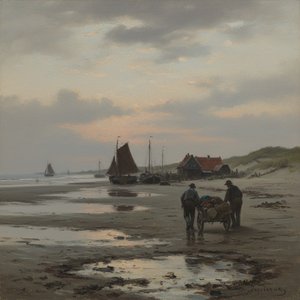
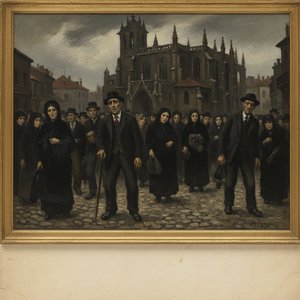
His brush captures the essence of costumbrista scenes and landscapes with a precision that earns him the title "Pintor de Toledo." The work reflects a specific era of Spanish realism, characterized by:
- Landscapes: Detailed views of the Tagus River and the surrounding terrain.
- Genre Scenes: Meticulous depictions of everyday life and local customs.
- Cityscapes: Documentative captures of Toledo's architectural quarters.
Recognition arrives through medals at the National Exhibition of Fine Arts in 1884 and 1895. These honors coincide with a period where his paintings, such as A Garden and Toledo, find their place within the Spanish art scene.
Legacy in Stone and Oil
The end of his life finds him in Madrid, but his presence remains etched into the very streets he helped preserve. His role as a professional archaeologist and his work on the plans for the Rojas Theatre link his artistic eye to the structural survival of Toledo. He moves through the social circles of his time, acting as a guide for visitors, yet his primary contribution remains the visual record of a changing Spain.
His works reside in significant institutions, including the Museo Nacional del Prado and the National Museum of Western Art in Tokyo. Through these canvases, the light of the Tagus and the textures of 19th-century Spanish life endure.
Spørgsmål og svar
Hvordan finder jeg alle værker af Ricardo Arredondo Calmache inden for et bestemt medie?
Siden Alle medier grupperer Ricardo Arredondo Calmaches værker efter teknik.
Hvor kan jeg se Ricardo Arredondo Calmaches værker i kronologisk rækkefølge?
Se en tidslinje over Ricardo Arredondo Calmaches værker på siden Tidslinje for kunstværker, hvor kunstværkerne er sorteret efter dato.
Hvor mange kunstværker af Ricardo Arredondo Calmache er tilgængelige at gennemse?
Du kan gennemse 1 kunstværker værker af Ricardo Arredondo Calmache på siden Alle kunstværker.
Kan jeg gennemse Ricardo Arredondo Calmaches værker efter farvepalette?
Se Ricardo Arredondo Calmaches værker sorteret efter farvepalette på kunstnerens Efter farvepalet side.