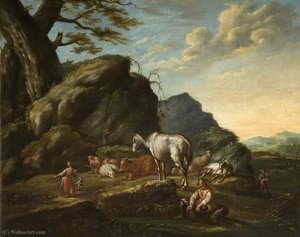
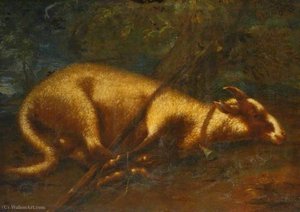
Goats and Flock of Sheep
Goats and Flock of Sheep is an oil painting by Philipp Peter Roos. The artist, who was also known by the moniker Rosa di Tivoli, produced this work about 1681. He was a German Baroque painter born in Sankt Goar, Germany.
Kort sagt
Af alle de originale værker, som Philipp Peter Roos efterlod, er det mest berømte Goats and Flock of Sheep (1681), som er en del af samlingen på Bavarian State Painting Collections i München. Lige efter følger Piece of Livestock (1681) og Landscape with Cattle and Shepherd (1681). Vores katalog indeholder 93 værker af Philipp Peter Roos; galleriet har bevaret de 92 værker, som verden beundrer mest, hver vist med sin dato, sit museum og sin historie.
Goats and Flock of Sheep is an oil painting by Philipp Peter Roos. The artist, who was also known by the moniker Rosa di Tivoli, produced this work about 1681. He was a German Baroque painter born in Sankt Goar, Germany.
Piece of Livestock is an oil painting by Philipp Peter Roos, executed in 1681. The work originates from the Baroque period, a time when the artist was establishing his presence within the Italianate landscape tradition.
Landscape with Cattle and Shepherd is a work by the German Baroque painter Philipp Peter Roos. Created about 1681, the painting reflects the artist's specialized focus on pastoral scenes and animal subjects. Roos was a significant figure in the development of Italianate landscapes, often characterized by his intimate study of livestock and the natural environment.
In Piece of Livestock, Philipp Peter Roos organizes a pastoral scene through a close-up, ground-level perspective that establishes an immediate intimacy with the subjects. The composition is dominated by a large, seated cow positioned slightly to the right of the center. To the left, a smaller lamb or calf provides a sense of scale, while a woman interacts with a dog in the space behind the primary subject. This arrangement…
Resting Flock with Shepherds is an oil painting by the German Baroque artist Philipp Peter Roos. Created about 1681, this work captures a quiet moment within a rugged landscape. The composition focuses on a group of livestock and a shepherd, rendered with a sense of immediate presence that draws the viewer into the scene.
Resting Flock with Shepherds is an oil painting by Philipp Peter Roos. The canvas captures a heavy stillness among livestock and their guardian. This work was created about 1681. It presents a scene of animals and men gathered in a quiet, layered space under a turbulent sky.
In this Baroque-style oil painting, the mythological drama of the Liberation of Io unfolds with a sudden, heavy intensity. Created by Philipp Peter Roos about 1681, the scene captures a moment of profound tension between the divine and the mortal. A massive, powerful bull dominates the foreground, its muscular form rendered with a weight that feels almost tangible. This central figure looms over the landscape, its presence commanding the space…
This oil on canvas painting, dated 1681, presents a monochromatic scene rendered in various shades of gray. In the foreground, a young woman is positioned amidst a group of livestock, including sheep or goats. The composition is a medium shot, placing the human subject and the animals in the immediate front and middle ground. The terrain is undulating, forming rolling hills that recede into a background of hazy mountains and…
Returning Flock with Shepherds is an oil painting by Philipp Peter Roos. Created about 1681, the work captures a quiet moment of pastoral movement. The artist, a German Baroque painter, was born in Sankt Goar. He would later become known by the moniker Rosa di Tivoli.
The scene unfolds in Shepherd with Cow, Sheep and Goats in Italian Mountain Landscape, a work that captures a quiet moment of pastoral life. This painting, created about 1680, brings together a shepherd and his diverse herd amidst a rugged, mountainous setting. The figures and animals exist within a landscape that feels both immediate and deeply rooted in the natural world.
De fire motiver, der optræder hyppigst i disse originaler, hver med sit fineste eksempel.
De 8 museer, der rummer flest af malerierne på denne side.
| Museum | By | Værker af Philipp Peter Roos | Malerier fra denne liste |
|---|---|---|---|
| München | 15 | Goats and Flock of Sheep, Piece of Livestock, Landscape with Cattle and Shepherd | |
| København | 5 | Cattle Piece, Landscape with a Bull, Sheep and Goats, A Shepherd with his Herd | |
| Buenos Aires | 4 | Landscape with shepherd and animals, Landscape with figures and animals, Shepherd and animals in a landscape | |
| Bratislava | 3 | Goat Herd with a Goatherd, Shepherd's Idyl in a Romantic Landscape with Ruins, Herd by an Ancient Well | |
| Prag | 3 | Ravine with a Stream, a Shepherd and His Herd, Horse and Goats Grazing, Shepherd with a Herd of Sheep and Goats | |
| Wien | 3 | Herd with Sleeping Shepherds, Rider Meeting, Landscape with Flock of Sheep | |
| Sankt Petersborg | 3 | Landscape with a Grotto, Landscape with a Waterfall, Landscape with a Herd | |
| Stockholm | 3 | Dead Hare, Landskap med hjord, A Goat Resting |
Vælg et årti for at se det originale værk, der definerer det.
This large-scale oil painting, dated 1669, presents a crowded, maximalist composition of diverse animal species. The arrangement is packed, with various animals overlapping to create a sense of density and movement. The color palette relies on deep, earthy tones, including rich browns, blacks, and dark ochres. These dark shades are interrupted by specific highlights of white and cream, alongside splashes of red from a rooster and parrots. The lighting follows…
Goats and Flock of Sheep is an oil painting by Philipp Peter Roos. The artist, who was also known by the moniker Rosa di Tivoli, produced this work about 1681. He was a German Baroque painter born in Sankt Goar, Germany.
A heavy, dark-colored cow anchors the center of this scene, its presence felt in the weight of its silhouette. To the left, two goats rest upon the ground, one a pale contrast of white and light tan against the shadows. A man sits nearby, leaning back in a moment of stillness, his gaze directed toward the animals or perhaps the viewer. The air in the enclosure feels thick and dim,…
In this work, titled Shepherd's Idyl in a Romantic Landscape with Ruins, the artist Philipp Peter Roos presents a quiet moment of rural existence. Created about 1700, the painting captures a shepherd tending to his flock amidst a landscape of rolling hills and weathered stone structures. There is a sense of stillness in the way the figures and animals occupy the space, suggesting a life governed by the rhythms of…
Goats and Flock of Sheep (1681), Bavarian State Painting Collections, München. Derefter følger Piece of Livestock (1681) og Landscape with Cattle and Shepherd (1681).
24 år gammel: Goats and Flock of Sheep er fra 1681, og Philipp Peter Roos blev født i 1657.
Goats and Flock of Sheep, Piece of Livestock, Landscape with Cattle and Shepherd, Piece of Livestock, Resting Flock with Shepherds, Resting Flock with Shepherds, Liberation of Io, Piece of Cattle, Returning Flock with Shepherds og Shepherd with Cow, Sheep and Goats in Italian Mountain Landscape. Ranglisten ovenfor viser det enkelte værks årstal og museum.
Vores katalog indeholder 93 værker af Philipp Peter Roos, dateret fra 1669 til 1700.
Primært i Bavarian State Painting Collections (München), Statens Museum for Kunst (København) og National Museum of Fine Arts (Buenos Aires). Museumslisten ovenfor viser dem alle.
I 1680s: 21 af de 92 værker på denne side blev skabt dengang, herunder Goats and Flock of Sheep.
På denne side er det tidligste Various animals gathered before Noah's Ark (1669) og det seneste Shepherd's Idyl in a Romantic Landscape with Ruins (1700).
Landscape (33), Animals (29) og Goats (19), fordelt på de 92 værker på denne side.
Oil On Canvas, for 18 af de 92 værker på denne side.
Baroque, baseret på originalerne på denne side.
Goats and Flock of Sheep, Piece of Livestock og Landscape with Cattle and Shepherd: Bavarian State Painting Collections, München har 15 af værkerne på denne side.
I den italienske baroks gyldne lys er der få navne, der fremkalder landdistrikternes pastorale ro så stærkt som Philipp Peter Roos. Kendt i historien under sit stemningsfulde øgenavn, Rosa di Tivoli, transformerede denne tyskfødte mester landskabsgenren gennem en dyb, næsten instinktiv forbindelse til den naturlige verden. Født i 1655 i Rhinlandet – nærmere bestemt nær Sankt Goar – var Roos skæbnebestemt til penslen fra sine tidligste år. Han var søn af Johann Heinrich Roos, en respekteret landskabsmaler, der gav ham de grundlæggende lektioner i tonal harmoni og kompositionel balance, som senere skulle definere kunstnerens modne stil. Dette tidlige læretid handlede ikke blot om teknik; det var en fordybelse i en måde at se verden på gennem lysets, skyggernes og jordens stille værdighed.
Roos' livsbane ændrede sig drastisk i 1677, et vendepunkt drevet af den gavmilde landgreve Karl 1. af Hessen-Kassel. Da landgreven så det spirende talent i den unge maler, sikrede han de økonomiske midler, der gjorde det muligt for Roos at påbegynde en transformativ rejse til Rom. Denne vandring fra de germanske traditioner til hjertet af den italienske barok tillod Roos at opsuge den levende energi fra romersk kunst. Det var her, han søgte vejledning hos den berømte Giacinto Brandi, hvis indflydelse hjalp med at forfine Roos' evne til at blande klassisk struktur med en mere spontan, atmosfærisk realisme. Denne periode i Rom var også dybt personlig; det var i disse år, at Roos forelskede sig i Isabella Brandi, hans mentors datter. Deres forening førte ham til sidst til Tivoli, en flytning, der for altid ville knytte hans identitet til det landskab, han elskede så højt.
Det, der virkelig adskiller Rosa di Tivolis værk, er den uovertrufne autenticitet i hans dyremotiver. I modsætning til mange af hans samtidige, der brugte dyr som blot dekorative eftertanker i et landskab, behandlede Roos hvert eneste væsen – fra den massive tyr til den livlige ged – med en portrætmalers ærbødighed. Hans residens i Tivoli var berømt for at være indrettet efter et koncept, der mindede om et levende atelier; han opretholdt en omfattende samling af eksotiske og hjemlige dyr, hvilket effektivt forvandlede hans omgivelser til en kontinuerlig undersøgelse af bevægelse, anatomi og temperament. Denne intime nærhed gjorde det muligt for ham at indfange det subtile ryk i et øre eller den muskuløse spænding hos et dyr under pres, hvilket gav hans lærreder en åndeløs vitalitet.
Hans tekniske mesterskab er tydeligt i den måde, han navigerede i den barokke æstetiks kompleksitet. Mens hans kompositioner ofte trækker på de rolige, atmosfæriske kvaliteter fra den hollandske guldalder, er de gennemsyret af den dramatiske intensitet, der kendetegner den italienske skole. Hans værker udmærker sig ofte ved:
Philipp Peter Rooses historiske betydning ligger i hans evne til at bygge bro mellem de strukturerede landskabstraditioner i Nordeuropa og det følelsesladede, lysfyldte drama i Italien. Han trådte frem på et tidspunkt, hvor tidens videnskabelige undersøgelser begyndte at kræve mere præcise observationer af den naturlige verden, selvom religiøse og mytologiske temaer stadig dominerede den kunstneriske bevidsthed. I hans malerier finder man både naturalismens omhyggelige detaljerigdom og romantikerens poetiske sjæl. Ved at dokumentere den romerske landskabs flora og fauna med en sådan hengivenhed, skabte han et visuelt vidnesbyrd, der handler lige så meget om tidens ånd, som det gør om selve motiverne.
Selvom han gik bort i 1706 og efterlod sig en arv, der er indgraveret i selve jorden i Tivoli, har hans indflydelse bestået. Han forbliver en central skikkelse for enhver, der studerer udviklingen af dyremaleri og det italiensk-inspirerede landskab. Gennem hans øjne ser vi ikke blot en samling af husdyr; vi vidner en dyb fejring af livet i dets mest fundamentale, uforfalskede former. Hans arbejde fortsætter med at resonere som et vidnesbyrd om observationens kraft og den vedvarende skønhed i det pastorale ideal.