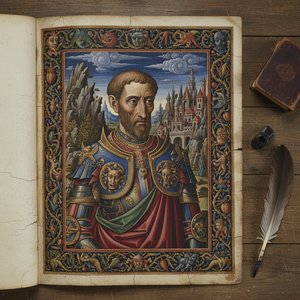
The Legacy of Lorenzo Costa: A Renaissance Visionary
In the vibrant tapestry of the Italian Renaissance, few names evoke the splendor of courtly life and humanist ideals as gracefully as Lorenzo Costa. Born in Ferrara around 1460, Costa emerged from a period of profound artistic transformation, carrying with him the stylistic seeds planted by the masters of the Ferrarese School. His early years were shaped by the intense, almost sculptural energy of artists like Cosimo Tura and Ercole de Roberti, yet Costa possessed a unique sensibility that allowed him to transcend the rigid edges of his predecessors. He moved toward a more lyrical, luminous approach, blending the structural strength of Ferrara with the soft, emotive grace of the Bolognese School, creating a visual language that was both intellectually profound and aesthetically enchanting.
The trajectory of Costa’s career was marked by monumental achievements that redefined the boundaries of religious and secular narrative. His breakthrough arrived in 1483 with the Bentivoglio Altarpiece, a work of such scale and spiritual resonance that it established him as a premier figure in Bologna. This period of his life was characterized by an obsession with light and meticulous detail, where every brushstroke served to elevate the divine through human emotion. As he matured, his artistry became a bridge between the late Quattrocento and the burgeoning High Renaissance, capturing the transition from stiff iconographic traditions to a more fluid, naturalistic portrayal of the human condition.
The Splendor of the Mantuan Court
The zenith of Costa’s professional life was undoubtedly his tenure as the court painter for the Gonzaga family in Mantua. Invited by Marquis Francesco Gonzaga in 1506, Costa found himself immersed in one of the most sophisticated intellectual circles in Europe. This patronage provided him with an unparalleled stage to realize his most ambitious visions, often working alongside the legendary drawings of Andrea Mantegna. In the intimate settings of the Ducal Palace, Costa breathed life into mythological allegories that celebrated both classical antiquity and the prestige of his patrons. His works, such as The Reign of Comus, stand as testaments to a period where art served as the ultimate instrument of political and cultural soft power.
Beyond the grand frescoes that adorned the halls of Mantua, Costa’s influence extended into the very fabric of Renaissance pedagogy. He was not merely a solitary creator but a mentor whose lineage continued through his family; his sons, Ippolito and Girolamo, followed in his footsteps, ensuring that his stylistic nuances were passed down to subsequent generations. His ability to harmonize the mythological with the monumental allowed him to create spaces—like the studiolo of Isabella d'Este—that functioned as immersive environments of beauty and thought. Even as the tides of art history shifted toward the more dramatic Mannerist style, Costa’s legacy remained anchored in that perfect Renaissance equilibrium of clarity, color, and classical poise.
Artistic Contributions and Historical Significance
The enduring significance of Lorenzo Costa lies in his role as a stylistic synthesizer. He successfully navigated the complex demands of diverse patrons, moving seamlessly between the solemnity required for altarpieces and the playful complexity of mythological cycles. His contributions can be summarized through several key artistic pillars:
- Stylistic Synthesis: The seamless integration of Ferrarese precision with Bolognese luminosity.
- Humanist Narrative: A profound ability to imbue religious figures with a palpable, human emotional depth.
- Courtly Innovation: The development of large-scale fresco cycles that transformed ducal residences into epic mythological landscapes.
- Educational Legacy: The establishment of a familial and professional lineage that nurtured the next wave of Italian Renaissance painters.
Today, when we gaze upon the remnants of his frescoes or the delicate compositions of his altarpieces, we see more than just pigment on plaster; we witness the heartbeat of the Renaissance itself. Lorenzo Costa remains a vital figure for understanding how the era's greatest tensions—between the classical past and the Christian present, and between individual genius and courtly duty—were resolved through the transformative power of art.
Spørgsmål og svar
Hvor mange kunstværker af Lorenzo The Younger Costa er tilgængelige at gennemse?
Du kan gennemse 1 kunstværker værker af Lorenzo The Younger Costa på siden Alle kunstværker.
Kan jeg udforske Lorenzo The Younger Costas værker via nøgleord?
Udforsk Lorenzo The Younger Costas værker via nøgleord på kunstnerens Efter nøgleord-side, hvor hvert nøgleord samler de relaterede kunstværker.
Hvilken by og hvilket land er Lorenzo The Younger Costa født i?
Lorenzo The Younger Costa blev født i Mantua, i Italy.