


1

Pompejis sidste dag
Karl Bryullov skabte Pompejis sidste dag mellem 1830 og 1833. Dette monumentale historiske lærred var bestilt af Anatoly Demidov. Værket indfanger det katastrofale udbrud fra Vesuv i år 79 e.Kr.

Opdateret november 2026 · rangeret efter vores popularitetsscore (søgninger, besøg og ordrer for hvert værk) · 407 værker af Karl Pavlovitj Brjullov i vores katalog
Kort sagt
Af alle de originale værker, som Karl Pavlovitj Brjullov efterlod, er det mest berømte Pompejis sidste dag (1833), som er en del af samlingen på Det Statlige Russiske Museum i Sankt Petersborg. Lige efter følger Rytteren (1832) og Bathsheba (1832). Vores katalog indeholder 407 værker af Karl Pavlovitj Brjullov; galleriet har bevaret de 100 værker, som verden beundrer mest, hver vist med sin dato, sit museum og sin historie.
Karl Bryullov skabte Pompejis sidste dag mellem 1830 og 1833. Dette monumentale historiske lærred var bestilt af Anatoly Demidov. Værket indfanger det katastrofale udbrud fra Vesuv i år 79 e.Kr.

Karl Pavlovich Bryullovs "Rytteren", malet i 1832, er mere end blot et portræt; det er et omhyggeligt konstrueret tableau af aristokratisk fritid og spirende romantisk sentimentalitet. Dette fængslende værk, som nu er tilgængeligt som en overvældende håndmalet reproduktion fra WahooArt.com, transporterer beskueren til et solbeskinnet italiensk gods og indfanger en intim scene med en ung kvinde – Giovanina og Amacilia Pacini, de adopterede børn af grevinde Yuliya Pavlovna Samoil –…

In the quiet, luminous depths of Karl Pavlovich Bryullov’s 1832 masterpiece, Bathsheba, we find ourselves transported to a moment where time itself seems to hold its breath. This monumental canvas is far more than a mere biblical illustration; it is a profound psychological study wrapped in the velvet textures of the Romantic era. The scene captures the biblical Bathsheba in a state of private contemplation, seated as she tends to…

To stand before Karl Pavlovich Brulloff's depiction of Pilgrims at the Entrance of the Lateran Basilica is to step across the threshold of time itself. This oil on canvas, executed in 1825, is far more than a mere historical scene; it is a profound meditation on faith, community, and the enduring human journey toward something sacred. Brulloff captures that exquisite moment when the weight of worldly experience meets the promise…

The artwork is titled Portrait of F.A. Bruni and was executed by the artist Karl Bryullov. This specific work is a monochromatic portrait sketch that focuses on the head and upper torso of a man. The subject is presented in a three-quarter view, with his gaze directed toward the viewer. Based on the title, the man depicted is likely F.A. Bruni.

The canvas bears the title Princess Yuliya Pavlovna Samoilova Leaving a Ball with Adopted Daughter Amacilia Pacini. It is a work by the artist Karl Bryullov. Within the frame, the Countess Yuliya Pavlovna Samoilova and her adopted daughter Amacilia Pacini are captured in a moment of quiet transition. The portrait reflects the artist's specific skill in rendering the likeness and presence of his subjects.

The Portrait of V. A. Perovsky is an oil on canvas painting from 1837. The subject is a man positioned in a military uniform, standing upon a dirt road. He holds a flag, a detail that establishes a sense of authority within the scene. A horse is situated near the center of the composition, providing a sense of depth to the landscape. In the background, two additional figures are visible,…

Karl Pavlovich Bryullov's "Child in a Swimming Pool," painted in 1829, is more than just a charming pastoral scene; it’s a poignant meditation on innocence, fleeting beauty, and the ephemeral nature of childhood. This watercolor masterpiece, currently residing within the hallowed halls of the Tretyakov Gallery in Moscow, captures a young boy – widely believed to be Prince Alexander Gagarin, a future figure in Russian history – immersed in a…

The evening air settles heavily around the figures in Vespers, a genre painting by Karl Bryullov. Created in 1825, the work captures a quiet, communal moment of devotion. Here, the artist turns his gaze toward the simple, profound acts of faith that define a community. The scene unfolds as a gathering of souls, each caught in a private moment of prayer or reflection during an evening service.

In this portrait of Countess Samoilova by Karl Bryullov, the composition is anchored by the central figure of the woman. She is positioned prominently in the middle of the frame, wearing a blue dress and a crown upon her head. This central placement establishes her as the primary focus of the work. To her sides, two other figures complete the grouping. On one side, a person is dressed in a…
 Portrait of the Shishmariov Sisters1839
12
 Girl riding a horse
13
 Daphnis and Chloe1850 · Hermitage Museum
14
 Portrait of Baroness Reinthal with her daughter.1825 · Nationalmuseet i Warszawa
15
 Italian Morning1823
16
 Portrait of N. A. Okhotnikov1827 · Hermitage Museum
17
 Portrait of U. M. Smirnova1840
18
 Portrait of Countess Yu. P. Samoilova and Her Ward Amacilia Pacini Leaving a Ball1842
19
 The head of Bacchus1811
20
 Self-portrait1816
21
 Portrait of the Actor A. N. Ramazanov1821
22
 Kleobis and Biton1827
23
 Hylas, Carried Along by the Nymphs in Water1827
24
 Portrait of F. D. Gverazzi1830
25
 Portrait of Alexander Bruloff1826
26
 The Last Day of Pompeii1830
27
 Hylas and the Nymphs1827
28
 Alexander Ribeaupierre1829
29
 Portrait of V. A. Perovsky1824
30
 Portrait of A. N. Lvov1824
31
 Portrait of the Poet and Playwrigh Nestor Kukolnic1836 · Tretyakov Gallery
32
 Portrait of the Artist Prince G. G. Gagarin1829
33
 Aleksandr Turgenev1833
34
 Portrait of a Young Woman Embroidering1832
35
 Innocence, leaving the Earth1839
36
 Portrait of V. A. Zhukovsky1837 · Taras Shevchenko National Museum
37
 Portrait of I. A. Krylov1839
38
 Sketch on the Subject of the Trinity Beneath the Oak of Mambre1821 · Hermitage Museum
39
 Portrait of a woman1841 · Finnish National Gallery
40
 M.P. Volkonskaia1840
41
 Portrait of the architect A. Bolotov1843
42
 The Return of Pope Pius IX to Rome from Basillica Santa Maria Maggiore1850
43
 Flying Angel Mourning Victims of the Inquisition1850
44
 Portrait of Countess O.I.Orlova-Davydova and Her Daughter1834 · Tretyakov Gallery
45
 Portrait of Sculptor I. P. Vitaly1836 · Tretyakov Gallery
46
 Portrait of Georg Kleberg1833 · The Art Museum RIGA BOURSE
47
 Portrait of the Poet and Playwright Alexey Tolstoy as a Youth1836
48
 Portrait of Children of Volkonsky1843 · Tretyakov Gallery
49
 Girl in a Forest1851
50
 Greek lying on a rock1835
51
 Greek Morning in Myraca1835 · Pushkin State Museum of Fine Arts
52
 Erminia and the Shepherds. (Unfinished)1824 · Tretyakov Gallery
53
 Genserich's Invasion of Rome. Study1833 · Tretyakov Gallery
54
 Siege of Pskov1843 · Tretyakov Gallery
55
 Portrait of Ye. I. Durnova1836 · Tretyakov Gallery
56
 Portrait of Ye. Mussart and E. Mussart. (Riders)1849
57
 Grape Harvest Celebration1827 · Tretyakov Gallery
58
 Portrait of Grand Duchess Elena Pavlovna1829 · Tretyakov Gallery
59
 Temple of Apollo in Phigalia1835 · Pushkin State Museum of Fine Arts
60
 Genserich's Invasion of Rome1835
61
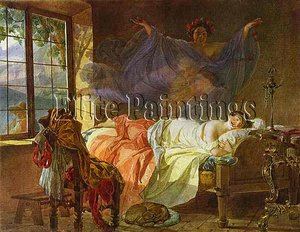 A Dream of a Girl Before a Sunrise1833
62
 Nuns of the Nunnery of Saint Heart in Rome1849 · Tretyakov Gallery
63
 Girl Gathering Grapes in a Suburb of Naples1827
64
 Forced to Swim1852
65
 Portrait of P. V. Kukolnic1837 · Tretyakov Gallery
66
 Self Portrait1813 · Tretyakov Gallery
67
 Male Portrait1829
68
 The Narcissus1819
69
 Genius of Art1820
70
 Portrait of Maria Kikina as a Child1817 · Tretyakov Gallery
71
 Portrait of the Secretary of State Piotr Kikin1822
72
 Portrait of the Actor A.N.Ramazanov1821 · Tretyakov Gallery
73
 Portrait of Maria Kikina as a Child1821
74
 Portrait of Maria Kikina as a Child1820
75
 Portrait of M. A. Kikina1821 · Tretyakov Gallery
76
 The Model1822
77
 The Nymph1828
78
 Ascension Baron Shieling1824
79
 Bivouac on a Crater, Vesuvius1824
80
 Participants of the expedition to Mount Vesuvius1824
81
 Italian morning1823
82
 Voltigeur1830
83
 Italian Midday1827 · Tretyakov Gallery
84
 Italian Midday1825
85
 Portrait of V. A. Perovsky on column capitals1824
86
 The Last Day of Pompeii1830
87
 The Last Day of Pompeii (detail 2)1830
88
 Portrait of the Architect K. A. Ton1827
89
 Satyr and Bacchante (Bacchanalia)1824
90
 Portrait of Alexander Bruloff1827
91
 Scene at the Entrance of a Cathedral1827
92
 Mother Awoken by Her Crying Child1831
93
 The Last Day of Pompeii1828
94
 Nun's Dream1831
95
 Vespers1825 · Tretyakov Gallery
96
 The Last Day of Pompeii (detail 4)1830
97
 Portrait of A. N. Demidov, Prince of San-Donato1831
98
 Portrait of the Artist Sylvester Shchedrin1824
99
 Confession of an Italian Woman1830
100
 A Merry Return1830
De fire motiver, der optræder hyppigst i disse originaler, hver med sit fineste eksempel.
De 8 museer, der rummer flest af malerierne på denne side.
| Museum | By | Værker af Karl Pavlovitj Brjullov | Malerier fra denne liste |
|---|---|---|---|
 Tretyakov Gallery |
Moskva | 32 | Rytteren, Bathsheba, Pilgrims at the Entrance of the Lateran Basilica |
 Hermitage Museum |
Sankt Petersborg | 5 | Daphnis and Chloe, Portrait of N. A. Okhotnikov, Sketch on the Subject of the Trinity Beneath the Oak of Mambre |
 Pushkin State Museum of Fine Arts |
Moskva | 6 | Greek Morning in Myraca, Temple of Apollo in Phigalia |
 Den Statlige Russiske Museums |
Saint Petersburg | 3 | Princess Yuliya Pavlovna Samoilova Leaving a Ball with Adopted Daughter Amacilia Pacini |
 Det Statlige Russiske Museum |
Sankt Petersborg | 2 | Pompejis sidste dag |
 Finnish National Gallery |
Helsinki | 2 | Portrait of a woman |
 Nationalmuseet i Warszawa |
Warszawa | 1 | Portrait of Baroness Reinthal with her daughter. |
 Taras Shevchenko National Museum |
Kiev | 1 | Portrait of V. A. Zhukovsky |
Vælg et årti for at se det originale værk, der definerer det.

The head of Bacchus, a work by Karl Bryullov, dates to about 1811. This drawing focuses on the head and upper shoulders of a female figure. The subject is characterized by prominent horns curving above the head, a visual attribute likely representing Bacchus, the Roman god of wine, or Dionysus.
To stand before Karl Pavlovich Brulloff's depiction of Pilgrims at the Entrance of the Lateran Basilica is to step across the threshold of time itself. This oil on canvas, executed in 1825, is far more than a mere historical scene; it is a profound meditation on faith, community, and the enduring human journey toward something sacred. Brulloff captures that exquisite moment when the weight of worldly experience meets the promise…
Karl Bryullov skabte Pompejis sidste dag mellem 1830 og 1833. Dette monumentale historiske lærred var bestilt af Anatoly Demidov. Værket indfanger det katastrofale udbrud fra Vesuv i år 79 e.Kr.

The Portrait of U. M. Smirnova is an oil on canvas work by the artist Karl Bryullov. Created in 1840, the painting captures a woman in a moment of quiet repose. She is accompanied by a dog, its fur resting near her. This portrait is also known by the alternative title Portrait of Ulyana Smirnova, née Spiridonova.

In this oil painting, two figures occupy a woodland setting during twilight or a nocturnal hour. The composition centers on the interaction between Daphnis and Chloe. One figure, Chloe, stands with her back to the viewer, while Daphnis sits on the right, facing her. The figures are rendered with pale, luminous skin tones that contrast against a background of deep greens and dark shadows. A small stream flows through the…
Pompejis sidste dag (1833), Det Statlige Russiske Museum, Sankt Petersborg. Derefter følger Rytteren (1832) og Bathsheba (1832).
34 år gammel: Pompejis sidste dag er fra 1833, og Karl Pavlovitj Brjullov blev født i 1799.
Pompejis sidste dag, Rytteren, Bathsheba, Pilgrims at the Entrance of the Lateran Basilica, Portrait of F.A. Bruni, Princess Yuliya Pavlovna Samoilova Leaving a Ball with Adopted Daughter Amacilia Pacini, Portrait of V. A. Perovsky, Child in a Swimming Pool (Portrait of Prince A.G. Gagarin in Childhood), Vespers og Portrait of Countess Samoilova. Ranglisten ovenfor viser det enkelte værks årstal og museum.
Vores katalog indeholder 407 værker af Karl Pavlovitj Brjullov, dateret fra 1811 til 1852.
Primært i Tretyakov Gallery (Moskva), Hermitage Museum (Sankt Petersborg) og Pushkin State Museum of Fine Arts (Moskva). Museumslisten ovenfor viser dem alle.
I 1820s: 44 af de 100 værker på denne side blev skabt dengang, herunder Pilgrims at the Entrance of the Lateran Basilica.
På denne side er det tidligste The head of Bacchus (1811) og det seneste Forced to Swim (1852).
Portrait (23), Man (17) og Woman (15), fordelt på de 100 værker på denne side.
Oil On Canvas, for 33 af de 100 værker på denne side.
Romantikken og Neo-classicism, baseret på originalerne på denne side.
Rytteren, Bathsheba og Pilgrims at the Entrance of the Lateran Basilica: Tretyakov Gallery, Moskva har 23 af værkerne på denne side.
Karl Pavlovich Bryullov (født Karl Briullo) blev født den 23. december 1799 i Sankt Petersborg, Rusland. Hans far, Pavel Ivanovich Briullo, var akademiker, træskærer og graver af huguenottisk afstamning, og det var ham, der indgydede den unge Karl en dyb kærlighed til kunsten. Bryullovs kunstneriske rejse begyndte under farens vejledning, før han i 1809 formelt blev optaget på Det Kejserlige Kunstakademi i Sankt Petersborg.
Selvom han blev uddannet inden for en klassisk ramme, omfavnede Bryullov aldrig fuldt ud dens stive begrænsninger. Fra en tidlig alder følte han en stærk dragning mod Italien, og hans kunstneriske udvikling blev i betydelig grad formet af de italienske renæssancemestre. Hans værk udviser tydelig indflydelse fra kunstnere som Rafael, Michelangelo og Caravaggio, især i deres dramatiske brug af lys og skygge samt deres mesterskab over anatomiske detaljer.
Bryullovs store gennembrud kom med “Pompejis sidste dag” (1830-1833), et monumentalt historisk maleri, der sendte ham direkte til international berømmelse. Værket, som skildrer det kaotiske udbrud fra Vesuv, blev hyldet for sin dramatiske komposition, følelsesmæssige intensitet og tekniske brillans. Det vakte enorm beundring hos samtidige som Pushkin og Gogol.
Efter succesen med “Pompejis sidste dag” vendte Bryullov triumferende tilbage til Rusland og sikrede sig i 1836 en prestigefyldt stilling ved Det Kejserlige Kunstakademi. Han tjente som professor der frem til 1848, hvor han prægede en hel generation af russiske kunstnere.
Karl Pavlovich Bryullov betragtes som en skelsættende figur i den russiske romantik. Hans arbejde markerede et skift mod større følelsesmæssig ekspression og dramatisk historiefortælling inden for russisk kunst. Han byggede bro mellem den neoklassiske formalitet og den spirende romantiske bevægelse, hvilket påvirkede efterfølgende generationer af kunstnere, herunder Gavriil Gorelov.
Bryullovs eftermæle rækker langt ud over hans malerier; han var en respekteret lærer og en forkæmper for kunstnerisk innovation. Hans bidrag cementerede hans plads som en af de største visuelle kunstnere i russisk historie og satte et uudsletteligt præg på nationens kulturarv. Han døde den 23. juni 1852 nær Rom og er begravet på Cimitero Acattolico.


